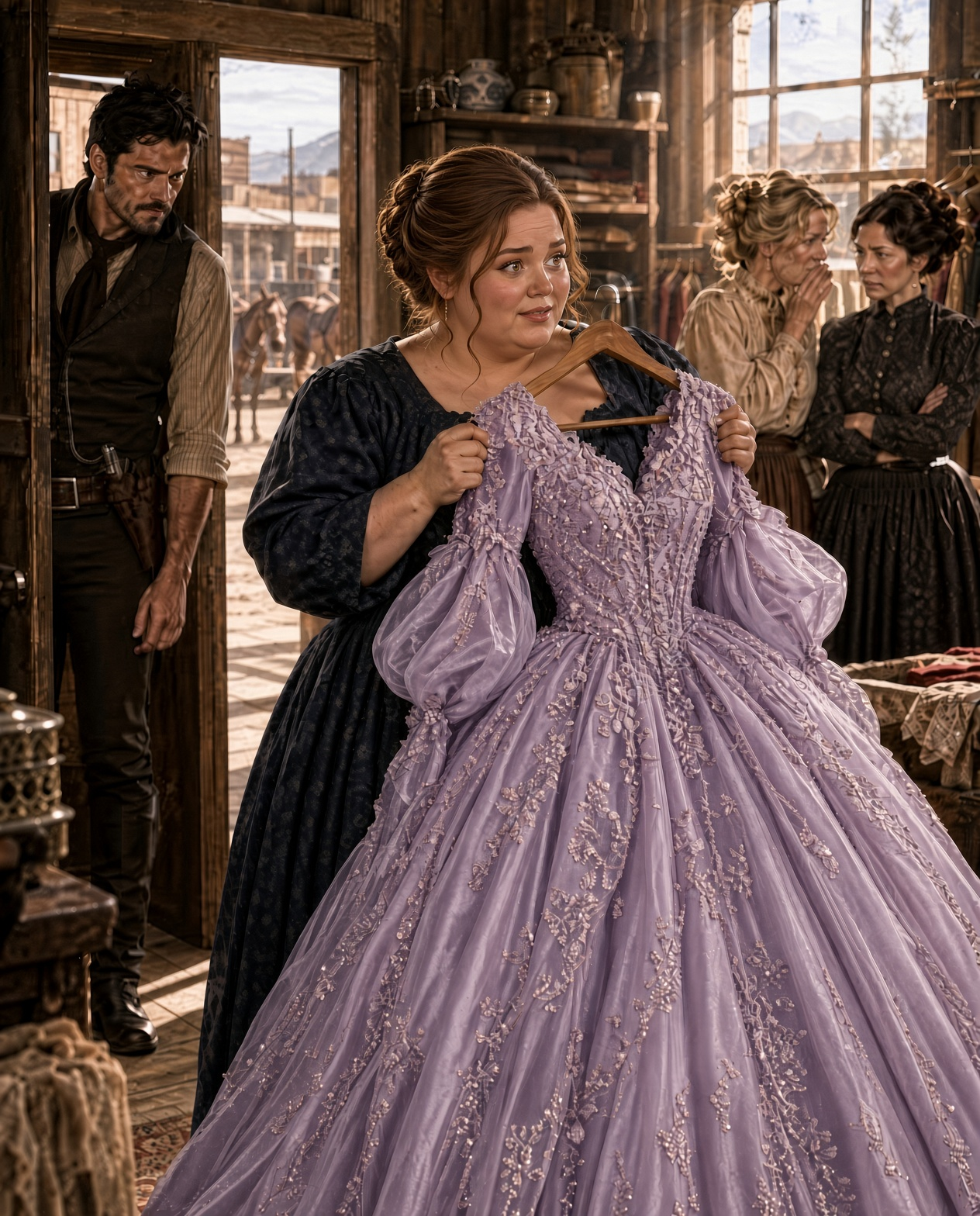
"That name shouldn't be on the deed."
Martha's voice was barely audible, but it stopped everyone in my kitchen.
Sheriff Daniel Reeves stood in the doorway holding a leather folder, his hat dusted with fresh snow. Walter Hensley hovered behind him, looking like a man who had spent the entire ride to my ranch regretting the journey.
I looked from the folder to my wife.
"Eleanor Bellamy?" I asked.
Martha nodded slowly.
"Her father took everything from mine."
The sheriff stepped inside.
And for the first time that evening, I understood that the woman who had laughed at my wife in the dress shop might have been connected to her suffering long before we married.
"Close the door, Gideon," Reeves said. "We have something to discuss."
I shut it behind them.
Martha remained beside the kitchen table. The letter from my dead brother lay open in front of her, its pages scattered beside the small scraps of blue, green, and crimson silk she had saved from my gifts.
I had never imagined those pieces of fabric would be lying beside a document capable of reopening a wound from her childhood.
But there they were.
The sheriff removed his gloves.
"I apologize for arriving so late, Mrs. Mercer."
Martha shook her head.
"Please tell me what you've found."
Reeves glanced at Walter.
The old man looked down.
"Mr. Hensley brought certain records to my office this afternoon," the sheriff explained. "He believed they might concern an improper transfer of property."
"What property?" I asked.
"Land near the old schoolhouse. A parcel that once belonged to Martha's father."
I turned toward my wife.
She was staring at the leather folder.
"Papa lost that land when I was seventeen," she whispered.
"How?"
She swallowed.
"He borrowed money during a bad winter. The cattle died. The crops failed. We couldn't pay."
I knew the story in broad terms.
Martha had told me her family had suffered financial ruin before she reached adulthood. She had described years of hard work, hunger, and moving from one temporary home to another.
But she had never told me who had taken their property.
Now I knew why.
"Who held the debt?" I asked.
Martha's eyes lifted.
"Arthur Bellamy."
Eleanor's father.
The same banker whose business records had supposedly involved my brother Thomas.
I looked at Sheriff Reeves.
"And Eleanor inherited the property?"
"That's what the county records indicate."
"But?" I asked.
He opened the folder.
"But the documents don't agree."
Walter shifted uneasily.
The sheriff removed two sheets of paper and laid them beside Thomas's letter.
One was a copy of the recorded deed.
The other was older, its edges yellowed and its writing faded.
"According to the official record," Reeves explained, "Arthur Bellamy acquired the property after Martha's father failed to satisfy a secured loan."
Martha nodded.
"That's what we were told."
"But this earlier document suggests the debt may have been settled before the transfer was recorded."
I stared at him.
"Settled by whom?"
Reeves looked at Walter.
The old man cleared his throat.
"Thomas Mercer."
The name struck me like a hammer.
I looked down at the papers.
My brother had paid a debt belonging to Martha's father?
Seven years after his death, I was discovering that Thomas had been involved in a family I had not even known existed when he was alive.
"Why would Thomas do that?" I asked.
Walter rubbed his hands together.
"Your brother traveled through the settlement during the winter of 1880. He found families starving. Martha's father was trying to keep a small supply route open."
Martha closed her eyes.
"I remember that winter."
Her voice was so soft I almost missed it.
I moved beside her.
"What happened?"
She looked at me.
For several seconds, she seemed unable to speak.
Then she sat down.
"My father was a proud man," she began. "Not wealthy. Not important. But honest."
I pulled out the chair beside her.
She continued.
"He owned a little land near Cheyenne. Not much, but enough for a house, a garden, and a few animals. He worked every day. My mother took in sewing."
Her fingers moved unconsciously toward the silk scraps.
"When the winter came early, everything changed."
I waited.
"The animals began dying. Food became scarce. Papa borrowed money from Mr. Bellamy because he believed spring would give him time to repay it."
She looked down.
"But spring didn't come soon enough."
Walter lowered his head.
Martha's voice trembled.
"Mr. Bellamy came to our house with two men. He told Papa the debt had grown too large."
"What did your father say?" I asked.
"He begged for another month."
She swallowed.
"Mr. Bellamy laughed."
I felt my jaw tighten.
Martha looked toward the window.
"I remember standing beside my mother. She was holding a basket of mending. Mr. Bellamy looked at us and said, 'A man who cannot provide for his family has no business pretending he owns land.'"
The room fell silent.
Martha wiped her cheek.
"My father never forgot those words."
Neither would I.
"What happened next?"
"We lost the property. Papa took work wherever he could find it. My mother became ill. We moved into a rented room behind a boardinghouse."
She looked at her hands.
"I was seventeen. Old enough to understand what had happened, but too young to do anything about it."
I reached for her hand.
She let me hold it.
"Did your father know the debt might have been paid?"
She shook her head.
"Not that I know of."
Reeves cleared his throat.
"That's what we're trying to establish."
I looked at him.
"You're saying my brother may have paid the loan, but Bellamy took the land anyway?"
"I'm saying the records raise that possibility. We don't yet have proof of fraud."
I appreciated the distinction.
A sheriff's suspicion was not the same as evidence.
But I could see something changing in Martha's face.
For years, she had believed her father lost everything because he failed.
Now she was being told there might have been another explanation.
One that had nothing to do with his worth.
"Why wasn't this discovered earlier?" I asked.
Walter looked miserable.
"Because some of the records were never properly filed."
"Why?"
He hesitated.
"Arthur Bellamy handled the transaction privately. Your brother was traveling. There were delays, missing receipts, and disagreements about what had been paid."
I studied him.
"And you knew about it?"
Walter nodded.
"Some of it."
"How much?"
"Enough that I should have asked questions sooner."
I wanted to demand more.
But Martha spoke first.
"Mr. Hensley, did my father know Thomas Mercer?"
Walter looked at her.
"Yes, ma'am."
Her eyes filled.
"Was he the man who brought flour to our house?"
Walter nodded.
Martha covered her mouth.
I turned toward her.
"You remember him?"
She nodded slowly.
"Not his name. Not clearly."
She looked at me.
"There was a man who came with a wagon during that winter. He brought sacks of flour, blankets, and medicine. Papa tried to refuse because we couldn't pay."
Her voice broke.
"The man said he wasn't selling anything."
I felt my throat tighten.
That sounded like Thomas.
My reckless, generous younger brother.
The man I had accused of wasting money on strangers.
The man whose last argument with me had been about whether helping people mattered more than protecting one's own fortune.
I looked down at the document.
Perhaps he had spent his final months doing exactly what I had once criticized him for.
And perhaps my wife had unknowingly continued the same work.
The sheriff stayed another half hour.
He explained that the original deed had been found among records connected to the Bellamy estate. Walter had helped locate the papers after noticing inconsistencies in the old accounts.
Eleanor's name appeared on the folder because she was the current recorded owner of the property.
That did not mean she had personally committed any wrongdoing.
But it did mean she had a financial interest in what the documents might reveal.
"Why did she come here tonight?" I asked.
Reeves considered the question.
"Perhaps she knew Mr. Hensley had begun looking into the matter."
"She brought me a shipment record."
"That may be part of the same transaction."
I thought of Eleanor's expression when she mentioned my brother.
Her careful words.
Her repeated attempts to embarrass Martha.
I could not prove she was trying to frighten us.
But I no longer believed her visit had been innocent.
Reeves gathered the papers.
"I'll make inquiries at the county office. Until then, I suggest you avoid confronting Mrs. Bellamy."
I gave him a humorless smile.
"You're the second man to tell me that today."
"Then perhaps you should listen."
He stood.
Walter followed him toward the door.
But before leaving, the old man turned toward Martha.
"Mrs. Mercer?"
She looked up.
"I'm sorry."
She seemed confused.
"For what?"
"For waiting so long to bring these things forward."
Martha studied him.
Then she said quietly, "If the truth is still there, it isn't too late to find it."
Walter's face crumpled.
He nodded once and stepped outside.
I watched the two men disappear into the darkness.
Then I closed the door.
The house felt strangely quiet.
Martha sat at the table, staring at the silk scraps.
I returned to my chair.
For a while, neither of us spoke.
Then she whispered, "Your brother helped my family."
"It seems he did."
"And I never knew."
"Neither did I."
She looked at me.
"Do you think he would have liked me?"
The question caught me off guard.
I smiled sadly.
"Martha, Thomas would have adored you."
Her eyes filled.
"Why?"
"Because he spent half his life trying to convince me that a person's worth had nothing to do with what they owned."
I looked at the folded silk.
"And you seem to have been living by that belief all along."
She lowered her head.
I moved beside her.
"Martha, there's something I need you to understand."
She looked up.
"You don't owe me an explanation for helping people."
Her lips trembled.
"But I do owe you the truth."
I nodded.
"Yes."
She took a long breath.
Then she began telling me about the families.
Not just their names.
Their lives.
Mrs. Whitcomb, who had been raising three grandchildren after losing her daughter.
The Miller family, whose youngest child had been sick for weeks.
A widow named Ruth Carter, who had sold her wedding ring to buy coal.
A former railroad worker who could no longer use his injured hand.
A young couple expecting their first baby with barely enough money to keep their stove burning.
Martha knew them all.
She knew which children needed shoes.
Which mothers had gone without supper.
Which fathers were too proud to ask for help.
And which families would accept a parcel left quietly on their doorstep but refuse charity offered in public.
I listened.
For the first time, I truly listened.
"How did you find them?" I asked.
She gave a small smile.
"People talk when they think no one important is listening."
I thought of the women in the dress shop.
The cruel laughter.
The whispers.
"You're important," I said.
She shook her head.
"Not in the way they mean."
I took her hand.
"Then they're measuring importance incorrectly."
She looked away.
I could see the old shame returning.
The same shame that had made her return the dresses.
I wanted to erase it with a sentence.
But I was beginning to understand that wounds made over years could not be healed in a single evening.
So I asked another question.
"Did you ever buy anything for yourself with the store credit?"
She shook her head.
"Not once?"
"No."
"Why?"
She looked embarrassed.
"Because I already had everything I needed."
I studied her.
"Everything?"
She nodded.
"A home. Food. Work. Someone who cares whether I come back at night."
Her voice broke.
"I never expected to have so much."
I felt tears sting my eyes.
My wife considered ordinary security a luxury.
She considered being loved an unexpected blessing.
And she believed beautiful things belonged to other women.
I reached across the table.
"Martha, when I bought those dresses, I wasn't trying to change you."
She looked at me.
"I know."
"Do you?"
She hesitated.
I continued.
"I didn't buy them because I thought you needed silk to become beautiful. I bought them because I saw something lovely and wanted to give it to the woman I love."
A tear slipped down her cheek.
"I wanted to wear them," she whispered.
I nodded.
"I know that now."
She looked at the crimson fabric.
"I used to imagine going to a dance with you."
I smiled.
"Then why didn't we?"
Her expression changed.
"Because I knew what people would say."
"What people?"
She hesitated.
Then she whispered, "Women like Eleanor."
I waited.
Martha stared at her hands.
"When I was young, Eleanor used to visit her father's office. She was older than I was, but she knew my family had lost our land."
I felt my jaw tighten.
"Did she mistreat you?"
Martha gave a sad smile.
"She didn't need to do much."
"What did she do?"
"She laughed when I came looking for work. She told other girls I was too large to fit into proper dresses. Once, when I asked whether the dressmaker needed an assistant, she said I would be better suited to carrying flour."
My hands curled into fists.
Martha noticed.
"Please don't be angry."
I looked at her.
"How can I not be?"
"Because it was a long time ago."
"That doesn't make it right."
She lowered her eyes.
"I learned not to give people reasons to laugh."
The words broke my heart.
She had spent years making herself smaller so others would feel comfortable.
And I had mistaken her silence for contentment.
I moved closer.
"Martha, look at me."
She did.
"You never have to make yourself smaller for anyone."
Her lips trembled.
I continued.
"Not Eleanor Bellamy. Not Clara Whitfield. Not anyone in Cheyenne."
She began to cry.
I held her.
And for a long time, I said nothing.
The next morning, I woke before dawn.
The house was quiet.
Martha slept beside me, her face relaxed for the first time in days.
I watched her for a moment.
Then I slipped out of bed and dressed.
I had made a decision during the night.
If Martha wanted to help those families, she would no longer have to do it alone.
I went to the barn and found Caleb preparing feed.
"Morning, boss."
"Morning."
He glanced at the sky.
"Looks like snow."
"Probably."
I saddled my horse.
"Where are you headed?"
"Town."
"Need anything?"
"Actually, yes."
He looked surprised.
I handed him a short list.
"Have the men prepare the spare wagon. We'll need room for flour, coal, blankets, and winter clothing."
Caleb stared at the paper.
"That's quite a load."
"I know."
"Who for?"
I looked toward the house.
"People who need it."
He smiled.
"Mrs. Mercer's idea?"
I studied him.
"How did you know?"
Caleb hesitated.
Then he laughed softly.
"Boss, half the ranch knows Mrs. Mercer has been helping folks."
I stared at him.
"What?"
He looked embarrassed.
"Well, not exactly what she's been doing. But she asks us about families in town. Whether anyone needs work. Whether anyone's children are sick."
I shook my head.
"And nobody told me?"
Caleb shrugged.
"She asked us not to make a fuss."
I looked toward the kitchen window.
A light had appeared.
Martha was awake.
I felt a strange mixture of amusement and sorrow.
My wife had built an entire network of quiet kindness while I was busy worrying about missing dresses.
"Caleb," I said, "from now on, if Mrs. Mercer asks whether someone needs help, you tell her the truth."
He nodded.
"And if she needs supplies, you help her get them."
"Yes, sir."
I mounted my horse.
Then I paused.
"One more thing."
Caleb looked up.
"Nobody is to make her feel as though she's doing something wrong."
His expression grew serious.
"Understood."
I rode toward Cheyenne as the first pale light touched the horizon.
By midmorning, I had purchased enough supplies to fill the wagon.
Samuel Porter watched me with quiet satisfaction.
"That's a considerable order," he said.
"Not enough."
He raised an eyebrow.
I smiled.
"My wife has eleven families on her list."
Samuel nodded.
"Then we'd better get started."
We worked through the morning.
Flour.
Coal.
Blankets.
Children's shoes.
Winter coats.
Medicine.
I asked Samuel to keep the purchases private.
He agreed.
Then he showed me something I had not expected.
A small notebook.
Inside were names Martha had written herself.
Beside each name were notes.
Mrs. Carter — coal before December.
Millers — medicine for youngest boy.
Whitcomb children — shoes, blankets, flour.
Henderson family — baby due soon.
I stared at the handwriting.
It was careful.
Organized.
Full of concern.
My wife had not simply given away expensive dresses.
She had built a quiet system of care.
And she had done it because she remembered what it felt like to have nothing.
I closed the notebook.
"Samuel, I want to help every family on this list."
He looked at me.
"All of them?"
"Every one."
He smiled.
"Mrs. Mercer will be pleased."
I shook my head.
"She'll probably tell me I'm spending too much."
Samuel laughed.
"That sounds like her."
I was about to leave when the store door opened.
Mrs. Whitcomb entered.
She carried a small basket and looked exhausted.
When she saw me, she stopped.
"Mr. Mercer."
"Mrs. Whitcomb."
Her eyes moved toward the supplies stacked near the counter.
Then she looked at Samuel.
Something passed between them.
I smiled gently.
"You don't have to worry. Martha told me."
The old woman's face changed.
"She did?"
"Enough."
Mrs. Whitcomb began to cry.
I stepped closer.
"What's wrong?"
She shook her head.
"Nothing. It's just..."
She looked toward the window.
"Your wife has been so good to us."
"I know."
"No," she whispered. "You don't."
I frowned.
"What do you mean?"
She gripped the basket.
"There's something Martha never told you."
I felt my stomach tighten.
Mrs. Whitcomb looked at Samuel.
He shook his head slightly.
But she continued.
"She didn't just help us after we became poor."
I stared at her.
"What?"
The elderly woman swallowed.
"She made a promise to my daughter before Sarah died."
I remembered the grave.
The blue silk pouch.
The silver coin.
"What promise?"
Mrs. Whitcomb's eyes filled.
"Sarah asked Martha to look after the children if anything happened to her."
I nodded slowly.
"That explains why she's been helping."
Mrs. Whitcomb shook her head.
"No, Mr. Mercer."
Her voice trembled.
"That's not all Sarah asked."
Samuel stepped forward.
"Mrs. Whitcomb—"
But the old woman had already reached into her basket.
She removed a small wooden box.
Its lid was scratched.
Its corners were worn.
And carved into the top were two initials.
T.M.
My brother's initials.
I stared at the box.
Mrs. Whitcomb placed it on the counter.
"Sarah told me to keep this until Martha was ready."
My mouth went dry.
"Ready for what?"
The old woman looked at me.
Then she whispered, "To learn why your brother really came to Cheyenne."
I reached for the lid.
Mrs. Whitcomb caught my hand.
"Wait."
I looked at her.
Her face had gone pale.
"There's something else."
She turned toward the store window.
A carriage had stopped outside.
A woman in a burgundy coat stepped down.
Eleanor Bellamy.
Mrs. Whitcomb's voice dropped to a whisper.
"Mr. Mercer, you must hide that box."
I stared at her.
"Why?"
She looked toward the door.
"Because Eleanor has been searching for it for years."
The brass bell above the entrance suddenly rang.
Eleanor stepped inside.
Her eyes swept across the store.
Then stopped on the wooden box.
And the moment she saw the initials carved into its lid, her expression changed completely.
She pointed at it.
"That belongs to my family."
I placed my hand over the box.
Eleanor took one step forward.
Then she said five words that silenced the entire store.
"Your brother was not innocent."






Comments 0