"Your brother was not innocent."
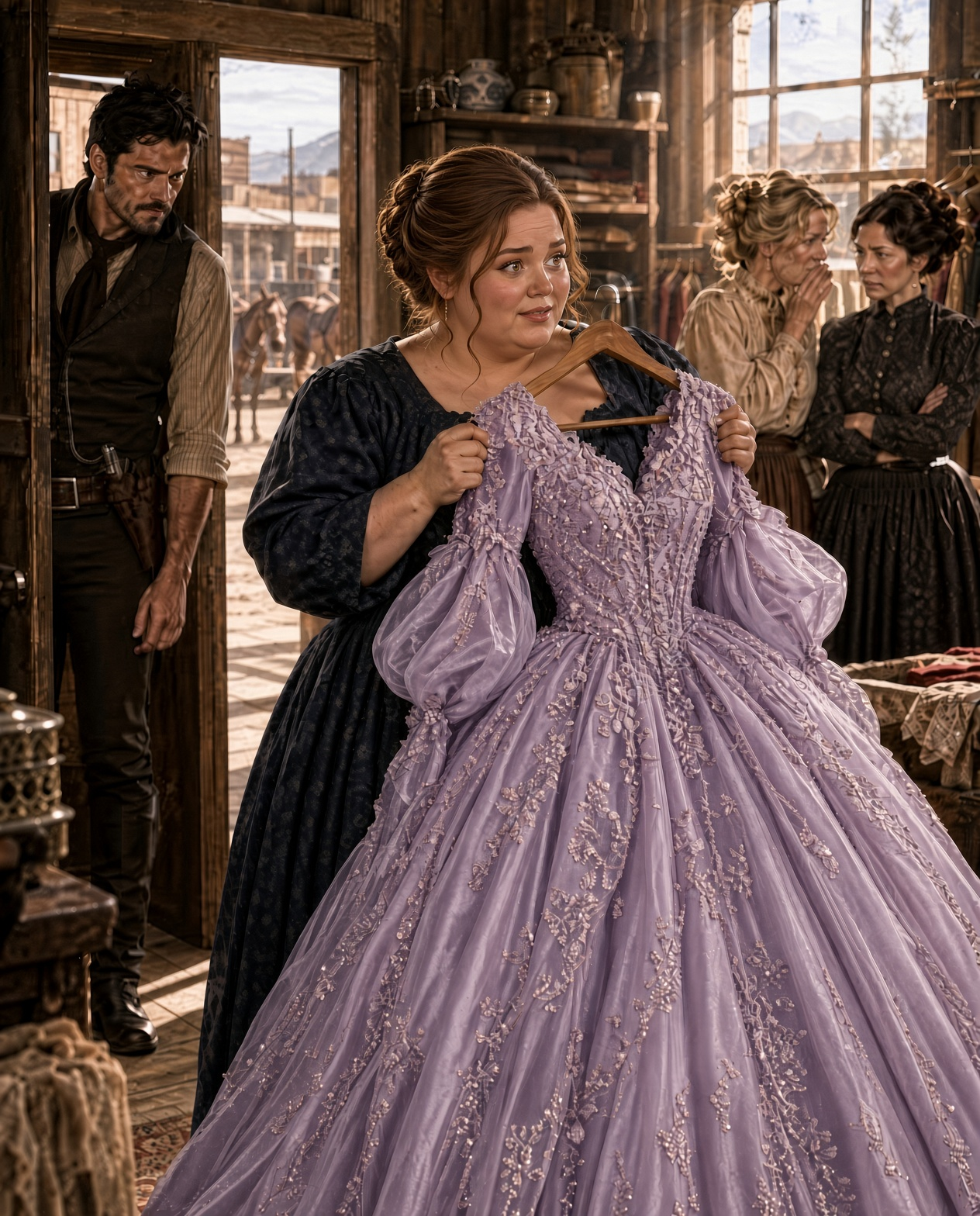
Eleanor Bellamy stood inside Samuel Porter's general store, pointing at the wooden box beneath my hand.
For a moment, nobody moved.
Mrs. Whitcomb stood beside the counter, clutching her empty basket. Samuel watched Eleanor with an expression I had never seen on his face before.
It was not surprise.
It was disgust.
I looked directly at Eleanor.
"Be careful what you say about my brother."
She lifted her chin.
"I am simply telling you the truth."
"Then start with the part you can prove."
Her eyes flickered toward the box.
"That belonged to my father."
I looked down at the initials carved into its lid.
T.M.
Thomas Mercer.
"My brother's initials are on it," I said.
"Your brother was involved in my father's business affairs."
"That doesn't make his property your father's."
Eleanor's mouth tightened.
"You have no idea what you're interfering with."
"Then explain it."
She glanced toward Mrs. Whitcomb.
The elderly woman took a step backward.
I noticed.
And suddenly I understood that Eleanor's arrival was not simply another attempt to embarrass Martha.
She had come because she was afraid of something.
Something inside that box.
"Mrs. Bellamy," Samuel said quietly, "you should leave."
She turned toward him.
"This is a matter between the Mercer family and mine."
"Not in my store."
Eleanor looked offended.
"Mr. Porter, I have conducted business here for years."
"And I've tolerated more than I should have."
The silence that followed was almost satisfying.
Eleanor straightened her gloves.
"Very well. But I suggest you consider the consequences of withholding property."
I stepped closer.
"Are you threatening my wife?"
She blinked.
"I never mentioned Martha."
"You've spent two days making her the subject of your accusations. Don't pretend otherwise."
Her expression hardened.
"Your wife has been meddling in matters she doesn't understand."
I felt my temper rise.
"She has been feeding hungry children."
"With money that could have been used more responsibly."
I stared at her.
"More responsibly?"
Eleanor looked toward the sacks of flour stacked beside the counter.
"Charity encourages dependence, Mr. Mercer."
Mrs. Whitcomb made a small sound.
I turned.
Her eyes were wet.
That was enough.
I faced Eleanor again.
"Those children lost their mother. Their grandmother has worked herself nearly to death keeping them alive. My wife bought them shoes."
Eleanor said nothing.
"If you believe that was irresponsible, then we have nothing more to discuss."
Her face reddened.
"You will regret taking this position."
I rested my hand on the box.
"Perhaps. But I won't regret standing beside my wife."
For several seconds, Eleanor stared at me.
Then she turned sharply and walked out.
The bell above the door rang behind her.
Through the window, I watched her climb into her carriage.
She did not look back.
Only after the carriage disappeared did Mrs. Whitcomb release the breath she had been holding.
"Lord preserve us," she whispered.
Samuel came around the counter.
"Gideon, you'd better take that box somewhere safe."
I looked at him.
"What's inside?"
Mrs. Whitcomb lowered herself into a chair.
"Letters," she answered. "And a few things Sarah kept."
"Why would Eleanor want them?"
The old woman shook her head.
"I don't know everything. Sarah never told me everything."
I looked at the box again.
"May I open it?"
Mrs. Whitcomb hesitated.
Then she nodded.
"Sarah wanted Martha to have it. I believe she'd trust you to keep it safe."
I lifted the lid.
Inside lay several folded papers, a small brass key, a faded photograph, and a silver brooch shaped like a wildflower.
The brooch caught my attention.
It was simple, almost plain, but beautifully made.
A tiny blue stone sat at its center.
Beneath it lay a narrow strip of paper bearing my brother's handwriting.
I recognized it immediately.
For the schoolhouse. Keep the children safe.
I stared at those words.
"The schoolhouse?"
Mrs. Whitcomb leaned forward.
"Sarah helped teach there before she became ill."
I looked at the photograph.
It showed several people standing outside a small wooden building.
A young woman held a book against her chest.
Beside her stood a man in a dark coat.
My breath caught.
Thomas.
My brother.
Younger than I remembered him.
Smiling.
Alive.
I had not seen his face in a photograph for years.
My fingers trembled as I lifted it.
Mrs. Whitcomb watched me.
"He was a good man," she said.
I swallowed.
"Eleanor says otherwise."
"Then Eleanor is wrong."
I looked at her.
She continued quietly.
"Your brother brought food to families who would have starved. He helped repair the schoolhouse. He paid for books when the children had none."
I looked down at the photograph.
Thomas had always been generous.
Sometimes foolishly so.
I had accused him of wasting money on people who could never repay him.
Now I was discovering that those people had remembered him for years.
And that my wife had unknowingly followed the same path.
"Why did Sarah keep these things?" I asked.
Mrs. Whitcomb looked at the brooch.
"Because she believed someone might need proof of what happened."
"What happened?"
She shook her head.
"I only know there was trouble over the land. Your brother tried to help Martha's father. Then Thomas died, and everything became confused."
I opened one of the folded papers.
It contained figures.
Payments.
Dates.
A reference to Arthur Bellamy's bank.
But several lines had been crossed out.
At the bottom was a notation.
Original receipt retained separately.
I frowned.
"Where's the receipt?"
Mrs. Whitcomb shook her head.
"I don't know."
I looked at Samuel.
He was staring at the brass key.
"What's wrong?" I asked.
He pointed.
"That looks like one of the old schoolhouse keys."
I lifted it.
The metal was worn.
A small number had been stamped into the handle.
Seven.
"Does the schoolhouse have numbered locks?"
"It used to," Samuel said. "There were storage cupboards for books and supplies."
I turned the key in my hand.
"Does anyone still use them?"
"Some, I imagine."
I looked at the box.
A letter.
A photograph.
A brooch.
A key.
And somewhere, perhaps, a missing receipt that could explain why my wife's family had lost everything.
I closed the lid.
"Mrs. Whitcomb, I'm taking this home."
She nodded.
"Give it to Martha."
"I will."
"And Gideon?"
I looked at her.
"Don't let Eleanor frighten her."
I thought of Martha sitting in our kitchen, apologizing because strangers had laughed at her.
"She won't," I said.
But I knew that was a promise I could not make lightly.
By the time I returned to the ranch, the sky had turned the color of iron.
Snow drifted across the road in thin, restless sheets.
The wind was rising.
I found Martha in the kitchen.
She was kneeling beside a wooden chest, sorting winter clothes.
When she heard the door open, she looked up.
"You're home."
I smiled.
"Did you miss me?"
"Of course."
Then she saw my face.
Her smile faded.
"What happened?"
I placed the wooden box on the table.
She stared at it.
"What's that?"
"Something Mrs. Whitcomb kept for Sarah."
Martha rose slowly.
I watched her approach.
When she saw the initials carved into the lid, her hand flew to her mouth.
"Thomas Mercer?"
I nodded.
She looked at me.
"Where did you find it?"
"Mrs. Whitcomb brought it to Samuel's store."
Martha touched the wood.
"Sarah used to speak about a man who helped her family."
"My brother."
She nodded.
"I know that now."
I opened the box.
She examined the photograph first.
Her eyes filled when she recognized Sarah.
"That's her," she whispered.
I moved beside her.
"She looks happy."
Martha nodded.
"She was. Before everything happened."
I waited.
She traced the edge of the photograph.
"Sarah used to teach the younger children at the schoolhouse. She believed every child deserved to learn, even if their parents couldn't afford proper books."
I thought of the note.
For the schoolhouse. Keep the children safe.
"Did you help her?"
Martha gave a small smile.
"When I could. I mended clothes. Sometimes I brought food."
She looked down.
"After she died, I promised myself the children would never feel forgotten."
I reached for her hand.
"You kept that promise."
She shook her head.
"Not well enough."
"Martha."
"The youngest still had holes in his shoes."
"And now he doesn't."
She looked at me.
I continued gently.
"You cannot fix every hardship in the world by yourself."
Her eyes filled.
"I know."
"Do you?"
She gave a sad little laugh.
"I try."
I placed the box aside.
Then I pulled out a chair.
"Sit with me."
She hesitated.
"There's supper to prepare."
"It can wait."
She sat.
I took the chair opposite her.
For a moment, I simply looked at my wife.
I had spent months trying to make her happy by giving her beautiful things.
But I had never understood why receiving those things made her afraid.
Now I knew enough to ask the question I should have asked long ago.
"Martha, when did you first start believing you weren't beautiful?"
She stared at me.
The question seemed to strike her harder than any accusation could have.
"I don't know what you mean."
"Yes, you do."
She looked away.
I waited.
Finally, she whispered, "I suppose I've always known."
My chest tightened.
"Known what?"
"That I'm not the kind of woman men admire."
I shook my head.
"That's not true."
She gave a small, painful smile.
"Gideon, you don't have to pretend."
"I'm not pretending."
She looked down at her hands.
"When I was a girl, my mother used to sew dresses for wealthy families."
I listened.
"Sometimes the women brought their daughters for fittings. They would stand in front of the mirror while Mama pinned the hems."
She paused.
"I loved watching them."
I imagined a younger Martha standing in a cramped sewing room, admiring fabrics she could never afford.
"One day," she continued, "a customer left a piece of blue silk behind. Mama said I could keep it."
Her eyes softened.
"I wrapped it around my shoulders and stood in front of the mirror."
I waited.
"I thought I looked beautiful."
Her voice broke.
"Then one of the girls came back for her gloves."
I felt my stomach tighten.
"She saw me."
Martha nodded.
"She laughed."
I closed my eyes briefly.
"She called the others."
Martha's hands began to tremble.
"They stood in the doorway and laughed at me. One said I looked like a cow dressed for a wedding."
My jaw tightened.
Martha continued.
"Another said no amount of silk could make a girl like me graceful."
She wiped her cheek.
"I took the fabric off."
I could barely breathe.
"What did your mother say?"
"She told them to leave."
"And you?"
"I apologized."
I stared at her.
"For what?"
"For touching something that wasn't meant for me."
The words nearly destroyed me.
I reached across the table and took her hands.
"Martha, listen to me."
She looked up.
"You were a child."
She nodded.
"You did nothing wrong."
Her lips trembled.
"I know that now."
But I could see she did not truly believe it.
Not completely.
I moved my chair beside hers.
"Who were those girls?"
She hesitated.
Then she whispered, "Eleanor was one of them."
I closed my eyes.
Of course.
The woman who had laughed at Martha in the dress shop had been doing it for years.
Long before our marriage.
Long before the dresses.
Long before Martha had learned to hide her longing for beautiful things.
"Did she ever apologize?" I asked.
Martha shook her head.
"She probably doesn't even remember."
"I doubt that."
Martha looked at me.
"Why?"
"Because she did the same thing yesterday."
Her face changed.
I continued gently.
"I heard her."
Martha lowered her eyes.
"I know."
I stared at her.
"You knew I was there?"
She shook her head.
"Not then. But when you spoke to her last night, I understood."
I felt ashamed.
"I should have stepped inside."
"No."
Her answer came quickly.
I looked at her.
"Why not?"
"Because I couldn't have borne it."
I waited.
She swallowed.
"If you had defended me in front of them, they would have laughed even harder after we left."
I shook my head.
"That doesn't matter."
"It mattered to me."
Her voice was suddenly firm.
I stopped.
She looked at me with tears in her eyes.
"Gideon, you are respected in this town. Men listen when you speak. People admire you."
I waited.
"And I know what they think when they see us together."
"What do they think?"
"That you could have married someone prettier."
I felt something break inside me.
She continued.
"Someone younger. Someone who knew how to wear silk without looking foolish."
"Martha—"
"Someone who wouldn't embarrass you."
I took her face gently between my hands.
"Stop."
She looked startled.
I softened my voice.
"Please stop saying those things about the woman I love."
Her eyes filled.
I continued.
"I did not marry you because I couldn't find someone else."
She began to cry.
"I married you because I didn't want anyone else."
A sob escaped her.
I pulled her into my arms.
For a long time, she cried against my chest.
I held her and listened.
I did not tell her to stop.
I did not tell her she was being foolish.
I simply held her.
And for the first time, I understood that the dresses had never been the problem.
The problem was that Martha had spent so many years being told she was unworthy of beauty that she could no longer recognize it when someone offered it freely.
That evening, I did something I had never done before.
I asked Martha to bring me the small parcel of silk scraps.
She looked confused.
"Why?"
"Because I want to see them."
She brought the parcel from her sewing basket.
We spread the pieces across the kitchen table.
Blue.
Green.
Crimson.
Each scrap represented a gift she had returned.
But now I saw something different.
They were not reminders of wasted money.
They were evidence of the kindness she had given to others.
I picked up the blue silk.
"This one bought shoes for Mrs. Whitcomb's children."
Martha nodded.
I touched the green fabric.
"And this?"
"Blankets. Coal. Some medicine."
I looked at the crimson piece.
"And this?"
She hesitated.
"Flour. Winter coats. A few other things."
I smiled.
"Then these are the finest dresses I've ever purchased."
She looked at me.
"Even though I never wore them?"
"Especially because of what you did with them."
Her eyes filled.
I took her hand.
"But I want you to promise me something."
"What?"
"The next time I give you something beautiful, you won't decide you don't deserve it."
She looked frightened.
"Gideon—"
"You don't have to wear it into town. You don't have to show anyone. You can keep it folded in a drawer if you like."
I smiled gently.
"But you must allow yourself to own something simply because it makes you happy."
She stared at me.
For a long moment, she said nothing.
Then she whispered, "I'll try."
It was not a grand promise.
But it was enough.
I kissed her forehead.
She smiled.
A real smile.
And for the first time since our wedding, I saw something in her eyes that had been missing.
Hope.
Later, after supper, Martha sat beside the stove sewing a patch onto a child's coat.
I examined the contents of Thomas's box again.
The photograph.
The letters.
The brass key.
The silver brooch.
I turned the brooch over.
There was a tiny inscription on the back.
For courage.
I wondered who had given it to Sarah.
Perhaps Thomas.
Perhaps someone else.
I placed it beside the key.
Then I unfolded the remaining papers.
Most concerned supplies delivered during the winter of 1880.
But one page contained a rough drawing of the old schoolhouse.
I studied it.
There was a small mark near the eastern wall.
A square.
Beside it, Thomas had written a single word.
Below.
I frowned.
Below what?
The floor?
A cupboard?
A foundation stone?
I turned the paper over.
Nothing.
I looked at Martha.
"Did Sarah ever mention hiding anything at the schoolhouse?"
She stopped sewing.
"Why?"
I showed her the drawing.
She examined it.
Her expression changed.
"That's the old eastern classroom."
"How do you know?"
"Sarah used to teach there."
She pointed to the square.
"There was a storage cupboard against that wall."
I looked at the brass key.
Number seven.
"Do you think this opens it?"
Martha nodded slowly.
"Possibly."
I studied her face.
"Would you come with me tomorrow?"
She hesitated.
"To the schoolhouse?"
"Yes."
She looked toward the window.
The wind had grown louder.
Snow tapped against the glass.
"I don't know if the weather will allow it."
I nodded.
"We'll see."
She returned to her sewing.
But I noticed her hands were trembling again.
"Martha?"
She looked up.
"Are you all right?"
She forced a smile.
"Just tired."
I did not believe her.
But I had learned enough that day to know when to wait.
I gathered the papers and returned them to the box.
Then I noticed something I had missed.
A second compartment beneath the wooden lining.
I pressed gently against the edge.
The panel shifted.
Inside lay a folded piece of cloth.
I lifted it.
It was a small child's handkerchief.
White cotton.
Carefully embroidered.
In one corner were two initials.
M.W.
Martha's maiden initials.
I looked at my wife.
She had gone completely still.
"Where did you get that?" she whispered.
"It was in Thomas's box."
Her face drained of color.
I held up the handkerchief.
"Is it yours?"
She nodded.
Her lips trembled.
"I lost that when I was seventeen."
I stared at her.
"Where?"
She looked toward the window.
"At the schoolhouse."
I felt a chill move through me.
"What happened there?"
She did not answer.
I moved closer.
"Martha?"
Her eyes filled with tears.
Then she whispered, "Gideon, there's something I never told you about that winter."
I waited.
She opened her mouth.
But before she could speak, a sudden pounding came from the front door.
Three frantic blows.
Then a fourth.
Caleb shouted from outside.
"Boss! Open up!"
I crossed the room.
When I pulled the door open, Caleb stumbled inside, his coat covered in snow.
His face was white.
"What's happened?" I demanded.
He struggled to catch his breath.
"The schoolhouse."
I stared at him.
"What about it?"
He swallowed.
"Miss Harper sent a boy to the ranch. The children are still there."
Martha rose from her chair.
"Why haven't they gone home?"
Caleb looked at her.
"Because the road's already disappearing."
I stepped onto the porch.
Beyond the yard, the wind had turned the world into a wall of white.
Caleb grabbed my arm.
"Boss, there's something else."
I turned.
His eyes were wide with fear.
"The boy said Miss Harper found a locked cupboard in the eastern classroom."
I felt the brass key in my hand.
Caleb's voice dropped.
"And when she opened it, she found a note with Mrs. Mercer's name on it."
Martha made a small sound behind me.
I looked back.
She was staring at the key.
Then Caleb spoke again.
"The boy said the note was written by Thomas Mercer."
I froze.
Outside, the wind screamed across the yard.
And before I could ask another question, a second rider appeared through the snow.
He was bent low over his horse.
One arm hung uselessly at his side.
When he reached the porch, he nearly fell from the saddle.
I caught him.
He looked up at me.
Blood ran down his forehead.
"Mr. Mercer," he gasped, "you have to come."
"What's happened?"
The rider seized my coat.
His eyes were wild.
"The schoolhouse roof is coming down."
He swallowed.
"And Mrs. Bellamy's carriage is trapped outside with the children."
I stared at him.
Then he whispered the words that sent Martha running for her coat.
"One of the little girls is still inside."






Comments 0