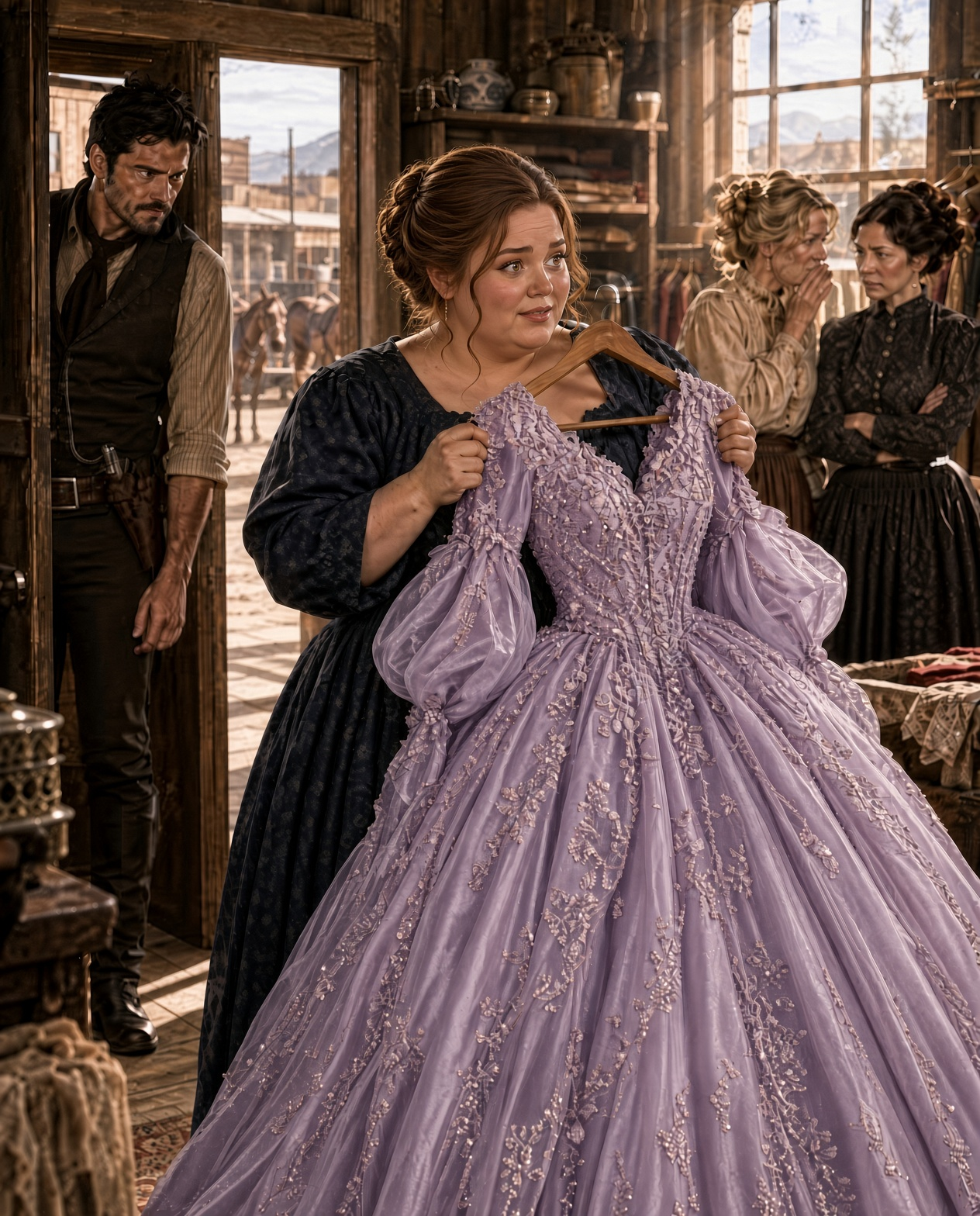
The man standing in the doorway smiled as though he had arrived for Sunday dinner.
"Well, Gideon," he said, "you've always been a difficult man to surprise."
I stared at him.
"Samuel?"
Samuel Porter removed his hat.
The familiar face of Cheyenne's most trusted general-store owner emerged from the shadows.
For nearly twenty years, I had purchased supplies from him.
He had sold flour to struggling families on credit, donated blankets during hard winters, and greeted every customer with the same warm smile.
He was the man who had first shown me Martha's secret charity ledger.
The man who had helped me understand how much good my wife had been doing.
And now he stood inside a hidden cellar beneath an abandoned freight station, smiling at the discovery of a prisoner who might still be alive.
Sheriff Reeves raised his revolver.
"Mr. Porter, put your hands where I can see them."
Samuel glanced at the weapon.
"Really, Daniel? Is that necessary?"
"Now."
Samuel slowly raised his hands.
Martha stood beside me, gripping the photograph of her father.
Her voice trembled.
"Mr. Porter?"
Samuel looked at her.
"Mrs. Mercer."
She swallowed.
"Why are you here?"
His smile faded.
"Because some people refuse to leave old business alone."
A terrible coldness moved through me.
"What business?"
Samuel looked toward the writing carved into the cellar wall.
Then he sighed.
"Arthur Bellamy was a complicated man."
I took a step forward.
"He stole Martha's father's land."
Samuel tilted his head.
"That depends on how one chooses to interpret the records."
"He had a receipt proving the debt was paid."
"Receipts can be misunderstood."
"And Thomas was attacked."
Samuel said nothing.
I looked into his eyes.
For the first time, I saw something beneath the friendly expression I had trusted for years.
Calculation.
Not anger.
Not fear.
The cold patience of a man accustomed to deciding what other people were allowed to know.
Sheriff Reeves stepped closer.
"Samuel Porter, I'm placing you under arrest pending investigation into the Bellamy property fraud and the attacks connected with it."
Samuel's smile returned.
"On whose testimony?"
"Several witnesses."
"Which witnesses?"
Reeves did not answer.
Samuel looked at Thomas.
Then at Amos Fletcher.
Then at Martha.
"An injured man with a damaged memory. A frightened ranch hand who accepted money. And a woman who has spent years imagining insults where none were intended."
I felt my fists tighten.
"Don't you dare speak about my wife."
Samuel looked at me.
"Ah, Gideon. There it is."
"What?"
"That temper. The same temper that drove your brother away."
The words struck exactly where he intended.
Thomas moved beside me.
"Samuel."
Porter turned.
My brother's voice was steady.
"You don't get to use my brother's grief against him."
Samuel studied him.
Then his expression hardened.
"I had hoped you would stay dead."
For a moment, nobody moved.
The words seemed to hang in the cold cellar.
Then Sheriff Reeves advanced.
"Hands against the wall."
Samuel sighed.
"Daniel, you really should have listened to me."
He lowered his hands.
Reeves raised the revolver.
"Don't move."
Samuel glanced toward the staircase.
And suddenly I understood.
He was not alone.
"Daniel!" I shouted.
A gunshot cracked from above.
The lantern beside the stairs shattered.
Darkness swallowed half the room.
Martha screamed.
I grabbed her and threw us behind the wooden table.
Another shot struck the stone wall.
Fragments sprayed across the floor.
Sheriff Reeves fired toward the staircase.
"Drop your weapon!"
A man shouted.
Then boots thundered overhead.
Caleb lunged toward the stairs.
"Stay back!" I yelled.
He stopped just as a third shot tore through the doorway.
Thomas dropped behind a barrel.
Amos Fletcher seized a fallen lantern and dragged it toward the far wall.
Its flame had survived.
The weak light revealed Samuel moving toward the iron door.
I sprang forward.
My injured shoulder screamed.
I caught his coat.
We crashed against the stone wall.
Samuel struck me across the face.
Pain flashed through my jaw.
I held on.
"You aren't leaving!"
He drove his elbow into my ribs.
I staggered.
Then Martha appeared beside us.
She swung the heavy wooden chair with both hands.
The chair struck Samuel's knees.
He collapsed with a cry.
I fell on him.
Sheriff Reeves rushed forward and forced his wrists behind his back.
Iron handcuffs clicked shut.
Samuel struggled.
"You have no idea what you've done!"
I leaned close.
"Then explain it."
He spat blood onto the floor.
"You've destroyed everything."
Martha stood above him, breathing hard.
Her hands trembled.
But her voice was clear.
"No, Mr. Porter. You destroyed things. We are only finding them."
I looked at her.
My wife.
The woman who had once been afraid to enter a dress shop because other women might laugh.
Now she stood before the man who had helped ruin her family.
And she did not lower her eyes.
The gunman upstairs tried to escape through the rear entrance.
Caleb and the ranch hands caught him before he reached his horse.
His name was Elias Rusk, a former freight guard who had worked for Arthur Bellamy.
Sheriff Reeves recognized him immediately.
Rusk had disappeared from Cheyenne years earlier after accusations of assault and intimidation.
Now he was back.
And he had been paid to silence anyone who might expose the old property scheme.
Reeves brought him into the main station room.
Samuel sat handcuffed beside the stove.
Thomas remained close to Martha.
Amos stood near the door, looking as though he wished the ground would swallow him.
I placed Nathaniel Ward's photograph on the counter.
Then I looked at Samuel.
"Where is he?"
Samuel stared at me.
"Who?"
I struck the counter with my palm.
"Nathaniel Ward."
Martha flinched.
I immediately regretted frightening her.
But Samuel only smiled.
"Your wife's father?"
I stepped closer.
"You know exactly who I mean."
Samuel glanced at the photograph.
"That is an old picture."
"The writing on the back is three months old."
"Is it?"
I felt my anger rising.
Sheriff Reeves placed a hand on my shoulder.
"Gideon."
I stepped back.
Reeves turned toward Samuel.
"Mr. Porter, we have evidence that Nathaniel Ward was held here against his will. We have a signed receipt proving his debt was settled. We have statements concerning false property transfers, threats, and attacks."
Samuel looked bored.
"And?"
"And we have a witness who says you were the man Arthur Bellamy called 'the Gentleman.'"
For the first time, Samuel's expression changed.
Only slightly.
But enough.
Thomas leaned forward.
"I remember you now."
Samuel looked at him.
My brother continued.
"You came to the freight yard the night I was attacked."
Samuel said nothing.
"You were wearing a black coat."
Thomas touched the scar above his eyebrow.
"And you told the men not to leave witnesses."
Martha pressed a hand to her mouth.
I stared at Samuel.
He looked toward the window.
Then said quietly, "Memory is a dangerous thing, Thomas. Especially when it returns in pieces."
My brother's face hardened.
"I remember enough."
We searched the freight station for nearly two hours.
Caleb found a locked cabinet behind the old ticket counter.
Inside were account books, correspondence, and several packets of receipts.
The records were dated across more than a decade.
Sheriff Reeves examined them with growing disbelief.
Some documents bore Arthur Bellamy's signature.
Others carried Samuel Porter's initials.
Together, they showed a pattern.
Families had borrowed small sums to survive bad harvests or illness.
Payments had been received but entered into different accounts.
Additional fees had been invented.
Land had been seized.
Then transferred through companies connected to Bellamy and Porter.
The scheme was larger than Martha's family.
Much larger.
I saw familiar names.
The Carters.
The Millers.
The Hendersons.
Families Martha had been helping with money from her returned dresses.
I stared at the pages.
"Good Lord."
Martha moved beside me.
"What?"
I showed her the names.
Her face changed.
"These are the families."
I nodded.
"The same ones."
She looked toward Samuel.
"You knew."
He said nothing.
She stepped closer.
"You knew why they were poor."
Samuel looked at her.
"Mrs. Mercer—"
"You knew their land had been taken."
He looked away.
Martha's voice trembled.
"And you let me buy flour from your store to help them."
I felt my chest tighten.
She continued.
"You watched me count pennies. You watched me return dresses. You watched me carry food to children whose families had been cheated."
Samuel's jaw tightened.
"I gave you favorable prices."
Martha stared at him.
Then she shook her head.
"You made a profit from their suffering twice."
The room fell silent.
I watched Samuel's expression.
He had no answer.
Martha looked at the ledger.
Tears filled her eyes.
"For months, I thought I was helping families survive bad luck."
She looked up.
"But it wasn't bad luck."
I took her hand.
"No."
She swallowed.
"It was people."
I nodded.
"Yes."
She looked at Samuel.
And in that moment, I saw the last trace of fear leave her face.
By late afternoon, Sheriff Reeves had enough evidence to take Samuel and Rusk into custody.
But Martha's father remained missing.
I refused to leave the station without another search.
Caleb checked the cellar.
Thomas examined the old freight records.
Walter Hensley, who had joined us with additional deputies, studied the dates and locations.
Then he called my name.
"Gideon."
I crossed the room.
Walter held a shipping manifest.
"Look at this."
The entry was dated three months earlier.
It listed medical supplies delivered to a settlement north of Cheyenne.
The destination was a small charitable home called Mercy House.
I frowned.
"What is it?"
Walter pointed to the recipient's signature.
The writing was shaky.
But the name was clear.
Nathaniel Ward.
Martha approached.
She stared at the page.
Then pressed a hand against her chest.
"Papa."
I looked at Walter.
"Is Mercy House still operating?"
He nodded.
"As far as I know."
"How far?"
"Half a day's ride in good weather."
I turned toward Sheriff Reeves.
"We're going."
He shook his head.
"Not tonight."
I stared.
"Daniel—"
"Listen to me. We've arrested two dangerous men. The roads are still icy. And your wife has been through more than anyone should endure."
Martha stepped forward.
"I'm going."
Reeves looked at her.
"Mrs. Mercer—"
"Please."
Her voice was quiet.
But there was no hesitation in it.
"I've spent most of my life believing my father died ashamed of us."
She looked down at the manifest.
"If he's alive, I need to see him."
I took her hand.
"We'll go at first light."
She looked at me.
Her eyes filled.
"Promise?"
I nodded.
"I promise."
We returned to Cheyenne with Samuel Porter and Elias Rusk under guard.
News spread faster than the wagons could travel.
By the time we reached the sheriff's office, a crowd had gathered.
People stood in the snow, whispering.
Some looked angry.
Others looked frightened.
I recognized several of the families named in the ledgers.
Ruth Carter stood near the front, holding her youngest child's hand.
Mr. Henderson was beside her.
Mrs. Miller stood wrapped in a worn shawl.
When Samuel stepped down from the wagon in handcuffs, a murmur moved through the crowd.
"Samuel Porter?"
"The storekeeper?"
"What happened?"
Sheriff Reeves raised his voice.
"Everyone remain calm. There will be a public hearing when the evidence has been reviewed."
A man shouted, "What evidence?"
Another called, "What did he do?"
Martha stood beside me.
Her hand tightened around mine.
I looked at her.
She was trembling.
"Do you want to go home?"
She shook her head.
"No."
I studied her face.
"Are you sure?"
She nodded.
"Those families deserve to know."
Before I could answer, Ruth Carter approached.
"Mrs. Mercer?"
Martha turned.
"Ruth."
The widow looked frightened.
"Is it true? Did Mr. Porter have something to do with our land?"
Martha's eyes filled.
She looked toward Sheriff Reeves.
Then back at Ruth.
"There are records that suggest several families were cheated."
Ruth covered her mouth.
"My husband died believing he'd failed us."
Martha reached for her.
"I'm so sorry."
Ruth began crying.
Martha embraced her.
And soon other families gathered around them.
Some asked questions.
Some wept.
Some simply stood in stunned silence.
I watched my wife hold Ruth Carter while the crowd grew.
The woman who had hidden her kindness for fear of being mocked was now standing in the middle of Cheyenne, comforting people who had been robbed of their homes and dignity.
And for once, nobody laughed.
The hearing began the following morning in the county courthouse.
I had expected a handful of witnesses.
Instead, the room was packed.
Farmers.
Ranchers.
Widows.
Shopkeepers.
Men who had lost land.
Women who had lost husbands.
Children who had grown up believing their families had failed.
Sheriff Reeves presented the recovered records.
Benjamin Cole testified about the false accounts.
Amos Fletcher admitted his part in Thomas's disappearance.
Thomas described the attack and the years he had spent trying to recover his memory.
Then Martha was called.
I watched her rise.
She wore a plain blue wool dress.
Not silk.
Not fashionable.
But she looked beautiful.
She walked to the front of the room with her shoulders straight.
The county magistrate asked her to describe what had happened to her family.
Martha took a breath.
Then began.
She spoke about her father.
His farm.
Her mother's sewing machine.
The debt they had struggled to repay.
The day the Bellamy men arrived.
The furniture carried into the street.
The humiliation.
The hunger.
The years of shame.
Her voice trembled at times.
But she did not stop.
Then she described the receipt Thomas had preserved.
The document proving the debt had been paid.
The magistrate examined it.
The room fell silent.
Martha looked toward the crowd.
"For years, I believed my family lost everything because we weren't good enough."
I felt tears rise.
She continued.
"I believed being poor meant we had done something wrong."
Her eyes moved across the faces before her.
"But we were not failures."
Ruth Carter began crying.
Martha's voice grew stronger.
"My father worked hard. My mother worked hard. They loved me. They did everything they could."
She swallowed.
"And someone took advantage of that."
I looked toward Samuel Porter.
He sat beside the sheriff, his face pale.
Martha continued.
"I cannot give my parents back the years they lost. I cannot erase what happened to the other families."
She looked toward the magistrate.
"But I can tell the truth."
The room remained silent.
Then Martha said something I knew I would remember for the rest of my life.
"Poor people do not deserve less kindness. And wealthy people do not deserve more forgiveness simply because they can afford it."
A murmur moved through the courtroom.
The magistrate raised his hand for silence.
But I could see the effect of her words.
People were listening.
Really listening.
For the first time, Cheyenne was hearing Martha Ward's story without laughter.
Without ridicule.
Without anyone telling her to be ashamed.
The magistrate ordered the disputed property records preserved and referred the evidence for further prosecution.
Samuel Porter and Elias Rusk remained in custody.
Amos Fletcher was released under supervision pending further proceedings.
The court did not pretend that every wrong could be repaired in a single day.
But the old transfers were being challenged.
The false accounts were being examined.
And families who had been told their losses were their own fault finally had proof that something else had happened.
Outside the courthouse, people gathered around Martha.
Ruth Carter embraced her.
Mrs. Miller thanked her.
Mr. Henderson removed his hat.
Then Eleanor Bellamy approached.
The crowd grew quiet.
I stepped closer to my wife.
Eleanor's injured ankle was supported by a cane.
Her face looked drawn.
She stopped several feet away.
"Martha."
My wife looked at her.
"Eleanor."
For a moment, neither spoke.
Then Eleanor lowered her eyes.
"I heard what you said."
Martha waited.
Eleanor swallowed.
"My father told me your family had cheated him."
She looked toward the courthouse.
"I believed him."
Martha's expression remained still.
Eleanor continued.
"And when people laughed at you, I joined them."
Her voice broke.
"Sometimes I started it."
I felt my jaw tighten.
Martha said nothing.
Eleanor looked at her.
"I can't undo that."
"No," Martha said softly. "You can't."
Eleanor nodded.
Tears slipped down her cheeks.
"I'm sorry."
Martha looked at her for a long moment.
Then she said, "I hope you mean it."
Eleanor nodded.
"I do."
Martha took a breath.
"Then prove it by helping the families your father hurt."
Eleanor stared.
Martha continued.
"You own land that may never have belonged to him."
Eleanor lowered her eyes.
"I know."
"Then help make it right."
For several seconds, Eleanor stood silent.
Then she nodded.
"I will."
Martha stepped back beside me.
I took her hand.
And we walked away together.
We left for Mercy House before sunrise the next morning.
The sky was clear.
The road north stretched across frozen prairie.
Martha sat beside me in the wagon, wrapped in a thick blanket.
Thomas rode with Caleb behind us.
Sheriff Reeves had sent a deputy along for safety.
I looked at my wife.
She had barely slept.
Her hands were folded tightly in her lap.
"Are you frightened?" I asked.
She nodded.
"Very."
I took her hand.
"Whatever we find, I'm here."
She looked at me.
"I know."
Her eyes filled.
"What if Papa doesn't remember me?"
I swallowed.
"Then we'll help him."
"What if he's very sick?"
"Then we'll bring him home if we can."
She looked toward the road.
"And what if..."
Her voice broke.
I waited.
"What if he's already gone?"
I pulled the wagon to a stop.
Then turned toward her.
"Martha."
She looked at me.
"I can't promise what we'll find."
Tears slipped down her cheeks.
"But I can promise you won't face it alone."
She nodded.
I kissed her forehead.
Then we continued north.
Mercy House stood at the edge of a small settlement, surrounded by bare cottonwoods.
It was a modest building.
Whitewashed walls.
A low porch.
Smoke rising from the chimney.
A wooden sign hung above the entrance.
Martha stared at it.
Her hands began trembling.
I helped her down from the wagon.
Thomas joined us.
For a moment, we stood together in the snow.
Then I knocked.
An elderly woman opened the door.
She wore a plain gray dress and a white apron.
"Can I help you?"
I removed my hat.
"Ma'am, we're looking for a man named Nathaniel Ward."
Her expression changed.
Martha stepped forward.
"He's my father."
The woman looked at her.
Then at me.
For several seconds, she said nothing.
Finally, she whispered, "Oh, my dear."
Martha's face drained of color.
"Is he here?"
The woman nodded slowly.
Martha began crying.
"He's alive?"
The woman reached for her hand.
"Come inside."
We followed her through a narrow hallway.
The building smelled of soap, bread, and wood smoke.
Several rooms opened along the corridor.
At the far end stood a closed door.
The woman stopped before it.
She looked at Martha.
"Your father has waited a very long time."
Martha pressed a hand against her mouth.
I stood beside her.
Thomas remained a few steps behind us.
The woman reached for the handle.
Then hesitated.
"There's something you should know."
My heart began pounding.
"What?"
She looked at Martha.
"Your father has been asking for you every day."
Martha began sobbing.
The woman opened the door.
And from inside came a frail voice.
"Martha?"
My wife froze.
The voice spoke again.
"My little girl?"
Martha took one step forward.
Then another.
I stood beside her as she reached the doorway.
And there, sitting beside the window in a worn wooden chair, was an elderly man holding a faded blue ribbon.
He looked up.
His eyes widened.
His trembling hands reached toward her.
"Martha?"
She whispered, "Papa?"
He began to rise.
Then his expression changed.
His eyes moved past her.
Toward the hallway.
Toward someone standing behind us.
His face filled with terror.
"No," he whispered.
I turned.
A shadow moved across the doorway.
And Nathaniel Ward screamed.
"MARTHA, GET AWAY FROM HIM!"






Comments 0