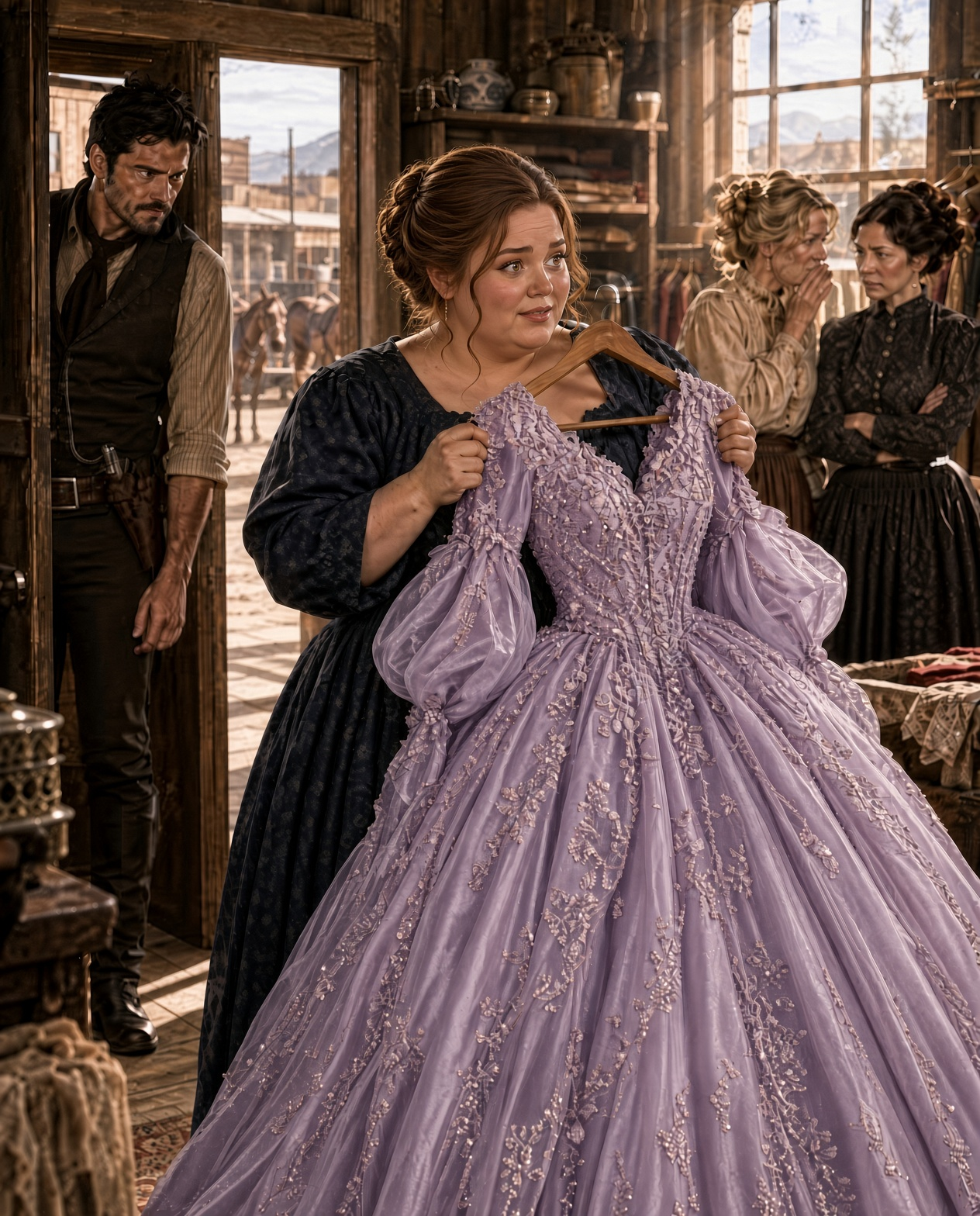
"Perhaps Gideon bought it because he cannot see what everyone else sees," a woman whispered, laughing behind my wife's back.
I stood in the doorway of the Cheyenne dress shop, holding the receipt for the silk gown Martha had just returned.
There was a small handwritten note on the back.
Exchange for store credit. No cash.
That was when I realized my wife had not been throwing away my gifts.
She had been turning them into something else.
And whatever it was, she had gone to extraordinary lengths to keep me from finding out.
I should have walked into that shop immediately. I should have confronted the two women who stood near the window, whispering behind their gloved hands as though cruelty became respectable when delivered quietly.
Instead, I stayed where I was.
Because Martha had heard them.
I saw it happen.
The slight stiffening of her shoulders. The way her fingers tightened around the folded silk. The almost invisible movement of her chin as she lowered her face.
She did not argue.
She did not defend herself.
She simply accepted the insult as though it were something she had expected.
That hurt me more than the words themselves.
My name is Gideon Mercer, and I had been married to Martha for six months when I discovered that the woman sharing my home had been carrying a secret I could not begin to understand.
I owned a cattle ranch several miles outside Cheyenne, Wyoming. It was not the largest spread in the territory, but it was prosperous enough that I could afford a comfortable house, good horses, and the occasional luxury.
Before Martha came into my life, none of those things had mattered much.
I had spent most of my adult years believing that a man's worth could be measured by the strength of his hands, the condition of his livestock, and whether his word meant something when he gave it.
Then I met Martha.
And everything I thought I knew about what made a life worthwhile began to change.
She was not the kind of woman who commanded attention when she entered a room.
She was full-figured, strong, and practical, with warm hazel eyes and a face that revealed more kindness than vanity.
Her auburn hair was usually pinned into a modest bun, though loose strands often escaped when she worked.
She laughed easily when nobody was watching.
She could mend a torn saddle strap, cook enough supper for twelve hungry ranch hands, and carry two heavy buckets from the well without asking for assistance.
But whenever someone complimented her appearance, she looked as uncomfortable as a horse standing on unfamiliar ground.
I had noticed that before we married.
I had not understood it.
Our wedding had been small.
A handful of ranch workers, the local preacher, two neighboring families, and an elderly widow named Mrs. Whitcomb attended.
Martha wore a simple brown dress she had sewn herself.
I remembered asking whether she wanted something finer.
She smiled and said, "I'd rather have a dress I can wear again."
That was Martha.
Always thinking about usefulness.
Always measuring the value of something by what it could do for somebody else.
I loved that about her.
But after our wedding, I began noticing something that troubled me.
Martha worked constantly.
She rose before dawn to prepare breakfast.
She helped with the livestock when the weather turned bad.
She patched clothing for ranch hands who had families of their own and little money to spare.
She even spent her evenings sewing by lamplight after everyone else had gone to bed.
Whenever I suggested she rest, she gave the same answer.
"There's always something needs doing."
At first, I assumed she was simply accustomed to hard work.
Then I began to wonder whether she believed she had to earn her place in my home.
One evening, I found her scrubbing the kitchen floor long after supper.
"Martha," I said, "we have a perfectly good housekeeper who comes twice a week."
She looked up from her knees.
"I know."
"Then why are you doing her work?"
She hesitated.
"Because I can."
I crouched beside her.
"You don't have to prove anything to me."
Her expression changed.
Only for a second.
Then she smiled.
"I'm not proving anything, Gideon."
But I had the distinct feeling she was lying.
Not the kind of lie told to deceive someone for personal gain.
The kind people tell when the truth feels too painful to explain.
I did not press her.
That was my first mistake.
My second came several weeks later, when I traveled into Cheyenne to purchase supplies.
A new shipment of dresses had arrived from Denver.
They were displayed in the front window of a fashionable shop on the main street.
One caught my attention immediately.
It was made of deep blue silk, with delicate embroidery along the bodice and sleeves.
I knew very little about women's clothing.
But I knew Martha had never owned anything like it.
The shopkeeper assured me it was fashionable.
I bought it without asking the price twice.
That evening, I carried the wrapped package into our kitchen.
Martha was peeling potatoes.
"What's that?" she asked.
"Something for you."
She looked genuinely startled.
"For me?"
"Unless you know another Martha Mercer living on this ranch."
She laughed.
I placed the package on the table.
She wiped her hands carefully before opening it.
When she lifted the blue silk from the paper, she went completely still.
For several seconds, she said nothing.
Then she touched the embroidery with one finger.
"Oh, Gideon."
I thought she was delighted.
I was wrong.
Her eyes filled with something I could not identify.
"Do you like it?" I asked.
"It's beautiful."
"Then try it on."
She looked at me.
"Now?"
"Why not?"
She hesitated before carrying the dress into our bedroom.
When she returned, she stood just inside the doorway, one hand resting nervously against her waist.
The dress fit her beautifully.
The blue silk brought out the warmth in her complexion, and the delicate sleeves made her look as though she belonged at one of the grand dances held in town.
I rose from my chair.
"Martha."
She lowered her eyes.
"Is it too much?"
"Too much?"
"Too fancy, I mean."
I crossed the room.
"You look wonderful."
She gave a small, uncertain smile.
"You're kind to say so."
"I'm not being kind. I'm telling you the truth."
For one moment, she seemed almost happy.
Then she caught sight of herself in the small mirror beside the kitchen doorway.
Her smile faded.
She looked away.
The next morning, the dress was gone.
I assumed she had put it away.
But several weeks passed, and I never saw it again.
When I finally asked, Martha said she had decided it was not suitable for ranch life.
That seemed reasonable enough.
I let the matter rest.
A month later, I bought her a green silk dress.
That disappeared too.
Then came the crimson gown.
I ordered it from Denver after noticing Martha pause outside a shop window during one of our visits to town.
She had admired the fabric for perhaps five seconds.
No more.
But I remembered.
When the package arrived, I carried it home myself.
The gown was expensive, even by the standards of a man who owned a successful cattle ranch.
Its silk was soft, its stitching fine, and its color rich enough to catch the light from across a room.
Martha opened the box.
Her face changed immediately.
"Gideon," she whispered, "you shouldn't have."
"Why not?"
"It's too much money."
"That's my concern."
She looked wounded by the answer.
I softened my voice.
"I wanted you to have something beautiful."
She stared at the gown.
Then she said something I would remember for the rest of my life.
"It's too beautiful for me."
I laughed gently, believing she was being modest.
"Nonsense."
But Martha did not laugh.
She carefully folded the dress back into its box.
And three days later, it vanished.
That was when I began asking questions.
Not because I suspected my wife of wrongdoing.
Not at first.
I simply wanted to understand.
Had I offended her?
Did she dislike the dresses?
Was there something about the gifts that reminded her of an unhappy time before our marriage?
Whenever I asked, she gave the same gentle answer.
"They were too beautiful for me."
I tried telling her she deserved them.
I tried telling her money was not a problem.
I even suggested we attend one of the dances in Cheyenne so she would have a reason to wear something elegant.
She declined.
Every time.
And the more I tried, the quieter she became.
Eventually, I stopped asking.
But I did not stop wondering.
One cold afternoon in November, I noticed Martha preparing to leave the ranch.
She had wrapped herself in her old wool coat and tied a dark scarf beneath her chin.
Under one arm, she carried a carefully folded parcel.
"Going into town?" I asked.
She nodded.
"Just a few errands."
"Need me to come?"
"No, thank you."
The answer came too quickly.
I glanced at the parcel.
"What's that?"
"Something I need to take back."
She looked away as she spoke.
I knew that look.
I had seen it whenever I asked about the dresses.
"Will you be home for supper?"
"Of course."
She kissed my cheek and hurried outside.
I stood by the window and watched her climb into the small wagon.
The parcel rested beside her.
For several minutes, I argued with myself.
A husband ought to trust his wife.
I believed that.
But I also believed something was hurting Martha, and she had decided to suffer through it alone.
I saddled my horse.
I kept my distance as she traveled toward Cheyenne.
The road was hard beneath the wheels of her wagon, and patches of old snow remained in the shaded ditches.
I followed far enough behind that she would not notice me.
By the time she reached town, the streets were crowded with wagons and riders.
I tied my horse outside a feed store and watched Martha cross toward the dress shop.
She carried the parcel inside.
I waited.
Through the large front window, I could see her speaking with the shopkeeper.
The woman behind the counter examined the crimson gown.
Martha stood quietly while the dress was unfolded.
Then two fashionable women entered the shop.
I recognized one of them.
Mrs. Eleanor Bellamy.
Her husband owned several commercial properties in Cheyenne, and she behaved as though that entitled her to judge every woman who crossed her path.
The second woman was Mrs. Clara Whitfield, the wife of a local merchant.
They were both known for their expensive clothing and their fondness for gossip.
I had never cared much for either of them.
As I approached the doorway, I heard Mrs. Bellamy speak.
"Isn't that Gideon Mercer's new wife?"
Mrs. Whitfield turned.
"Oh, yes. The ranch woman."
Something in her tone made me stop.
Martha stood at the counter, waiting for the shopkeeper to finish examining the gown.
Mrs. Bellamy looked her up and down.
"Such lovely silk," she murmured.
Mrs. Whitfield smiled.
"A pity."
The women laughed quietly.
Martha heard them.
I knew she did because her shoulders stiffened.
Mrs. Bellamy continued.
"Look at her. She actually thinks silk will make her elegant."
My hands tightened.
Then Mrs. Whitfield delivered the remark that nearly brought me through the doorway.
"Perhaps Gideon bought it because he cannot see what everyone else sees."
I had never struck a woman in my life.
I had no intention of starting.
But I wanted those two women to understand exactly what kind of man they were insulting when they mocked my wife.
Then Martha spoke.
Her voice was so quiet I almost missed it.
"Could I please have the store credit?"
The shopkeeper nodded.
"Of course, Mrs. Mercer."
She wrote something on a small slip of paper.
Martha accepted it with both hands.
"Thank you."
Then she turned toward the door.
I stepped aside before she could see me.
She passed within a few feet of where I stood, carrying a small paper parcel.
Her face was pale.
Her eyes were lowered.
And she walked with the careful dignity of someone determined not to let strangers witness her pain.
I watched her disappear into the crowd.
Then I looked back through the window.
Mrs. Bellamy was still laughing.
I could have confronted her.
I wanted to.
But something stopped me.
The paper parcel.
Martha had not returned the gown for cash.
She had accepted store credit.
And the shopkeeper had handed her a parcel that was far too small to contain another dress.
I remembered the blue gown.
The green one.
The crimson silk.
Three expensive gifts.
Three disappearances.
And a wife who had repeatedly insisted she needed nothing.
I followed Martha down the street.
She stopped outside the general store.
Before entering, she glanced over her shoulder.
I ducked behind a wagon.
When I looked again, she had disappeared inside.
I waited a moment before approaching the window.
Through the glass, I saw Martha speaking with the storekeeper.
She handed him the credit slip.
He nodded and disappeared into the back room.
A few minutes later, he returned carrying several sacks of flour, wool blankets, children's shoes, and bundles of winter clothing.
I frowned.
That was enough merchandise to supply a small household.
Martha carefully counted the items.
Then she reached into her purse and added several coins of her own.
The storekeeper said something.
She shook her head.
He looked concerned.
She insisted.
Finally, he nodded.
I moved closer to the door.
That was when I heard Martha speak.
"Please make certain Mrs. Whitcomb gets the children's shoes. The youngest boy has been walking barefoot."
My stomach tightened.
Mrs. Whitcomb?
The elderly widow who had attended our wedding?
I knew she had been struggling since her daughter died, leaving three children in her care.
But I had no idea Martha had been helping her.
The storekeeper lowered his voice.
"And the other families?"
Martha glanced toward the door.
"Same as before."
The man hesitated.
"Mrs. Mercer, you know your husband could afford—"
"Please," she interrupted.
Her voice trembled.
"Don't tell Gideon."
I stood perfectly still.
The storekeeper looked at her for a long moment.
Then he nodded.
"Your secret is safe with me."
Martha turned toward the back of the store.
I followed her movement with my eyes.
There was a narrow doorway behind the counter.
She disappeared through it.
A moment later, I heard a child's voice.
"Mrs. Martha?"
Then another.
"Did you bring the shoes?"
I moved toward the doorway.
And just as I reached it, I heard an elderly woman begin to cry.
She said something that made every question I had ever asked about my wife seem terribly small.
"God bless you, Martha. I don't know how much longer we could have kept this from him."
Then the storekeeper stepped in front of me.
His face went pale.
"Mr. Mercer," he whispered. "There's something you need to see."






Comments 0