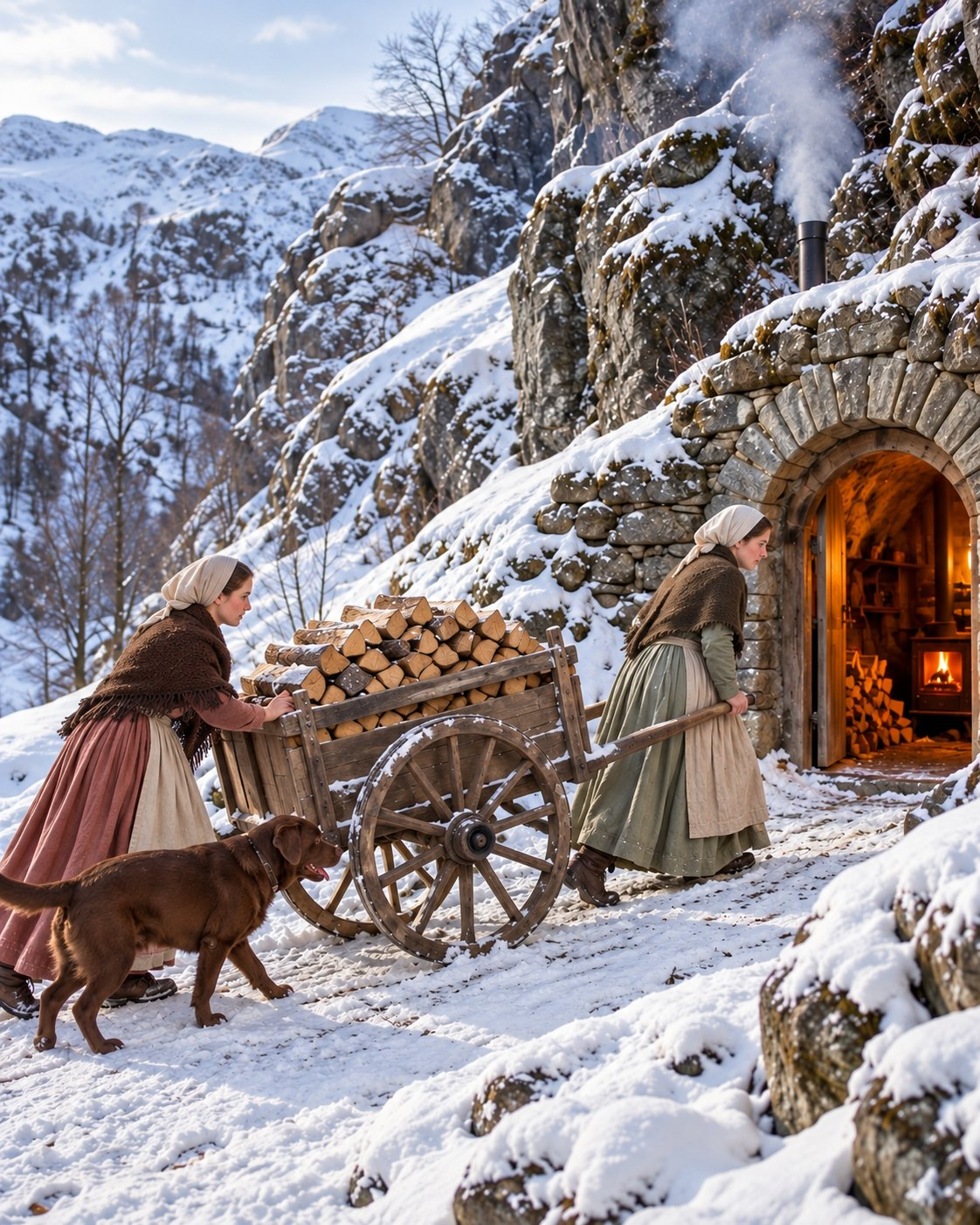
I grabbed my twin sister's arm as Mrs. Crane slammed the orphanage door in our faces.
"Please, Mrs. Crane! Just give us until morning!"
The matron stepped forward, clutching my father's stolen war medal.
But the words she whispered next changed everything.
"Your father should have taken his secrets to the grave."
I stared at the medal.
Then I understood that our banishment had never been about the weather.
It was September 17, 1873, and the first snowflake landed on my cheek.
I remember because I had been looking at the sky when it happened. I had spent the entire summer watching the clouds, recording wind directions, measuring the creek, and marking the unusual movements of birds in my father's old ledger. I knew what that snowflake meant.
Winter was coming.
Not the ordinary winter Virginia knew every year. Not the kind that brought a few inches of snow and sent children running outside with red cheeks and wet mittens.
This was something different.
And my sister Ruth and I had spent weeks trying to warn everyone.
Nobody had listened.
Now we stood outside the Redemption Hollow Orphanage with everything we owned piled at our feet.
One flour sack.
A small bundle of food.
Two worn wool shawls.
My father's rusted hatchet.
And a single iron key.
That was our inheritance.
Behind the upstairs windows, several children watched us. Their small faces were pressed against the glass, and I could recognize every one of them.
There was Samuel, who always hid bread beneath his mattress. Little Elizabeth, who cried whenever thunder rolled over the hills. And Tommy Doyle, twelve years old, whose father had died during the war.
Tommy was holding the window frame with both hands.
His eyes were red.
The night before, he had come to our room carrying something wrapped in a piece of cloth. It was a folding knife his father had carried during the war.
He had wanted to give it to me.
I had refused.
"Keep it, Tommy," I had whispered. "Someday you'll need it more than I will."
He had looked disappointed, but eventually he tucked the knife into his pocket.
Unfortunately, Mrs. Crane had caught him leaving our room.
I heard the blows through the floorboards.
I heard him trying not to cry.
And I heard Mrs. Crane telling him that children who disobeyed her would grow up to become useless burdens on society.
I had wanted to run downstairs.
I had wanted to stop her.
But Ruth had held my hand and whispered that if we were expelled before we could collect our father's belongings, we would lose the only things that might help us survive.
That helplessness had stayed with me all night.
Now Tommy stood behind the window, watching us leave.
I raised my hand.
He raised his.
Neither of us spoke.
Then Mrs. Crane pulled the curtain shut.
"Come on, Hannah," Ruth whispered.
I looked at her.
Although we were identical twins, our expressions had always been different. I tended to hide my feelings. Ruth could never quite conceal hers.
Her cheeks were pale, and her lower lip trembled.
She was frightened.
So was I.
But I couldn't let her see it.
I bent down, picked up the flour sack, and placed it across my shoulder.
"Let's go."
We started walking.
Behind us, the orphanage door remained closed.
Mrs. Martha Crane had been the matron of Redemption Hollow Orphanage for almost eleven years.
She was a tall, narrow woman with gray hair arranged in a tight bun and a voice that could make even the strongest children lower their heads.
She believed in discipline.
She believed in obedience.
And she believed that children without parents had no right to question the adults responsible for them.
But there was something about Mrs. Crane that I had never understood.
She hated our father.
Not simply because he had worn a Union uniform. Several men in town had fought for the Union, and although some people still disliked them, most had learned to live with their differences.
Mrs. Crane's hatred was personal.
Whenever someone mentioned Thomas Whitlock, her mouth tightened.
Whenever Ruth or I asked about his belongings, she changed the subject.
And whenever we asked for his bronze war medal, she became unusually angry.
That morning, before throwing us out, I had finally asked her why.
"Why won't you give his medal back?"
She had been standing beside her desk, examining a stack of household accounts.
For a moment, she didn't move.
Then her fingers closed around the medal hidden beneath her apron.
"That is not yours to question."
"It belonged to our father."
"Your father left you nothing of value."
"He left us his ledger."
Mrs. Crane laughed.
"That ridiculous book of weather observations? You expect respectable people to believe two little girls know more about winter than experienced men?"
"I never said that."
"Then stop frightening the children."
"I'm trying to protect them."
Her expression changed.
It was a small change, but I noticed it.
The muscles around her eyes tightened. Her hand moved toward the medal.
Then she leaned closer.
"There are things women should not know," she whispered. "My mother died because she knew too much."
I stared at her.
"What does that have to do with our father?"
For several seconds, she said nothing.
Then her face hardened again.
"Get out."
And now, as we walked down the muddy main street, I kept thinking about those words.
There were things women should not know.
What had Mrs. Crane meant?
And why had she been so frightened when I mentioned the medal?
Our parents had died six years earlier.
Typhoid had taken our mother first, then our father a few weeks later.
I remembered the smell of boiled water, the damp sheets, and the way our father had struggled to lift his head when we entered the room.
He had been a Union scout during the war.
He knew how to read tracks, follow rivers, identify edible plants, and recognize changes in the weather.
Our mother, Mary, had known something different.
She understood roots, leaves, herbs, and the properties of plants that grew in the forests around our home.
Together, they had taught us things most children never learned.
Father taught us to watch the migrating birds.
Mother taught us to recognize plants by their leaves and smell.
Father showed us how to measure the creek after rainfall.
Mother taught us which roots could be boiled into food when supplies became scarce.
Their lessons had seemed like games when we were young.
After they died, those lessons became the only inheritance we could trust.
Before his final night, Father had given me a weather ledger.
Its leather cover was cracked, and several pages had become stained from years of use.
He placed it in my hands and told me something I had never forgotten.
"Never trust the calendar more than the land, Hannah. The mountains will tell you what is coming if you learn to listen."
I had promised him I would remember.
I had.
Every summer since entering the orphanage, I had continued recording observations.
That year, the evidence frightened me.
The geese had begun migrating earlier than usual.
Squirrels were gathering food with unusual urgency.
The creek had dropped to a level I had never recorded in September.
The northern winds were arriving weeks before their expected season.
Even the crows had changed their usual flight paths.
At first, I thought I had made a mistake.
I checked the dates.
I checked the measurements.
I repeated the observations.
The signs remained.
I showed the ledger to Reverend Caleb Thorne.
He examined three pages, closed the book, and laughed.
"God does not send winter according to the calculations of two orphan girls."
I tried to explain.
He raised his hand.
"Your father was a soldier, not a prophet."
The following Sunday, he mentioned our predictions during his sermon.
He did not use our names, but everyone knew who he meant.
Some people laughed.
Others shook their heads.
Silas Burke, the town storekeeper, was particularly pleased.
He had disliked our father since the war. His bitterness had never faded, and he refused to forget the sight of Thomas Whitlock wearing a Union uniform.
When I asked him to sell us additional flour for the orphanage, he had pushed the sack back across the counter.
"Perhaps your father can send you some from wherever he is."
I had left without arguing.
I thought about that conversation now.
I wondered whether Silas would still laugh when the snow reached his shop windows.
By noon, Ruth and I had passed the church, the blacksmith's workshop, and the last row of houses.
The townspeople watched us from their porches.
Some looked sympathetic.
Others seemed relieved.
An old woman named Abigail Turner stood outside her cottage holding a basket of laundry.
"Hannah?"
I stopped.
She approached slowly.
"I heard what happened."
Ruth adjusted the shawl around her shoulders.
"We're going to our father's cave," she explained.
Abigail looked toward the mountains.
"That old place?"
"Yes, ma'am."
"Child, nobody has lived there in years."
"We know."
Abigail hesitated.
Then she reached into her apron and produced two small apples.
"Take these."
I accepted them.
"Thank you."
She looked at the sky.
The clouds were moving strangely. A cold wind had begun blowing through the street.
"Perhaps you girls were right," she whispered.
Before I could answer, someone called her name from across the road.
It was Silas Burke.
He stood outside his store with his arms folded.
"Abigail! Don't encourage their nonsense."
The old woman lowered her eyes.
Silas turned toward us.
"Three days in those mountains, and you'll be crawling back."
Ruth tightened her grip on the flour sack.
I said nothing.
Silas laughed.
"Perhaps the wolves will believe your weather stories."
That was when I noticed something.
The wind had shifted.
It was coming directly from the north.
I looked at the bare branches above the street.
A cluster of birds suddenly lifted from the trees and flew south.
Not east.
Not west.
South.
My stomach tightened.
I opened my father's ledger and wrote the time beside the observation.
September 17.
Northern wind.
Early migration.
First snowfall.
Ruth watched me.
"You think it will be bad?"
I closed the book.
"I think we have less time than we thought."
We reached the western road shortly before sunset.
The houses had disappeared behind us.
The path narrowed as it approached the foothills.
Ruth walked beside me, carrying the smaller bundle.
For a while, neither of us spoke.
Then she said, "Do you think Tommy will be all right?"
I looked toward the town.
"I hope so."
"Mrs. Crane will punish him again."
"I know."
"Maybe we should have taken him with us."
I stopped walking.
The thought had crossed my mind more than once.
But Tommy was twelve. He was small, and the mountains were becoming dangerous.
We had barely enough food for ourselves.
Taking him with us might have put all three of us at risk.
"I couldn't promise to keep him safe," I said.
Ruth looked down.
"Father would have known what to do."
I wanted to agree.
Instead, I adjusted the sack on my shoulder.
"Father taught us what to do."
She looked at me.
"That's not the same."
"No," I admitted. "But it's what we have."
We continued west.
The first night, we found shelter beneath a large rock formation.
Ruth spread our wool shawl across the ground, and I gathered a few dry branches from beneath the trees.
We had no proper shelter.
No bed.
No firewood supply.
Just the clothes on our backs and a small amount of food.
The temperature dropped rapidly.
Ruth moved closer to me.
I wrapped the shawl around both of us.
"Do you think we will find the cave?" she whispered.
"Father said it was west of the old ridge."
"That was six years ago."
"I know."
"What if the entrance has collapsed?"
I looked into the darkness.
For the first time that day, I allowed myself to consider the possibility.
What if the cave was gone?
What if the key no longer worked?
What if Father had been wrong?
I reached into the flour sack and removed his old book.
The leather cover was cold beneath my fingers.
I opened it carefully.
Most of the pages contained weather observations, hand-drawn maps, and notes about the surrounding mountains.
But I had never read the entire book.
Some pages were too damaged.
Others were filled with handwriting that became increasingly difficult to understand.
I turned toward the final section.
Something was folded inside the back cover.
A piece of paper.
I had never seen it before.
My heart began beating faster.
"Ruth."
She leaned closer.
"What is it?"
I unfolded the paper.
The handwriting was unmistakably our father's.
My girls,
If you are reading this, you have been driven out.
I am sorry I cannot protect you.
Go to the cave.
The key opens the inner door.
There is more inside than you can see.
Keep going.
Your father loves you.
I read it twice.
Then a third time.
Ruth covered her mouth.
"He knew?"
I stared at the final line.
For six years, I had believed that the cave was nothing more than an abandoned shelter he had once used during the war.
Now I understood that he had left us something deliberately.
Something he had expected us to need.
I looked at the iron key resting beside my father's hatchet.
The metal was dark with age.
Its teeth were unusually shaped.
And suddenly, the words on the paper seemed more important than anything else we possessed.
"The inner door," Ruth whispered.
I nodded.
"Tomorrow, we find it."
We slept badly.
The wind continued blowing through the trees, and sometime during the night, I heard an animal moving nearby.
I sat upright and reached for the hatchet.
Ruth woke immediately.
"What is it?"
"Stay still."
Something moved beyond the rocks.
A low growl came from the darkness.
I held the hatchet in both hands.
A pair of eyes appeared between the trees.
Then another movement.
A wolf stepped onto the path.
It was lean and hungry.
Its fur was gray, and its ribs were visible beneath its coat.
Ruth grabbed my sleeve.
"Hannah..."
I remembered Father's lessons.
Never run.
Never turn your back.
Make yourself difficult to approach.
I slowly raised the hatchet and tapped its metal head against a nearby stone.
Once.
Twice.
Three times.
The wolf stopped.
I repeated the rhythm Father had taught us.
The animal watched us for several seconds.
Then it turned and disappeared into the trees.
Ruth released a breath.
"How did you know to do that?"
"Father taught me."
I lowered the hatchet.
"I never thought I'd need it."
Neither of us slept much after that.
By the second afternoon, our feet were blistered.
The food sack was lighter.
The snow had become heavier.
Ruth stumbled beside a fallen log and sat down.
"I can't keep going."
I stopped.
She looked exhausted.
Her bonnet was wet, and several strands of dark hair had escaped her braid.
I placed the flour sack beside her.
"We'll rest."
She shook her head.
"We could go back."
I said nothing.
"There's a roof in Redemption Hollow," she continued. "Even if Mrs. Crane hates us, there's a kitchen. There's food."
I looked at the mountains.
Going back meant admitting that we had no other place to go.
It meant returning to people who had laughed at us.
It meant accepting that Father had left us nothing useful.
But the truth was that I was tired too.
My feet hurt.
My fingers were numb.
And I had begun wondering whether our father's cave was nothing more than a story we had misunderstood.
I opened his book again.
The folded letter was still inside.
I read the words one more time.
Go to the cave.
The key opens the inner door.
There is more inside than you can see.
I looked at Ruth.
"Father knew this journey would be difficult."
She stared at the letter.
"He knew we'd be thrown out?"
"I don't know."
"Then why did he write this?"
I held the paper carefully.
"Because he wanted us to keep going."
For several moments, Ruth remained silent.
Then she stood.
She brushed the snow from her skirt and picked up the smaller bundle.
"All right."
I shouldered the flour sack.
Together, we continued west.
By late afternoon, the mountains had begun to disappear behind a curtain of snow.
The trail narrowed.
The wind became colder.
And somewhere ahead, hidden behind the rocks and trees, was the only place our father had left us.
I didn't know whether the cave would save us.
I only knew we had to reach it.
Then, just as the last daylight began fading, Ruth suddenly stopped.
"Hannah."
I turned.
She was pointing toward a thick cluster of hawthorn bushes.
Behind the branches, something dark interrupted the white mountain slope.
I moved closer.
A wooden structure.
Old.
Weathered.
Almost completely hidden beneath the snow.
I pushed the branches aside.
And there it was.
The cave.
But when I examined the entrance, my stomach tightened.
The outer door was rotten.
The padlock was covered in rust.
And beside it, carved into the stone, was a mark I recognized from my father's ledger.
Two letters.
TW.
I reached for the iron key.
Then I heard something from inside the cave.
A faint sound.
Like water running beneath the stone.
And for the first time since we had left Redemption Hollow, I wondered whether our father had hidden something much bigger than a shelter inside that mountain.






Comments 0