I read Mother's final sentence again.
If the winter comes early, the mountain may still provide food when the fields outside are buried.
Ruth stood beside me, holding the candle.
Neither of us spoke.
For six years, we had believed that our parents had left us with nothing except a few memories, an old ledger, and a handful of belongings.
Now we were discovering that they had spent years preparing for a future they might never live to see.
I examined the document more closely.
Mother had written about plants that could grow in sheltered underground environments.
She had recorded the locations of edible roots, wild greens, and medicinal herbs.
Some notes referred to the warm earth near the spring.
Others described a small area where moisture and natural warmth created conditions suitable for growing certain plants.
I looked toward the green moss.
It was exactly where she had marked it.
"Ruth."
She moved closer.
I showed her the drawing.
She traced the lines with one finger.
"This is the chamber we're standing in."
I nodded.
"And this is the spring."
Her eyes widened.
"Mother knew about it too."
I turned the page.
A small handwritten note appeared near the bottom.
The mountain does not give everything freely. It rewards patience, careful observation, and respect.
I smiled faintly.
That sounded like Mother.
We spent the next several hours examining the storage chamber.
There was more inside than we had expected.
The shelves contained old jars, a few metal cooking utensils, and several tools wrapped in cloth.
One jar contained dried beans.
Another held salt.
A third contained what appeared to be dried herbs.
The food was too old to trust, so we did not eat any of it.
But the containers themselves were useful.
We cleaned them carefully and arranged them near the spring.
The trunk also contained several pieces of folded fabric.
One was a wool blanket.
Another was a thick piece of canvas.
There were two small leather pouches and a bundle of handwritten instructions.
I recognized Father's handwriting.
He had written about the entrance, the chimney, and the spring.
But there was something else.
A page titled:
Instructions for a Winter Refuge.
I read it slowly.
The first section described how to reinforce the entrance.
The second explained how to maintain airflow.
The third concerned water.
The fourth contained a list of food supplies.
At the bottom, Father had written:
Never store all supplies in one place. Moisture, fire, or a damaged entrance can destroy everything.
I looked at Ruth.
"We need another storage area."
She nodded.
"And we need to make sure the food stays dry."
We began organizing everything.
It was exhausting work.
But for the first time, our future seemed less uncertain.
The following morning, Ruth began preparing a small growing area near the spring.
We used flat stones to separate the soil from the walking path.
I examined Mother's notes before touching any plants.
Some varieties required more light than the cave could provide.
Others could survive in shaded conditions.
We had no seeds yet, but the notes gave us a direction.
Mother had even drawn a small arrangement of stones designed to guide water toward the growing area without flooding it.
We followed her instructions carefully.
The work reminded me of the afternoons we had spent in our childhood garden.
Mother would kneel beside us, showing us how to distinguish useful plants from dangerous ones.
She never hurried.
Whenever Ruth became impatient, Mother would smile.
"Plants cannot be bullied into growing," she used to say.
"Neither can people."
I repeated those words to Ruth.
She laughed softly.
"Mother would say that you were the difficult one."
I raised an eyebrow.
"Me?"
"You always wanted everything finished before supper."
I shook my head.
For a moment, the cave felt like home in a way I had not experienced since our parents died.
Our food supplies remained limited.
We had flour, dried apples, a little meat, and the provisions Elias had brought.
We needed more.
I examined the surrounding slopes and marked several places where we might find edible plants once the snow eased.
Mother's notes were especially helpful.
She had recorded which roots could be safely collected and how they should be prepared.
We also began checking our small snares.
On the third morning, one had caught a rabbit.
Ruth cleaned it while I prepared the cooking pot.
The meal was simple, but it was nourishing.
We saved the bones for broth.
Nothing could be wasted.
Our dog received a small portion and settled beside the hearth.
Tommy watched us prepare the food.
"Do you think we'll have enough for winter?"
I looked at the supplies.
"Not yet."
His face fell.
"But we will keep looking."
He nodded.
Then he asked something I had not expected.
"Will you teach me how to read the weather?"
I looked at him.
"Why?"
"So I can help."
I closed Father's ledger.
"All right."
I opened it again and pointed to the first page.
"Then you must learn to observe before you make predictions."
He leaned closer.
And I began teaching him the way Father had taught me.
By the end of the week, the cave had changed considerably.
The entrance was reinforced with timber.
The hearth was functioning.
The chimney carried smoke safely upward.
The spring supplied clean water.
The storage chamber had been organized.
And the sleeping area was dry.
Ruth had made a simple arrangement for the blankets.
Tommy had helped stack the firewood.
Our dog had claimed a place near the warmest stone.
But I knew that comfort was not the same as security.
The winter could still become worse.
The roof might leak.
The entrance might collapse.
The food might run out.
And Silas Burke had not forgotten us.
I checked the wooden barrier every morning.
I examined the path.
I recorded the weather.
I kept the iron key inside my dress.
Father had prepared this place for us.
I would not allow carelessness to destroy it.
One afternoon, Elias arrived with a message from Abigail Turner.
She wanted to know whether we were safe.
He also brought news from the town.
The first serious snowfall had begun covering the fields.
Several families had started bringing their livestock into barns.
The school had closed.
And Reverend Thorne had finally canceled Sunday services.
"People are beginning to worry," Elias said.
Ruth looked up.
"Are they listening now?"
"Some are."
"What about Silas?"
Elias sighed.
"Silas is telling everyone that the winter will pass."
I opened my ledger.
"How much food does the town have?"
"Not enough for a long winter."
I looked at him.
"Then they need to prepare immediately."
He nodded.
"I'll tell them."
Before leaving, he placed a small bundle on the table.
Inside were several seeds.
Some beans.
A few hardy greens.
And a handful of root vegetables suitable for planting.
"Abigail sent these," he explained.
"She said your mother once gave her something similar."
Ruth smiled.
"Tell her thank you."
Elias looked toward the growing area.
"Your mother would be proud."
I turned away before he could see my expression.
That night, I examined Mother's notes more carefully.
There was a section I had overlooked.
It described a small natural chamber near the warm spring where certain roots could be preserved for long periods.
The chamber maintained a relatively stable temperature.
Mother had called it the mountain pantry.
I followed the directions.
Behind a large stone formation, I found a narrow recess.
It was dry.
Cooler than the spring chamber.
And protected from direct airflow.
The perfect place to store food.
I showed Ruth.
We began moving our supplies.
The seeds went into small cloth bags.
The dried apples were placed in a sealed container.
The flour was wrapped carefully.
The beans were separated into portions.
I recorded everything in the ledger.
We were learning to live with the mountain rather than fight against it.
A few days later, the first major problem appeared.
Water began dripping from the ceiling near the sleeping area.
At first, it was only a small leak.
Then the dripping increased.
Ruth placed a bowl beneath it.
I examined the stone above.
The snowfall had melted slightly during the afternoon, and water was entering through a narrow crack.
I remembered Father's instructions.
Natural drainage must never be blocked.
I searched the map.
The water was following a channel toward the sleeping chamber.
If it continued, the floor would become wet.
We moved the blankets.
Then I examined the ceiling more closely.
There was a small opening where the water emerged.
I placed a flat stone beneath it and created a shallow channel toward the spring basin.
The water began flowing away from the sleeping area.
It worked.
But the incident taught us something important.
The cave was warm.
It was dry in most places.
But it was still a natural mountain shelter.
We had to understand its weaknesses.
The next morning, I found Tommy examining the weather ledger.
He had drawn several small marks beside the temperature records.
"What are these?"
He looked embarrassed.
"I was trying to compare the wind directions."
I examined his work.
The observations were surprisingly accurate.
He had noticed that the northern wind strengthened whenever the clouds gathered above the western ridge.
I smiled.
"That's good."
His face brightened.
"Really?"
"Very good."
He looked at the book.
"Do you think the storm is coming?"
I examined the sky through the entrance.
The clouds were thick.
The wind was changing.
The birds had disappeared.
I felt the same uneasiness I had experienced before our banishment.
"Yes," I said.
"How bad?"
I closed the ledger.
"Bad enough that we need to finish preparing today."
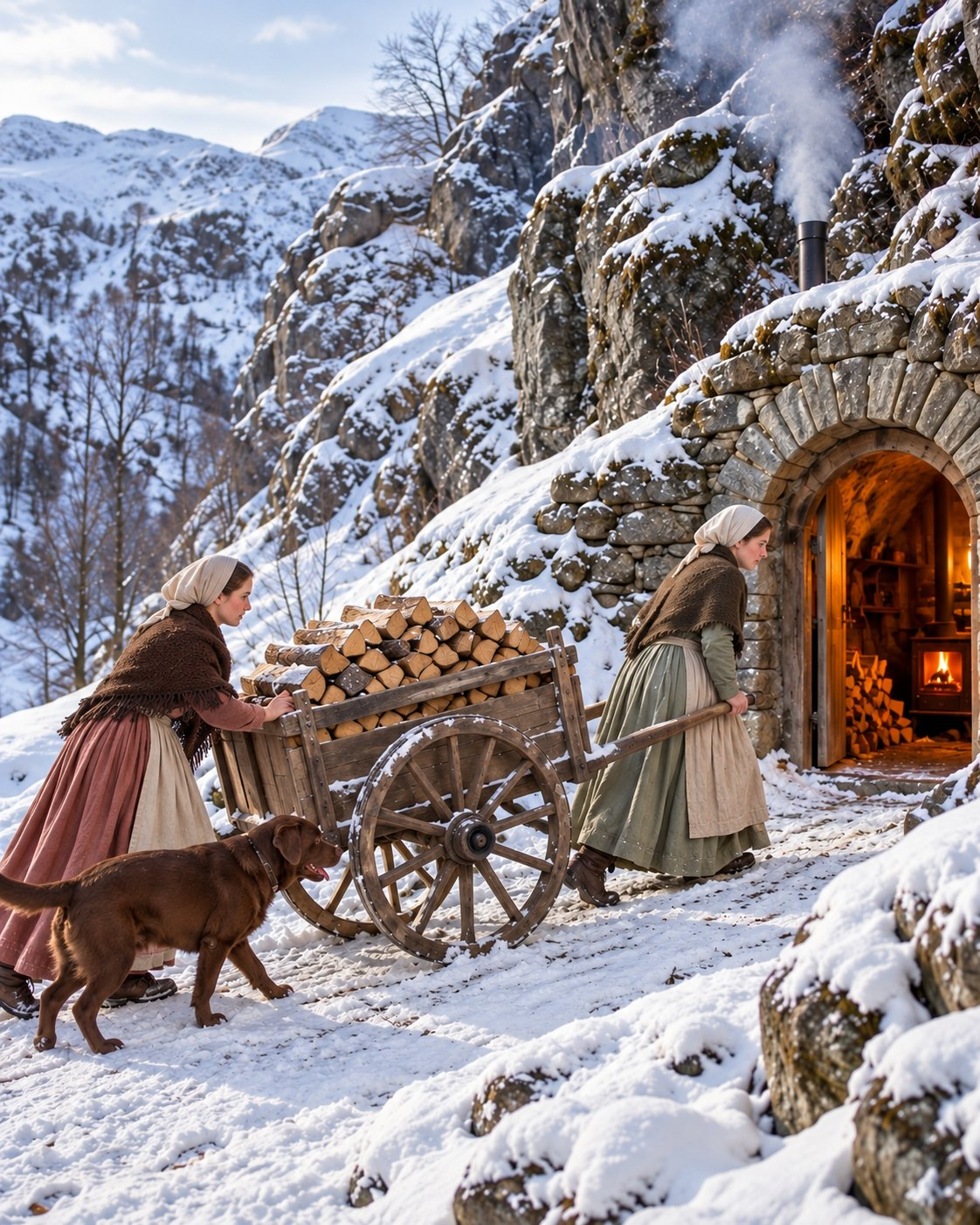
We spent the afternoon gathering additional firewood.
The cart was difficult to maneuver over the uneven ground.
Ruth pushed from behind while I guided it around the rocks.
Tommy collected smaller branches.
The dog followed us, occasionally stopping to sniff the snow.
We stacked the wood near the entrance.
Then we covered it with canvas.
The work exhausted us.
But the pile was growing.
By sunset, the cave was ready for another night.
Ruth prepared a simple meal.
Tommy sat near the hearth.
I opened Father's book.
Something had been tucked between two pages.
A small drawing.
It showed the cave entrance from outside.
A line extended from the wooden barrier toward the northern ridge.
At the end of the line was a mark.
Three small circles.
Beneath them, Father had written:
If the spring begins to fall, check the northern passage.
I looked toward the hidden door.
The spring had not changed.
But the note troubled me.
Why would the spring fall?
And what did the northern passage have to do with it?
I examined the drawing again.
Then I heard something outside.
A distant crack.
The sound of a tree breaking beneath the weight of snow.
Ruth looked toward the entrance.
"Was that thunder?"
I shook my head.
"No."
The wind had begun rising.
Snow started moving across the ground in thick white sheets.
I closed the ledger.
"We need to secure the entrance."
We worked quickly.
Ruth checked the timber supports.
Tommy moved the remaining supplies away from the entrance.
I secured the canvas over the firewood.
The dog paced nervously.
Then a gust of wind struck the barrier.
The wooden supports groaned.
One of the branches shifted.
I rushed forward and held it in place.
Ruth brought another piece of timber.
Together, we reinforced the frame.
The wind continued.
And then the snowfall became so heavy that the entrance disappeared behind a white curtain.
We could no longer see the mountain path.
We could barely see the nearest trees.
I looked at Ruth.
She looked back at me.
Neither of us needed to speak.
The storm had arrived.
And it was only the beginning.
That night, I stayed awake beside the hearth.
The fire burned steadily.
The spring continued flowing.
The cave remained warm.
But every time the wind struck the entrance, the wooden supports trembled.
I thought about the people in Redemption Hollow.
The families with children.
The elderly people.
The farmers whose animals were outside.
The orphanage.
Tommy's empty bed.
I wondered whether Mrs. Crane had enough firewood.
I wondered whether Reverend Thorne still believed the winter would pass.
And I wondered whether Silas Burke had finally understood the danger.
I opened Father's ledger.
The final page contained a note I had not seen before.
It was written in a different ink.
The handwriting was smaller.
And beneath it was a date.
September 1873.
I leaned closer.
When the first great storm arrives, the people will come looking for warmth. Do not turn them away simply because they failed to believe you.
I read it again.
Then I looked toward the entrance.
Father had known.
He had known that the town might reject us.
He had known that winter could force those same people to seek shelter.
And somehow, he had anticipated what would happen next.
But there was one final sentence.
I had to bring the candle closer to read it.
Before you open the mountain to others, discover who is responsible for closing the old water gate.
I stared at the words.
The old water gate?
I had never seen one.
I turned toward the northern passage.
And suddenly remembered the strange symbol on the map.
Three circles.
Three lines.
A hidden mechanism.
Somewhere beneath our cave, an old water gate was waiting to be found—and the storm outside was already beginning to test it.






Comments 0