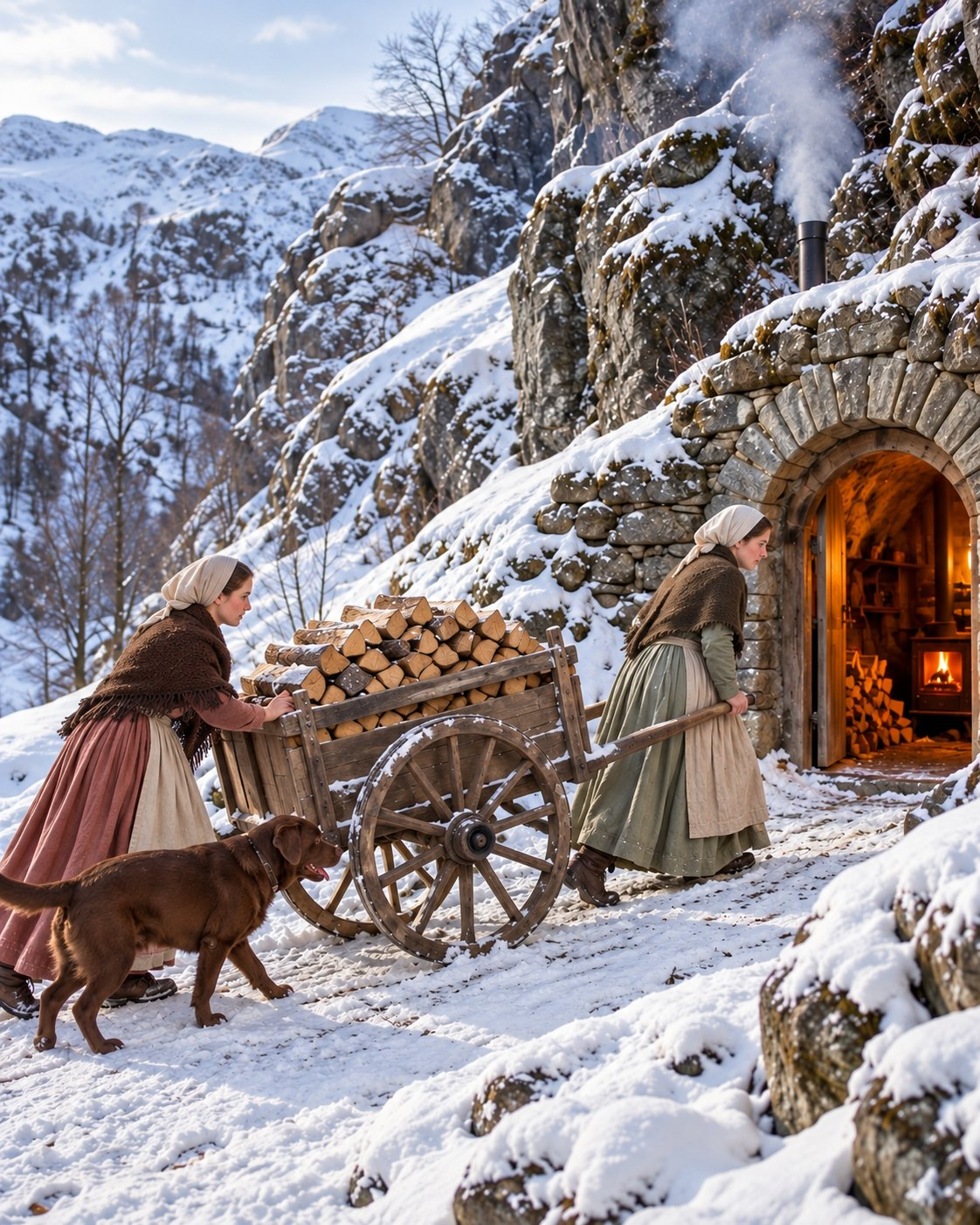
"Who's there?" I shouted.
The voice outside did not answer immediately.
I grabbed Father's hatchet and moved toward the entrance.
Ruth pulled the blanket around her shoulders and stood behind me.
The dog began growling.
Then the voice came again.
"Please. I'm not here to hurt you."
I recognized it.
It was a man's voice, but weak and unsteady.
I approached the wooden barrier and looked through a narrow gap.
A figure stood outside.
He wore a dark coat covered in snow. His hat was pulled low over his forehead, and one hand rested against the rocks for support.
I raised the candle.
"Who are you?"
The man lifted his head.
It was Elias Mercer, the old blacksmith from Redemption Hollow.
He looked exhausted.
His beard was covered in frost, and his cheeks were red from the cold.
"Hannah," he said. "Thank God."
I didn't lower the hatchet.
"What are you doing here?"
He looked past me toward the cave.
"I followed your tracks."
Ruth stepped forward.
"Why?"
Elias hesitated.
Then he glanced toward the mountain path.
"Because the weather has changed."
I stared at him.
"What do you mean?"
He swallowed.
"The creek froze last night."
I looked at Ruth.
Elias continued.
"People are beginning to worry. Reverend Thorne says the snowfall is temporary, but the temperature has dropped so quickly that the livestock are already suffering."
I remained silent.
The old blacksmith looked at the wooden barrier.
"May I come inside?"
I thought about Father’s warning.
Never let Silas Burke discover what is buried beneath the spring.
I thought about Mrs. Crane's strange words.
I thought about the medal.
And then I thought about the children behind the orphanage windows.
Elias had never treated us badly.
He had once repaired a broken cooking pot for our mother without charging her.
I stepped aside.
"Come in."
Elias entered slowly.
The moment he crossed the threshold, he stopped.
His eyes moved around the cave.
He looked at the fire.
Then at the warm spring.
Then at the reinforced entrance.
"Good heavens."
Ruth offered him a place near the hearth.
He sat down carefully, rubbing his hands together.
I poured some warm water into a cup.
He accepted it with both hands.
For a while, he said nothing.
Then he looked at the spring.
"How did you find this?"
"It belonged to our father."
Elias lowered his eyes.
"Thomas."
I nodded.
"You knew about the cave?"
He shook his head.
"Not this place. But I knew your father spent time in the mountains."
I sat across from him.
"Why?"
The blacksmith looked into the fire.
"Your father was a careful man. He believed the world was full of things people refused to notice."
I remembered his lessons.
Birds.
Wind.
Water.
Tracks.
"Did he ever tell you about the spring?"
"No."
"Did he mention Silas Burke?"
Elias looked up.
The change in his expression was immediate.
"Why are you asking about Silas?"
I opened my father's ledger.
I showed him the note.
Elias read it.
Then he read it again.
His face became pale.
"Where did you find this?"
"In a box hidden behind the spring."
He returned the paper.
"Hannah, I think you should be careful."
"Why?"
Elias glanced toward Ruth.
"Because Silas has been asking questions about this mountain for years."
I wanted him to explain.
But Elias seemed reluctant.
He drank the warm water and stared at the fire.
Eventually, he told us that Silas had once attempted to purchase several acres of mountain land from the county.
The property included the area surrounding our cave.
The sale had never been completed.
Thomas Whitlock had objected.
He had argued that the land contained a natural water source that should not be privately controlled without proper examination.
Silas had become furious.
"Why would he care about an underground spring?" Ruth asked.
Elias shook his head.
"I don't know."
I thought about the list of measurements in Father's box.
The maps.
The drawings.
The careful instructions.
This cave had been more than a shelter.
Father had studied the mountain.
He had understood something about it.
And he had made certain that we could find it.
I looked at Elias.
"Did anyone else know about the spring?"
"Not that I can say."
He paused.
"Although I remember one argument between your father and Silas. It happened shortly before your parents became ill."
"What was it about?"
"The mountain."
I leaned forward.
"What exactly did they say?"
Elias rubbed his forehead.
"I wasn't there for the entire conversation. But I heard Silas threaten to make your father regret standing in his way."
Ruth looked at me.
A chill moved through my chest.
Not because of the cold.
Because I was beginning to understand that our father's death, the hidden medal, and this cave might be connected in ways we had never imagined.
But Elias suddenly changed the subject.
"How much food do you have?"
I looked at the sack.
"Not enough."
"Then you'll need supplies."
"We don't have money."
He shook his head.
"I didn't ask whether you had money."
He reached inside his coat and removed a small parcel.
Inside were two pieces of dried meat and a handful of flour.
"Take these."
Ruth looked at him.
"Why?"
"Because I remember your mother."
He placed the parcel on the stone floor.
"And because I don't think this winter will be ordinary."
Elias stayed until the fire burned low.
Before leaving, he examined our temporary entrance.
He showed us how to position the thicker logs so the structure would resist the wind.
He also explained how to keep snow from accumulating against the wooden supports.
His practical knowledge was invaluable.
When he finally stepped outside, he turned toward us.
"Don't let anyone convince you that you imagined what you saw."
I nodded.
He looked toward the mountain path.
"Especially not Silas."
Then he disappeared into the falling snow.
Ruth closed the entrance.
We stood together in silence.
"Do you think he knows something?" she asked.
"I think he knows more than he told us."
"About Father?"
"Perhaps."
I looked toward the hidden chamber.
The spring continued flowing.
And for the first time, our cave seemed less like a refuge and more like the beginning of a mystery.
The following morning, we began improving the shelter.
Our first priority was the entrance.
The temporary barrier Elias had helped us construct was stronger than the original arrangement, but it was still vulnerable.
I examined Father's drawings again.
He had marked the location of several fallen trees on the slope above the cave.
We could use their branches and trunks to reinforce the opening.
Ruth suggested building a small covered storage area inside the entrance.
That would keep the firewood dry.
We agreed.
The work occupied most of the morning.
We dragged branches.
Carried stones.
Filled gaps.
And gathered moss from beneath sheltered rocks.
Our dog helped in its own way, following us everywhere and occasionally carrying small sticks in its mouth.
By midday, the cave was beginning to look different.
The entrance had a stronger wooden frame.
The sleeping area was cleaner.
The hearth had been arranged more carefully.
And a small section near the spring had become our kitchen.
Ruth found an old flat stone that could serve as a work surface.
I cleaned it with warm water.
Then we arranged our limited supplies.
Flour.
Dried apples.
A little salt.
Dried meat.
Several handfuls of edible greens.
It was not enough to feed us for an entire winter.
But it was enough to keep us going while we searched for more.
That afternoon, Ruth discovered something unusual.
She was collecting moss near the back of the spring chamber when she noticed that one patch was growing differently from the others.
It was unusually thick.
Bright green.
And surrounded by dark, rich soil.
She called me.
I examined it.
The earth beneath the moss was softer than the surrounding ground.
Warm too.
I remembered Father's warning.
Do not dig beneath the green moss until you understand what lies above it.
I pulled my hand away.
"Leave it."
Ruth looked confused.
"Why?"
I showed her the note.
She read it carefully.
"Then what is above it?"
I examined the ceiling.
There was a narrow crack in the stone.
A thin line of water ran down the wall.
I looked at the map.
The same area was marked with a small symbol.
I could not understand what it meant.
We decided not to disturb anything.
Father had known this place better than we did.
There was no reason to rush.
By the third day, the weather had become frightening.
Snow covered the surrounding slopes.
The path leading to the cave had nearly disappeared.
The wind pushed through the trees with a constant low howl.
I spent the morning checking the weather.
I recorded the temperature as best I could with the simple tools we possessed.
The creek outside was partially frozen.
Several birds had disappeared from the nearby trees.
The animals were behaving as if the worst of winter had already arrived.
Ruth looked at my ledger.
"How much earlier is this than normal?"
"Several weeks."
"Could it be a short cold spell?"
I considered the question.
"It could."
She looked relieved.
"But I don't think it is."
Her expression changed.
"Then the town..."
I closed the ledger.
"They still have time to prepare."
"Will they?"
I thought about Reverend Thorne.
Silas Burke.
Mrs. Crane.
The townspeople who had laughed at us.
"I don't know."
That evening, we shared the last of the dried apples.
Ruth sat beside the spring, carefully repairing a tear in her apron.
I was examining the maps when she spoke.
"Do you remember the old house?"
I looked up.
"Which one?"
"Our house. Before we went to the orphanage."
I nodded.
She smiled faintly.
"Mother used to put apples near the window so they would dry in the sun."
I remembered.
I remembered the smell of herbs hanging from the ceiling.
The sound of Father's boots on the wooden floor.
Mother singing while she prepared dinner.
For a moment, I could almost hear her voice.
"Do you think they would be proud of us?" Ruth asked.
I looked toward the fire.
"I think Father would tell us to stop wasting time and collect more wood."
She laughed.
I smiled faintly.
Then she became serious.
"I wish they were here."
"So do I."
We sat quietly.
Outside, the snow continued falling.
Inside, the spring kept flowing.
The following morning, I decided to explore the narrow passage beyond the sleeping chamber.
Father's map showed a second opening.
It was marked with a small cross.
I carried the candle and the compass.
Ruth stayed near the hearth.
The passage was narrow enough that I had to turn sideways in several places.
The stone walls were damp.
The floor sloped gently downward.
After several minutes, I found a small chamber.
It contained several old wooden supports.
Some had collapsed.
Others remained firmly embedded in the stone.
I examined them.
There were tool marks.
Fresh-looking scratches beneath the older layers of dust.
Someone had worked here.
Not recently, but certainly after the cave was first discovered.
I found a small metal hook embedded in the wall.
Beneath it lay a fragment of cloth.
I picked it up.
It was dark brown.
The fabric resembled the material used in military coats during the war.
I turned it over.
A small brass button remained attached.
There was a number stamped into its surface.
I held it closer to the candle.
The number was familiar.
It matched the number on my father's old military papers.
I slipped the button into my pocket.
Then I noticed something on the floor.
A narrow line had been scratched into the stone.
It led toward a section of wall that appeared completely solid.
I approached it.
There was a small gap near the bottom.
Cold air moved through it.
I placed my hand against the stone.
It shifted.
Only slightly.
But enough to make me realize that the wall was not as solid as it appeared.
I returned to the main chamber and called Ruth.
Together, we examined the opening.
She touched the edge.
"It's a door."
I nodded.
"A hidden one."
We searched for a mechanism.
There were no handles.
No obvious hinges.
Only a narrow indentation near the bottom.
I took out the iron key.
It fit.
But before I could turn it, a loud crack echoed through the cave.
The entrance.
Something heavy had fallen outside.
Ruth turned toward the sound.
The dog began barking.
I hurried back toward the main chamber.
Then I heard another noise.
Footsteps.
Someone was approaching the cave.
Not walking carefully.
Running.
A moment later, a man's voice echoed through the entrance.
"Hannah! Ruth! Open the door!"
I recognized the voice immediately.
It belonged to Tommy Doyle.
But he was not alone.
And behind him, someone was shouting our names.
It was Mrs. Crane.






Comments 0