The sound came again.
Water.
Not the distant rush of a mountain stream, but a steady trickling sound coming from somewhere deep inside the cave.
Ruth moved closer to me.
"Do you hear that?"
I nodded.
I had heard stories about underground springs, but I had never seen one. Most caves in the Appalachian Mountains were cold, damp places where water collected after heavy rain. Some contained small pools, but none of the stories I had heard mentioned warm water.
I looked at the rotten wooden entrance.
A rusted padlock hung from an iron loop.
The lock was old enough to have been exposed to several winters, and the wood around it had begun to split.
"Try the key," Ruth said.
I removed it from the small pocket sewn inside my dress.
The iron felt painfully cold.
I inserted it into the lock.
It wouldn't turn.
I tried again, pushing harder.
Nothing.
Ruth examined the mechanism.
"Perhaps it's the wrong key."
I shook my head.
"Father said it opened the inner door."
"Then perhaps this isn't the door he meant."
She looked at the dark opening beyond the rotten boards.
I followed her gaze.
The entrance had been partly covered by fallen branches and years of accumulated debris. The old wooden door was no longer attached properly to its hinges.
I placed my shoulder against it.
"Help me."
Together, we pushed.
At first, nothing happened.
Then a long crack split the wood.
A second push broke the lower section, and the door collapsed inward with a heavy thud.
Dust rose around our feet.
Ruth stepped backward.
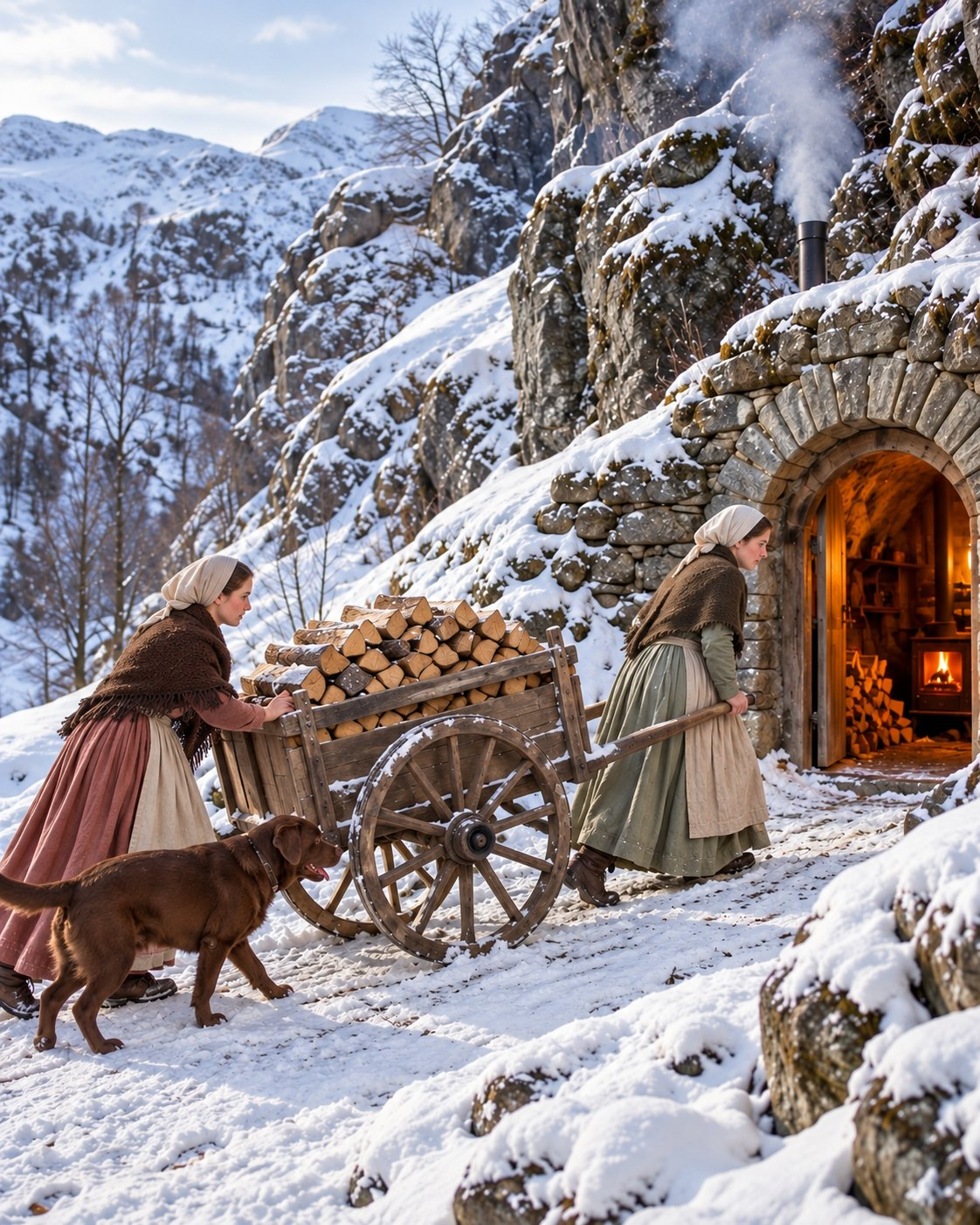
The dog, which had followed us along the trail, began sniffing the entrance.
I raised the candle.
Beyond the broken door was darkness.
Not ordinary darkness.
The kind that seemed to absorb the light rather than simply lack it.
I looked at Ruth.
"We found it."
She nodded.
But neither of us entered immediately.
For three days, we had imagined reaching this place. We had imagined finding shelter, a dry floor, perhaps enough space to build a fire.
Standing at the entrance, I suddenly realized that we had no idea what waited inside.
I took a deep breath.
Then I stepped forward.
The first chamber was enormous.
My candle barely illuminated the ceiling.
The walls rose into darkness, and the floor was uneven, covered with stones and patches of old mineral deposits.
The air smelled of damp earth.
Ruth followed close behind me.
"Do you think anyone has been here recently?"
I examined the floor.
There were no fresh footprints.
No signs of recent activity.
Only old scratches in the stone and the remains of what looked like a wooden storage shelf.
I approached it.
Most of the boards had rotted away.
A small iron hook remained attached to the wall.
Beside it, someone had carved a narrow line into the stone.
I brought the candle closer.
It looked like a measurement mark.
Then I noticed another.
And another.
There were dozens.
Some were low to the ground, while others reached almost to my shoulder.
I touched one of them.
The edges were smooth from age.
"Father measured something here," I said.
Ruth looked around.
"Water?"
"Perhaps."
I opened his ledger and compared the marks with the small drawings he had made near the back.
One sketch showed a cross-section of a mountain.
A narrow line passed through the middle.
Below it, Father had written three words.
Follow the warmer stone.
I read the instruction aloud.
Ruth lifted her candle.
"Which stone?"
I looked at the floor.
The cave seemed to stretch in several directions. One passage descended toward the darkness, while another narrowed behind a formation of large rocks.
Then I noticed something.
A faint movement in the flame.
The candle was being pulled toward the narrower passage.
There was air moving through it.
"That way."
We followed the passage slowly.
The floor became smoother.
The air changed.
It was still cold, but less bitter than the mountain air outside.
The sound of running water grew louder.
After several minutes, Ruth stopped.
"Hannah."
She was looking at the wall.
I turned.
A small patch of green moss was growing between two rocks.
It was bright.
Fresh.
Alive.
That was strange enough in September, but the cave entrance had been exposed to freezing temperatures for days. The moss should have been dormant or at least cold and wet.
I touched it.
The stone beneath it was warmer than my hand.
I withdrew my fingers.
"Ruth."
She pressed her palm against the same spot.
Her eyes widened.
"It's warm."
I looked toward the passage ahead.
For the first time, I began to suspect that the cave contained something our father had understood long before we did.
The underground spring was hidden in a chamber beyond the narrow passage.
We discovered it almost accidentally.
Ruth stepped over a fallen stone, and her boot slipped against the damp floor.
She caught herself against the wall.
A small stream of water ran beneath her foot.
I lowered the candle.
The stream emerged from a crack in the rock, traveled across the floor, and disappeared into a shallow basin.
The water was clear.
I knelt beside it.
Then I placed two fingers into the basin.
I gasped.
It was warm.
Not hot enough to burn, but warm enough to feel extraordinary after three days of freezing weather.
"Ruth."
She hurried toward me.
I moved aside.
She dipped her hand into the water.
For a moment, she simply stared.
Then she looked at me.
"How is this possible?"
I examined the surrounding rock.
There was no visible fire.
No pipe.
No human construction.
The water appeared to rise naturally from beneath the mountain.
I remembered something Mother had once told us about underground springs.
Some were fed by water that traveled through deep layers of earth before returning to the surface. Depending on the geological conditions, the water could emerge warmer than the air surrounding it.
I explained what I remembered.
Ruth listened carefully.
"Then the mountain is heating it?"
"Not exactly. The earth is warming the water somewhere below us."
She smiled faintly.
"Mother would have liked this place."
I looked at the spring.
"She would have known what to do with it."
For a moment, neither of us spoke.
Then Ruth noticed something above the water.
She raised the candle.
There were letters carved into the stone.
Two initials.
And a date.
TW — 1864.
She touched them.
"Father."
I opened my ledger.
The same date appeared on one of its oldest pages.
1864.
The year Father had first served as a scout in the mountains.
I looked at the inscription again.
He had been here.
Not once.
Not accidentally.
He had returned often enough to leave a permanent mark.
"Ruth, look."
I pointed toward the wall beside the inscription.
There was a small rectangular outline carved into the stone.
It resembled the outline of a door.
My fingers moved over its edges.
The carving was unusually precise.
A narrow opening appeared near its center.
I reached for the iron key.
Then I stopped.
Father had written that the key opened the inner door.
This had to be it.
The key entered the opening without resistance.
I turned it.
For several seconds, nothing happened.
Then something clicked deep inside the rock.
Ruth stepped backward.
"What was that?"
I turned the key again.
A small stone section moved.
Not enough to open the wall, but enough to reveal a narrow gap.
I placed my fingers against it.
The stone shifted slightly.
Behind it was a dark recess.
Inside lay a small wooden box.
My heart began racing.
I pulled it carefully from its hiding place.
The wood was old but remarkably well preserved.
There was no lock.
Only a strip of leather wrapped around it.
Ruth moved closer.
"Open it."
I removed the leather.
The lid creaked.
Inside were several folded papers, a small bundle of dried herbs, and a piece of cloth wrapped around a metal object.
I unfolded the cloth.
It was a compass.
Father's compass.
I recognized the scratch near its brass rim. I had seen it countless times when I was little.
Ruth picked up the papers.
The first was a map.
It showed the cave and the surrounding mountains.
The second was a list of measurements.
The third contained several pages of handwriting.
I recognized Father's writing immediately.
He had left instructions.
Not just about entering the cave.
About living inside it.
There were notes about water, drainage, airflow, and the placement of a hearth.
He had even drawn a rough plan showing where timber should be positioned to reinforce the entrance.
Ruth stared at the pages.
"He planned all of this."
I nodded.
"But why?"
She looked at me.
"Why would he prepare a place like this for us?"
I couldn't answer.
The papers were dated across several years.
Some had been written before our parents became ill.
Others appeared to have been written much later.
One page contained a list of supplies.
Dry beans.
Salt.
Flour.
Dried apples.
Wool blankets.
A metal cooking pot.
Basic tools.
The list was unfinished.
I looked around the chamber.
There were no supplies.
Only the old box.
Perhaps Father had intended to return.
Perhaps he had run out of time.
Or perhaps someone had discovered what he was preparing and prevented him from completing it.
I couldn't know.
But one thing was certain.
The cave was not a random inheritance.
It was a carefully chosen refuge.
And he had wanted us to find it.
We spent the next hour exploring the chamber.
The cave had more space than I had first realized.
A wide section near the spring was dry, and a natural opening above the far wall appeared to carry air upward.
I examined the rock formation with Father's notes.
The chimney fissure.
That was what he had called it.
He had marked its position on the map.
The natural opening provided a route for smoke to escape.
It wasn't a perfect arrangement, but it gave us the possibility of building a small hearth.
Ruth found a flat section of stone suitable for sleeping.
She began removing loose rocks.
I examined the entrance again.
The wooden door was damaged beyond repair, but we could use fallen branches and timber from the surrounding slope to reinforce the opening.
We had work to do.
A great deal of work.
But we finally had a plan.
Outside, the snowfall had become heavier.
I stepped toward the entrance and looked at the mountain.
The world had changed while we were inside.
The path we had followed was already disappearing beneath fresh snow.
The trees stood motionless.
The sky had turned a dull gray.
Ruth joined me.
"We can't stay outside much longer."
"I know."
She looked toward the cave.
"Do you think this place will be enough?"
I thought about the winter signs.
The migrating geese.
The northern winds.
The strange behavior of the animals.
The measurements in Father's ledger.
"No," I said honestly. "Not yet."
Ruth's face fell.
"But we can make it enough."
I turned toward her.
"We have the spring. We have a place for a fire. And Father left us instructions."
She looked at the old box.
Then she nodded.
"We'll do it."
We began by collecting fallen timber from the slope outside.
The work was difficult.
The snow made the rocks slippery, and the wind pushed against us whenever we left the shelter of the cave.
We gathered branches first.
Then we found several thicker pieces of wood beneath a fallen tree.
Ruth tied the smaller branches together using strips of old cloth.
I used Father's hatchet to cut the loose ends.
Our dog followed us constantly.
Sometimes it disappeared between the rocks, only to return with its nose covered in snow.
By the time we had collected enough wood for the first night, our hands were aching.
We carried everything inside.
Then we began reinforcing the entrance.
The old wooden door was already broken.
We used the remaining pieces as a temporary frame.
Larger branches were placed across the opening.
Ruth filled the gaps with moss.
I mixed damp earth with snow and pressed it into the spaces between the wood and stone.
It wasn't beautiful.
It wasn't permanent.
But it reduced the wind.
For the first time, the cave began to feel like a place where human beings might live.
That evening, we prepared our first meal.
It was hardly a feast.
We had a small piece of bread, two dried apples, and a handful of greens I had identified from the notes Mother had left us.
Ruth boiled everything in a small metal pot over our first carefully arranged fire.
The flames were weak at first.
Smoke rose toward the ceiling.
I watched the natural chimney opening anxiously.
For several seconds, the smoke seemed to gather above us.
Then it began moving upward.
The airflow worked.
Ruth laughed.
It was the first time I had heard her laugh since leaving Redemption Hollow.
I looked at her.
She looked younger.
Not like a girl who had been forced out of her home.
Not like someone who had spent three days walking through a freezing wilderness.
Just Ruth.
My sister.
Sitting beside a fire.
Safe enough to laugh.
I moved closer to the hearth.
The dog settled beside her.
Outside, the wind continued howling.
Inside, the spring flowed quietly beneath the stone.
I opened Father's ledger and recorded the day's discoveries.
September 19, 1873.
Cave located.
Underground spring confirmed.
Natural warmth present.
Chimney fissure functional.
Entrance partially reinforced.
I paused.
Then I added one more sentence.
We are still alive.
Before sleeping, I examined the papers from the wooden box again.
One page had been folded separately.
Unlike the others, it contained no measurements or drawings.
Only a short message.
I held it close to the candle.
My girls,
There is something I never told you about this mountain.
The spring is only the beginning.
I stopped reading.
Ruth noticed my expression.
"What is it?"
I turned the paper over.
There was another line.
A warning.
Do not dig beneath the green moss until you understand what lies above it.
I looked toward the chamber behind the spring.
The patch of moss was still visible.
Bright green.
Growing in the warm earth.
Ruth read the sentence over my shoulder.
"What do you think he meant?"
I folded the paper.
"I don't know."
Then I looked toward the darkness beyond the chamber.
Somewhere deep inside the mountain, water continued flowing.
And beneath our feet, something remained hidden.
That night, as Ruth finally fell asleep beside the fire, I stayed awake reading every line of my father's notes.
Near the bottom of the last page, I discovered a sentence written in smaller handwriting.
It had been added later.
The ink was darker.
And the date beside it was only six years old.
If the girls ever reach this place, they must never let Silas Burke discover what is buried beneath the spring.
I read the name again.
Silas Burke.
The same man who had refused to sell us flour.
The same man who had laughed when we warned the town about winter.
And now, according to our father, the one person we were never supposed to let find this cave.
Then I heard a sound outside.
Three slow knocks against the wooden entrance.
I raised my head.
Ruth woke beside me.
The dog stood up, its ears pointed toward the door.
Another three knocks followed.
And this time, a voice came from the other side.
"Hannah Whitlock?"






Comments 0