The farmer's name was Joseph Miller.
I recognized him immediately.
He had once stood outside Silas Burke's store when the storekeeper refused to sell us flour.
He had said nothing that day.
Now he stood at our entrance, holding his hat in both hands.
Behind him were eight people.
Two women.
Three children.
And three men carrying empty wooden buckets.
"The creek has stopped flowing," Joseph explained. "The upper channel is buried beneath ice and fallen branches. Several wells have frozen. We have been melting snow, but it's not enough."
I looked at Ruth.
She understood.
The mountain spring could provide water.
But our father had prepared something larger.
A hidden system of channels connected the mountain to the surrounding valley.
We needed to find it.
"Bring them inside," I said.
Joseph looked relieved.
Ruth immediately began organizing blankets and warm water.
Tommy helped the children.
Elias approached me.
"Are you thinking what I think you're thinking?"
I opened Father's map.
"The western entrance."
He nodded.
"If it connects to the lower valley, it may give us access to the water channels."
I looked toward the farmer.
"How long has the town been without water?"
"Almost two days."
I closed the ledger.
"Then we don't have much time."
We gathered everyone near the hearth.
I explained what we had discovered.
The two springs.
The northern water gate.
The underground channels.
And the possibility of an emergency route leading toward the valley.
Nobody interrupted.
Even Silas, who had remained near the back of the chamber, listened carefully.
When I finished, Reverend Thorne stepped forward.
"Can the water reach the town?"
"I don't know yet."
"Then how can we be certain?"
I looked at him.
"We cannot."
The reverend lowered his head.
I continued.
"But Father believed it could. And he left us a map."
Elias placed the drawing on the table.
He pointed toward the western passage.
"We need to inspect this route."
Joseph volunteered immediately.
"So will I."
Two other farmers offered to help.
Silas remained silent.
Then he stepped forward.
"I know the western ridge."
I looked at him.
"Why?"
He hesitated.
"Because I once surveyed the land with your father."
I studied his face.
He had finally admitted something he had hidden for years.
"Then you can help us find the entrance."
He nodded.
We prepared before sunrise.
I carried Father's compass.
Ruth carried the map.
Elias brought the tools.
Joseph and the other farmers carried ropes and lanterns.
Tommy wanted to join us, but I asked him to remain with Abigail.
He agreed reluctantly.
Before leaving, I gave him the weather ledger.
"Keep recording the conditions."
He nodded.
"And if the water level changes, tell Elias."
"I will."
Ruth hugged him.
Then we entered the western passage.
The tunnel was narrower than the others.
In several places, we had to crawl beneath low stone formations.
The floor was uneven.
Water trickled along the sides.
We followed Father's markings.
At the first junction, the passage split.
I checked the compass.
The western route continued toward the valley.
The northern branch led toward the water gate.
We stayed on the western route.
After nearly an hour, we reached a chamber containing several wooden supports.
One had collapsed.
Another leaned against the wall.
The passage beyond was partially blocked.
Joseph examined the fallen stones.
"We can move these."
Elias shook his head.
"Not all at once. The ceiling may be unstable."
I studied Father's map.
There was a small drawing of a support structure.
He had marked three stones that needed to remain in place.
I showed Elias.
He examined the arrangement.
"Your father knew what he was doing."
Together, we began clearing the passage carefully.
The farmers moved the smaller rocks.
Elias reinforced the wooden supports.
Silas helped remove a large branch that had become trapped between two stones.
I watched the ceiling.
Every movement mattered.
After several hours, we opened a narrow route.
Beyond it was another chamber.
And in that chamber stood a wooden structure.
A large water-control wheel.
I stopped.
"That's it."
The wheel was attached to an old iron mechanism.
A narrow channel ran beneath it.
Water moved through the channel, but the flow was weak.
I examined the mechanism.
It resembled the northern gate.
There was a lever.
A locking pin.
And a small metal plate.
I wiped away the dirt.
The inscription became visible.
Thomas Whitlock.
Below it were the words:
Emergency valley supply.
I felt my throat tighten.
Father had built this.
He had intended to use it when the ordinary water supply failed.
I opened the map.
The route continued toward a narrow outlet beyond the western ridge.
But the wheel was stuck.
Elias examined it.
"Something is blocking the lower channel."
I looked beneath the mechanism.
A large stone had become wedged between two supports.
The water was flowing around it.
If we could remove the obstruction, the channel might reopen.
Joseph and the farmers brought ropes.
We secured the stone.
Then we pulled.
Nothing happened.
We tried again.
The stone shifted slightly.
I remembered Father's instructions.
Never force the lower release before clearing the side channel.
I looked toward the wall.
There was another narrow opening.
It was covered by loose rock.
I used the hatchet to remove the smaller pieces.
Water began escaping through the opening.
The pressure dropped.
Elias nodded.
"Try again."
We pulled.
This time, the stone moved.
Then it rolled aside.
A rush of water filled the channel.
The old wheel began turning.
Slowly.
Then faster.
A deep mechanical sound echoed through the chamber.
We stepped backward.
The system was working.
For several minutes, we watched the water.
It flowed steadily.
The wheel continued turning.
A narrow stream passed through the lower channel.
I checked the map.
The route extended toward the valley.
I looked at Elias.
"How long before it reaches the town?"
He examined the channel.
"If the route remains open, perhaps several hours."
I closed my eyes briefly.
For the first time, I felt something close to relief.
We had found it.
Our father had prepared this route years earlier.
And it was still working.
When we returned to the main cave, Tommy was waiting.
He ran toward us.
"Did you find it?"
I nodded.
"The water is flowing."
His face brightened.
Abigail began smiling.
The farmers exchanged relieved looks.
Ruth embraced me.
Then we heard someone speaking near the entrance.
It was Silas.
He stood apart from the others.
His face was pale.
He looked toward the spring.
Then toward the map.
"I was wrong," he said.
Nobody answered.
He continued.
"Your father was right."
I looked at him.
For a long moment, I considered all the things he had done.
The threats.
The lies.
The stolen records.
The damage to the water gate.
The years of fear he had created.
Then I spoke.
"You almost destroyed the thing he spent his life protecting."
Silas lowered his head.
"I know."
"People could have died."
"I know."
He looked at the floor.
"I wanted to own something valuable. I thought the water would make me powerful."
I waited.
He finally looked up.
"But your father understood something I didn't."
"What?"
Silas swallowed.
"Water is only valuable when people can drink it."
Nobody spoke.
Then he removed his coat.
He rolled up his sleeves.
And he walked toward the woodpile.
"I'll help repair the entrance."
I watched him go.
I did not forgive him that morning.
But I allowed him to work.
There would be time for the county officials to deal with his actions.
For now, the town needed water.
By the following afternoon, the first water reached the lower valley.
Joseph returned with the news.
The stream had begun flowing into the old collection basin.
The townspeople gathered around it.
Some cheered.
Others simply stood in silence.
A woman filled a bucket.
Then another.
Children dipped their hands into the water.
It was clear.
Fresh.
And flowing.
The town finally had a reliable supply again.
When the news reached the cave, Ruth began laughing.
Tommy jumped up and down.
Abigail wiped her eyes.
Elias sat beside the hearth.
He looked toward the ceiling.
"I wish Thomas could see this."
I looked at the spring.
"He knows."
The following weeks were difficult but productive.
The townspeople worked together to repair the water channels.
Elias supervised the wooden supports.
Joseph and the other farmers cleared the western outlet.
Reverend Thorne organized volunteers to gather firewood.
Abigail helped prepare meals.
Ruth continued maintaining the growing area.
Tommy became responsible for recording the weather.
I worked with the county clerk to preserve the original documents.
The mountain cave became a central shelter.
Not because we owned the people who entered it.
But because we understood what it meant to be without a home.
Families came when the roads became dangerous.
Children stayed near the hearth.
Older people rested beside the warm spring.
Farmers brought food whenever they could.
Nobody was turned away.
Silas faced an official investigation.
The county examined the documents and confirmed that he had no right to claim the spring.
His attempts to interfere with the water system were recorded.
He was required to help repair the damage and surrender the papers he had taken.
He also had to answer for the threats he had made against several residents.
I did not attend every meeting.
I had work to do.
But I learned that the truth had finally become impossible to hide.
The people of Redemption Hollow understood that their water supply had almost been lost because one man wanted to control it.
And they understood that two seventeen-year-old girls had protected what the entire town had failed to recognize.
Mrs. Crane eventually came to the cave.
She arrived alone.
Her coat was old.
Her hands were trembling.
She stood outside for several minutes before knocking.
Ruth opened the entrance.
The matron looked at us.
"I came to return something."
She removed a small cloth bundle.
Inside was a second piece of our father's military medal ribbon.
I recognized it.
It had been missing for years.
Mrs. Crane placed it on the table.
Then she handed me a letter.
It was a statement describing everything she had hidden.
The documents.
The threats.
Her involvement with Silas.
And the reason she had kept our parents' belongings.
She had signed it.
I read the final paragraph.
I cannot undo what I did to you girls. But I can finally tell the truth.
Ruth looked at me.
I folded the paper.
"Thank you for telling us."
Mrs. Crane lowered her eyes.
"Do you think you can ever forgive me?"
I thought about Tommy.
The children at the orphanage.
The years we had spent believing that nobody cared what happened to us.
Then I answered honestly.
"I don't know."
She nodded.
"That's fair."
Before leaving, she asked whether the orphanage children could visit the cave when the roads became safe.
I looked at Ruth.
She smiled.
"Of course."
The first children arrived three days later.
Tommy stood outside the entrance waiting for them.
When the carriage appeared, he ran toward it.
Samuel jumped down first.
Then Elizabeth.
Several others followed.
They carried small baskets and bundles.
One child brought a wooden toy.
Another brought a loaf of bread.
Tommy introduced them to the dog.
Ruth prepared warm water.
I showed them the spring.
They stared at the flowing water with amazement.
Then Tommy led them toward the hearth.
For the first time, the cave sounded like a home filled with children.
There was laughter.
There were questions.
There were small arguments over blankets.
And there was no one telling them that they were worthless.
As winter continued, the cave became more comfortable.
We improved the sleeping areas.
Built additional storage shelves.
Expanded the growing space near the spring.
Mother's notes proved invaluable.
Some hardy plants survived in the warmer chamber.
We learned how to preserve roots.
How to dry certain leaves.
And how to store food safely.
The water remained constant.
The hearth provided warmth.
The chimney carried smoke through the natural fissure.
The entrance held against the wind.
Our father's preparations had saved us.
But Mother's knowledge had helped us turn the shelter into something more.
A place where people could live.
One evening, Ruth and I sat beside the spring.
The children had gone to sleep.
The dog rested near the hearth.
Outside, snow covered the mountain.
Ruth looked at the water.
"Do you remember the day we found this place?"
I smiled faintly.
"I remember you slipping on the rocks."
She laughed.
"I remember you pretending not to be frightened."
"I was frightened."
"I know."
She rested her head against my shoulder.
"Do you think we'll ever return to the orphanage?"
I looked toward the entrance.
"Not to live there."
She nodded.
"Good."
We sat quietly.
Then she spoke again.
"I used to think being sent away meant nobody wanted us."
I looked at her.
"But we found a place where we could help people."
She smiled.
"Perhaps Father knew."
I looked toward the old journals.
"Perhaps both of them knew."
In March, the worst of the winter finally began to ease.
The snow melted from the lower slopes.
The creek returned to its usual course.
The mountain paths slowly reopened.
The farmers began preparing their fields.
The children returned to their lessons.
And the people of Redemption Hollow began rebuilding what the winter had damaged.
The cave remained open.
The spring continued flowing.
The growing area expanded.
The town established a shared supply system so that no family would be left without water or basic provisions during future emergencies.
The county formally recognized the Whitlock family's stewardship of the cave and its natural water channels.
The arrangement also protected public access to the spring during emergencies.
I kept Father's ledger.
Ruth kept Mother's journals.
Together, we continued recording the weather and maintaining the mountain refuge.
On the first warm morning of April, we walked to the entrance.
The snow was melting from the rocks.
Small patches of green appeared along the path.
Ruth carried a basket of seeds.
I carried the old iron key.
Our dog walked between us.
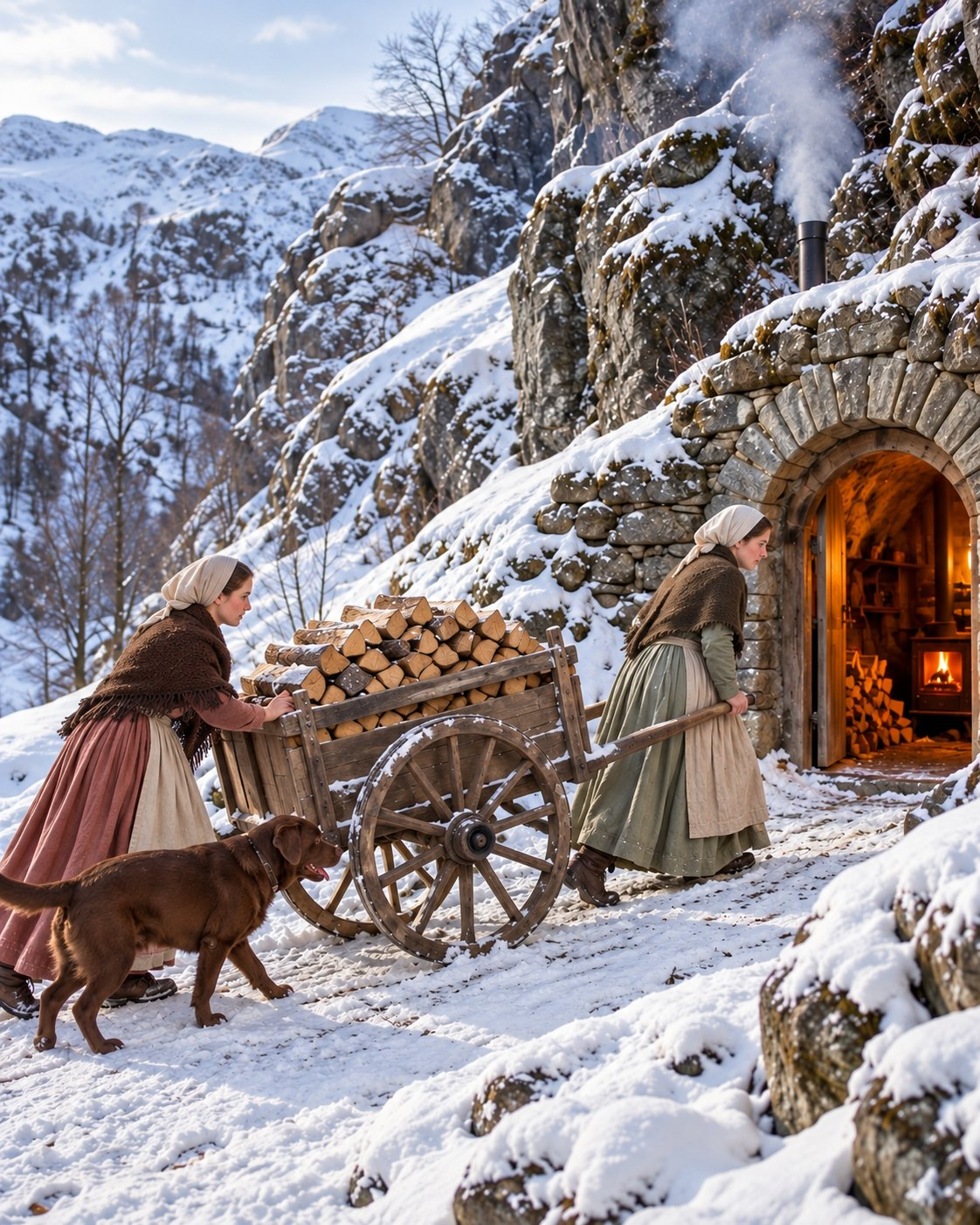
We stopped beside the wooden cart.
It was the same cart we had used when we first arrived.
Its wheels were worn.
Its boards were weathered.
But it had survived.
Ruth touched the handle.
"Do you remember how difficult it was to push this through the snow?"
I nodded.
"I thought we'd never reach the entrance."
She looked toward the valley.
"Look at the town."
I followed her gaze.
Redemption Hollow lay below us.
Smoke rose from the chimneys.
Children were playing near the road.
Farmers were working in the fields.
People were carrying water from the shared supply basin.
The town looked alive again.
And this time, nobody was laughing at the girls who had warned them.
A few days later, Reverend Thorne visited.
He brought a small wooden sign.
It had been carved by the blacksmith.
He placed it beside the entrance.
The words were simple.
WHITLOCK MOUNTAIN REFUGE
Below them was another line.
Water, warmth, and shelter for all who need them.
Ruth touched the lettering.
Then she looked at me.
I felt my eyes grow warm.
We had arrived at the mountain with almost nothing.
One flour sack.
A little food.
A rusty hatchet.
And an iron key.
Now the cave was a place where families could find safety.
Where children could learn.
Where the elderly could rest.
And where the town could prepare for whatever winter brought next.
That evening, I opened Father's ledger for the final time that season.
I turned to the first page of September.
The handwriting was mine.
September 17, 1873.
First snowfall.
Northern wind.
Early migration.
Winter approaching.
I turned to the final page.
Then I wrote:
April 1874.
The winter has passed.
The spring continues flowing.
The mountain refuge remains open.
The town has survived.
I paused.
Then I added one final sentence.
We were sent away because nobody believed us. We stayed because we believed in what our parents taught us.
I closed the book.
Ruth was waiting beside the hearth.
She held two cups of warm spring water.
I took one.
We sat together and watched the flames.
For the first time in six years, I no longer felt like an orphan who had been forgotten.
I felt like the daughter of Thomas and Mary Whitlock.
And I knew exactly what they had left us.
Not merely a cave.
Not merely a spring.
Not even a hidden passage through the mountains.
They had left us knowledge.
They had left us courage.
And they had taught us that a person's worth was never measured by how much power they possessed, but by what they were willing to protect.
Years later, people in Redemption Hollow would still tell the story of the winter when two seventeen-year-old sisters were banished for warning their town about the coming frost.
They would remember the first snowflake.
The orphanage door.
The long journey through the mountains.
And the thin column of smoke that rose from a forgotten cave.
But the part of the story they remembered most was what happened afterward.
The sisters who had been turned away opened their shelter to the very people who had rejected them.
They did not demand payment.
They did not demand apologies.
They simply offered warmth, water, and a place to survive.
Hannah continued recording the weather.
Ruth continued caring for the plants.
Tommy grew into a capable young man who eventually helped maintain the mountain refuge.
The dog grew old beside the hearth.
And the cave remained a place of safety for generations.
The winter that had threatened to destroy Redemption Hollow became the winter that taught the town to prepare, to listen, and to care for one another.
As for the iron key, Hannah kept it for the rest of her life.
She never locked the inner chamber again.
There was no reason to hide what her parents had worked so hard to preserve.
The mountain had given them shelter.
Their parents had given them knowledge.
And the people they once feared had become their neighbors, friends, and family.
One spring morning, Hannah stood outside the cave with Ruth.
Sunlight fell across the rocks.
The last patches of snow melted into the earth.
Far below, the creek flowed freely through Redemption Hollow.
Ruth looked toward her sister.
"We made it."
Hannah took her hand.
"Yes."
Then she looked at the mountain.
"We all did."






Comments 0