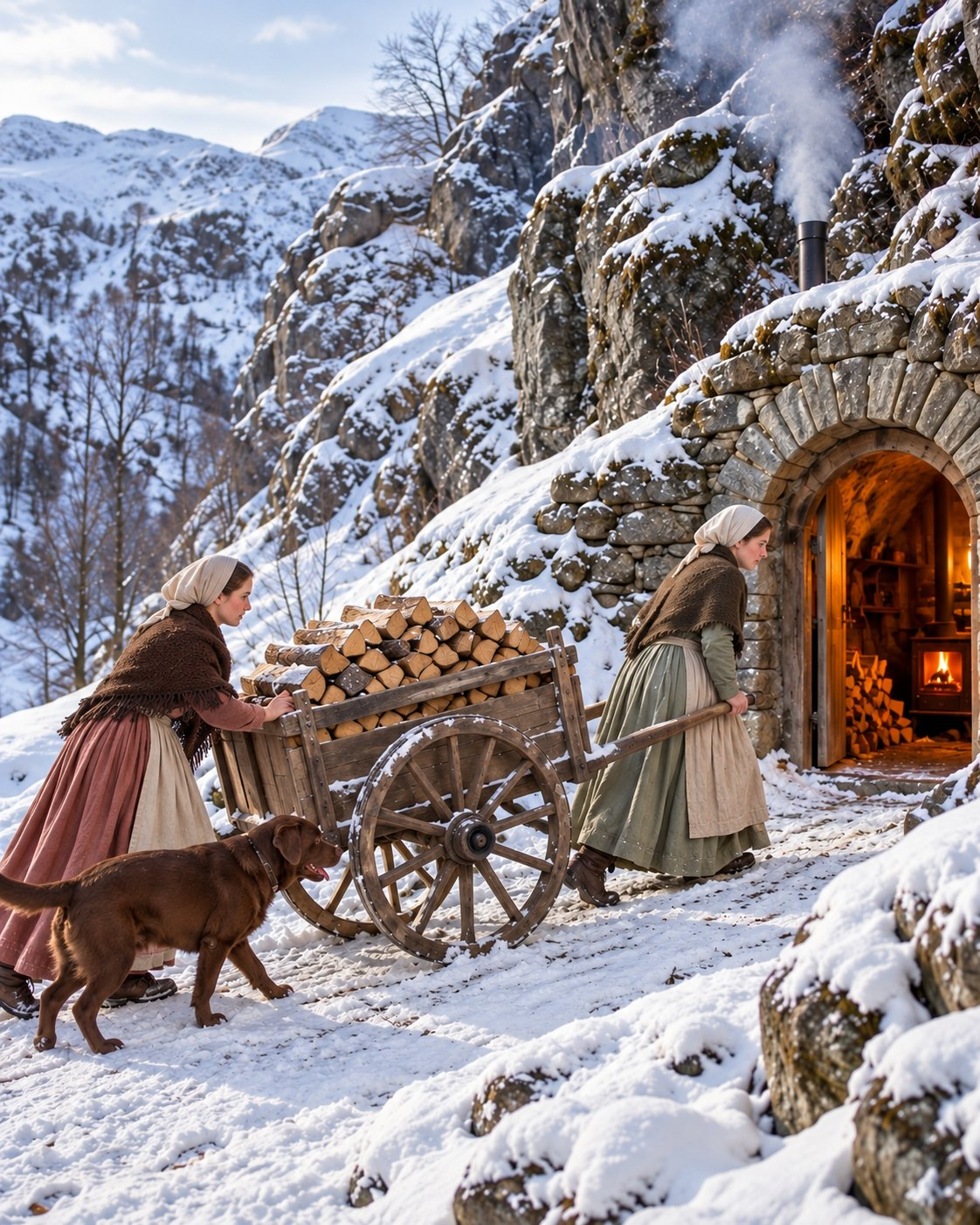
The storm lasted through the night.
By morning, the entrance was almost completely buried.
I could see only a narrow strip of gray daylight through the upper opening.
The wooden supports had held, but several branches had broken beneath the weight of the snow.
Ruth was already awake.
She stood beside the hearth, warming her hands.
Tommy slept beneath the wool blanket.
Our dog lay near the entrance, occasionally lifting its head whenever the wind changed.
I checked the spring.
The water was flowing normally.
Then I examined the drainage channel.
It was clear.
Nothing appeared to be blocked.
I returned to Father's ledger.
The old water gate.
I could not stop thinking about it.
If the mountain had a hidden water system, there might be a mechanism controlling part of the flow.
Perhaps Father had discovered it during his earlier visits.
Perhaps Silas had known about it too.
I looked at the map.
The three circles were marked near the northern passage.
I decided to investigate once the storm weakened.
For now, our priority was survival.
Ruth prepared breakfast from the remaining flour.
She mixed it with water and made small flat cakes over the hearth.
We ate them with dried meat.
Tommy woke halfway through the meal.
"Is it still snowing?"
I nodded.
"More than yesterday."
He looked toward the entrance.
"Can we go outside?"
"Not yet."
He sighed.
I understood his frustration.
The cave was warm, but the darkness made it difficult to know how much time had passed.
I had begun marking each day on the wall beside the ledger table.
September 24.
September 25.
September 26.
The dates were becoming frightening.
Winter had barely begun.
And already the mountains were almost impassable.
On the fourth day, the wind finally weakened.
I cleared part of the entrance.
Snow fell inward as I removed the branches.
The outside world had changed completely.
The slope was covered in deep snow.
Several trees had bent beneath its weight.
The trail had disappeared.
I stepped outside carefully.
The air was painfully cold.
I looked toward the ridge.
A thin line of smoke rose from the valley.
Redemption Hollow.
I could barely see the town.
But I recognized the church steeple.
Ruth joined me.
"Do you think they have enough firewood?"
I watched the distant smoke.
"Some families will."
"What about the orphanage?"
I didn't answer.
The wind shifted.
Our own chimney was releasing a thin stream of smoke into the cold air.
It rose above the rocks, then drifted toward the northern trees.
I had become accustomed to seeing it.
But from a distance, it was surprisingly visible.
I realized then that the cave was no longer completely hidden.
Anyone looking toward the mountain might notice it.
I turned toward the entrance.
"Let's move the firewood farther inside."
Ruth nodded.
But before we could begin, I noticed something on the ridge.
A figure.
Standing among the trees.
Watching.
I raised my hand to shield my eyes.
The figure did not move.
I could not identify the person.
The distance was too great.
I stepped back into the cave.
"Ruth, get Tommy."
She hurried inside.
I examined the ridge again.
The figure had disappeared.
I took Father's compass and checked the direction.
North.
The same direction marked on the map.
I looked at the smoke rising from our chimney.
Then I understood something.
We had been careful with the entrance.
We had hidden the cave as best we could.
But we had forgotten the most obvious thing.
Smoke could be seen for miles.
That evening, Elias arrived.
He came carrying a small bundle of supplies and looked troubled.
"Have you seen anyone near the northern ridge?" I asked.
He stopped.
"Why?"
"I saw someone watching the cave."
He removed his hat.
"Then you should know that Silas has been asking about the smoke."
Ruth looked up.
"What did he say?"
"He told people that someone was living illegally in the mountain."
I stared at him.
"Did he say who?"
"No."
Elias placed the supplies on the table.
"But he knows it is you."
I felt my stomach tighten.
"How?"
"Someone saw your cart near the western slope."
I glanced toward the entrance.
Our cart was still outside.
The snowfall had partially covered it.
Elias continued.
"Silas is telling the town that the cave belongs to him."
I shook my head.
"He has no proof."
"He claims he has an old county deed."
I looked at Father's documents.
"Then we need to find the original land record."
Elias nodded.
"That may be difficult."
"Why?"
He hesitated.
"Because the county office is closed. The roads are buried, and the clerk has gone to stay with relatives in another settlement."
I looked toward the fire.
Silas had chosen the timing carefully.
He knew the town was frightened.
He knew the roads were becoming impassable.
And he was using the situation to strengthen his claim.
After Elias left, Ruth and I examined the land papers again.
There were several old documents in the storage chamber.
Most were difficult to read.
Some referred to the original property boundaries.
Others contained descriptions of the mountain and the surrounding woodland.
One paper bore Father's signature.
Another contained Mother's.
I examined the dates.
The documents had been prepared before our parents became ill.
Then I found something important.
A small handwritten statement at the bottom of a page.
The spring and its natural channels shall remain protected from obstruction or private interference.
I read it aloud.
Ruth looked at me.
"Does that mean nobody can own the water?"
"Not necessarily."
I examined the wording.
"But Father wanted to protect it."
I searched the papers for a legal reference.
There was a number beside the statement.
A county registry number.
I copied it into my ledger.
If we could find the original record, perhaps we could prove what our father had intended.
But first, we needed to survive the storm.
The next morning, I decided to investigate the northern passage.
Ruth insisted on coming.
Tommy stayed near the hearth.
I carried a candle, the compass, a rope, and Father's map.
The passage was narrow.
We moved slowly.
At the first bend, I noticed a small mark carved into the stone.
Three circles.
The same symbol.
I examined the wall.
There was a shallow indentation.
I pressed it.
Nothing happened.
Ruth looked at the map.
"Perhaps it needs the key."
I tried the iron key.
It fit into a small opening beneath the symbol.
I turned it.
A metallic click echoed through the passage.
Then something moved beneath the floor.
We stepped backward.
A section of stone shifted.
A narrow opening appeared.
Cold air rushed through it.
I lowered the candle.
Beyond the opening was a sloping passage.
At the bottom, I could hear water.
Not the gentle trickle of the spring.
Something stronger.
A deeper rushing sound.
I looked at Ruth.
"The water gate."
She nodded.
We tied the rope around a stone support and began descending.
The passage ended in a low chamber.
Water moved through a narrow channel in the rock.
There were several wooden supports.
Some were old.
Others appeared to have been replaced more recently.
I examined the walls.
A metal lever was attached to a stone pillar.
Beside it was a small wooden panel.
I opened the panel.
Inside were several iron components.
The mechanism appeared to control the movement of water through the channel.
I remembered Father's warning.
Do not block the natural drainage.
I examined the lever.
It was stuck.
I tried moving it gently.
Nothing.
Then I noticed something lodged beneath the mechanism.
A piece of timber.
It had become swollen from moisture.
I carefully removed it.
The water level changed.
The rushing sound became louder.
Ruth looked alarmed.
"What did you do?"
"I think the gate was partly blocked."
I examined the mechanism again.
The wood had probably been there for years.
Perhaps the previous winter had caused it to swell.
Perhaps someone had deliberately placed it there.
I could not know.
But the water was now moving more freely.
I checked the channel.
It was draining toward the lower passage.
The system seemed to be working.
I wrote the discovery in my ledger.
Then I noticed a small metal plate attached to the pillar.
It bore an inscription.
Thomas Whitlock.
And beneath it:
Maintenance completed — 1864.
Father had built or repaired this mechanism almost nine years earlier.
We returned to the main chamber.
Ruth was quiet.
She had been thinking about the same thing I had.
Father had prepared the cave.
He had maintained the spring.
He had reinforced the water channels.
And he had left us instructions.
But the most troubling question remained.
Why had he hidden the medal?
Why had Mrs. Crane kept it?
And why was Silas so determined to claim the mountain?
I opened the wooden box.
The old papers were arranged carefully.
I searched for the county registry number.
It appeared on a folded document at the bottom.
I unfolded it.
There were two signatures.
Thomas Whitlock.
And a second name.
Silas Burke.
I stared.
Ruth leaned over my shoulder.
"Why is Silas's name there?"
I examined the document.
It was a formal agreement.
It described a temporary arrangement concerning the mountain property.
But the final paragraph was missing.
The paper had been torn.
I searched the box.
Nothing.
Then I noticed a small envelope hidden beneath the cloth lining.
Inside was another sheet.
It contained the missing paragraph.
I read it slowly.
The agreement stated that Silas had been granted permission to inspect the land.
Not purchase it.
Not own it.
And certainly not claim the spring.
The final sentence was written in Father's handwriting.
Any attempt to obstruct or seize the water source shall be considered a violation of this agreement.
I looked at Ruth.
We had found something important.
But the document was incomplete without the original registry.
That afternoon, Tommy came to me.
He had been sitting beside the fire, studying Father's ledger.
"Can I ask you something?"
"Of course."
He looked toward the entrance.
"Do you think the people in town will come here?"
I considered the question.
"Perhaps."
"Will you let them in?"
I looked at the warm spring.
The growing area.
The wood.
The supplies.
Then I remembered Father's final instruction.
Do not turn them away simply because they failed to believe you.
"Yes," I said.
Tommy seemed surprised.
"Even Mrs. Crane?"
I thought about the bruises on his wrist.
I thought about the medal.
And the way she had looked when I asked about our father.
"Even her."
He lowered his eyes.
"Why?"
"Because being cruel to someone doesn't make the winter less cold."
He nodded slowly.
Then he returned to his work.
The following evening, the smoke from our chimney became visible again.
The wind had shifted.
Instead of drifting toward the northern trees, it traveled across the valley.
I watched from the entrance.
The smoke rose in a thin column.
Then a gust pushed it toward Redemption Hollow.
I wondered how many people would notice.
I wondered whether Silas would see it.
And I wondered what he would do.
Ruth came beside me.
"Hannah."
She pointed toward the valley.
Several small figures were moving along the road.
At first, I thought they were travelers.
Then I recognized the shapes of people carrying bundles.
There were more than three.
More than five.
They were coming from town.
And they were heading toward the mountain.
I counted seven.
Then nine.
Then twelve.
Ruth stepped closer.
"Are they coming here?"
I watched them struggle through the snow.
One of them carried a lantern.
Another pushed a small handcart.
At the front was a woman holding a child.
I recognized her.
Abigail Turner.
Behind her walked several townspeople.
And at the very back was a familiar tall figure.
Silas Burke.
I felt my stomach tighten.
The smoke had betrayed our secret.
But it had also revealed something else.
For the first time, the people who had laughed at our warnings were coming to our mountain because they needed what we had found.






Comments 0