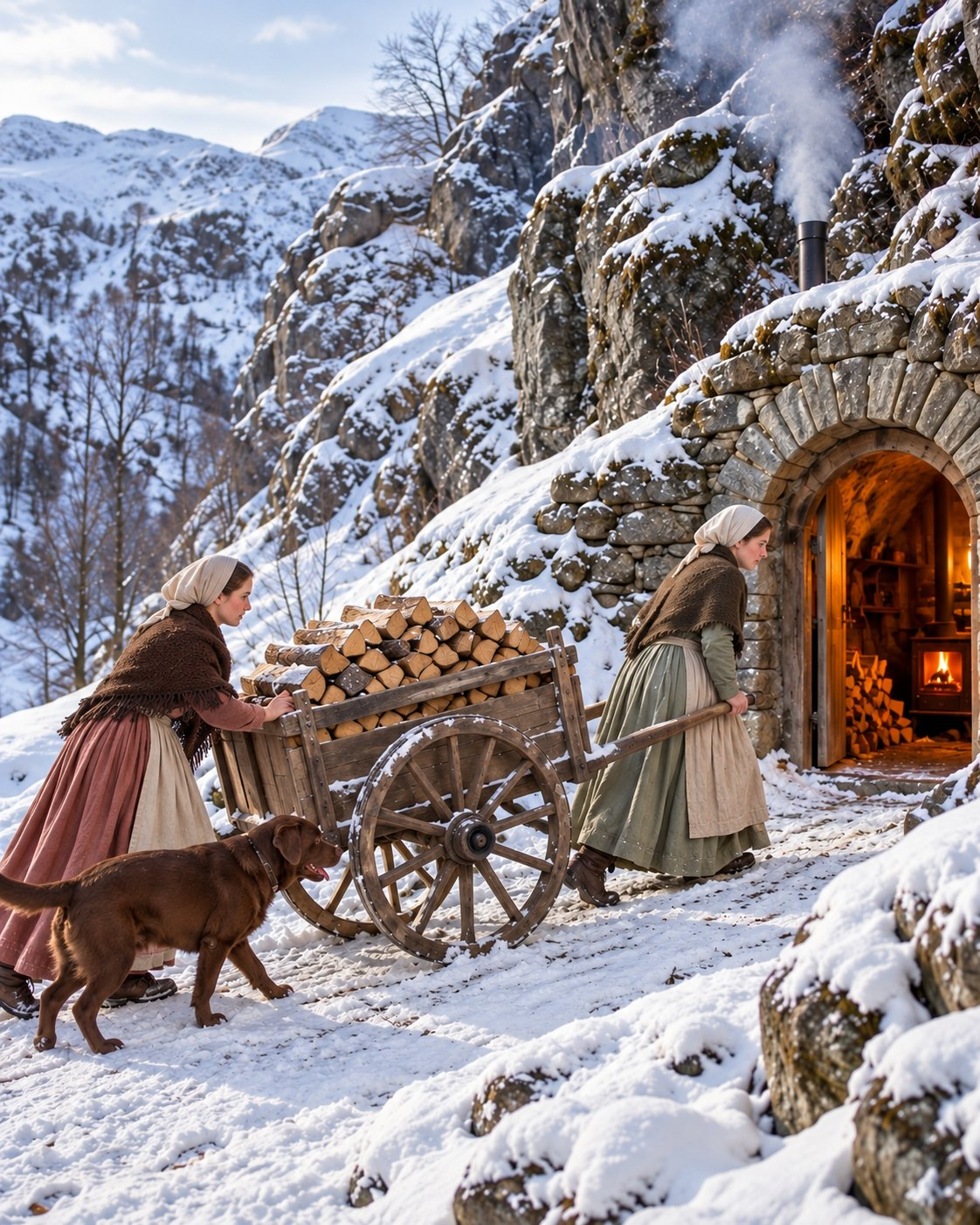
Silas Burke stood outside our cave as if he owned the mountain.
His coat was expensive, his boots were polished, and his expression carried the same contempt I remembered from his general store.
Reverend Caleb Thorne stood beside him.
The third man held a leather document case.
I recognized the stranger as a county surveyor. I had seen him once in Redemption Hollow, measuring land near the western road.
Silas looked directly at me.
"Well, Hannah. It seems you found your father's little hiding place."
I tightened my grip on the hatchet.
"Why are you here?"
He smiled.
"To discuss property."
I glanced at the surveyor.
Then at the document case.
"This land belongs to our father."
Silas laughed.
"Your father is dead."
"And the land?"
"Your father had no legal claim to this mountain."
I felt Ruth move closer behind me.
Silas took another step.
"Now, I suggest you gather your belongings and return to the orphanage before this becomes unpleasant."
I looked at him.
"We don't live at the orphanage anymore."
"Then perhaps you should find somewhere else."
I said nothing.
He seemed disappointed by my lack of fear.
Then the surveyor opened his case.
Inside was a folded document.
At the top, I saw our father's name.
Thomas Whitlock.
The surveyor introduced himself as Mr. Edwin Fletcher.
He explained that Silas had requested an examination of the mountain property several years earlier.
According to the document, a portion of the land had been registered under an old county record.
The ownership was disputed.
Silas claimed that the land had been abandoned.
I asked to examine the document.
He refused.
"These are legal papers," he said.
"So are the papers in our father's box."
Silas's expression changed.
Only slightly.
But I noticed.
"What box?"
I looked at him.
"The one he left behind."
For several seconds, nobody spoke.
Then Silas turned toward Reverend Thorne.
"Do you see what I mean? The girls have been filling their heads with nonsense."
The reverend sighed.
"Hannah, Ruth, this is not a matter for children."
I looked at him.
"Then why are grown men standing outside our cave trying to frighten us?"
His face reddened.
Silas stepped forward.
"Enough."
He pointed toward the entrance.
"You have until tomorrow morning to leave."
I looked at the snow-covered path.
Then at the wooden barrier we had built with our own hands.
"No."
His smile disappeared.
"What did you say?"
"I said no."
Silas stared at me.
For the first time, I saw genuine anger in his eyes.
He turned to the surveyor.
"Write down that they refused to leave."
Mr. Fletcher looked uncomfortable.
"I cannot remove anyone without verifying the property records."
Silas gave him a cold look.
"Then verify them."
He turned and walked away.
The reverend followed.
The surveyor remained behind for a moment.
He looked at me.
"Be careful, Miss Whitlock."
Then he lowered his voice.
"Your father was a good man."
Before I could ask what he meant, he followed the others.
Ruth closed the entrance.
"Do you think they can take the cave?"
"I don't know."
"Silas looked certain."
"Silas always looks certain."
I placed Father's medal on the stone table.
The four words hidden inside it remained in my thoughts.
The water remembers everything.
I looked toward the spring.
Perhaps Father had hidden something there.
Perhaps the truth about the land was connected to the water.
We needed to understand the cave before anyone could force us out.
I returned to the map.
The underground spring was marked with a small circle.
Beneath it, several measurements had been written in Father's handwriting.
I compared them with the chamber dimensions.
Something was missing.
A measurement of depth.
I looked at the floor.
The stone basin was shallow, but the water disappeared through a narrow opening between two rocks.
I lowered the candle.
The opening was too small for my hand.
Ruth brought a thin branch.
We used it to measure the depth.
The branch disappeared farther than expected.
I looked at the surrounding stone.
There was a narrow ledge beneath the basin.
Perhaps the water entered a deeper underground channel.
I remembered the warning about the green moss.
Do not dig beneath the green moss until you understand what lies above it.
I looked toward the back wall.
The moss was growing over a section of soft earth.
Above it was a narrow crack.
I examined the ceiling again.
A small quantity of water dripped from the crack.
It was not random.
The drops fell at regular intervals.
I took Father's notebook and wrote down the observations.
Ruth watched me.
"Are you going to dig?"
"Not yet."
I closed the book.
"First, we understand what Father was trying to tell us."
That evening, Elias returned with more timber.
He listened carefully as we explained what Silas had said.
When I showed him the document case, he frowned.
"Silas has wanted this land for a long time."
"Why?"
Elias examined Father's map.
"Because your father discovered something valuable."
I showed him the hidden medal.
He turned it over.
The symbol seemed familiar to him.
"I've seen that before."
"Where?"
"On an old survey marker near the northern ridge."
I looked at Ruth.
Elias continued.
"Your father used to visit that marker. He would spend hours measuring the surrounding ground."
"Did he tell you what he was searching for?"
"No."
Elias placed the medal on the table.
"But I remember something he said once."
"What?"
He looked toward the spring.
"He told me that a mountain could look empty while holding enough water to keep an entire valley alive."
I stared at him.
Then I understood why Silas was interested.
The cave was not simply a shelter.
It was connected to a natural water system.
And Father had discovered it.
The next morning, I examined the surrounding chamber.
I followed the water's movement.
It emerged from the rock, entered the basin, and disappeared beneath the stone.
I marked the location in my ledger.
Then I examined the green moss.
It grew in a narrow line extending toward the wall.
The earth beneath it was warm.
I remembered Father's warning.
There was something above the moss.
I lifted the candle.
The ceiling was covered with small mineral deposits.
One section looked different.
It was darker.
There was a small stone projection directly above the moss.
I touched it.
The stone moved.
Not much.
But enough.
I called Ruth.
Together, we examined it.
She pressed the projection while I watched the floor.
A faint scraping sound came from beneath the wall.
Then a narrow section of stone shifted outward.
Behind it was a small cavity.
Inside lay another folded paper.
I removed it.
The writing was faded.
But the first line was clear.
For my daughters, if they ever find the spring.
My hands trembled.
Ruth came closer.
I unfolded the letter.
My girls,
The spring is connected to a natural water channel beneath the mountain.
The warm water is not the only source.
There are deeper channels that carry water through the stone.
Do not block them.
Do not allow anyone to damage the natural drainage.
If you protect the spring, it may protect you.
I read the letter twice.
Then I examined the map again.
Father had drawn several underground channels.
One extended toward the western side of the mountain.
Another appeared to run beneath the northern ridge.
There was a note beside it.
Winter flow remains constant.
I looked at Ruth.
"That's why the spring stays warm."
She nodded slowly.
"And that's why Silas wants it."
We spent the following days learning the cave.
We discovered which sections remained dry during snowfall.
We identified the safest sleeping area.
We arranged the firewood so that it would not block the entrance.
Ruth began keeping a separate list of supplies.
She divided our food into daily portions.
I continued measuring the water and recording the temperature.
The spring remained steady.
Even when the air outside became bitterly cold, the water continued flowing.
We also discovered that the green moss was growing over an area of unusually warm soil.
Mother's knowledge of plants became useful.
She had taught us that healthy moss could indicate moisture and suitable growing conditions.
I wondered whether certain edible plants might survive in the chamber.
I carefully examined the area.
There were small roots growing near the water.
Some resembled plants Mother had shown us.
I did not harvest anything until I was certain.
We could not afford to make a mistake.
Tommy began helping with the daily work.
He was still weak from his journey, but his energy gradually returned.
He collected smaller branches.
He carried water.
He helped Ruth organize the supplies.
Whenever he had free time, he studied Father's maps.
One afternoon, he approached me with a question.
"Why did your father draw so many lines beneath the mountain?"
I examined the page.
"Those are probably underground water channels."
He pointed toward a small mark.
"Then what's this?"
I looked closely.
It was a small rectangle.
Beside it was a word.
Storage.
I examined the location.
It appeared to be another chamber.
Not far from the spring.
I compared the map with the passage we had discovered.
The measurements suggested that the hidden room might be accessible through the stone door.
I looked at the iron key.
Then at the hidden entrance.
We had found the cave.
We had found the spring.
But we had not yet discovered everything our father had left behind.
That evening, Elias told us that the weather was worsening across the valley.
Several farmers had already lost animals.
The northern road was becoming difficult to travel.
The creek near Redemption Hollow had frozen along its shallow banks.
Reverend Thorne still insisted that the snowfall would end soon.
Silas Burke had begun charging more for basic supplies.
People were becoming nervous.
"How many families are prepared?" Ruth asked.
Elias looked down.
"Not many."
I opened my ledger.
The observations were becoming more alarming.
The temperature was falling faster than expected.
The birds had almost disappeared.
The wind had shifted again.
I knew what that meant.
I looked at Elias.
"Tell the people to store as much food and firewood as possible."
He nodded.
"I will."
"And tell them not to wait until the first heavy storm."
He looked at me.
"Some people won't listen."
"I know."
He picked up his coat.
"Then I'll tell the ones who will."
The next morning, Ruth and I returned to the hidden stone door.
We had decided to investigate the storage chamber.
I inserted the iron key.
This time, the mechanism turned smoothly.
A deep click echoed through the wall.
The stone section moved.
A narrow opening appeared.
We pushed carefully.
The door opened inward.
Beyond it was a small room.
I raised the candle.
And froze.
There were shelves.
Wooden barrels.
Several metal containers.
A folded blanket.
And a large trunk.
Dust covered everything.
But the room was dry.
Remarkably dry.
Ruth stepped inside.
"Father prepared this."
I nodded.
We examined the shelves.
Some containers were empty.
Others held old tools.
There was a small hand saw, a hammer, several iron nails, and a bundle of rope.
The trunk was locked.
I tried the iron key.
It opened immediately.
Inside were several books.
A collection of handwritten notes.
And a folded document bearing our parents' names.
I removed it.
The paper was brittle.
The writing was Mother's.
I recognized her handwriting instantly.
At the top were the words:
Mary Whitlock — Notes on the Mountain Garden.
I stared at the page.
Mother had apparently discovered something in the cave too.
And the final paragraph contained a sentence that made me forget the cold entirely.
If the winter comes early, the mountain may still provide food when the fields outside are buried.
I looked toward the green moss.
Then toward the spring.
And suddenly I realized that our father's shelter might be capable of much more than keeping us alive.
It might contain the means to feed an entire community through the coming winter.






Comments 0