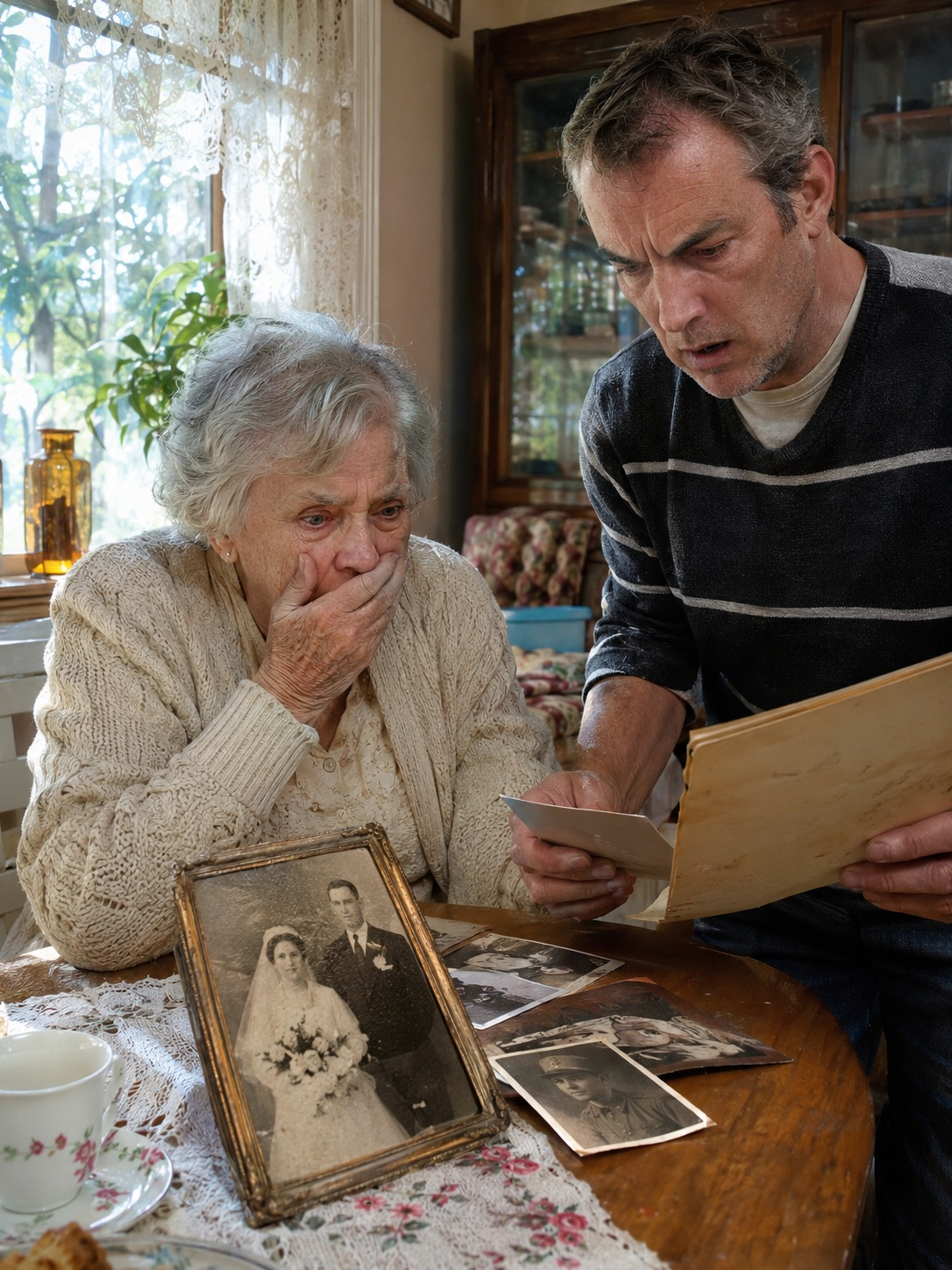
"Don't let her come in!" Peter shouted.
His sudden outburst startled everyone in the hospital room.
The woman standing outside the door stopped moving.
Helen Mercer, the hospital records administrator, looked at my son with an expression I couldn't understand.
"Peter," she said quietly, "you need to hear what she has to say."
"Then she can tell us who she is first."
I reached for my son's arm.
"Peter, please."
But he was staring at the doorway as though someone dangerous stood on the other side.
I was eighty years old, frightened about a mysterious mass growing inside my abdomen, and exhausted from hours of medical examinations. I had no patience left for people deciding what I should or shouldn't know.
"Open the door," I said.
Peter turned toward me.
"Mom—"
"Open it."
Something in my voice made him step aside.
Helen reached for the handle.
The door opened.
And there she stood.
A woman with shoulder-length silver hair, pale blue eyes, and a face I recognized despite the twelve years that had passed.
Eleanor Whitcomb.
For a moment, I couldn't speak.
The last time I had seen Eleanor, she had been standing in the back row of Walter's funeral service, wearing a dark coat and holding a white envelope.
She had left before I could speak to her.
Now she stood in my hospital doorway, looking as though she had spent the past twelve years dreading this exact moment.
"Hello, Ruth," she whispered.
I stared at her.
"Eleanor?"
She nodded.
Peter looked between us.
"You know her?"
I swallowed.
"She worked at St. Agnes."
Eleanor lowered her eyes.
"Yes. I did."
I remembered her from my hysterectomy.
She had been a senior nurse in the surgical department, the kind of woman who could calm a frightened patient with a few ordinary words.
She had held my hand before surgery.
She had brought me ice chips afterward.
And when Walter worried about my recovery, she had patiently explained everything the doctors were doing.
I had liked her.
Trusted her.
But there was something else.
Something I hadn't thought about in years.
Walter had mentioned Eleanor several times after my recovery.
Once, when I asked why she had called our house, he told me she was following up on an insurance question.
Another time, I found a Christmas card from her tucked inside his desk.
He said she sent cards to former patients.
I believed him.
Now, watching her stand beside my hospital bed, I wondered how many explanations I had accepted simply because they came from my husband.
"Eleanor," I said, "what are you doing here?"
She looked toward Helen.
"Helen called me."
"Why?"
"Because she found your name in the old records."
Peter stepped forward.
"Then maybe you can explain why my father signed a confidential medical document eleven days before he died."
Eleanor's face tightened.
"Peter, isn't it?"
"Yes."
"You've grown."
He didn't smile.
"I'm fifty-six years old. We don't need to pretend this is a family reunion."
"Peter," Beth murmured.
"No, Beth. My mother is lying in a hospital bed with a mass in her abdomen, and apparently everyone except her knows something about it."
Eleanor accepted his anger without defending herself.
Then she looked directly at me.
"Ruth, I'm sorry."
Those three words frightened me more than anything she could have said.
"Sorry for what?"
She opened her mouth.
Then closed it.
I felt my heartbeat quicken.
"Eleanor, don't you dare come into this room and apologize without telling me why."
Her eyes filled with tears.
"I made Walter a promise."
I stared at her.
"What promise?"
"That I wouldn't discuss the preliminary findings until the review was completed."
Peter held up the yellowed document.
"The review was never completed."
"I know."
"Then why didn't you tell my mother?"
Eleanor looked down at her hands.
"Because Walter died. And afterward, the hospital closed its surgical unit, the records were transferred, and I was told the matter had been resolved."
"By whom?" Peter demanded.
She hesitated.
"By the physician responsible for the review."
I leaned forward.
"What physician?"
Eleanor looked at Helen.
Helen's expression remained guarded.
"Ruth," Eleanor said, "before I answer that, I need you to understand something. Your husband wasn't the only person involved."
I felt cold.
"What does that mean?"
"It means the document he signed was only one part of a much larger file."
Peter placed both hands on the foot of my bed.
"Then where's the rest of it?"
Eleanor glanced at the folder Helen had brought.
"That's what I've been trying to find for twelve years."
Silence settled over the room.
I looked at the woman who had once helped me through surgery.
She looked older now.
Tired.
And terribly afraid.
"What happened to me at St. Agnes?" I asked.
Eleanor pulled a chair closer.
"Ruth, do you remember why you had your hysterectomy?"
"Of course. I had persistent bleeding and fibroids."
"That's right."
"The surgery went well."
She hesitated.
"That's what you were told."
I stared at her.
Peter straightened.
"What are you saying?"
Eleanor took a slow breath.
"During your surgery, the team documented an unexpected finding."
I looked down at my swollen abdomen.
"What kind of finding?"
"An abnormal structure near your right ovary."
I blinked.
"My ovary?"
"Yes."
"But I thought they removed everything."
Eleanor shook her head.
"Your uterus was removed. According to the original surgical plan, your ovaries were supposed to remain unless there was a medical reason to remove them."
I tried to remember.
Fourteen years was a long time.
I remembered signing forms.
I remembered Walter sitting beside me.
I remembered a surgeon explaining that I would no longer have menstrual bleeding.
But the details had faded.
"I don't understand," I whispered.
Eleanor leaned forward.
"The surgical report described a small cystic structure. It was supposed to be evaluated."
"Was it?"
"That's where the records become complicated."
Peter gave a humorless laugh.
"Complicated seems to be everyone's favorite word today."
Eleanor looked at him.
"I understand your frustration."
"No, you don't. My mother has spent six months watching her stomach grow. Now you're telling us someone saw something fourteen years ago?"
"I am telling you that a finding was documented. I cannot tell you yet whether it is related to her current condition."
That distinction mattered.
Even through my fear, I understood it.
But another question had already formed in my mind.
"Why did Walter have a document about it twelve years ago?"
Eleanor's expression changed.
"Because he came back to St. Agnes."
I stared at her.
"Without me?"
"Yes."
"When?"
"About two years after your surgery."
My mouth went dry.
"Why?"
She looked toward the framed wedding photograph Peter had placed on the bedside table.
"Because he had received a letter."
I frowned.
"What letter?"
"A notice from the hospital concerning an internal review of certain surgical records."
Peter moved closer.
"What kind of review?"
Eleanor looked at Helen again.
Helen answered.
"At the time, St. Agnes was reviewing discrepancies between operative notes, pathology submissions, and follow-up documentation in a number of cases."
Peter's eyes narrowed.
"Medical errors?"
"Potential documentation and follow-up failures," Helen said carefully. "The surviving records don't establish every outcome."
I felt sick.
"Was I one of those patients?"
Eleanor nodded.
"Your name was on the review list."
I stared at her.
"Then why wasn't I told?"
Nobody answered.
That silence was answer enough.
I turned toward the window.
For fifty years, Walter had been the person I trusted most.
When I didn't understand a medical bill, he explained it.
When I was frightened about surgery, he reassured me.
When I forgot an appointment, he reminded me.
I had never imagined that his protectiveness might also have kept information from me.
"Did Walter know?" I asked.
Eleanor lowered her eyes.
"He knew there was a concern."
"Did he know something was wrong inside me?"
"We don't know what he was told in the final review, Ruth."
"But he signed that paper."
"Yes."
"And he wrote that I wasn't to be told."
Eleanor looked at me with an expression that almost resembled pain.
"Yes."
I closed my eyes.
For a moment, I heard Walter's voice as clearly as if he were sitting beside me.
Don't worry, Ruthie. I'll take care of it.
He had said those words hundreds of times.
I used to find them comforting.
Now they sounded different.
A nurse entered to check my blood pressure.
She glanced at the group gathered around my bed.
"Mrs. Callahan, are you feeling all right?"
I almost laughed.
Was I feeling all right?
I had a mysterious mass in my abdomen, my dead husband's name was on a secret medical record, and a woman from my past had just told me that my surgery might have involved an undisclosed problem.
"No," I said. "Not particularly."
The nurse looked concerned.
"Are you having pain?"
"Not more than before."
She checked the monitor.
My blood pressure was elevated.
She asked everyone to give me a few minutes to rest.
Peter protested, but I raised my hand.
"Let her do her job."
For the next several minutes, nobody spoke.
The nurse adjusted my pillow and checked my vital signs.
When she left, Dr. Grant returned.
She carried a new report.
"I've spoken with the gynecologic surgery team," she said. "They want to admit you for further evaluation."
Peter immediately asked, "Is she in danger?"
"Her condition requires prompt attention. The mass is large, and we need to assess its effects on surrounding organs. But she's stable right now."
I looked at her.
"Can you tell me what it is?"
"We have a working diagnosis, but I don't want to give you a definitive answer before the specialist reviews everything."
"What diagnosis?"
Dr. Grant sat beside me.
"The imaging suggests a large complex cystic lesion, possibly arising from the remaining ovarian tissue. There are some unusual features that require further investigation."
I thought about the strange movement.
"Is that why I felt something shifting?"
"Possibly. A large fluid-filled structure can change position slightly as you move, and pressure on your intestines can produce sensations that feel like internal movement."
I nodded.
At least that part made sense.
But Peter wasn't finished.
"Could this have been growing for twelve years?"
Dr. Grant considered the question.
"Some cystic lesions grow slowly over many years. Others develop more recently. We can't determine the age of this particular lesion from one scan."
Eleanor looked down.
I noticed.
So did Peter.
"What?" he demanded.
She shook her head.
"Nothing."
"Don't do that."
"Peter—"
"You reacted when the doctor said it could have been growing for years."
Eleanor looked at me.
"Because the old scan described something in the same general area."
My hands tightened around the blanket.
"How big was it then?"
She hesitated.
"Small."
"How small?"
"Approximately four centimeters, according to the notation."
I looked toward Dr. Grant.
"And now?"
The doctor checked her tablet.
"The largest measurement is a little over twenty-seven centimeters."
Beth made a small sound.
Peter closed his eyes.
Twenty-seven centimeters.
I didn't know exactly what that meant.
But I knew it was enormous.
I looked at my stomach.
For months, I had told myself I was simply getting old.
I had laughed when my dresses stopped fitting.
I had dismissed Beth's concern.
Now I wondered how long my body had been trying to warn me.
"Could someone have prevented this?" I asked.
Dr. Grant answered carefully.
"Earlier evaluation might have changed how it was managed. But we don't yet know whether the old finding and the current mass are the same condition."
Eleanor's eyes filled again.
I looked directly at her.
"Did Walter know about the four-centimeter finding?"
She nodded.
"Yes."
The room seemed to tilt.
I gripped the edge of the bed.
"And he never told me?"
Eleanor looked miserable.
"Not as far as I know."
I turned away.
I didn't want anyone to see my face.
For twelve years, I had mourned Walter.
I had kept his clothes longer than I should have.
I had refused to replace his favorite chair.
I had talked to his photograph on lonely evenings.
And now I was learning that he might have known something important about my health and chosen not to tell me.
I felt betrayed.
But beneath that betrayal was another feeling.
Confusion.
Because the Walter I knew would never deliberately allow me to suffer.
Would he?
I remembered the last year of his life.
He had become more protective.
He insisted on driving me to appointments.
He handled the mail.
He asked me to let him take care of insurance paperwork.
At the time, I thought he was being thoughtful.
Now I wondered whether he had been controlling what information reached me.
"Why?" I whispered.
Nobody answered.
I looked at Eleanor.
"Why would he do that?"
She pressed her lips together.
"I don't know everything he was told."
"Then tell me what you do know."
She took a deep breath.
"Walter believed the hospital had made a mistake."
Peter leaned forward.
"What mistake?"
"He believed a finding from your surgery had been mishandled."
"And?"
"He requested copies of your records."
"Did he get them?"
"Some of them."
"Then what happened?"
Eleanor hesitated.
"He met with the physician who had reviewed your case."
I stared at her.
"Who was that?"
She looked at Helen.
Helen shook her head slightly.
I saw it.
And I was tired of it.
"Stop looking at each other," I snapped.
Everyone went still.
"I am sitting right here. I am not a child. I am not confused. I am not incapable of understanding difficult information."
My voice trembled.
But I kept speaking.
"If someone made a mistake, tell me. If Walter lied, tell me. If there is something wrong with my body, tell me."
Peter reached for my hand.
I pulled it away.
"Please. I have spent eighty years being polite. I am finished being polite about this."
Eleanor looked ashamed.
Helen opened the folder.
"The physician's name was Dr. Adrian Bellamy."
I frowned.
The name meant nothing to me.
Peter, however, reacted immediately.
"Bellamy?"
Helen nodded.
"Yes."
Peter looked toward Beth.
She stared back at him.
"What?" I asked.
Peter swallowed.
"Mom, that name sounds familiar."
"From where?"
He hesitated.
"From Dad's old financial records."
I stared at him.
"What financial records?"
Peter rubbed his forehead.
"After Dad died, I helped organize his estate. There were several payments I couldn't identify."
"Payments to whom?"
"I don't remember exactly. But I remember the name Bellamy."
Eleanor sat very still.
Helen closed the folder.
Peter noticed.
"You know something."
Helen looked at him.
"I know there were financial records associated with the review, but I haven't verified their purpose."
Peter's voice hardened.
"Then we're going to verify them."
Dr. Grant intervened.
"Right now, our priority needs to be your mother's health."
I looked at her.
She was right.
Whatever Walter had done, he had been dead for twelve years.
My abdomen was swollen now.
My body needed help now.
I took a slow breath.
"Doctor, what happens next?"
She explained that the specialist would examine me, review the imaging, and order additional tests.
There might be surgery.
There might be further scans.
They would assess the risks carefully because of my age and the size of the mass.
I listened.
I asked questions.
I made Peter write down the answers.
For the first time that day, I felt a little steadier.
Fear was easier to manage when it had a plan.
By late afternoon, I had been moved to a private hospital room.
Beth went home to collect some of my clothes and medications.
Peter stayed.
He sat beside the window with his laptop open, reviewing old financial records he had saved after Walter's death.
I watched him work.
He looked so much like his father when he concentrated.
The same furrow between his eyebrows.
The same habit of pressing his lips together.
It hurt to look at him.
"Peter?"
He glanced up.
"Yeah, Mom?"
"Do you think your father was a bad man?"
His expression changed.
"Mom, no."
"Then why am I beginning to feel like I never knew him?"
He closed the laptop.
"Because we don't have all the facts."
I looked at him.
"You're trying to protect me."
"I'm trying not to accuse Dad of something before we know what happened."
I appreciated that.
Even now.
Even after everything.
I didn't want Walter condemned without understanding his reasons.
But I also didn't want his memory used as an excuse to hide the truth.
Peter moved his chair closer.
"Mom, do you remember the last conversation you had with Dad?"
I thought for a moment.
"Which one?"
"Before he died."
I looked down at my wedding ring.
Walter had died on a Thursday morning.
The night before, we had eaten chicken soup at the kitchen table.
He had barely touched his.
I asked whether he was feeling sick.
He said he was tired.
Later, as we prepared for bed, he held my hand.
He told me he loved me.
Then he said something I hadn't understood.
"Ruthie, if something happens to me, promise you'll listen to Peter."
I had laughed.
"Why Peter?"
"Because he asks questions."
I remembered smiling.
"And our other children don't?"
Walter had shaken his head.
"Peter doesn't stop until he finds the answer."
I looked at my son.
"He told me to listen to you."
Peter's face softened.
"When?"
"The night before he died."
He looked away.
For a moment, I thought he might cry.
Then his laptop made a small notification sound.
He glanced at the screen.
His expression changed.
"What is it?" I asked.
He opened a document.
"Mom, I found something."
My heart quickened.
"What?"
"A payment."
"To Dr. Bellamy?"
"Not directly."
He turned the laptop toward me.
It was an old bank statement.
A withdrawal had been made from Walter's personal savings account.
The date was familiar.
Eleven days before his death.
The same day he signed the confidential medical document.
I leaned closer.
"How much?"
Peter hesitated.
"Forty-eight thousand dollars."
I stared at him.
"Forty-eight thousand?"
He nodded.
I felt my face grow hot.
Walter and I had never been wealthy.
We were comfortable.
We had saved carefully.
We paid our bills.
We helped our children when we could.
But forty-eight thousand dollars was an enormous amount of money.
"Where did it go?"
Peter pointed at the screen.
"The payment was made to a company called Meridian Patient Services."
I frowned.
"I've never heard of it."
"Neither have I."
He typed the name into a search engine.
Several results appeared.
Then he stopped.
"What?" I asked.
He clicked one.
The company had been dissolved eleven years earlier.
Its registered address was a small office building near St. Agnes.
Peter opened another record.
His expression darkened.
"Mom."
"What?"
"Dr. Adrian Bellamy was listed as one of its directors."
I stared at the screen.
Forty-eight thousand dollars.
A secret medical review.
A doctor connected to both.
And my husband had never mentioned any of it.
Peter leaned back.
"Why would Dad pay a company connected to the doctor reviewing your records?"
I couldn't answer.
A terrible possibility entered my mind.
Had Walter paid someone to keep me from learning the truth?
Or had someone demanded money from him?
I looked toward the door.
"Eleanor might know."
Peter nodded.
"I'm going to ask her."
He picked up his phone.
Before he could make the call, someone knocked.
A young nurse entered.
"Mrs. Callahan, there's a physician here to speak with you."
Peter stood.
"Dr. Grant?"
"No. A specialist."
The nurse stepped aside.
A tall man in a white coat entered.
He appeared to be in his early sixties.
His hair was silver at the temples, and he wore thin metal-framed glasses.
He introduced himself as Dr. Jonathan Reeves.
"I'm the gynecologic surgeon reviewing your case."
I felt a small wave of relief.
Finally.
Someone who might tell me what was happening inside my body.
Dr. Reeves sat beside my bed.
He spoke gently.
He explained that the mass appeared to be arising from the right adnexal region, where my ovary had been left after the hysterectomy.
He said there were features suggesting a rare, slowly developing cystic condition.
He also explained that they needed to rule out malignancy and other complications.
I listened carefully.
"Can you remove it?" I asked.
"That is one of the options we're evaluating."
"Will I survive the surgery?"
He met my eyes.
"We would assess your heart, lungs, and overall condition before proceeding. I won't promise there are no risks, but we are taking those risks seriously."
I appreciated his honesty.
Peter asked about additional imaging.
Dr. Reeves answered.
Then he glanced at the old medical record lying on the bedside table.
"May I see that?"
Peter handed it to him.
Dr. Reeves studied the document.
His expression changed.
He turned it over.
Read Walter's handwritten note.
Then examined the signature at the bottom.
For several seconds, he said nothing.
"Doctor?" I asked.
He looked at me.
"Where did you get this?"
"It belonged to my husband."
"Your husband was Walter Callahan?"
"Yes."
Dr. Reeves stared at the paper.
I noticed his fingers tighten.
"Did you know him?" Peter asked.
The doctor didn't answer immediately.
Then he said something that made the room go silent.
"I remember this case."
I stared at him.
"What case?"
He looked at my abdomen.
Then at the old document.
"Your husband's request for a review."
Peter moved closer.
"You were involved?"
"Not directly. I was a junior consultant at St. Agnes around that time."
My heart began pounding.
"Then tell me what happened."
Dr. Reeves hesitated.
"There were concerns about the original surgical documentation."
"We know that," Peter said. "What we don't know is why Dad paid forty-eight thousand dollars to a company connected to Dr. Bellamy."
The doctor's expression changed completely.
"Forty-eight thousand?"
Peter nodded.
"Yes."
Dr. Reeves looked genuinely disturbed.
"Are you certain?"
"I have the bank statement."
The doctor removed his glasses.
He rubbed the bridge of his nose.
Then he looked at me.
"Mrs. Callahan, I need to ask you something."
I swallowed.
"What?"
"Did your husband ever mention a second medical opinion?"
"No."
"An independent pathology review?"
"No."
"An outside laboratory?"
I shook my head.
"No."
Dr. Reeves looked toward Peter.
Then back at the document.
"That doesn't make sense."
Peter's voice sharpened.
"Why not?"
The doctor hesitated.
"Because the review I remember wasn't supposed to involve a payment from the family."
I felt cold.
"What do you mean?"
He leaned forward.
"St. Agnes had identified discrepancies in several surgical cases. The hospital was supposed to investigate those discrepancies at its own expense."
Peter stared at him.
"Then why did Dad pay Bellamy's company?"
Dr. Reeves looked down at the paper.
"I don't know."
But his expression told me he was beginning to suspect something.
He stood.
"I need to make a phone call."
"To whom?" Peter demanded.
"Someone who worked in the pathology department at St. Agnes."
I watched him move toward the door.
"Doctor?"
He stopped.
"Yes, Mrs. Callahan?"
"Was Walter trying to protect me?"
Dr. Reeves looked at me for a long moment.
"I believe he was trying to find out what happened."
That answer should have comforted me.
Instead, it raised another question.
If Walter was trying to uncover the truth, why had he kept it from me?
And why had he died before the review was completed?
Dr. Reeves left.
Peter sat beside me.
For several minutes, neither of us spoke.
Then he opened the old document again.
"Mom, look at this."
He pointed to a small number printed near the bottom.
A reference code.
SG-0417-RC.
"What is it?" I asked.
"Probably a file number."
He typed it into his laptop notes.
Then he looked at the second signature.
The one partially obscured by the photocopy mark.
He enlarged a photograph of it.
I watched the letters appear on the screen.
E.
Then a curved letter.
Then something that looked like an L.
Peter adjusted the contrast.
The name became slightly clearer.
I leaned forward.
My breath caught.
"Peter."
He looked at me.
"What?"
"I know that handwriting."
His eyes widened.
"Whose?"
I stared at the screen.
The letters brought back a memory I had buried for years.
A Christmas card.
A white envelope.
Walter standing beside the fireplace.
His sudden anger when I asked who had sent it.
He had never been angry about a Christmas card before.
I remembered him taking it from my hand.
Telling me it was nothing.
Throwing it into the fire.
I had forgotten the incident until that moment.
"Mom?" Peter asked.
I swallowed.
"Your father received a card from someone years ago."
"Who?"
"I don't remember the full name."
"Try."
I closed my eyes.
I saw the envelope.
The blue handwriting.
The elegant signature.
Then I remembered something else.
A telephone call.
Walter answering in the kitchen.
His voice becoming sharp.
"Don't call this house again."
I had asked who it was.
He told me it was a wrong number.
But later that night, I heard him speaking in the garage.
And I remembered one sentence.
"Ruth can never know what happened."
My eyes opened.
Peter was watching me.
"Mom, you're shaking."
I looked at him.
"Your father was hiding something long before he died."
Peter reached for my hand.
"What was it?"
I shook my head.
"I don't know."
Then his phone rang.
He glanced at the screen.
Unknown number.
He answered.
"Hello?"
I watched his expression.
At first, he looked confused.
Then concerned.
Then completely still.
"Who is this?" he asked.
A pause.
"How did you get this number?"
Another pause.
He looked at me.
His face had gone pale.
"Mom," he whispered, "someone wants to talk to you."
I held out my hand.
He hesitated.
Then he gave me the phone.
"Hello?"
For a moment, I heard only breathing.
Then a woman's voice spoke.
Older.
Unsteady.
Familiar.
"Ruth Callahan?"
"Yes."
"My name is Evelyn Bellamy."
I sat upright.
"Bellamy?"
"Dr. Adrian Bellamy was my husband."
My heart began pounding.
"Why are you calling me?"
She took a shaky breath.
"Because I just learned you're in the hospital."
I looked at Peter.
He was staring at me.
"How did you know?"
"My husband left instructions."
"What instructions?"
"If you ever became ill again, I was supposed to contact you."
I felt the room spin.
"Again?"
There was a long silence.
Then Evelyn whispered, "Ruth, I need you to listen very carefully."
I gripped the phone.
"Go on."
"Your husband came to our house eleven days before he died."
I couldn't breathe.
"What?"
"He was frightened. He had documents with him."
"What documents?"
"Your medical records."
I looked toward the yellowed envelope.
Evelyn's voice began trembling.
"He told Adrian that if anything happened to him, the truth had to come out."
My hand shook.
"What truth?"
She started crying.
"I'm so sorry, Ruth."
"Sorry for what?"
"Because Walter wasn't supposed to die before he could tell you."
I closed my eyes.
"Tell me what?"
Evelyn took a breath.
Then she said, "There's something you need to know about the forty-eight thousand dollars."
Peter moved closer.
I put the call on speaker.
"What about it?" he demanded.
Evelyn went silent.
Then she whispered, "That money wasn't a payment for medical treatment."
Peter stared at the phone.
"Then what was it?"
"It was supposed to keep someone quiet."
My blood turned cold.
"Who?"
Evelyn began to answer.
But suddenly, I heard another sound through the phone.
A door opening.
Then a man's voice.
Low.
Angry.
"Evelyn, who are you talking to?"
She gasped.
"Please, don't—"
The phone struck something hard.
Peter stood.
"Mrs. Bellamy?"
No answer.
"Mrs. Bellamy, are you there?"
I heard footsteps.
Then a faint scraping sound.
Then the man's voice again.
Closer now.
"Did you tell Ruth about the second patient?"
My heart stopped.
Peter looked at me.
"Second patient?"
A woman screamed.
The line went dead.
Peter immediately tried calling back.
No answer.
He tried again.
Straight to voicemail.
He looked at me.
"Mom, we need to call the police."
I nodded.
But before he could dial, his laptop chimed.
An email had arrived.
The sender's name was unfamiliar.
The subject line contained only five words.
WALTER CALLAHAN — ORIGINAL MEDICAL FILE.
Peter opened the message.
There was no explanation.
Only one attachment.
A scanned hospital document.
He clicked it.
The file opened slowly.
At the top was the St. Agnes logo.
Below it was my name.
RUTH CALLAHAN.
Then another name.
A second patient.
Peter leaned closer to the screen.
His face drained of color.
"Mom," he whispered, "this isn't possible."
I reached for his arm.
"Who is it?"
He turned the laptop toward me.
I looked at the second name.
And for the first time in twelve years, I understood why Walter had been so frightened.
Because the name belonged to someone our family had buried long before my husband died.
Peter's finger hovered over the next page.
Then he whispered, "Mom, there's a photograph attached to this record."
He clicked.
The image began to load.
And just before it appeared, I saw the date printed beneath the second patient's name.
It was the exact date of my husband's funeral.






Comments 0