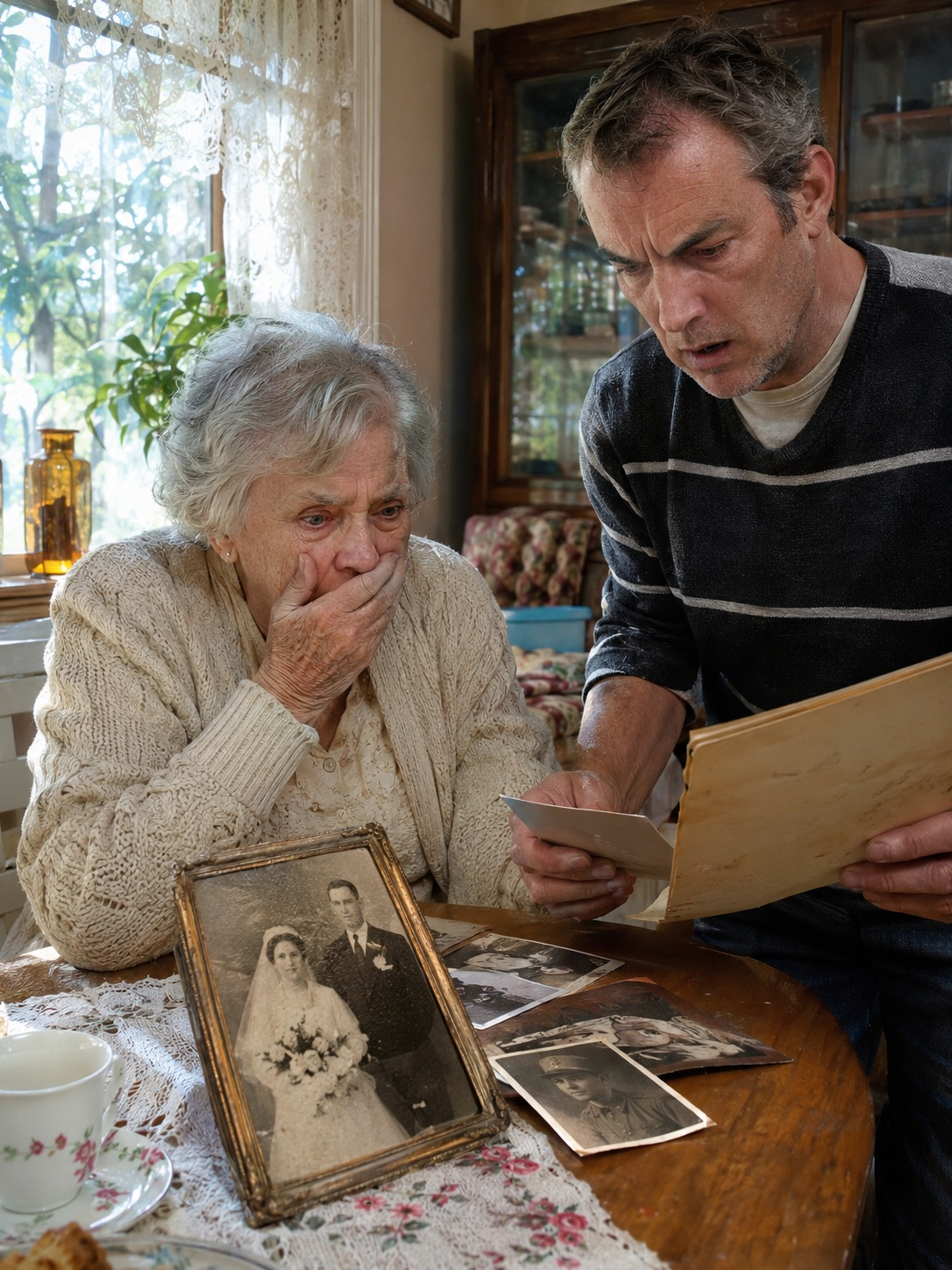
"Peter, something moved inside my stomach last night!"
I gripped the telephone so tightly that my fingers hurt.
My youngest son, Peter Callahan, was fifty-six years old, a successful accountant, and the kind of man who could stay calm during a house fire. But when I told him what had happened, he stopped speaking.
Then I heard his chair scrape against the floor.
"Mom, don't move. I'm coming over."
Before I could answer, my eyes fell on the framed wedding photograph of my late husband, Walter, standing on the dining table.
Behind the photograph was a yellowed envelope I had found among his belongings.
Three words were written across the back.
ST. AGNES — CONFIDENTIAL.
I had seen that handwriting before.
And suddenly, I knew my swollen stomach wasn't the only thing I needed to worry about.
My name is Ruth Callahan.
I am eighty years old.
I have raised three children, welcomed seven grandchildren, and lived long enough to hold four great-grandchildren in my arms.
I've buried my parents, survived two surgeries, watched my children make mistakes I couldn't prevent, and said goodbye to friends I thought would always be there.
But until six months ago, I believed the greatest heartbreak of my life had already happened.
That was the day I buried my husband.
Walter Callahan died twelve years ago, at sixty-eight, after what the doctors described as a sudden cardiac event.
We had been married for fifty years.
Fifty years of Sunday dinners, Christmas mornings, arguments over grocery bills, family vacations, and quiet evenings sitting beside each other without needing to speak.
Walter was not a perfect man.
He could be stubborn.
He hated admitting when he was wrong.
And he had an irritating habit of hiding important paperwork in places no reasonable person would think to look.
But he was my husband.
I loved him.
And I believed he loved me.
After his funeral, my children wanted me to sell our house.
They said it was too large for one woman.
They worried about the stairs, the maintenance, and the possibility of me falling when nobody was around.
I refused.
That house held fifty years of my life.
My children had taken their first steps across its floors.
Walter had painted the kitchen cabinets himself.
Every Christmas, he had climbed a ladder to hang lights around the front porch, even when his knees started bothering him.
I wasn't ready to leave those memories behind.
So I stayed.
And for twelve years, I lived quietly.
Until my body began changing.
It started so gradually that I barely noticed.
One morning, I couldn't button my favorite navy trousers.
I blamed the cookies my granddaughter had brought over.
A month later, my waistbands felt uncomfortable.
Then my dresses began fitting differently.
By the third month, my stomach had become noticeably rounded.
Not simply heavier.
Swollen.
Firm.
Unnatural.
I told myself it was age.
At eighty, the body does strange things.
I had seen enough doctors over the years to know that every new ache did not necessarily mean disaster.
But by the fifth month, bending over to tie my shoes had become difficult.
Sometimes I felt pressure beneath my ribs.
Other times, there was a strange sensation deep inside my abdomen, almost like something shifting when I changed positions.
I knew it wasn't normal.
I just didn't want to admit it.
The first person who confronted me was my daughter-in-law, Beth.
Beth had been married to Peter for thirty-one years.
She was practical, gentle, and far more observant than my own children sometimes realized.
One Sunday afternoon, she came over carrying a casserole.
I was standing at the kitchen counter when she stopped behind me.
"Mom, can I ask you something?"
"Of course, sweetheart."
She hesitated.
"Have you been to the doctor about your stomach?"
I looked down.
My loose cotton dress stretched across my abdomen.
I laughed.
"Beth, I'm eighty. Things aren't exactly where they used to be."
She didn't laugh.
"Ruth, I'm serious."
I turned toward her.
Her expression frightened me more than her words.
"How long has it been like that?"
"Oh, a few months."
"How many months?"
"Maybe six."
Her eyes widened.
"Six months?"
"Don't look at me like that."
"Mom, that's not normal."
I waved a hand.
"Probably bloating."
"Then let a doctor tell you that."
I promised her I would make an appointment.
I meant it when I said it.
But Monday came, and I had laundry to finish.
Tuesday, my neighbor Margaret invited me for coffee.
Wednesday, my oldest daughter called about her grandson's birthday.
By Thursday, I had convinced myself the swelling wasn't any worse.
Then came the night that changed everything.
I woke at 2:17 in the morning.
I remember the exact time because the glowing numbers on my bedside clock were the first thing I saw.
Something felt wrong.
There was a heavy pressure in my abdomen.
Not sharp pain.
Not exactly nausea.
Something deeper.
I shifted onto my left side.
The pressure changed.
Then I felt it.
A movement.
A slow, unmistakable shifting sensation beneath my hand.
I froze.
For several seconds, I couldn't breathe.
Then it happened again.
I sat upright.
"Dear God," I whispered.
My first thought was absurd.
At eighty years old, I knew perfectly well I wasn't pregnant.
Yet the sensation reminded me so strongly of the movements I had felt during my pregnancies that my mind went somewhere it had no business going.
I pressed my palm against my stomach.
Nothing.
Then another faint movement.
I turned on the bedside lamp.
My abdomen looked larger than it had the week before.
The skin beneath my nightgown appeared stretched.
I tried standing.
A wave of pressure made me grip the bedpost.
That was when I became frightened.
Not concerned.
Not mildly worried.
Frightened.
I considered calling an ambulance.
But the sensation gradually settled, and I convinced myself to wait until morning.
It was a decision I would later regret.
At seven-thirty, I called Peter.
"Mom?" he answered. "Everything okay?"
I tried to sound cheerful.
"Good morning, sweetheart."
"Mom."
"What?"
"You never call this early unless something's wrong."
I looked toward the window.
"Well, I had a strange night."
"What kind of strange?"
I told him.
Not everything at first.
Just the pressure.
The discomfort.
The fact that my stomach seemed larger.
Then I described the movement.
He went silent.
"Peter?"
"Mom, have you called your doctor?"
"No."
"Why not?"
"Because I wanted to talk to you first."
"Are you in pain right now?"
"Not exactly."
"Can you breathe normally?"
"Yes."
"Any dizziness? Fever? Vomiting?"
"No, sweetheart."
"Okay. I'm coming over. We're getting you checked."
I started protesting.
He interrupted.
"Mom, please."
There was something in his voice I hadn't heard since he was a little boy.
Fear.
I stopped arguing.
"All right."
He arrived twenty-eight minutes later.
Beth came with him.
She took one look at me and pressed her lips together.
Peter stood in the doorway holding his car keys.
For a moment, he didn't say anything.
Then he crossed the room and hugged me.
"You're going to be okay," he whispered.
I wanted to believe him.
But I noticed he didn't sound certain.
Beth helped me into a loose cardigan.
Peter collected my medications and insurance card.
Before we left, I asked him to bring the small folder from my dining table.
"Which folder?"
"The one beside your father's picture."
He walked into the dining room.
I heard papers moving.
Then he returned holding a pale yellow envelope.
"Mom, what's this?"
I looked at it.
The envelope was old, its edges slightly curled.
"I found it in your father's desk last week."
"Why didn't you tell me?"
"Because I didn't think it mattered."
He turned it over.
The words ST. AGNES — CONFIDENTIAL were written in blue ink.
"What's St. Agnes?"
"I don't know."
"Was Dad treated there?"
"Not that I remember."
Peter frowned.
"That's strange."
"Why?"
"St. Agnes was a medical center, Mom. It closed years ago."
I stared at him.
"How do you know?"
"One of my clients handled part of the property sale."
He examined the envelope again.
"Did you open it?"
"No."
"Why not?"
I hesitated.
The truth was embarrassing.
Because it had Walter's handwriting on it.
Because it felt private.
Because even after twelve years, there were things belonging to my husband that I couldn't bring myself to disturb.
"I suppose I was waiting for the right time."
Peter looked at me.
Then he slipped the envelope into the folder.
"We'll deal with it later."
At the hospital, the emergency department was busy.
A nurse checked my blood pressure, temperature, oxygen level, and pulse.
She asked about my symptoms.
I explained the swelling.
The pressure.
The strange movements.
She listened carefully.
Then she asked how long it had been happening.
"Six months."
Her pen stopped.
"Six months?"
I nodded.
She glanced at Peter.
I didn't like that glance.
Within an hour, I had blood drawn and was examined by an emergency physician named Dr. Melissa Grant.
She was a woman in her forties with kind eyes and a voice that made difficult questions sound manageable.
She pressed gently around my abdomen.
"Does this hurt?"
"A little."
"Here?"
"More pressure than pain."
She moved her hand.
"How long have you noticed the enlargement?"
"About six months."
"Any loss of appetite?"
"Some."
"Feeling full after small meals?"
"Yes."
"Any changes in bowel habits?"
I answered.
She listened.
Then she sat beside my bed.
"Mrs. Callahan, I'd like to order imaging of your abdomen."
Peter leaned forward.
"What are you looking for?"
"There are several possibilities. We need more information before making conclusions."
"Could it be cancer?" he asked.
The word struck me like a slap.
Cancer.
I had avoided saying it.
Hearing my son say it aloud made the room feel smaller.
Dr. Grant didn't dismiss the concern.
"Some causes of abdominal swelling are serious, and some are treatable. Imaging will help us understand what's happening."
I looked at her.
"Doctor, I felt something move."
She nodded.
"Fluid, bowel movement, or pressure from an internal mass can sometimes create unusual sensations. We shouldn't assume what caused it until we have the scan."
That explanation made sense.
I clung to it.
They took me for a CT scan.
The technician helped me lie flat.
I stared at the ceiling while the machine moved around me.
I thought about Walter.
Not because I believed he had anything to do with my illness.
But because being frightened in a hospital made me miss him.
Walter had always held my hand during medical appointments.
Even when we argued, he was there.
During my gallbladder surgery, he slept in an uncomfortable chair beside my bed.
After my knee replacement, he learned to cook three meals without burning them.
He had been my partner through every frightening moment.
And now, when I needed him, he was gone.
When I returned to the examination room, Peter was speaking quietly with Beth.
They stopped when they saw me.
"What?" I asked.
"Nothing, Mom," Peter said.
"Don't start that."
He smiled weakly.
"Start what?"
"Talking about me like I'm already dead."
Beth reached for my hand.
"Nobody's doing that."
I looked from one to the other.
"Then stop looking so worried."
Peter sat beside me.
"Okay."
We waited.
And waited.
After nearly an hour, Dr. Grant returned.
She was carrying a tablet.
Her expression was professional, but I noticed she had brought another doctor with her.
He introduced himself as Dr. Samuel Price, a radiologist.
That frightened me.
Doctors didn't usually arrive in pairs to announce that everything was fine.
Dr. Grant sat down.
"Mrs. Callahan, the scan shows a very large fluid-filled structure in your abdomen."
I swallowed.
"What does that mean?"
"It appears to be a complex cystic mass. It's occupying a significant amount of space."
Peter leaned forward.
"How significant?"
Dr. Price answered.
"Large enough to displace some surrounding organs."
Beth covered her mouth.
I stared at him.
"Is it cancer?"
"We can't determine that from this scan alone," he said. "We need additional testing and a specialist's evaluation."
I tried to understand.
A cyst.
A mass.
Something large enough to move my organs.
No wonder I couldn't button my trousers.
"Can you remove it?"
"That may be possible," Dr. Grant said. "But first we need to understand its origin and the safest way to treat it."
Peter asked several questions.
I barely heard them.
My mind was stuck on one thought.
Something had been growing inside me for six months.
And I had done nothing.
Dr. Grant explained that a gynecologic specialist would review the imaging.
Then she asked a question that seemed to come from nowhere.
"Mrs. Callahan, have you ever had abdominal surgery other than your gallbladder removal?"
I frowned.
"My appendix when I was young. And a hysterectomy years ago."
"What year was your hysterectomy?"
I thought for a moment.
"Fourteen years ago. Maybe fifteen."
"Do you remember where?"
"St. Agnes Medical Center."
Peter turned toward me.
I saw his expression change.
"Mom."
"What?"
"St. Agnes?"
I nodded.
"Yes."
He reached for the yellow envelope in his folder.
The doctor noticed.
"Is something wrong?"
Peter looked at her.
"My father left some old paperwork from St. Agnes."
Dr. Grant's eyes moved toward the envelope.
"What kind of paperwork?"
"We don't know yet."
He opened the folder.
The envelope lay inside.
I watched him turn it over.
Then he carefully lifted the flap.
It had never been sealed.
Inside were two folded sheets.
The first looked like a hospital billing statement.
The second was a photocopied form.
Peter unfolded it.
His expression changed.
"What's wrong?" I asked.
He didn't answer.
"Peter?"
He stared at the page.
Then he looked at Dr. Grant.
"Can I ask you something?"
"Of course."
"Would a hospital ever keep a medical record under a family member's name instead of the patient's?"
Dr. Grant frowned.
"That depends on the type of record. A guarantor or authorized representative might be listed, but the patient's clinical record should identify the patient."
Peter looked down again.
"Then why is my father's name here?"
He handed her the paper.
Dr. Grant examined it.
Her expression became serious.
She read the document twice.
Then she glanced at Dr. Price.
"Would you excuse us for a moment?"
The radiologist stepped outside.
I felt my heart begin to pound.
"Doctor?"
She looked at me.
"Mrs. Callahan, I want to be careful. This is an old document, and I can't verify its meaning without reviewing the original records."
"What does it say?"
Peter reached for my hand.
"Mom—"
"No."
I pulled away.
"Don't do that. Don't protect me from my own life."
He looked hurt.
I didn't care.
I was eighty years old.
I had earned the right to hear the truth.
Dr. Grant placed the paper on the table.
At the top was the name of the medical center.
ST. AGNES.
Below it was a date.
Twelve years earlier.
The year Walter died.
And beneath that was a heading.
SPECIAL RECORDS — RESTRICTED ACCESS.
I stared at it.
"What is that?"
Dr. Grant hesitated.
"It appears to reference a previous medical review."
"Of me?"
"Possibly."
"Then why is Walter's name on it?"
She didn't answer immediately.
Peter squeezed my hand.
I looked at him.
His face had turned pale.
"Peter, what aren't you telling me?"
He swallowed.
"Mom, Dad signed something."
"What?"
"A request."
"For what?"
He looked toward the doctor.
She answered carefully.
"An independent review of a medical finding."
I frowned.
"What finding?"
Dr. Grant looked at the CT report on her tablet.
Then back at the old document.
"That's what concerns me. The description here may refer to something similar to what we're seeing today."
For a moment, nobody spoke.
I looked down at my swollen abdomen.
Then at the paper.
"Are you telling me this was there twelve years ago?"
"We don't know that yet," she said. "The dates and terminology need to be verified."
Peter stared at the signature.
"That's Dad's handwriting."
I knew it was.
Walter had signed his name the same way for fifty years.
A large W.
A narrow A.
The final R curling sharply beneath the line.
I had watched him sign birthday cards, mortgage documents, school permission slips, and our children's college checks.
There was no mistaking it.
But another detail bothered me.
The date.
The form had been signed eleven days before Walter died.
I remembered those eleven days.
He had been unusually quiet.
He stopped going to his weekly card games.
He made several phone calls from the garage.
Once, I walked into his study and found him sitting at his desk with tears in his eyes.
When I asked what was wrong, he said he was tired.
I believed him.
Now I wondered whether he had been hiding something.
"Peter," I whispered, "turn the page over."
He looked at me.
"Mom?"
"Please."
He turned it.
There was writing on the back.
Not much.
A short handwritten instruction.
I recognized Walter's handwriting immediately.
Do not discuss this with Ruth until the review is complete.
My stomach seemed to drop.
For fifty years, Walter had told me everything.
At least, I thought he had.
"Why would he write that?" I whispered.
Peter didn't answer.
Dr. Grant spoke gently.
"We shouldn't interpret a note without knowing the circumstances."
But I wasn't listening.
I remembered Walter's final week.
The way he had hugged me longer than usual.
The way he had insisted on taking me out for dinner even though he seemed exhausted.
The way he had said something strange while we were washing dishes.
"Ruth, if you ever find out I made a mistake, promise me you'll remember I loved you."
I had laughed.
"What kind of mistake?"
He kissed my forehead.
"Nothing, sweetheart. Just an old man talking."
I had forgotten that conversation.
Until now.
A nurse entered and told Dr. Grant that the specialist wanted to review my case.
The doctor excused herself.
Peter sat beside me.
Beth stood near the window.
For several minutes, nobody spoke.
Then I reached for the document.
"Let me see it."
Peter hesitated.
I held out my hand.
He gave it to me.
I studied the writing.
The date.
The signature.
Then I noticed something beneath the printed text.
A second signature.
Smaller.
Written in dark ink.
I couldn't read the name clearly because part of it had been obscured by a photocopy mark.
"Peter, who signed here?"
He leaned closer.
"I can't tell."
"Look carefully."
He adjusted the paper beneath the light.
The first name appeared to begin with an E.
The last name was partially visible.
I could make out the final letters.
I felt a strange pressure in my chest.
Because those letters looked familiar.
Very familiar.
"Mom?" Peter asked.
I shook my head.
"Nothing."
But it wasn't nothing.
I had seen a signature like that before.
Years earlier.
On a Christmas card Walter had received from a woman I had never met.
I remembered asking him about her.
He told me she was an old hospital administrator.
Someone who had helped with paperwork after my surgery.
I hadn't questioned him.
Why would I?
We had been married almost forty years at the time.
I trusted him.
Peter took the document back.
"Mom, we need to find out what this means."
I nodded.
"Yes."
He reached for his phone.
"I'm going to call someone who might know how to request old hospital records."
Before he could dial, the door opened.
Dr. Grant returned.
This time, she wasn't alone.
A woman in a dark blue suit stood beside her.
She appeared to be in her sixties, with neatly styled silver hair and a hospital identification badge clipped to her jacket.
Dr. Grant looked unusually tense.
"Mrs. Callahan, this is Helen Mercer. She works with our medical records and patient advocacy department."
The woman looked directly at me.
Then at the document in Peter's hands.
Her expression changed.
She stepped closer.
"Where did you get that?"
Peter stood.
"It belonged to my father."
Helen didn't seem to hear him.
Her eyes remained fixed on the old form.
"Mrs. Callahan," she said quietly, "I need to ask you something."
I looked at her.
"What?"
"Did your husband ever tell you what happened at St. Agnes twelve years ago?"
I shook my head.
"No."
She closed her eyes briefly.
Then she reached into her briefcase and removed a thin folder.
"I was afraid of that."
Peter moved closer to me.
"What are you talking about?"
Helen placed the folder on the table.
Across its cover was a red stamp.
CONFIDENTIAL — PATIENT NOTIFICATION PENDING.
My name was printed beneath it.
RUTH CALLAHAN.
I stared at the folder.
My mouth went dry.
"Why would there be a file about me?"
Helen looked at Dr. Grant.
Then she looked at my son.
Finally, she turned toward me.
"Mrs. Callahan, before your husband died, he requested that a particular medical record be reviewed. The review was never properly completed."
Peter's voice hardened.
"What record?"
Helen slowly opened the folder.
Inside was a single photograph.
She looked at it.
Then she looked at my swollen stomach.
The color drained from her face.
"That can't be right," she whispered.
Peter stepped forward.
"What can't be right?"
Helen lifted the photograph.
It showed an image from a medical scan.
A date was printed in the corner.
Twelve years earlier.
And beneath the image was a handwritten note.
Helen read it silently.
Then she turned the photograph toward me.
I leaned forward.
The image was unfamiliar.
But the name printed at the top was unmistakable.
Mine.
RUTH CALLAHAN.
I looked at Helen.
"What is that?"
She swallowed.
"Mrs. Callahan, this image was taken twelve years ago."
Peter stared at the photograph.
Then at the current CT report.
His expression changed.
"Wait."
He placed both images beside each other.
He looked from one to the other.
Then he whispered something I could barely hear.
"No. That's impossible."
I grabbed his arm.
"Peter, tell me what's happening."
He didn't answer.
Instead, he pointed toward a small handwritten notation in the lower corner of the old image.
Helen leaned forward.
Her eyes widened.
Then she whispered, "I know who wrote that."
Peter looked at her.
"Who?"
Helen slowly turned toward the doorway.
Her face had gone completely pale.
"There's someone you need to meet."
At that exact moment, footsteps stopped outside my hospital room.
Helen looked toward the door.
Her voice trembled.
"She's the person who signed your husband's file."
The door handle began to turn.
And then I heard a woman's voice say my name.
A voice I hadn't heard in twelve years.
"Ruth? It's time you knew what Walter made me promise..."






Comments 0