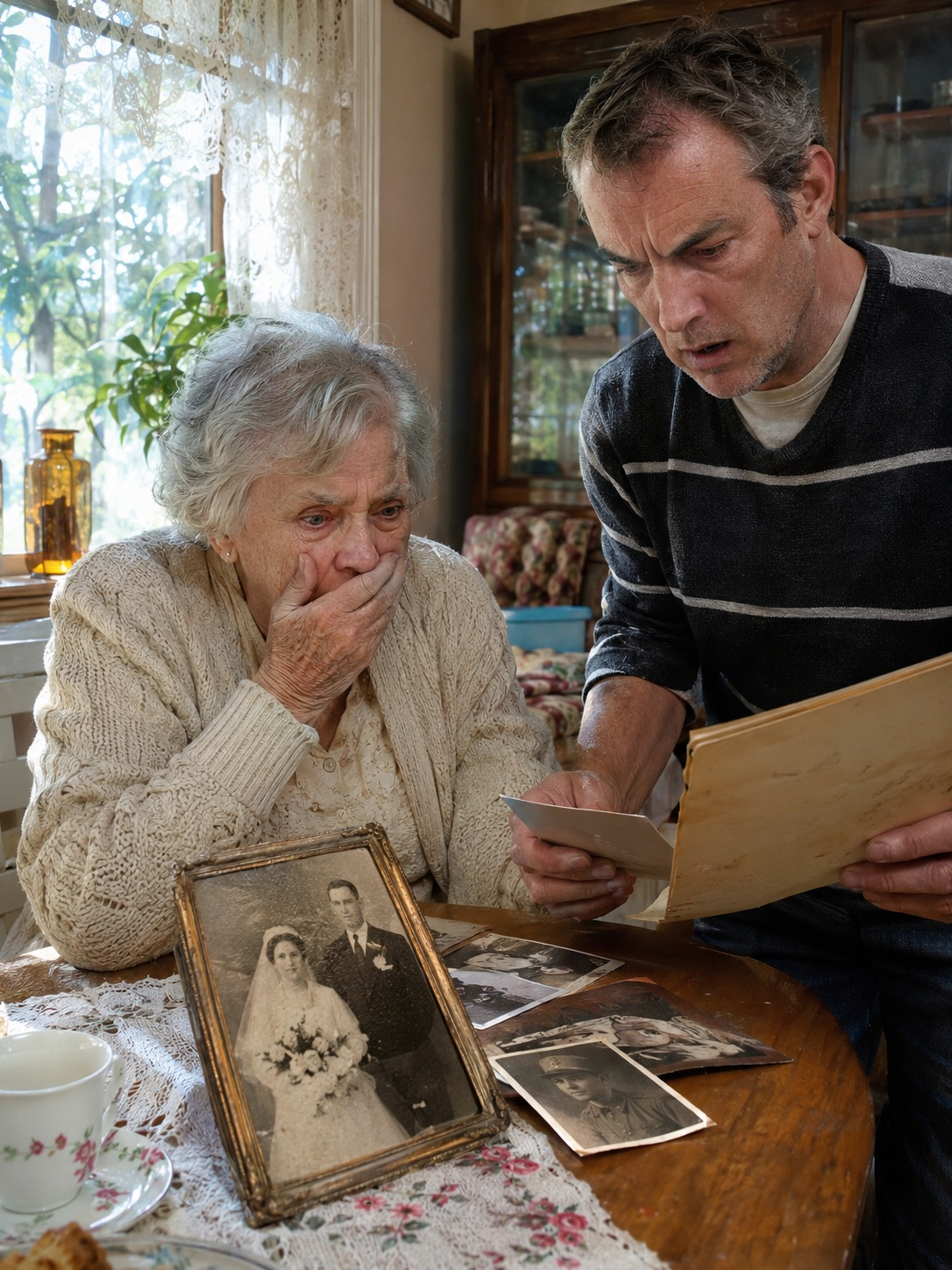
"Don't let him take that certificate!" I shouted.
The man standing behind Margaret stopped in the hospital doorway.
My sister gripped the frame with one hand. Her silver bracelet slipped beneath the sleeve of her dark coat, but I had already seen it.
The little heart.
The dent along its edge.
The crescent-shaped scar on her other wrist.
Twenty years after I had watched a coffin lowered into the ground, my younger sister was standing in front of me.
And someone was trying to stop her from speaking.
"Who are you?" I demanded.
The man stepped into the light.
He was tall and thin, with a deeply lined face and neatly combed gray hair. He wore a brown overcoat over a dark suit, and his right hand held a yellowed document inside a transparent protective sleeve.
He looked about seventy.
His expression was tense, but he did not look surprised to see me.
"Mrs. Callahan," he said, "my name is Daniel Whitcomb."
I stared at him.
"Whitcomb?"
"Yes."
"Eleanor's husband?"
He nodded.
I felt a rush of anger.
"Where is Eleanor?"
He looked toward Margaret.
"That's one of the reasons I'm here."
Margaret turned on him.
"Daniel, you promised you wouldn't interfere."
"I promised to bring you safely to the hospital."
"You told me I could speak to Ruth."
"And you can. But not about Walter's death until we know who has the original records."
I gripped the blanket.
"Stop."
Both of them looked at me.
"I have spent the entire day listening to people speak in half-sentences. I am eighty years old. I have a mass growing inside my abdomen, and I have just discovered that my sister may have been alive for twenty years while I mourned her."
My voice trembled.
"Nobody is going to tell me what I am allowed to hear."
Daniel lowered his eyes.
Margaret began crying.
And then she took another step into the room.
"Ruthie."
I had heard that nickname thousands of times when we were young.
Our mother used it.
Walter used it.
But Margaret always said it differently.
She drew out the first syllable, as though she were trying to make me laugh.
I looked at her face.
The years had changed her.
Her cheeks were thinner.
Deep lines framed her mouth.
Her hair, once almost black, was now silver.
But her eyes were the same.
Green.
Bright.
And filled with the kind of sadness that doesn't come from one terrible day.
It comes from years.
"Margaret?" I whispered.
She nodded.
I tried to get out of bed.
A sharp pressure moved through my abdomen.
I gasped and grabbed the rail.
Margaret rushed forward.
"Don't get up."
She reached for my hand.
The moment her fingers touched mine, I began to cry.
Not because I understood what had happened.
I didn't.
Not because I had forgiven anyone.
I hadn't.
I cried because her hand was warm.
Because she was breathing.
Because the sister I had buried was standing beside my hospital bed.
"You're alive," I whispered.
She pressed my hand against her cheek.
"I'm here."
I stared at her.
"How?"
She began shaking.
"I'm going to tell you."
"Why didn't you come home?"
Her expression collapsed.
"Ruth—"
"Why didn't you call me?"
She closed her eyes.
"Please."
"Twenty years, Margaret."
I pulled my hand away.
"Twenty years."
She stepped back.
The pain in her face was almost unbearable to watch.
But I couldn't stop.
"Do you know how many birthdays I spent wishing you were here? Do you know how many times I wanted to call you? Do you know what it felt like standing beside your grave?"
She covered her mouth.
"I'm sorry."
I shook my head.
"No. Not yet. You don't get to apologize before you explain."
Behind her, Daniel remained near the doorway.
Then footsteps approached from the hall.
Peter appeared.
He stopped so abruptly that Beth nearly walked into him.
For several seconds, he simply stared.
Then he whispered, "Aunt Margaret?"
My sister turned.
Her face changed.
"Peter."
He looked at her bracelet.
Then her face.
Then me.
"Mom?"
I nodded.
My son pressed one hand against the wall.
He had been eight years old when Margaret supposedly died.
He remembered her bringing candy.
He remembered her laughing at Walter's terrible jokes.
He remembered the little birthday cards she sent with five-dollar bills tucked inside.
Now she was standing in front of him.
He took a step forward.
"Is it really you?"
Margaret nodded.
"Oh, Peter."
He crossed the room and hugged her.
For a moment, I watched them.
Then I looked at Daniel Whitcomb.
He was still holding the death certificate.
"Put that on the table," I said.
He hesitated.
"Mrs. Callahan—"
"Now."
He placed it beside my bed.
Peter released Margaret and turned toward him.
"Who are you?"
"Daniel Whitcomb."
Peter's expression hardened.
"Eleanor's husband."
"Yes."
"Where is she?"
Daniel swallowed.
"I haven't been able to reach her."
Peter moved closer.
"Someone interrupted our call with her. We heard a crash and a man shouting."
Daniel's face tightened.
"I know."
"You know?"
"She called me before she contacted you. She said someone had discovered the Meridian records."
Peter stared at him.
"Then why didn't you call the police?"
"I did."
"When?"
"Earlier tonight."
Peter folded his arms.
"We've already reported what happened. The police need to know you're here."
Daniel nodded.
"I understand."
Margaret looked frightened.
"Daniel, please."
He turned toward her.
"I'm not going anywhere."
I watched them.
There was something strange about the way Margaret looked at him.
Not affection.
Not exactly fear.
Something closer to dependence.
As though he had been responsible for keeping her safe.
Or keeping her somewhere.
I didn't yet know which.
"Peter," I said, "call the nurse."
He looked at me.
"Mom?"
"I want someone to know these people are here."
Daniel nodded.
"That's reasonable."
Peter pressed the call button.
Within minutes, a nurse arrived.
She checked my blood pressure, noticed my distress, and asked whether I wanted visitors to leave.
"No," I said. "I want them to stay. But I want their names recorded."
The nurse looked at Daniel and Margaret.
They gave their names.
She explained that hospital security would need to verify late-night visitors and that my medical care couldn't be interrupted.
I agreed.
Then I looked at Margaret.
"Sit down."
She obeyed.
For the first time in twenty years, my sister sat beside me.
And I waited for her to tell me why I had buried a stranger.
Margaret stared at her hands.
The silver bracelet rested against her wrist.
I remembered our mother giving it to her on her eighteenth birthday.
Margaret had been so proud.
She wore it to school.
To work.
To church.
And apparently through whatever had happened during the past twenty years.
"Start with the night you called me," I said.
She looked up.
"The night before I disappeared?"
"Yes."
She swallowed.
"I was frightened."
"Of Walter?"
Her eyes filled with tears.
"Not at first."
Peter sat beside the window.
Beth stood behind him.
Daniel remained near the door.
Margaret looked toward him.
He gave a small nod.
I noticed.
"Margaret," I said, "look at me when you speak."
She turned back.
"I'm sorry."
"Tell me."
She took a breath.
"Twenty years ago, I was helping Walter organize financial records for his business."
I nodded.
I remembered that.
"He had asked me to review several accounts because his regular bookkeeper was ill."
"What did you find?"
"Payments that didn't belong to his business."
Peter leaned forward.
"What kind of payments?"
Margaret hesitated.
"Transfers to a medical consulting organization."
My heart began pounding.
"Meridian?"
She shook her head.
"No. Meridian didn't exist yet. The earlier company had another name."
"What name?"
"Northbridge Clinical Services."
Peter immediately wrote it down.
Margaret continued.
"At first, I thought Walter was helping someone pay medical bills. He was generous, Ruth. You know that."
I nodded.
Walter had quietly helped neighbors.
He paid for a young employee's dental surgery.
He once covered three months of rent for a widow who lived down the street.
He rarely talked about those things.
But he always told me when he used our money.
At least, I thought he did.
"Then I found invoices," Margaret said.
"From whom?"
"A physician named Adrian Bellamy."
Peter looked up.
"Bellamy was involved twenty years ago?"
Margaret nodded.
"He wasn't the doctor who treated me. He was connected to the records review that came later."
I frowned.
"What records?"
Margaret looked down.
"Mine."
The room became quiet.
I stared at her.
"What happened to you?"
She pressed her fingers together.
"I had been seeing a doctor because of headaches, dizziness, and episodes when I couldn't remember things."
My stomach tightened.
"Why didn't you tell me?"
"Because I didn't want you to worry."
I almost laughed.
Those words again.
The same excuse Walter had used.
The same explanation everyone seemed to offer when they had decided to keep me ignorant.
Margaret noticed my expression.
"I know how that sounds now."
"Then keep going."
She nodded.
"One evening, I became confused while driving. I pulled into a parking lot and called Walter because he was the first person I could reach."
"Why Walter?"
"He knew about the appointments. He had helped me with the insurance forms."
I looked at Daniel.
He was watching Margaret closely.
She continued.
"Walter took me to St. Agnes. They admitted me for observation."
"What did they find?"
"At the time, they suspected a neurological problem. Later, another doctor believed some of my symptoms might have been related to medication."
Peter frowned.
"What medication?"
Margaret looked uncomfortable.
"I don't remember every name. I know I was given several prescriptions, and afterward I became more confused."
I felt sick.
"Did you have a stroke?"
She shook her head.
"Not the kind they told you about."
I gripped the blanket.
"Then why did they tell me you died?"
Margaret's face changed.
She looked toward Daniel again.
This time, I turned on him.
"Stop looking at her."
He seemed startled.
"Mrs. Callahan—"
"Every time she gets close to answering, she looks at you. Why?"
He opened his mouth.
Margaret spoke first.
"Because Daniel helped me."
I stared at her.
"Helped you do what?"
"Survive."
The word hung between us.
She took a trembling breath.
"Ruth, I was very ill. I wasn't thinking clearly. There were days I couldn't remember where I was. I became frightened of the doctors. I became frightened of Walter."
"Why?"
"Because I thought he was trying to keep me in the hospital."
My throat tightened.
"Was he?"
Margaret looked at me.
"I don't know what he believed at the beginning."
Peter leaned forward.
"What do you mean?"
She rubbed her hands together.
"Walter told me the doctors were trying to stabilize me. He said I needed treatment."
"Did you?"
"Yes. But I also needed someone to explain what was happening. And nobody seemed willing to do that."
I thought about my own day.
Doctors.
Documents.
People speaking in careful language.
Everyone deciding how much information I should receive.
For the first time, I understood how frightened Margaret must have been.
"What happened next?" I asked.
She looked at Daniel.
He stepped forward.
"Mrs. Callahan, there are parts of this that Margaret doesn't remember clearly."
I turned toward him.
"Then you can explain those parts."
He nodded.
"Twenty years ago, I worked as an administrative investigator for a regional health oversight organization."
Peter frowned.
"Not as an attorney?"
"No. My wife Eleanor was a nurse, and I worked in compliance."
"How did you meet Margaret?"
"Through a complaint concerning her treatment."
"Who filed it?"
Daniel hesitated.
"Walter."
I stared at him.
"My husband?"
"Yes."
That answer surprised me.
If Walter had been trying to hide Margaret, why would he file a complaint?
Daniel continued.
"He believed her medical care had been mishandled. He requested an independent review."
I looked at Margaret.
"Then why were you afraid of him?"
She began crying.
"Because I didn't know who to trust."
I felt my anger weaken.
Not disappear.
But change.
I was beginning to understand that the story might not be as simple as one cruel man hiding his sister-in-law.
There had been doctors.
Records.
Financial transfers.
And a woman who was ill enough to lose pieces of her memory.
Still, one question remained.
"Who was buried in your coffin?"
Margaret closed her eyes.
Daniel looked down.
I waited.
Finally, he spoke.
"A woman named Clara Bennett."
The name meant nothing to me.
I stared at him.
"Who was she?"
"A patient at St. Agnes."
"Why was she buried as my sister?"
Daniel took a breath.
"Because her identification was incorrectly associated with Margaret's during a serious administrative failure."
Peter sat upright.
"An accidental mistake?"
"That's how it was initially recorded."
"Initially?"
Daniel nodded.
"Later, there were indications that someone had recognized the error and failed to correct it."
My hands began trembling.
"Who?"
He shook his head.
"We never established that conclusively."
I stared at Margaret.
"Did you know I buried someone else?"
She began crying harder.
"Not at the time."
"When did you find out?"
"Years later."
"How many years?"
She looked at me.
"Eight."
I felt as though she had struck me.
Eight years.
She had known for twelve years that I had buried the wrong woman.
And she hadn't contacted me.
"Margaret."
My voice broke.
"Why?"
She reached for me.
I pulled away.
"Why didn't you come home?"
She lowered her hand.
"Because I was afraid."
"Of whom?"
She looked toward Daniel.
He remained silent.
Then Margaret whispered, "Of the person who signed the original death certificate."
I looked at the yellowed document on the table.
Daniel picked it up.
"Mrs. Callahan, this is a certified copy of the original death certificate."
He placed it in front of me.
I looked at the printed information.
MARGARET ELLIS.
Date of death.
Cause of death.
Attending physician.
And beneath the physician's name was another signature.
A witness.
I leaned closer.
The handwriting was familiar.
Too familiar.
I recognized the elegant loops.
The narrow letters.
The signature from the Meridian payment authorization.
Eleanor Whitcomb.
My breath caught.
"She signed it."
Daniel nodded.
"Yes."
I stared at him.
"Your wife signed my sister's death certificate?"
"She signed as the person who verified the transfer of the identification documentation. She did not medically certify the death."
Peter leaned forward.
"Was she aware the identity was wrong?"
Daniel's expression tightened.
"That's one of the questions she has spent years trying to answer."
I looked at Margaret.
"You trusted her?"
Margaret nodded.
"Eventually."
"Even after she signed that?"
"She was the one who helped me get out."
I stared at her.
"Out of where?"
Margaret's hands began shaking.
"A long-term care facility."
My heart pounded.
"Why were you there?"
"Because I wasn't well enough to live alone. At least, that's what they told me."
I looked at Daniel.
"Who authorized it?"
He hesitated.
Then he said, "A temporary guardian."
Peter leaned forward.
"Who?"
Daniel looked at me.
"Your husband."
For a moment, I couldn't speak.
Walter.
Again.
My husband had apparently become my sister's guardian.
He had arranged her funeral.
He had helped place her in a care facility.
And he had never told me she was alive.
I felt physically sick.
"Why would he do that?"
Margaret shook her head.
"He said he was trying to protect me."
I closed my eyes.
Those words had become unbearable.
Protect.
Protect.
Protect.
Everyone kept using that word.
But nobody seemed to understand what it had cost me.
I opened my eyes.
"Margaret, did Walter hurt you?"
She looked startled.
"No."
I stared at her.
"Are you sure?"
She nodded.
"He frightened me sometimes because he made decisions without explaining them. But he never struck me. He never threatened me."
"Then why didn't he tell me?"
Her face crumpled.
"Because someone told him you were at risk too."
My stomach tightened.
"What risk?"
She looked toward my swollen abdomen.
And suddenly, I understood that the medical mystery and the family secret were not separate stories.
They were connected.
"Margaret," I whispered, "what did they tell Walter about me?"
She opened her mouth.
But before she could answer, the hospital door opened.
Dr. Jonathan Reeves entered.
He looked surprised to see the visitors.
Then his eyes fell on Margaret.
He stopped.
For several seconds, nobody spoke.
Finally, he said, "Margaret Ellis?"
My sister went pale.
"Dr. Reeves?"
He stared at her.
"I thought you were—"
"Dead?" Margaret finished.
He didn't answer.
Peter stood.
"Doctor, you know her?"
Dr. Reeves looked from Margaret to Daniel.
Then back at me.
"I knew of her case."
I felt my heart pounding.
"Then maybe you can explain why my sister was declared dead while she was still alive."
Dr. Reeves closed the door.
He looked deeply troubled.
"Mrs. Callahan, I think we need to separate the medical records from the identity investigation."
I stared at him.
"Why?"
"Because your current condition may have been affected by the same documentation failures."
I pressed my hand against my stomach.
"What do you mean?"
He pulled a chair beside my bed.
"The old records suggest that a specimen from your hysterectomy was assigned more than one identification number."
Peter nodded.
"We know that."
"But what we didn't know earlier was why."
I leaned forward.
"Have you found out?"
"Not completely. However, Dr. Foster located a reference to a correction request."
"What correction?"
"One involving two patients whose records had been linked."
I looked at Margaret.
She looked frightened.
Dr. Reeves continued.
"Your sister's medical records were involved in an administrative investigation. Your surgical records were later included because of an overlapping identification code."
Peter frowned.
"Are you saying someone mixed up their medical files?"
"That is one possibility."
I stared at him.
"And my tumor?"
He spoke carefully.
"We still need to determine whether the old cystic finding was yours, whether it was followed appropriately, and how it relates to the mass we see now."
I looked down at my abdomen.
For months, I had blamed my age.
Now I wondered whether a medical mistake from years ago had been allowed to grow inside me.
"Doctor," I whispered, "could this have been prevented?"
He looked at me with genuine compassion.
"Earlier follow-up might have made a difference. But we need the complete records before making that conclusion."
I nodded.
Then Margaret spoke.
"Ruth, Walter tried to get those records."
I turned toward her.
"What?"
"He spent years trying."
I stared at her.
"Then why didn't he tell me?"
She looked down.
"Because the first time he tried, someone threatened to take away the only evidence he had."
Peter leaned forward.
"Who threatened him?"
Margaret shook her head.
"I don't know the person's name."
Daniel looked uncomfortable.
I noticed.
"Daniel," I said, "do you know?"
He hesitated.
Then he answered.
"I know there were threats. I don't know who made every one of them."
Peter crossed his arms.
"Then tell us about the ones you do know."
Daniel looked toward the door.
For the first time, I noticed he seemed frightened of someone entering.
"Mr. Whitcomb," Peter said, "we're not leaving until you explain."
Daniel took a breath.
"After Walter requested the independent review, someone began contacting him."
"Who?"
"An unidentified caller."
"What did they want?"
"For him to withdraw the complaint."
I felt cold.
"Did he?"
"No."
"Then what happened?"
Daniel looked at Margaret.
"She was moved."
I stared at him.
"Moved where?"
"To another facility."
"Without telling me?"
"Yes."
I gripped the blanket.
"Who authorized it?"
Daniel hesitated.
"That authorization is one of the missing records."
Peter looked furious.
"So my father was threatened, my aunt was moved, and my mother was never told?"
Daniel nodded.
"That's what the surviving documents suggest."
I looked at Margaret.
She was crying silently.
For the first time, I saw something beneath her fear.
Guilt.
She knew more.
I could feel it.
"Margaret," I said softly, "there's something you haven't told me."
She shook her head.
"Ruth—"
"Please."
Her eyes filled.
"I didn't want you to hate him."
I stared at her.
"Walter?"
She nodded.
I felt my heart break a little more.
"What did he do?"
Margaret covered her mouth.
For a long moment, she couldn't speak.
Then she whispered, "He made a choice."
"What choice?"
She looked toward Daniel.
He shook his head.
"Margaret, not yet."
I turned on him.
"Enough!"
My voice startled everyone.
Even Dr. Reeves.
I leaned forward despite the pressure in my abdomen.
"I have spent twenty years mourning my sister and twelve years mourning my husband. I am not going to spend whatever time I have left listening to people decide when I deserve the truth."
Daniel lowered his eyes.
Margaret began crying harder.
I looked directly at her.
"Tell me."
She swallowed.
"Walter was given two options."
My heart pounded.
"What options?"
"He could expose the records discrepancy immediately."
"And?"
"Or he could sign an agreement that would allow the investigation to continue privately while I remained under supervised care."
I stared at her.
"Why would he choose that?"
"Because he was told that public disclosure might put both of us at risk."
I felt cold.
"Both of us?"
Margaret nodded.
"You and me."
I looked toward Dr. Reeves.
He seemed deeply concerned.
"What risk?" I asked.
Margaret shook her head.
"I never saw the full explanation."
Daniel stepped forward.
"The agreement was supposed to be temporary."
I stared at him.
"Temporary?"
"Yes."
"Twenty years is not temporary."
He looked ashamed.
"I know."
I turned back to Margaret.
"Did Walter ever try to tell me?"
She nodded.
"More than once."
"Then why didn't he?"
Her expression changed.
"Because the first time he tried, you became ill."
I stared at her.
"What?"
"You collapsed."
My mouth went dry.
I remembered a fainting episode years earlier.
Walter told me it was dehydration.
He took me to the hospital.
I stayed overnight.
The doctors said my blood pressure had dropped.
I had never connected it to Margaret.
"That was because of you?"
Margaret shook her head.
"I don't know what caused it. But Walter believed the stress was dangerous for you."
I looked at Dr. Reeves.
He spoke gently.
"Mrs. Callahan, we shouldn't assume that episode was caused by the situation without reviewing the medical record."
I nodded.
He was right.
But emotionally, it didn't matter.
Walter had used my health as a reason to keep me in the dark.
Whether he was right or wrong, he had made the decision for me.
And I had lost twenty years with my sister.
I looked at Margaret.
"Did you want to come home?"
She began sobbing.
"Every day."
I felt tears running down my face.
"Then why didn't you?"
She reached for my hand.
"Because by the time I was well enough to understand what had happened, I was told you believed I was dead. I was frightened that appearing suddenly would hurt you."
I shook my head.
"Margaret, losing you hurt me."
"I know."
"Not knowing hurt me."
"I know."
"And now I have to live with the fact that you were somewhere in this world while I visited your grave."
She closed her eyes.
"I'm sorry, Ruthie."
I looked at her for a long time.
Then I reached for her hand.
I wasn't ready to forgive everything.
But I wasn't willing to lose her again.
"Stay," I whispered.
She looked up.
"What?"
"Don't disappear again."
She nodded through tears.
"I won't."
For the first time in twenty years, I held my sister's hand.
And for a few moments, the hospital room became quiet.
The following morning, I woke to the sound of Peter speaking on the telephone.
He stood near the window.
His voice was low.
"Yes, I understand. But we need the original document."
I opened my eyes.
My abdomen felt heavy.
I had slept poorly.
Every time I closed my eyes, I saw Margaret standing in the doorway.
Peter noticed I was awake.
He ended the call.
"Morning, Mom."
I looked around.
"Where's Margaret?"
"She's with Beth in the family waiting area."
I felt a rush of relief.
She was still here.
I hadn't dreamed it.
"Good."
Peter sat beside me.
"I spoke with the police."
"And?"
"They're investigating the calls and the break-in. They've also asked Daniel and Margaret for statements."
I nodded.
"What about Eleanor?"
His expression darkened.
"Still no confirmed contact."
My stomach tightened.
"Do they think she's hurt?"
"They haven't told us that."
I looked toward the door.
I remembered Eleanor's voice.
Her fear.
The crash.
The man shouting.
I didn't know whether she had lied to us.
But I didn't want her harmed.
Peter reached into his bag.
"Mom, there's something else."
He placed a small notebook on my bed.
It was dark blue.
The cover was worn.
I recognized it immediately.
"Walter's."
Peter nodded.
"I found it among the estate papers I kept."
I opened it.
Walter's handwriting filled the pages.
Business appointments.
Phone numbers.
Reminders.
Then, near the back, a page had been folded.
Peter pointed to it.
"Look."
I unfolded the corner.
There was a handwritten note.
BLUE BOX — STUDY — LOWER DRAWER.
My heart began pounding.
"Peter."
He nodded.
"I know."
Walter's study.
The lower drawer.
I remembered that drawer.
It was built into the old oak desk he had used for decades.
He kept tax records in the upper drawers.
Business documents in the cabinet.
But the bottom drawer on the right was always locked.
I had asked him about it once.
He said it contained old insurance papers and personal business records.
"Nothing interesting, Ruthie."
I believed him.
After his death, I tried opening it.
The key was missing.
I asked Peter to look.
He couldn't find it.
Eventually, we stopped trying.
I had forgotten about the drawer.
Until now.
"Peter, that drawer is still locked."
He looked at me.
"Are you sure?"
"Yes."
"Then maybe the box was never inside it."
I shook my head.
"Walter wrote that note."
Peter studied the notebook.
"Maybe there's a hidden compartment."
I looked at him.
Walter had loved clever little mechanisms.
He built a secret shelf behind the books in our living room.
He installed a hidden latch in the kitchen pantry because he thought it was amusing.
Once, he spent an entire weekend designing a compartment beneath the stairs to store Christmas presents.
It would have been exactly like him to hide something inside his desk.
"Peter," I said, "we need to open that drawer."
He nodded.
"But the police are still processing the house."
"Then wait until they finish."
He looked surprised.
I smiled faintly.
"I'm frightened, not foolish."
He laughed for the first time in two days.
Then his expression became serious again.
"Mom, there's something I need to ask."
"What?"
"Do you want to know everything, even if it changes how you remember Dad?"
I looked down at my wedding ring.
For fifty years, Walter had been my husband.
For twelve years, he had been my memory.
I had loved the man I knew.
But now I understood that loving someone did not mean knowing every part of them.
I looked at Peter.
"Yes."
He nodded.
"Okay."
"Because whatever he did, whatever he hid, I want to understand it before I decide what to do with his memory."
Peter squeezed my hand.
"We'll find out."
By afternoon, Dr. Reeves had more information about my condition.
The additional imaging suggested that the large cystic mass was likely arising from my remaining right ovary.
The doctors were still evaluating whether it was benign or malignant.
They wanted to proceed carefully because of my age and the size of the growth.
I listened as Dr. Reeves explained the surgical options.
He spoke plainly.
There were risks.
But there was also a reasonable plan.
I asked whether I could survive the operation.
He looked at me.
"Mrs. Callahan, you're eighty, but your overall condition is better than you may realize. We need to complete the preoperative assessment, but I believe treatment is possible."
For the first time since entering the hospital, I felt genuine hope.
Not certainty.
Hope.
I looked at Margaret, who sat beside Beth.
She reached for my hand.
"You've always been tougher than anyone I know."
I smiled through tears.
"So have you."
She shook her head.
"No, Ruthie. I've been frightened for a long time."
I squeezed her fingers.
"Then we'll be frightened together."
Peter looked toward the window.
His phone vibrated.
He checked the message.
Then he stood.
"What is it?" I asked.
"The police have finished the initial examination of the house."
My heart quickened.
"Can we go inside?"
"They said I can arrange access, but they want us to report anything unusual."
I nodded.
"Then go."
Peter looked at Beth.
"Will you stay with Mom?"
"Of course."
Margaret leaned forward.
"Peter, I want to come with you."
He hesitated.
"Are you sure?"
She nodded.
"I know something about Walter's desk."
I stared at her.
"What?"
She looked at me.
"He showed me the hidden compartment once."
My heart began pounding.
"When?"
"Years ago."
"Why didn't you say anything?"
She looked ashamed.
"Because I didn't know whether it was still there."
Peter grabbed his keys.
"Then let's go."
I watched them prepare to leave.
Something inside me wanted to stop them.
Not because I didn't want the truth.
Because I was afraid of what they might find.
Margaret came to my bedside.
She kissed my cheek.
"I'll come back."
I held her hand.
"Promise?"
She nodded.
"I promise."
Then she left with Peter.
For the first time in twenty years, I watched my sister walk away knowing she was alive.
And I prayed she would return.
Two hours later, Peter called.
Beth answered and put him on speaker.
"Mom, we're inside the study."
I sat upright.
"Did you find the drawer?"
"Yes."
"Is it still locked?"
"Yes."
I heard movement.
Then Margaret's voice.
"Peter, look beneath the right side."
A scraping sound.
Then a click.
Peter gasped.
"Mom."
My heart pounded.
"What?"
"There's a hidden release."
I gripped the blanket.
"Did it open?"
"Yes."
I heard the drawer slide.
Then silence.
"Peter?"
No answer.
"Peter, what do you see?"
His voice came back.
"There's a second compartment beneath the drawer."
I closed my eyes.
Walter.
Of course.
Even after death, he had found a way to hide things.
"What's inside?"
Peter hesitated.
"An envelope."
"Anything else?"
"A small key."
I leaned forward.
"To the blue box?"
"Maybe."
I heard Margaret speaking quietly.
Then Peter said, "There's something written on the envelope."
"What?"
He read it aloud.
FOR PETER — IF RUTH EVER BECOMES ILL.
My breath caught.
Walter had written that.
Twelve years ago.
Before my stomach began swelling.
Before the doctors found the mass.
Before any of us knew something was wrong.
"Peter," I whispered, "open it."
I heard paper tearing.
Then silence.
A long silence.
"Peter?"
He didn't answer.
I looked at Beth.
Her face had gone pale.
"Peter, please."
Finally, he spoke.
His voice was shaking.
"Mom, Dad left instructions."
"What instructions?"
"He said that if you ever developed abdominal swelling, I had to contact a particular doctor immediately."
My heart began pounding.
"What doctor?"
Peter swallowed.
"Dr. Adrian Bellamy."
I closed my eyes.
Bellamy.
Again.
"Anything else?"
Peter was silent.
Then I heard Margaret gasp.
A chair scraped across the floor.
"Peter," I said sharply, "what happened?"
He took a breath.
"Mom, there's another document."
"What document?"
"A medical report."
I gripped the blanket.
"About me?"
"Yes."
"From when?"
"Twelve years ago."
I stared at the wall.
"What does it say?"
Peter hesitated.
Then he whispered, "Mom, Dad knew there was a mass."
My blood turned cold.
"What?"
"He knew."
I couldn't breathe.
"How big?"
Peter read from the paper.
"Four centimeters."
I closed my eyes.
The same size Eleanor had mentioned.
The same finding that had supposedly disappeared from my medical chart.
"Peter," I whispered, "why didn't he tell me?"
He didn't answer.
Then Margaret spoke in the background.
Her voice sounded frightened.
"Peter, look at the second page."
I heard paper moving.
Then my son made a sound I had never heard from him before.
A sharp, broken gasp.
"Mom."
I sat upright.
"What?"
"There's a photograph attached."
My heart pounded.
"Of what?"
He didn't answer immediately.
Then he whispered, "It's not a medical scan."
I stared at the phone.
"What is it?"
Peter's breathing became uneven.
"It's a photograph of Dad."
I frowned.
"Your father?"
"Yes."
"Where?"
"In a hospital room."
I gripped the blanket.
"With whom?"
Silence.
Then Margaret began crying.
Not softly.
Not quietly.
She was sobbing.
I heard her say, "Oh, Walter. What did you do?"
My hands began trembling.
"Peter, tell me."
He took a shaky breath.
"Mom, Dad is standing beside a hospital bed."
"And?"
"There's a woman lying in it."
My heart pounded.
"Who?"
He hesitated.
Then he said, "The woman has your name on her wristband."
I stared at the phone.
"But it isn't you."
I couldn't speak.
Peter continued.
"Mom, there's writing on the back of the photograph."
"What writing?"
He swallowed.
"One sentence."
I gripped the blanket.
"Read it."
He took a breath.
Then he whispered, "The woman in this bed was never supposed to be identified as Ruth Callahan."
The room seemed to tilt.
I stared at Beth.
She looked horrified.
"Peter," I whispered, "who is she?"
He didn't answer.
Instead, I heard Margaret say something in the background.
Something so quiet I almost missed it.
"Peter, turn the photograph over."
Paper moved.
Then silence.
A terrible silence.
Finally, Peter spoke.
"Mom, there's a name beneath the picture."
My heart stopped.
"What name?"
He took a breath.
Then the phone crackled.
A man's voice spoke behind him.
Calm.
Cold.
Unfamiliar.
"Don't read that name to your mother."
Peter shouted, "Who are you?"
I heard footsteps.
Then the sound of something heavy striking the floor.
Margaret screamed.
The phone slipped.
For several seconds, I heard only movement.
Then a door slammed.
Peter's voice came back, distant and frightened.
"Mom, someone just came into Dad's study."
I gripped the phone.
"Peter, get out!"
He didn't answer.
Then the man's voice spoke again.
Closer now.
"Give me the photograph, Peter."
A pause.
"And tell Ruth that the woman in that hospital bed was—"






Comments 0