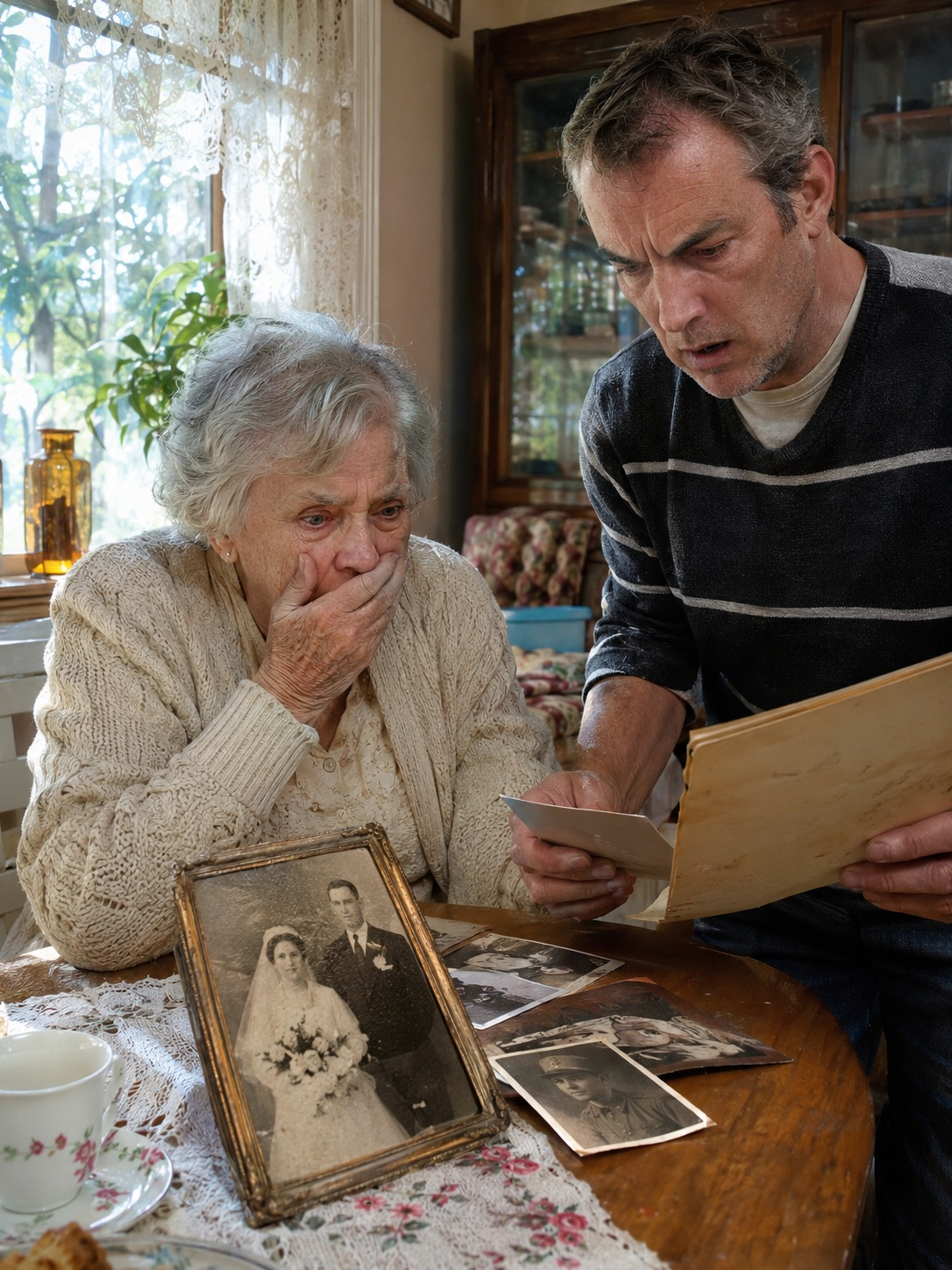
"Ruth, don't say my name."
The whisper came from my left.
Close enough that I felt the woman's breath against my cheek.
I froze.
The hospital room was completely dark.
Someone was crying near the window. I heard Peter calling for a nurse, followed by the scraping of a chair against the floor.
Then a hand closed around mine.
"Ruthie. It's me."
Margaret.
My sister.
The woman I had mourned for twenty years.
I knew her voice better than I knew my own heartbeat.
"Margaret?" I whispered.
"Please don't be frightened."
"Why did you tell me not to say your name?"
She didn't answer.
Instead, she pressed something into my palm.
A small piece of folded paper.
"Because I need you to understand before you look at me the way you looked at Walter."
My heart tightened.
"What have you done?"
Emergency lights flickered on above the door.
The room filled with a dim red glow.
Peter rushed to my bedside.
"Mom, are you all right?"
I nodded.
Beth was standing beside the wall, holding her phone. Elizabeth had moved toward Eleanor, who was sitting in a chair with her face buried in her hands.
Detective Bennett was speaking into her radio.
"Power interruption on the fourth floor. We need facilities and hospital security immediately."
I looked at Margaret.
Her face was wet with tears.
She slowly released my hand.
"Ruthie, I signed the document."
The room went silent.
I stared at her.
"The financial authorization?"
She nodded.
"Yes."
I felt as though the floor had disappeared beneath me.
"Three days after Walter's funeral?"
"Yes."
"But you were supposed to be dead."
Margaret closed her eyes.
"I know."
I looked down at the paper she had placed in my hand.
It contained a single sentence written in shaky handwriting.
I signed my name because I believed it would save the child.
I looked up.
"Elizabeth?"
Margaret nodded.
I stared at my sister.
For twenty years, I had dreamed of seeing her again.
Now she was standing beside my hospital bed, confessing to another secret.
I wanted to be angry.
I was angry.
But I also wanted to understand.
"Then tell me," I whispered. "Tell me everything."
Detective Bennett asked everyone to remain in the room until hospital security confirmed the cause of the outage.
A few minutes later, the overhead lights returned.
A nurse checked my blood pressure and examined the surgical dressing. I was sore and exhausted, but medically stable.
The interruption had been caused by a failure in an electrical distribution panel. The hospital's emergency system had operated as designed.
There was no intruder.
No hidden attacker.
Just a frightened family standing in a room full of secrets.
Detective Bennett sat beside Margaret.
"Mrs. Ellis, you understand that what you say may be relevant to an active criminal investigation?"
Margaret nodded.
"Yes."
"Would you prefer an attorney present?"
My sister looked at me.
Then at the detective.
"I want to explain what happened. But I would like an attorney before giving a formal statement."
"That's reasonable," Detective Bennett said. "You can tell your sister what you wish. We'll arrange the formal interview separately."
Margaret pulled her chair closer to my bed.
"Ruthie, twelve years ago, Walter told me he had discovered that money intended for Clara's daughter had been moved."
I nodded.
"The restricted account."
"Yes."
She wiped her cheeks.
"He was furious. He said Charles Voss had been changing documents and moving funds between accounts connected to Northbridge and Meridian."
I looked at Peter.
He was listening carefully.
Margaret continued.
"Walter asked me to help him find the original records. He knew I had worked with financial documents before I became ill."
I remembered that.
Before everything happened, Margaret had been excellent with numbers.
She could look at a bank statement and find an error in seconds.
"Did you help him?" I asked.
She nodded.
"We found discrepancies. Payments that didn't match invoices. Withdrawals described as administrative fees. Transfers approved using documents that had been changed after they were signed."
My heart tightened.
"And Charles?"
"He controlled access to many of the records."
I looked down.
"So Walter was trying to prove it."
"Yes."
Margaret took a breath.
"Then he died."
I closed my eyes.
The words still hurt.
Even after twelve years.
Margaret continued.
"Three days after his funeral, Eleanor contacted me. Charles had told her the restricted account would be closed unless the beneficiary authorization was renewed."
Elizabeth looked up.
"My account?"
Margaret nodded.
"The money Walter intended to preserve for you."
Elizabeth stared at her.
Margaret continued.
"Charles said the account required a signature from the person listed as the surviving protected beneficiary."
I frowned.
"Which was you?"
"Yes. Because the original records still identified me through the restricted arrangement."
I felt sick.
"Even though everyone believed you were dead."
Margaret nodded.
"That was why Charles wanted my signature."
I stared at her.
"Why would you agree?"
She began crying.
"Because he told me the money would otherwise disappear. He said Elizabeth would lose the funds Walter had set aside for her."
Elizabeth shook her head.
"I never knew."
Margaret looked at her.
"I know, sweetheart."
I studied my sister.
"Did you sign your own name?"
"Yes."
"On a document dated three days after Walter's funeral?"
"Yes."
I swallowed.
"And Charles used it?"
Margaret nodded.
"He attached my signature to an authorization that was supposed to preserve the account. But the version Detective Bennett found contained different payment instructions."
Peter leaned forward.
"So the signature was genuine, but the document was altered."
"That's what I believe."
Detective Bennett spoke carefully.
"We have evidence of changes to the payment instructions. The forensic review will establish which pages were substituted and when."
I looked at Margaret.
"Why didn't you tell me?"
She began sobbing.
"Because I was ashamed."
I stared at her.
"Of signing?"
"Of everything."
Her voice broke.
"Of being alive while you grieved. Of believing Walter when he said it was safer to stay away. Of signing another paper because someone frightened me."
I reached for her hand.
She hesitated.
Then took it.
"Margaret," I whispered, "I am angry that you kept this from me."
She nodded.
"I know."
"But I am not going to lose you again because you're afraid of telling me the truth."
She covered her face.
I squeezed her fingers.
"No more disappearing."
She nodded through tears.
"No more."
The next morning, Detective Bennett returned with an investigator from the financial crimes unit.
They had reviewed the original authorization recovered from Walter's wooden box.
The document contained two distinct sets of instructions.
One authorized preservation of the restricted funds.
The other directed payments to an account controlled through a company associated with Charles Voss.
The second set had been attached later.
Margaret's signature had been copied into the altered packet.
The detective explained that Charles had used the confusion surrounding Margaret's identity to make the transactions difficult to challenge.
He had also attempted to redirect the remaining funds using Beth's name.
That alteration had been designed to create another apparent beneficiary dispute and to draw attention away from the accounts he controlled.
Peter listened quietly.
Then he asked, "How much money did he take?"
The investigator opened his folder.
"Across the related accounts, the preliminary total is substantially more than Walter's original forty-eight-thousand-dollar payment. Some of those funds belonged to other patients and families."
I felt cold.
"Other families?"
He nodded.
"The investigation has identified additional questionable billing and transfer practices connected to Northbridge and Meridian."
I looked at Detective Bennett.
"So Clara wasn't the only person harmed."
"No," she said gently. "But her case helped us uncover the pattern."
I stared at the documents.
For days, I had imagined Charles Voss as a man trying to conceal one terrible mistake.
Now I understood something worse.
He had used the mistake.
He had used confusion.
He had used frightened people.
And he had used their silence to protect a financial scheme.
"What happened to Charles?" I asked.
Detective Bennett looked directly at me.
"He was arrested yesterday evening."
My breath caught.
"Arrested?"
"Yes. Investigators located him after obtaining records from several financial institutions. He is being held pending further proceedings."
I closed my eyes.
For the first time since Peter had found Walter's name on that twelve-year-old medical record, I felt the tension in my chest loosen.
Not disappear.
But loosen.
"Will he go to prison?"
The detective answered carefully.
"That will depend on the charges, evidence, and court proceedings. We have substantial evidence, but the legal process still has to take its course."
I nodded.
I didn't need her to promise a conviction.
I needed to know the investigation was real.
That the documents would not disappear.
That the truth would not be buried again.
"And the threats?" Peter asked.
Detective Bennett nodded.
"We have evidence connecting Charles to the attempted theft of records, the unauthorized entry into your mother's house, and threats against witnesses. Those matters are part of the investigation."
I thought of Evelyn Bellamy.
The frightened telephone call.
The crash.
The silence.
"Did you find Evelyn?"
"Yes," the detective said.
My heart jumped.
"Is she alive?"
"She is."
I covered my mouth.
Detective Bennett continued.
"She sought help after Charles threatened her. She had been staying with a relative outside the county. She is now cooperating with investigators."
I began crying.
Another woman who had been frightened into hiding.
Another person who could finally come home.
"And Eleanor?" I asked.
"She's receiving protection while she completes her statements. Her husband Daniel is safe as well."
I looked toward the window.
The circle of fear was finally breaking.
Two days later, Dr. Elaine Porter entered my room with a smile.
She carried a thin folder.
"Mrs. Callahan, I have your final pathology results."
My heart began pounding.
Peter was beside me.
Beth stood near the foot of the bed.
Margaret reached for my hand.
I looked at the doctor.
"Please tell me."
Dr. Porter sat down.
"The mass was a large benign mucinous cystadenoma arising from your right ovary."
For a moment, I couldn't speak.
"Benign?"
She smiled.
"Yes. The final examination found no evidence of malignancy in the removed mass."
I closed my eyes.
Then I began crying.
Peter put his arms around me.
Beth covered her mouth.
Margaret whispered, "Thank God."
I looked at Dr. Porter.
"Does that mean I'm going to be all right?"
She nodded.
"Your surgery went well, and the pathology is reassuring. You'll still need postoperative follow-up and time to recover, but we don't expect you to need cancer treatment for this mass."
I laughed through my tears.
A real laugh.
The kind I hadn't heard from myself in months.
For six months, I had watched my stomach grow.
I had felt pressure and movement.
I had been frightened to look in the mirror.
I had wondered whether I was dying.
Now the mass was gone.
And it wasn't cancer.
I looked at the doctor.
"Could it have been found earlier?"
She considered the question.
"The earlier report described a much smaller cystic finding. We cannot prove from the surviving records that it was the same lesion, but it should have prompted appropriate follow-up. The medical review will address why that didn't happen."
I nodded.
That mattered.
Not because I wanted to spend the rest of my life blaming someone.
Because I wanted the hospital to understand what had gone wrong.
And because I didn't want another woman to lie awake wondering why nobody had listened when her body began to change.
Dr. Porter squeezed my hand.
"You've been through a great deal."
I smiled.
"Doctor, you have no idea."
She laughed softly.
Then she stood.
"Let's concentrate on getting you home."
Home.
The word sounded wonderful.
The following week, Peter brought me another piece of news.
The hospital and its successor records organization had agreed to an independent review of the St. Agnes files.
Dr. Caroline Foster had provided her original correction request.
Dr. Reeves had submitted a written account of his involvement in Clara's emergency operation and Walter's final visit.
Dr. Bellamy had supplied the records he had preserved.
Grace Holloway and Laura had given statements.
And Eleanor had turned over the remaining documents from Meridian.
The investigators had enough evidence to reconstruct much of what happened.
Twenty years earlier, Margaret had been receiving treatment through a facility connected to Northbridge.
Walter believed she was being kept there without adequate independent review.
Charles Voss offered a restricted transfer arrangement.
Walter signed an authorization he did not fully understand.
Charles then used the protected identity paperwork in connection with Clara Bennett's transfer.
Clara's records were entered under my name.
When she died, the identification errors spread into the death documentation.
Charles exploited the confusion to conceal improper billing and record alterations.
Walter discovered that the records were wrong.
Instead of telling me immediately, he believed Charles's warnings that exposing the truth would endanger Margaret and disrupt her treatment.
He arranged Margaret's supposed funeral.
And he let me grieve.
For years.
Later, as Walter learned more, he began trying to correct what he had helped create.
He preserved documents.
He worked with Eleanor and Dr. Bellamy.
He set aside money for Clara's daughter.
He discovered suspicious financial transactions.
And eleven days before his death, he paid Meridian for an independent records review and the restricted fund.
The first payment had been used to preserve and examine documents.
The second was intended for Elizabeth.
Charles had attempted to divert the money.
Walter had discovered that too.
He was trying to expose it when he became ill.
I listened as Peter explained the findings.
Then I asked the question I had been carrying for twelve years.
"Did Charles kill your father?"
Peter looked at me.
"Mom."
I squeezed his hand.
"I need to know."
He took a breath.
"Detective Bennett said the medical review found no evidence that Dad was poisoned or physically attacked. The available records and his symptoms are consistent with a sudden cardiac event."
I closed my eyes.
Walter had experienced chest discomfort at St. Agnes.
Dr. Reeves had urged him to seek immediate evaluation.
Walter had refused.
He had gone home.
And the next morning, he was gone.
I felt tears filling my eyes.
"So he wasn't murdered."
"The evidence doesn't support that," Peter said. "But Charles's threats and the pressure Dad was under are part of the investigation."
I nodded.
It was painful.
But it was an answer.
For twelve years, I had wondered whether Walter's death was connected to something hidden.
Now I knew the truth was complicated.
He had died of a medical emergency after refusing care.
He had also been carrying fear, guilt, and evidence that someone desperately wanted concealed.
The truth didn't make his death easier.
But it made it understandable.
And sometimes understanding was the beginning of peace.
The most difficult conversation came after I returned home.
I sat in my favorite chair beside the living room window.
A blanket covered my knees.
A cup of tea rested on the table.
Peter had brought me home that morning, and Beth had filled the refrigerator with meals I could reheat.
Margaret was staying in the guest room.
For the first time in twenty years, my sister was sleeping under the same roof as me.
I still found myself looking toward the hallway to make sure she was there.
That afternoon, I asked her to sit with me.
She came carrying two cups of tea.
"Ruthie?"
I smiled.
"Sit down."
She lowered herself into the chair across from me.
For a while, we watched the sunlight move across the carpet.
Then I looked at her.
"Margaret, I need to ask you something."
She nodded.
"Anything."
"Why didn't you come to me after Walter died?"
Her face changed.
I continued.
"You were no longer afraid he would stop you."
She looked down.
"I was still afraid."
"Of Charles?"
"Yes. But not only Charles."
I waited.
Margaret took a shaky breath.
"I was afraid you would hate me."
My heart tightened.
She continued.
"I knew you had buried someone believing it was me. I knew Walter had lied. And I knew I had allowed the lie to continue."
I looked at her.
"Did you ever try?"
She nodded.
"Once."
My breath caught.
"When?"
"About ten years ago."
I stared at her.
"What happened?"
"I drove to your street."
My heart began pounding.
"You came here?"
She nodded.
"I parked across from the house."
I looked toward the window.
For years, I had sat in this room watching the neighborhood.
I had watched children ride bicycles.
I had watched neighbors walk their dogs.
I had watched seasons change.
And somewhere among those ordinary days, my sister had been sitting outside.
Alive.
Afraid.
Watching me.
"Did you see me?" I whispered.
Margaret began crying.
"Yes."
I covered my mouth.
She continued.
"You were in the garden. You were planting flowers."
I closed my eyes.
I remembered those years.
After Walter died, gardening had been one of the few things that made me feel useful.
I had planted roses.
Yellow ones.
Walter's favorite.
Margaret wiped her cheeks.
"I wanted to run to you."
"Why didn't you?"
She looked at me.
"Because you were smiling."
I stared at her.
She began sobbing.
"You looked peaceful. And I was afraid that if I walked into your life, I would destroy whatever peace you had found."
I shook my head.
"Oh, Margaret."
"I know now that I was wrong."
I reached for her hand.
"Yes," I whispered. "You were."
She nodded.
"I know."
I looked at her.
"Margaret, I wasn't peaceful because I had forgotten you."
She began crying harder.
"I know."
"I was learning how to live with losing you."
I squeezed her fingers.
"And I would have traded every peaceful afternoon in that garden for one more day with my sister."
She covered her face.
I moved carefully from my chair and sat beside her.
My abdomen still hurt, but I didn't care.
I put my arms around her.
She held me tightly.
We cried together.
For the years we had lost.
For the birthdays.
For the holidays.
For the ordinary telephone calls that never happened.
For the funerals and weddings and Sunday dinners we had missed.
And for the simple fact that we were both still alive.
When we finally pulled apart, I wiped her cheeks.
"Margaret, listen to me."
She nodded.
"We cannot get those years back."
"I know."
"But we can decide what happens with the years we have left."
She looked at me.
I smiled through tears.
"And I intend to make you very tired of me."
She laughed.
A beautiful, familiar laugh.
The laugh I remembered from childhood.
"I think I can manage that."
The legal proceedings continued over the following months.
Charles Voss was charged with offenses related to financial fraud, document falsification, and interference with the records investigation.
The court process took time.
There were hearings.
Witness statements.
Financial examinations.
And arguments over documents that had been altered years earlier.
I didn't attend every proceeding.
At eighty, recovering from major surgery, I had learned that I didn't need to prove my strength by exhausting myself.
Peter kept me informed.
Detective Bennett answered my questions.
And an attorney helped our family understand the corrected records.
Eventually, Charles entered a guilty plea to several of the charges.
He admitted that he had altered financial authorizations and concealed documents to protect the money he had diverted.
The court ordered restitution and imposed a prison sentence.
The remaining claims and financial recoveries were handled through the appropriate proceedings.
Not every dollar was recovered.
Not every missing document was found.
But the central fraud was established.
And the people who had been threatened were finally able to speak without hiding.
Eleanor completed her testimony.
Dr. Bellamy and Evelyn provided their records.
Grace and Laura were recognized for preserving evidence.
Dr. Reeves cooperated with the medical review and accepted professional scrutiny of his earlier role.
The hospital's successor organization issued corrected patient records and formally acknowledged the identification failures.
Clara Bennett's death record was corrected.
Margaret's false death registration was addressed through the court.
And my medical file was separated from the records that had been wrongly attached to it.
The old documents no longer told a false story about three women.
They told three different stories.
Mine.
Margaret's.
And Clara's.
That mattered more than I could explain.
Elizabeth came to visit me one Sunday afternoon.
She brought flowers.
White daisies.
She said they had been Clara's favorite.
We sat at the kitchen table while Margaret prepared coffee.
Elizabeth had received the corrected information about her birth mother.
She had learned where Clara was born.
Where she grew up.
What work she had done.
And how she had tried to challenge the records that were being used against her.
She had also received photographs from a distant relative.
In one, Clara was standing beside a lake, laughing.
In another, she was holding baby Anna.
Elizabeth showed me the pictures.
I stared at Clara's face.
She looked so young.
So alive.
"She was beautiful," I whispered.
Elizabeth nodded.
"She was."
I looked at the photograph of Clara holding her daughter.
"She loved you."
Elizabeth's eyes filled with tears.
"How do you know?"
I thought of Eleanor's account.
Of Clara lying in the hospital bed.
Of her final question.
Was Anna safe?
I looked at Elizabeth.
"Because when she was very ill, she asked whether you were safe."
Elizabeth covered her mouth.
Then she began crying.
I reached across the table and took her hand.
"That was what mattered to her."
She nodded through tears.
For a long time, neither of us spoke.
Then Elizabeth looked at me.
"Ruth, I used to think finding out what happened to my mother would make everything feel better."
I smiled sadly.
"Did it?"
"Some things."
She looked down.
"But it also made me angry."
I nodded.
"That's allowed."
She laughed softly.
"I keep forgetting that."
I squeezed her hand.
"Sweetheart, you can love the family who raised you and still grieve the mother you lost."
She looked at me.
"And you can love Walter and still be angry with him?"
I closed my eyes.
Then nodded.
"Yes."
For the first time, saying it didn't hurt quite as much.
Elizabeth eventually received the portion of the restricted funds that could be recovered, along with restitution awarded through the legal proceedings.
She used part of the money to establish a small scholarship for students entering nursing and medical records administration.
She named it the Clara Bennett Memorial Scholarship.
When she told me, I cried.
Because Clara's name was finally being used for something good.
Something that belonged to her.
Not a false identity.
Not a hidden account.
Not a grave marked with someone else's name.
Her own name.
Six months after my surgery, I returned to the hospital for a follow-up appointment.
Dr. Porter examined me and reviewed my recovery.
My incision had healed.
My strength had improved.
And I had begun taking longer walks.
The swelling that had frightened me for months was gone.
I could bend down to tie my shoes again.
I could sit comfortably at the kitchen table.
I could walk through the grocery store without feeling as though I was carrying a heavy stone inside me.
Dr. Porter smiled.
"You're doing very well, Mrs. Callahan."
I smiled back.
"I feel like myself again."
She nodded.
"That's what we like to hear."
I looked at her.
"Doctor, thank you for listening."
She seemed surprised.
"Of course."
I shook my head.
"No. I mean it."
I took a breath.
"For a long time, I was afraid to ask questions. I thought I was supposed to trust everyone else to know what was best for me."
Dr. Porter listened quietly.
I continued.
"But you explained things. You let me make decisions. You treated me like a person, not just an old woman in a hospital bed."
Her eyes softened.
"That's how you should always be treated."
I nodded.
"I know that now."
When I left the hospital, Peter was waiting beside the car.
He opened the passenger door.
"How did it go?"
I smiled.
"She says I'm doing very well."
He grinned.
"I could have told her that."
I laughed.
Then I looked at my son.
For weeks, he had carried fear on his shoulders.
Fear of losing me.
Fear of discovering what his father had done.
Fear of what the truth might mean for our family.
Now he looked lighter.
Older, perhaps.
But lighter.
I reached for his hand.
"Peter, I'm proud of you."
He looked surprised.
"Mom?"
I squeezed his fingers.
"Your father was right about one thing."
"What?"
"You ask questions."
He smiled.
Then his eyes filled with tears.
I continued.
"And you don't stop until you get answers."
He hugged me carefully.
"I love you, Mom."
"I love you too."
The following spring, I visited Walter's grave.
Margaret came with me.
We carried fresh flowers.
Yellow roses.
I stood in front of the headstone for a long time.
WALTER JAMES CALLAHAN
BELOVED HUSBAND AND FATHER
I read the words.
Then I looked at the man I had loved for fifty years.
Or rather, the place where he rested.
For months, I had wondered whether I should remove my wedding ring.
Whether I should put away his photographs.
Whether loving him meant forgiving everything.
I had finally understood that I didn't need to make one simple decision about a complicated life.
Walter had loved me.
That was true.
He had also lied to me.
That was true.
He had helped Margaret.
And harmed her.
He had tried to protect Elizabeth.
And failed to protect Clara.
He had tried to correct the records.
But only after years of silence.
He had been a good father in many ways.
And a frightened man who made terrible choices.
All of those things belonged to his story.
I looked down at the flowers.
"Walter," I whispered, "I know what happened."
The breeze moved gently through the trees.
I took a breath.
"I know you were afraid."
My eyes filled with tears.
"But you should have trusted me."
I paused.
"You should have told me Margaret was alive."
A tear slipped down my cheek.
"You should have told me about the medical records."
I looked at the headstone.
"And you should have let me decide what I could bear."
For a long time, I stood quietly.
Then I continued.
"I loved you, Walter."
My voice broke.
"I still do."
I wiped my eyes.
"But I am not going to spend the rest of my life protecting your secrets."
Margaret stepped closer.
I took her hand.
"We're going to live."
I looked at the headstone one final time.
"And we're going to tell the truth."
Then I placed the yellow roses on the grave.
I didn't feel that everything had been forgiven.
Perhaps it never would be.
But I felt something I hadn't felt in a very long time.
I felt free to remember Walter as he had truly been.
Not perfect.
Not evil.
Human.
And finally, no longer hidden behind the story I had told myself for fifty years.
That summer, we held a family dinner in my backyard.
Peter brought Beth and the children.
Margaret made her famous potato salad.
Elizabeth came with Eleanor and Daniel.
Laura arrived carrying a chocolate cake.
Dr. Bellamy and Evelyn stopped by for coffee earlier that afternoon, and Grace sent a handwritten card wishing us well.
There were flowers on the table.
String lights hung between the trees.
The air smelled of grilled vegetables and fresh bread.
I sat beneath the old maple tree, watching everyone talk.
For years, my house had been quiet.
After Walter died, the silence had settled into the rooms.
I had grown used to eating alone.
Watching television alone.
Going to bed alone.
Now the backyard was filled with laughter.
Peter was arguing with one of the grandchildren about how to grill corn.
Beth was laughing.
Margaret was telling Elizabeth a story about our childhood.
And Eleanor was listening with tears in her eyes.
I watched them.
All these people.
All these lives.
Connected by pain.
And now, slowly, connected by something better.
Truth.
Not the kind that erased the past.
The kind that allowed us to stop hiding from it.
Margaret came over and sat beside me.
"Ruthie?"
I smiled.
"Yes?"
"Are you tired?"
"A little."
"Do you want to go inside?"
I shook my head.
"No."
She looked around the backyard.
Then smiled.
"It's nice, isn't it?"
I nodded.
"Very."
For a moment, we sat quietly.
Then Margaret said, "Do you remember when we were girls and we promised we'd live next door to each other when we got old?"
I laughed.
"Yes."
"You said we'd have matching rocking chairs."
"And you said we'd spend all day complaining about our husbands."
Margaret laughed.
"Well, we certainly have enough material."
I laughed so hard my eyes filled with tears.
Then I looked at her.
"Margaret, I have an idea."
She smiled.
"That sounds dangerous."
I grinned.
"The house next door is for sale."
She stared at me.
Then began laughing.
"Ruthie."
"I'm serious."
She looked toward the fence.
Then back at me.
"You want me to move next door?"
I nodded.
"Why not?"
Her eyes filled with tears.
"After everything?"
I reached for her hand.
"Especially after everything."
She looked down.
Then whispered, "I'd like that."
I squeezed her fingers.
"Good."
A few months later, Margaret moved into the little house beside mine.
We didn't buy matching rocking chairs.
We bought different ones.
Hers was blue.
Mine was yellow.
But every afternoon, weather permitting, we sat on our porches and talked.
Sometimes about childhood.
Sometimes about the years we'd missed.
Sometimes about nothing important at all.
And those ordinary conversations became some of the most precious moments of my life.
On my eighty-first birthday, Peter gave me a small gift.
A wooden box.
Not Walter's.
A new one.
Peter had made it himself.
The corners were slightly uneven.
The brass latch was crooked.
I laughed when I saw it.
"Your father would have had something to say about this workmanship."
Peter grinned.
"I know."
I opened the box.
Inside was a small key.
I looked at him.
"What's this?"
He smiled.
"The spare key to Aunt Margaret's house."
I began laughing.
Then crying.
Peter put his arm around me.
"I thought you should have it."
I held the key in my palm.
A small brass key.
So ordinary.
And yet it meant more to me than any expensive gift.
For years, keys had been part of our family's secrets.
Locked drawers.
Hidden boxes.
Storage compartments.
Documents nobody was allowed to see.
But this key was different.
It wasn't meant to keep anyone out.
It was meant to let someone in.
I looked at Peter.
"Thank you."
He kissed my forehead.
"Happy birthday, Mom."
That evening, everyone gathered around the dining room table.
Margaret sat beside me.
Elizabeth brought a cake decorated with yellow roses.
Beth lit the candles.
The grandchildren sang.
And when they finished, Peter smiled.
"Make a wish, Mom."
I looked around the table.
At my son.
My daughter-in-law.
My grandchildren.
My sister.
The people who had come into my life through the strangest and most painful circumstances.
And the people who had stayed.
For a moment, I thought about everything that had happened.
The growing stomach that had frightened me.
The medical record bearing Walter's name.
The photograph of a woman who wasn't me.
The sister I thought I had buried.
The child who had grown up without knowing the full story of her mother.
The husband whose secrets had nearly destroyed the family he loved.
I thought about the fear.
The anger.
The grief.
And the long, difficult road toward the truth.
Then I looked at Margaret.
She smiled.
I looked at Peter.
He nodded.
I closed my eyes.
And made a wish.
Not for another fifty years.
Not for a perfect life.
Not even for a life without sorrow.
I wished for enough time to enjoy the people I loved.
Enough mornings to drink coffee with my sister.
Enough evenings to hear my grandchildren laugh.
Enough ordinary days to remember that being alive was a gift.
Then I blew out the candles.
Everyone cheered.
Margaret hugged me.
Peter kissed my cheek.
And I laughed.
A full, happy laugh.
The kind that came from somewhere deep inside me.
Later that night, after everyone had gone home, I stood in my bedroom and looked at Walter's photograph.
He was smiling.
The way he always smiled when someone pointed a camera at him unexpectedly.
I picked up the frame.
For a moment, I held it close.
"Well, Walter," I whispered, "we finally found the truth."
I looked at his face.
"I wish you had been brave enough to tell me."
My eyes filled with tears.
Then I smiled.
"But I'm glad I was brave enough to find it."
I placed the photograph back on the dresser.
Beside it stood another picture.
Margaret and me.
Taken only a week earlier.
We were sitting on our porches, laughing at something neither of us could remember afterward.
Two old women.
Two sisters.
Together again.
I looked at the photographs.
The past and the present.
The life I had lived.
And the life I still had.
Then I turned off the bedroom light.
The house was quiet.
But it no longer felt empty.
Tomorrow morning, Margaret would come over for coffee.
Peter would call.
Beth would probably remind me not to overdo things in the garden.
And I would have another ordinary day.
For most of my life, I had believed happiness came from knowing that everything was safe and certain.
Now I understood something different.
Happiness could exist even after terrible truths.
Even after grief.
Even after mistakes that could never be undone.
It could exist because people chose to stop lying.
Because they chose to forgive what they could.
Because they chose to stay.
I was eighty-one years old.
I had survived a frightening illness.
I had uncovered a twenty-year deception.
I had found my sister.
I had learned the truth about my husband.
And I had discovered that my life was not over simply because so much of it had already passed.
There were still birthdays.
Still Sunday dinners.
Still flowers to plant.
Still stories to tell.
And still people waiting for me on the other side of the door.
The next morning, I woke to sunlight.
I made coffee.
I opened the curtains.
And there was Margaret, standing on her porch, waving at me.
I smiled.
Then I picked up my cup, walked outside, and waved back.
For the first time in twenty years, I didn't have to wonder where my sister was.
I knew.
She was right next door.
And when she called, "Ruthie, are you coming over?"
I laughed.
"Of course I am."
I stepped into the warm morning sunshine.
And went to meet her.






Comments 0