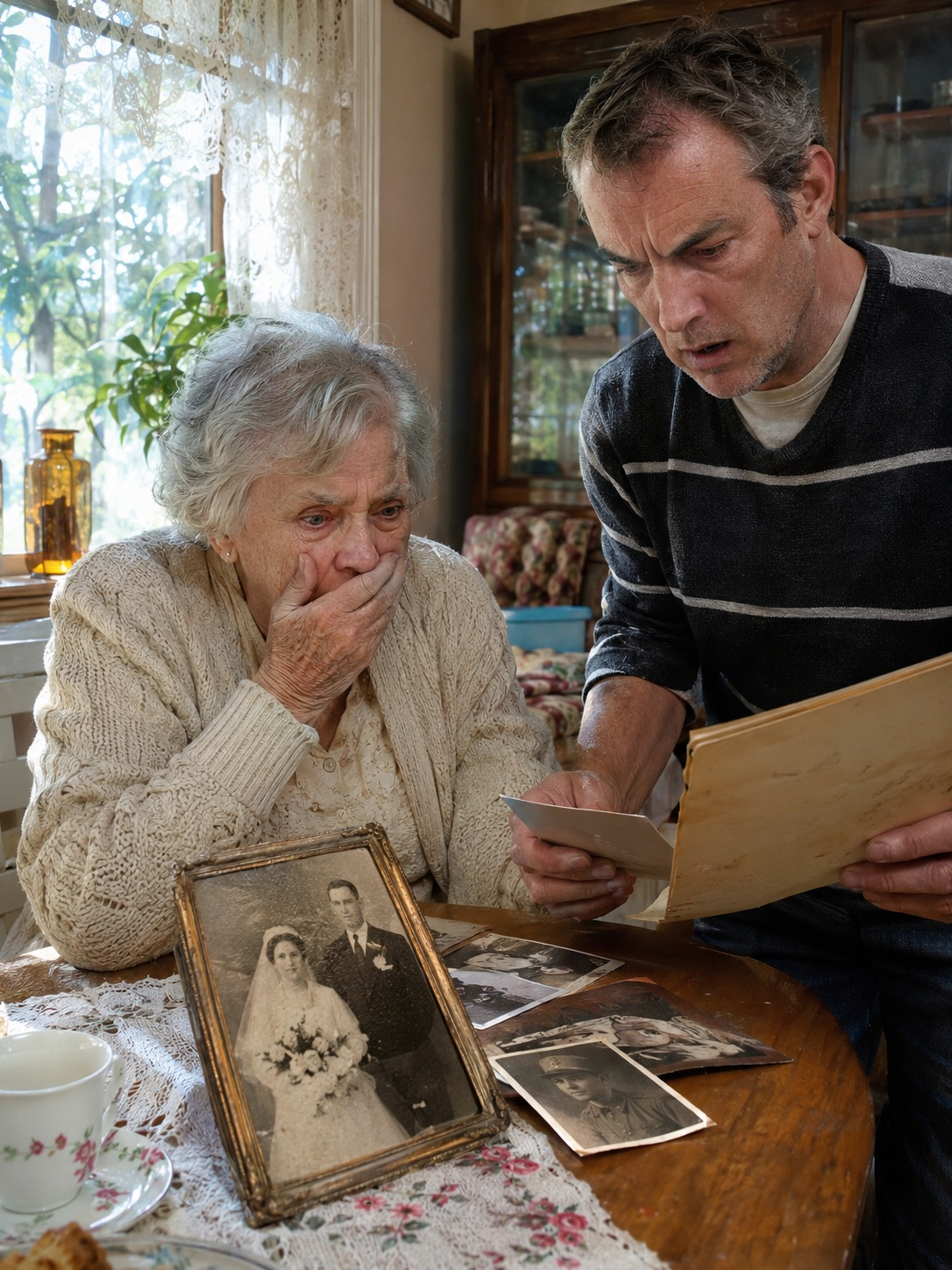
"Ruth, before you read that name aloud, you need to know why Walter chose me."
The woman standing in my hospital doorway was Eleanor Whitcomb.
For a moment, nobody moved.
Eleanor wore a dark blue coat, and her silver hair was pulled into the same neat twist I remembered from the day she first appeared beside my hospital bed. But something about her had changed.
She looked smaller.
Older.
And terribly frightened.
Detective Bennett stood immediately.
"Mrs. Whitcomb?"
Eleanor nodded.
"I know you have questions."
The detective glanced toward the hallway.
"How did you get here?"
"My daughter drove me."
"Are you safe?"
Eleanor hesitated.
"For now."
I stared at her.
The last time I had heard her voice, someone had interrupted our telephone conversation. There had been a crash, a struggle, and a man's angry voice.
I had imagined her injured.
Perhaps worse.
Now she was standing in front of me, looking as though she hadn't slept in days.
"Eleanor," I whispered, "what happened to you?"
She looked at the detective.
"Charles Voss came to my house. He wanted the documents Walter left with me."
Peter moved closer to my bed.
"Did he hurt you?"
"He frightened me. He took my telephone. I managed to get away through the back door when he went upstairs."
Detective Bennett reached for her phone.
"We need to arrange a formal statement and make sure you're protected."
Eleanor nodded.
"I'll cooperate."
Then she looked at the photograph in my hands.
Her eyes filled with tears.
"Oh, Ruth."
I felt my chest tighten.
"Do you know this woman?"
She nodded.
"Yes."
I looked down at the adoption record.
The young woman in the photograph had dark hair, green eyes, and a smile that reminded me of someone I had known for years.
Her adopted name was printed beneath the picture.
Elizabeth Anne Whitcomb.
I looked up.
"Your daughter?"
Eleanor nodded.
"Yes."
The room became silent.
Margaret pressed a hand against her mouth.
Peter looked from the document to Eleanor.
Beth whispered, "Elizabeth?"
I stared at the woman who had spent twenty years helping conceal the truth about my sister.
"You raised Clara Bennett's child?"
Eleanor began crying.
"Yes."
I looked at the adoption decree again.
Walter's signature appeared on one of the supporting documents.
My husband.
The man who had arranged Margaret's closed-coffin funeral.
The man who had helped authorize a transfer under my name.
The man who had left money in a restricted account.
The man who had died twelve years ago carrying secrets I was only now beginning to understand.
I looked at Eleanor.
"Tell me everything."
She lowered her eyes.
"I will."
"No more protecting me."
She nodded.
"No more."
I pointed toward the chair.
"Then sit down."
Eleanor sat beside the window.
Detective Bennett remained near the door, her notebook open.
Peter pulled a chair close to my bed.
Margaret sat on my other side, holding my hand.
I was still recovering from surgery. Every movement tugged painfully at my abdomen, and the medication made my thoughts feel slower than usual.
But I was awake.
I was alive.
And I was finished allowing other people to decide which truths I could bear.
Eleanor folded her hands.
"Twenty years ago, Clara Bennett was twenty-six years old. She was a single mother with a little girl."
I looked at the photograph.
"Elizabeth."
"Yes. Although that wasn't the name Clara gave her."
My heart tightened.
"What was her name?"
"Anna."
I looked down.
Anna Bennett.
A little girl who had lost her mother.
A child whose life had been changed by adults making decisions behind closed doors.
Eleanor continued.
"Clara had been receiving treatment through a private medical program connected to Northbridge Clinical Services. She had concerns about the way patient records were being handled."
I looked at Detective Bennett.
She was writing carefully.
"Was Clara a patient or an employee?" I asked.
"A patient. But she had previously worked in medical billing, and she recognized some of the irregularities in the documents she was given."
Peter leaned forward.
"What irregularities?"
"Charges for services she hadn't received. Different patient identification numbers on the same paperwork. Authorization forms that didn't match the treatment dates."
I felt cold.
"Did she report it?"
"She tried."
Eleanor's voice trembled.
"She told a staff member she wanted copies of everything. Shortly afterward, she became seriously ill and was transferred to St. Agnes."
I looked at her.
"Under my name."
Eleanor nodded.
"Yes."
"Why?"
She took a shaky breath.
"Charles Voss controlled part of the transfer paperwork. He used a restricted identity arrangement that had originally been proposed for Margaret."
I turned toward my sister.
Margaret closed her eyes.
Eleanor continued.
"Walter had been told the arrangement would protect Margaret while she received an independent medical evaluation. He signed a document believing he was helping remove her from a facility where he feared she was being improperly held."
I swallowed.
"But Clara was transferred instead."
"Yes."
"Did Walter know?"
Eleanor looked down.
"He knew there was a problem with the name. He didn't know Clara's full identity until afterward."
I felt anger rise.
"He signed anyway."
"Yes."
I stared at her.
"Then he was responsible for that decision."
Eleanor nodded.
"He was."
I appreciated that she didn't try to excuse him.
For too many days, people had spoken about Walter as though loving his family erased the consequences of his choices.
It didn't.
I loved him.
I had loved him for fifty years.
But love didn't make a signature disappear.
Eleanor continued.
"Clara survived the emergency operation initially. Later, she developed complications and died."
My eyes filled with tears.
"Did she ask for her daughter?"
Eleanor began crying.
"Yes."
The room went still.
I leaned forward.
"What did she say?"
Eleanor wiped her cheeks.
"She asked whether Anna was safe."
My throat tightened.
"Did anyone answer her?"
"I did."
I stared at Eleanor.
"What did you tell her?"
"That the child was being cared for."
"Was that true?"
"Yes. Anna was staying temporarily with a family friend."
I closed my eyes.
Clara had died worrying about her little girl.
The thought hurt more than any medical document.
I looked at Eleanor.
"How did you become involved?"
"After Clara died, I helped locate her child. There were concerns about who had authority to make decisions for her. The records were confused, and the people managing them weren't giving clear answers."
Peter frowned.
"Was there a legitimate adoption?"
Eleanor nodded.
"Eventually. The court reviewed the child's circumstances, and my husband and I were approved to adopt her."
I looked at the document.
"Harrison, Cole and Whitcomb."
Eleanor nodded.
"My late husband, David Whitcomb, was an attorney. His firm handled part of the legal work, although an independent attorney represented the child."
That explained a name that had troubled us for days.
The law firm.
The guardianship documents.
Eleanor's connection to both medicine and the courts.
I looked at her.
"Did Elizabeth know she was adopted?"
"Yes. We told her when she was old enough to understand."
"Did she know what happened to Clara?"
Eleanor's face crumpled.
"Not everything."
I shook my head.
"Why?"
"Because I was afraid."
I stared at her.
"Afraid of Charles?"
"Yes. And afraid that the mistakes surrounding Clara's death would be used to challenge the adoption or expose Elizabeth to people who wanted the records buried."
Detective Bennett spoke.
"Mrs. Whitcomb, an adoption wouldn't ordinarily become invalid merely because a medical record was wrong."
Eleanor nodded.
"I understand that now. But Charles made us believe otherwise."
I looked at her.
"What did he tell you?"
"That if the original records became public, the court would discover that the wrong woman had been identified in the death paperwork. He said everyone who signed anything could face prosecution."
I felt sick.
"And you believed him?"
"At first."
I looked down at my wedding ring.
Fear.
It kept appearing in every part of this story.
Walter had been afraid of losing Margaret.
Eleanor had been afraid of losing Elizabeth.
Margaret had been afraid of hurting me.
And Charles Voss had apparently learned how to turn everyone's fear into silence.
I looked at Eleanor.
"What did Walter know about Elizabeth?"
Her eyes filled with tears.
"He knew she was Clara's daughter. He knew my husband and I had adopted her. And he knew the false records had helped create the confusion that nearly separated her from the people caring for her."
I stared at her.
"Did he help arrange the adoption?"
"He provided a statement about what he knew of Clara's case. He also agreed to help locate the original records."
I looked at the signature.
Walter's name.
Not as Elizabeth's father.
Not as her guardian.
But as a witness.
A man trying, too late, to repair something he had helped break.
"Why did he leave money for her?"
Eleanor took a breath.
"Because he believed Clara's child deserved some measure of restitution."
I looked toward Peter.
The restricted account.
The twenty-four thousand dollars.
The beneficiary identifier.
The name changes.
For days, the money had seemed like evidence of a secret transaction.
Now it was becoming something else.
An attempt to provide for a child whose mother had died in circumstances nobody had properly explained.
But there was still the matter of Beth's name.
And Charles's altered authorization.
I looked at Eleanor.
"Did Elizabeth ever receive the money?"
She shook her head.
"No."
"Then where did it go?"
"I don't know."
Detective Bennett looked up.
"We have reason to believe Charles Voss altered the beneficiary designation after Walter's death."
Eleanor nodded.
"I suspected that."
Peter leaned forward.
"Why would he put Beth's name on it?"
Eleanor looked at my daughter-in-law.
"Because Charles knew Beth's family was connected to Laura."
Beth went pale.
"My sister?"
Eleanor nodded.
"Laura had worked at St. Agnes. She had copied records. Charles believed she might still have them."
I felt my stomach tighten.
"So he used Beth's name to frighten us."
"That may have been part of it," Detective Bennett said. "We're still tracing the transactions."
I looked at Beth.
She was crying quietly.
I reached for her hand.
"Sweetheart."
She looked at me.
"I never knew."
"I know."
She squeezed my fingers.
For days, someone had tried to make us doubt one another.
I wasn't going to let a forged document destroy the family I still had.
After Eleanor finished her initial account, Detective Bennett asked her to accompany an officer to a private room for a formal interview.
Before leaving, Eleanor turned toward me.
"Ruth, there's one more thing."
I felt my heart tighten.
"What?"
"Walter left a letter."
I stared at her.
"We found letters."
"This one was different."
My pulse quickened.
"Different how?"
"He gave it to me the week before he died. He said I was to keep it until the records were corrected."
I looked at her.
"And they never were."
She lowered her eyes.
"No."
I felt anger rising.
"Then why didn't you give it to me after his funeral?"
Eleanor began crying.
"Because Charles told me that if I did, Elizabeth's identity would become public and the people responsible for the original transfer would retaliate."
I stared at her.
"Twenty years of lies. Twelve years since Walter died. And you still kept it?"
She nodded.
"I did."
I looked away.
I wanted to shout.
I wanted to demand how many people had decided that I was too fragile to know the truth.
But my abdomen hurt, and my body was tired.
So I spoke quietly.
"Eleanor, I am eighty years old."
She looked at me.
"I know."
"I buried my husband. I buried my sister. I spent years mourning people while everyone around me knew pieces of a story I wasn't allowed to hear."
Tears slipped down my cheeks.
"I don't have another twenty years to wait."
Eleanor began sobbing.
"I'm sorry."
I looked at her.
"Then give me the letter."
She nodded.
"It's in my daughter's possession."
My heart quickened.
"Elizabeth has it?"
"Yes."
"Does she know what's inside?"
Eleanor hesitated.
"She knows part of the story."
I stared at her.
"Is she here?"
Eleanor nodded.
"She's waiting downstairs."
I closed my eyes.
Clara Bennett's daughter.
The child Walter had tried to protect.
The woman whose existence had been hidden inside hospital files and financial records.
She was in the same building.
I looked at Eleanor.
"Ask her to come."
Elizabeth Whitcomb entered my room just after four that afternoon.
She was in her forties, with dark hair pulled behind her shoulders and green eyes that seemed familiar in a way I couldn't explain.
She wore a cream-colored sweater and carried a small brown envelope.
For a moment, she stood uncertainly near the door.
Then she looked at me.
"Mrs. Callahan?"
I smiled faintly.
"Ruth."
She nodded.
"Ruth."
Her voice trembled.
"I don't know how to begin."
I looked at the envelope.
"Neither do I."
She gave a nervous laugh.
Then she stepped closer.
"My mother told me you were ill."
"I've had surgery."
"How are you feeling?"
"Like someone removed a bowling ball from my stomach."
She laughed.
A real laugh.
Warm.
Unexpected.
For a moment, she looked like an ordinary woman visiting an elderly relative.
Not someone connected to a twenty-year mystery.
She sat beside my bed.
"I knew I was adopted," she said.
I nodded.
"My parents never hid that."
"Did they tell you about Clara?"
"Some things."
She looked down.
"They told me my birth mother died when I was little. They said there had been confusion about her medical records, but they didn't know all the details."
I watched her carefully.
"Did you ever try to find out more?"
She nodded.
"Yes."
"When?"
"Several years ago. I requested records, but most of them were incomplete."
I sighed.
"That sounds familiar."
She smiled sadly.
"Then I found Walter's name."
My heart tightened.
"Where?"
"In an old court document."
I looked at her.
"Did you contact him?"
She shook her head.
"He had already died."
I closed my eyes.
Of course.
Another missed opportunity.
Elizabeth continued.
"I contacted my mother. She told me Walter had tried to correct the records before his death."
I looked at her.
"Did she give you his letter?"
"Not immediately."
I nodded.
"She was afraid."
Elizabeth looked down.
"Yes."
I studied her face.
"Are you angry with her?"
She thought for a moment.
"Sometimes."
I smiled sadly.
"I understand."
She looked at me.
"But she raised me. She loved me. She gave me a home."
I nodded.
"Both things can be true."
Elizabeth's eyes filled with tears.
"That's what I've been trying to understand."
I reached for her hand.
"Then you're doing better than most of us."
She laughed softly.
Then she placed the envelope on my blanket.
"Walter wrote this for you."
My heart began pounding.
I stared at the handwriting.
RUTH — PERSONAL. DO NOT OPEN UNTIL THE TRUTH ABOUT MARGARET IS KNOWN.
My throat tightened.
Walter's letters had always been easy to recognize.
He pressed too hard with his pen.
His capital letters leaned slightly to the right.
And he always underlined my name when he wrote it on an envelope.
I touched the paper.
For a moment, I couldn't move.
Then Elizabeth spoke.
"There's something else."
I looked at her.
"What?"
"Walter left instructions about the money."
My heart quickened.
"Did you receive any of it?"
She shook her head.
"No."
"Did you know he intended it for you?"
"Not until recently."
I nodded.
She continued.
"I don't want money that comes from someone else's suffering."
I looked at her.
"Elizabeth, your mother suffered."
Her eyes filled with tears.
"Yes."
"And you lost her."
She nodded.
"Yes."
I squeezed her hand.
"If Walter set money aside because he believed he owed you something, you have every right to know why."
She looked down.
"I just want to know who she was."
My heart broke.
Clara Bennett.
A woman whose name had been buried beneath other people's records.
A woman who had asked whether her little girl was safe.
I looked at Elizabeth.
"Then we'll find out."
She smiled through tears.
For a moment, I saw the child Clara had been worrying about.
Not a mysterious beneficiary.
Not a name on a bank document.
A daughter who had grown up without her mother.
I looked down at the envelope.
Then I opened it.
The letter contained six pages.
Walter had written them in blue ink.
The first page began:
My dearest Ruth,
If you are reading this, then I have failed to tell you something I should have told you years ago.
I stopped.
My eyes filled with tears.
Peter sat beside me.
"Mom, do you want me to read it?"
I shook my head.
"No."
I took a breath.
"I need to do this."
I continued.
I have spent most of our marriage believing that loving you meant protecting you from anything that might hurt you.
I was wrong.
My throat tightened.
Walter.
My Walter.
The man who had insisted on checking the locks every night.
The man who carried my groceries even when his knees hurt.
The man who called me every afternoon just to ask whether I needed anything.
He had believed protection was love.
And somewhere along the way, he had forgotten that love also required trust.
I continued reading.
When Margaret became ill, I was frightened. I saw how much you loved her. I knew what losing her would do to you.
Charles Voss told me he could arrange for her to receive independent treatment under a protected identity. He said the arrangement was legal and temporary.
I signed because I wanted to help her.
I should have asked more questions.
I closed my eyes.
There it was.
The beginning.
Not an evil plan.
Not a grand conspiracy Walter had designed.
A frightened man making a decision he didn't fully understand.
But the consequences had been enormous.
I turned the page.
When Clara Bennett was transferred under your name, I realized something was terribly wrong.
I demanded an explanation. Charles told me the records would be corrected after the review.
Then Clara died.
My hands began trembling.
The hospital's records were confused. Margaret's identity had been connected to the same restricted system. Charles told me that correcting the death documentation immediately could expose Margaret's location and place her treatment at risk.
I believed him.
I stopped reading.
My heart hurt.
I wanted to reach through time and shake Walter.
To tell him that nobody had the right to make such a decision for me.
To tell him that a sister wasn't something you could hide in a file.
To tell him that grief built on a lie was still grief.
I wiped my eyes.
Then I continued.
I allowed Ruth to believe Margaret had died.
The sentence stood alone.
No explanation.
No excuse.
Just the truth.
I stared at it for a long time.
Then I whispered, "You did."
Peter put his hand over mine.
I turned the page.
I told myself it would only be for a little while.
Then a little while became months.
Months became years.
And every year made the truth harder to tell.
I closed my eyes.
That was how lies grew.
Not always through cruelty.
Sometimes through cowardice.
Sometimes through shame.
Sometimes because the person telling the lie couldn't bear to face what they had done.
I continued.
Margaret eventually learned that Ruth believed she was dead. She wanted to contact her. I told her Ruth was unwell and that the shock might harm her.
That was not my decision to make.
My tears fell onto the paper.
For twenty years, Walter had known that.
At least some part of him had known.
And still he had kept the truth.
I turned the page.
When I learned about Clara's daughter, I realized the harm had spread beyond our family.
That little girl had lost her mother while adults argued over names, signatures, and records.
I helped Eleanor and David locate the proper legal assistance. I agreed to provide evidence about the transfer. Later, I set money aside because I believed Clara's child deserved help, and because I feared the people controlling the records might try to use her identity again.
I looked at Elizabeth.
She was crying quietly.
I reached for her hand.
She squeezed it.
I continued.
I never intended that money to purchase anyone's silence.
It was meant to remain untouched until the child's identity could be verified and the records corrected.
If Peter is reading this, I ask him to make certain the money reaches the person for whom it was intended.
Peter lowered his head.
For a moment, he couldn't speak.
I looked at my son.
Walter had trusted him.
He had named him successor trustee.
He had believed Peter would do what he himself had failed to do.
Tell the truth.
Follow the evidence.
Protect people without hiding their lives from them.
I turned the page.
The next paragraph made my breath catch.
Ruth, there is something else.
During the review, I discovered that an abnormal finding had appeared in an old scan associated with your medical records.
Because the records had been mixed with Clara's, I could not obtain a clear answer about which findings belonged to you.
I should have told you.
I closed my eyes.
My abdomen ached beneath the surgical dressing.
For months, I had carried a mass that had grown until it frightened me.
The doctors had removed it.
The pathology was still pending.
And Walter had known there was something in my records that needed attention.
I opened my eyes.
I was afraid that telling you would expose everything else.
I convinced myself I needed to correct the records first.
That was another mistake.
My voice broke.
"Oh, Walter."
I pressed the paper against my chest.
I had loved this man.
I had built a life with him.
I had raised children beside him.
I had held his hand when he died.
And now I was learning how many times he had chosen silence over honesty.
I looked toward the window.
For a moment, I felt angry enough to throw the letter across the room.
Then I looked at Peter.
He was crying.
I looked at Margaret.
She was crying too.
And I realized something painful.
Walter's secrets had not protected any of us.
They had left us alone with questions we didn't know how to ask.
I took a breath.
Then I continued reading.
The fifth page was shorter.
Walter's handwriting had become uneven.
I have begun working with Dr. Bellamy and Eleanor to preserve the original records.
I no longer trust Charles Voss.
I believe he has altered documents to conceal what happened to Clara and Margaret.
I also believe someone has been using the restricted account for purposes I never authorized.
My heart quickened.
Peter leaned forward.
"Mom, read that again."
I did.
He looked at Detective Bennett, who had returned after Eleanor's interview.
"That supports what we've found in the bank records."
She nodded.
"It may. We'll need to authenticate the letter and compare it with the financial documents."
I continued.
I have asked Grace Holloway to preserve a copy of the original transfer log.
If I cannot complete the review, Peter must receive the records.
He will ask the questions I should have asked twenty years ago.
My throat tightened.
Walter had said almost those exact words to me before he died.
Because he asks questions.
I looked at my son.
He wiped his eyes.
Then I turned to the final page.
There were only a few paragraphs.
Ruth, I do not ask you to forgive me.
I ask only that you know I loved you.
I loved you when we were young.
I loved you when our children were born.
I loved you through every ordinary morning and every difficult night.
But I allowed my fear of losing you to become the reason I kept you from the truth.
I was wrong.
I began sobbing.
Peter put his arms around me carefully.
I cried against his shoulder.
Not because the letter had made everything right.
It hadn't.
Nothing could return the years Margaret and I had lost.
Nothing could give Clara her life back.
Nothing could erase the fear I had carried into surgery.
But for the first time, Walter had stopped making excuses.
Even if he had done it too late.
I wiped my eyes.
Then I read the final paragraph.
There is one document I have not included with this letter.
It is the document that explains why Charles Voss became so desperate to keep the original records hidden.
I have placed it where only Ruth will know to look.
Not in the blue box.
Not in the locked drawer.
In the place where I kept the first promise I ever made to her.
I stared at the words.
My heart began pounding.
The first promise.
I looked at Peter.
"What does that mean?"
He shook his head.
"I don't know."
I read it again.
The place where I kept the first promise I ever made to her.
I closed my eyes.
Walter and I had been married for fifty years.
We had made thousands of promises.
Some spoken.
Some unspoken.
But the first?
I thought back to when we were young.
Before the wedding.
Before the children.
Before the house.
Before all the secrets.
Then I remembered.
A small wooden box.
Walter had made it himself.
He was twenty-two.
I was twenty.
We had been sitting on the porch of my parents' house.
He told me he didn't have much money.
He couldn't promise me a large home.
He couldn't promise me an easy life.
But he could promise one thing.
"Ruthie," he said, "whatever happens, you'll always have a place to come home to."
Then he gave me a small wooden box.
Inside was a key.
The key to the first little house we rented after our wedding.
I had kept that box for decades.
Even after we moved.
Even after the children grew up.
Even after Walter died.
I opened my eyes.
"The wooden box."
Peter looked at me.
"What?"
I stared at him.
"Your father made me a small wooden box before we married."
"Where is it?"
I thought carefully.
"In the bedroom."
My heart quickened.
"On the top shelf of the closet."
Peter stood.
"I'll get it."
Detective Bennett raised a hand.
"Mr. Callahan, let us arrange to retrieve it. Given the break-ins, we need to preserve any evidence properly."
Peter nodded.
"Of course."
I looked at the letter.
Walter had hidden one final document.
Not in his study.
Not behind the wedding photograph.
Not in the blue metal box everyone had been searching for.
But in the little wooden box he had given me when we were young.
The place where our marriage had begun.
I closed my eyes.
For a moment, I could almost see him.
Young Walter.
Standing on my parents' porch.
Holding out that little box.
Smiling nervously.
Promising me a home.
I opened my eyes.
"Detective," I whispered, "please find it."
She nodded.
"We will."
That evening, Dr. Elaine Porter came to discuss my recovery.
She examined the surgical incision.
She reviewed my vital signs.
She told me I was progressing well.
Then she sat beside the bed.
"Mrs. Callahan, we also have a preliminary pathology update."
My heart quickened.
Peter moved closer.
Margaret held my hand.
I looked at the doctor.
"Is it cancer?"
She answered carefully.
"The initial examination suggests the mass may be benign, but the final microscopic analysis is still underway."
I closed my eyes.
Relief washed over me.
Not certainty.
Not yet.
But hope.
Dr. Porter continued.
"The mass was removed successfully. We haven't seen anything in the preliminary findings that changes the recovery plan at this point."
I nodded.
"Thank you."
She smiled.
"You're doing well."
After she left, I looked at my family.
Peter smiled.
Beth began crying.
Margaret squeezed my hand.
For the first time in days, we allowed ourselves a little hope.
Not because everything was solved.
Because I was alive.
Because the operation was over.
Because there was still time.
At nine-thirty that night, Detective Bennett returned.
She carried a sealed evidence bag.
Inside was a small wooden box.
My heart stopped.
"That's it."
Peter leaned forward.
"The box?"
I nodded.
"Yes."
The wood was darker than I remembered.
The little brass latch had tarnished.
But I recognized the crooked corner Walter had sanded smooth with his own hands.
I reached toward it.
Then stopped.
"Can I touch it?"
Detective Bennett nodded.
"After we document the exterior, we'll open it with you present."
She placed it carefully on the table.
I stared at it.
Fifty years.
The box had sat in our bedroom for half a century.
I had dusted it.
Moved it.
Opened it occasionally to look at the old key.
And all that time, I had never imagined it might contain something else.
Detective Bennett examined the latch.
Then she looked at me.
"Mrs. Callahan, did your husband ever modify this box?"
I frowned.
"Not that I know of."
She turned it over.
There was a thin seam along the bottom.
My heart began pounding.
"That wasn't there before."
Peter leaned closer.
The detective examined the seam.
"It appears to have a concealed compartment."
I stared at the box.
Walter.
Even after death, he was still hiding things in places I thought I knew.
Detective Bennett carefully opened the compartment.
Inside was a folded document wrapped in waxed paper.
And a small brass key.
I stared at them.
The detective removed the paper.
She unfolded it.
Her expression changed.
Peter leaned forward.
"What is it?"
She didn't answer immediately.
I felt cold.
"Detective?"
She looked at me.
"Mrs. Callahan, this appears to be an original financial authorization."
My heart quickened.
"The restricted account?"
She nodded.
"Yes."
I leaned forward.
"Does it show who received the money?"
She examined the document.
"It includes an account number, a transfer date, and a signature."
Peter moved closer.
"Whose signature?"
Detective Bennett looked at him.
Then at me.
Her face had gone pale.
"Mrs. Callahan, I need to verify something before we draw conclusions."
I stared at her.
"Please."
She turned the document toward me.
At the bottom was a signature.
Not Walter's.
Not Eleanor's.
Not Charles Voss's.
A woman's signature.
I leaned closer.
My heart began pounding.
The name was familiar.
Too familiar.
I looked at Peter.
He stared at the page.
Then whispered, "Mom, that can't be right."
I looked back at the document.
The signature belonged to someone I had known for years.
Someone who had been inside our home.
Someone who had helped care for Walter.
Someone who had stood beside me at his funeral.
I tried to speak.
But no words came.
Then my phone vibrated.
An unknown number.
A message appeared.
RUTH, THE SIGNATURE IS REAL. BUT THE WOMAN WHO SIGNED IT IS NOT THE PERSON YOU THINK SHE IS.
I stared at the screen.
Another message arrived.
LOOK AT THE KEY.
My heart pounded.
I looked at the small brass key lying beside the document.
A tiny number was engraved on it.
214.
Detective Bennett picked it up.
"That may identify a locker or storage compartment."
Peter looked at me.
"Mom, do you recognize it?"
I shook my head.
"No."
Then the hospital room telephone rang.
Everyone froze.
I stared at the receiver.
The ringing continued.
Detective Bennett nodded toward it.
"Answer it. I'll stay here."
I picked it up.
"Hello?"
A man's voice answered.
Low.
Familiar.
"Ruth."
My blood turned cold.
I gripped the receiver.
"Who is this?"
The man took a slow breath.
Then whispered, "I was there when Walter died."
My heart stopped.
"Who are you?"
He ignored the question.
"That key opens the place where Walter hid the final recording."
I stared at the brass key.
"What recording?"
"The one he made after he learned who had been taking the money."
I leaned forward.
"Then tell me who signed the authorization."
The man hesitated.
Then whispered, "Ruth, the woman whose name appears on that document was supposed to be dead."
My hands began trembling.
"Who?"
He took a shaky breath.
Then said, "And she is standing in your hospital room right now."
I looked up.
Peter.
Beth.
Margaret.
Elizabeth.
Eleanor.
Detective Bennett.
Every face turned toward me.
The man whispered, "Look at the signature again."
I lowered my eyes.
The paper trembled in my hands.
Then I saw it.
The full name.
The familiar handwriting.
And the date.
Twelve years ago.
Three days after Walter's funeral.
My breath caught.
Because the signature belonged to—
The lights went out.
Someone screamed.
And in the darkness, a woman's voice whispered directly beside my bed:
"Ruth, don't say my name."






Comments 0