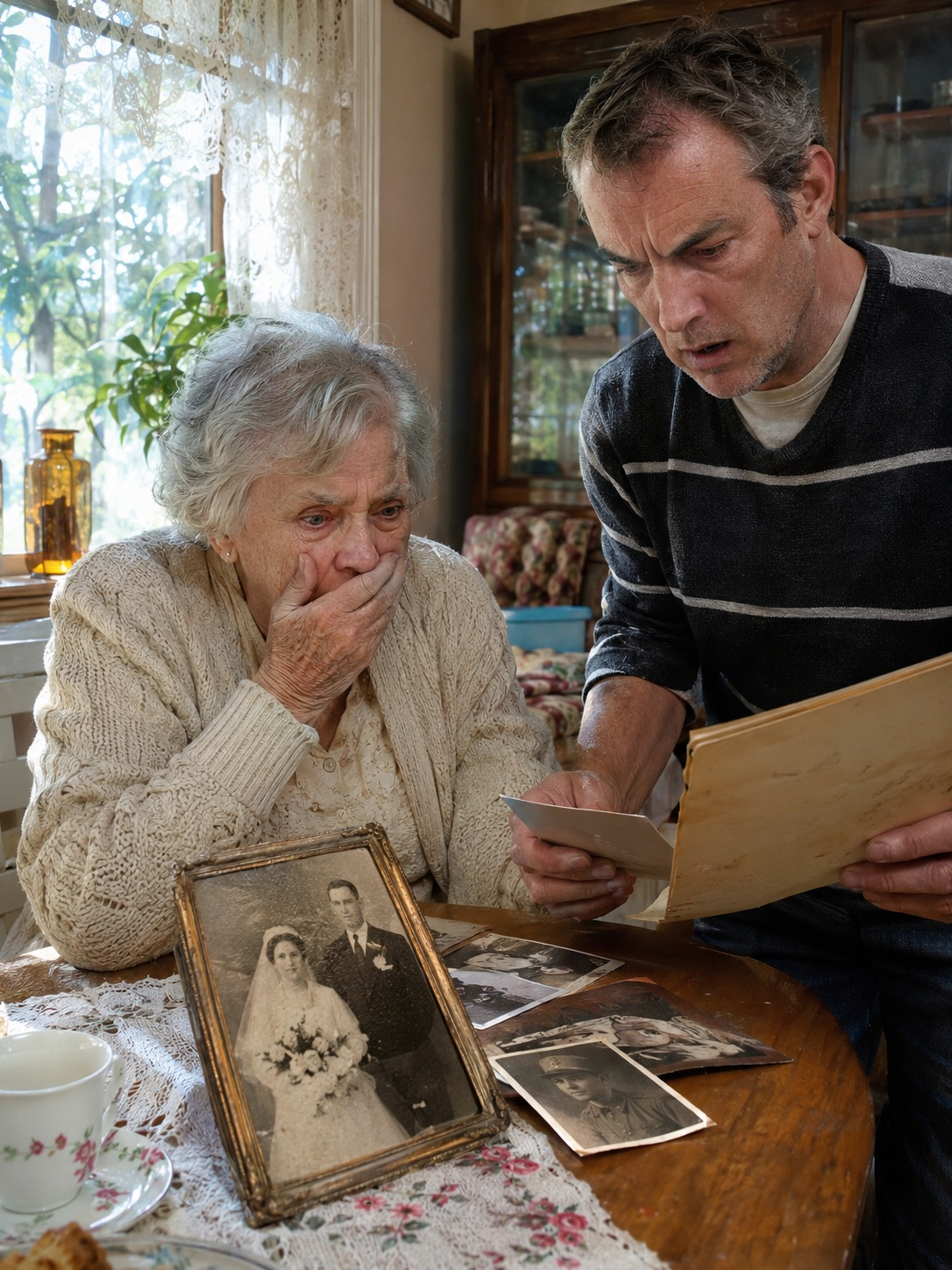
"Peter, why is your name on that document?"
My son stood beside my hospital bed, staring at the message on Beth's phone.
For several seconds, he didn't answer.
The room was so quiet that I could hear the soft hum of the air-conditioning above us.
Margaret sat near the window, her hands clasped tightly together. Beth looked from her husband to me, waiting for him to speak.
On the screen was the final message from the stranger who had entered my house.
ASK PETER WHY HIS NAME IS ON THE DOCUMENT INSIDE.
I looked at my son.
"Peter."
He swallowed.
"Mom, I don't know."
"Are you sure?"
He turned toward me.
"Of course I'm sure."
I wanted to believe him.
He was my son.
The boy I had raised.
The man who had driven me to the hospital when I finally admitted something was wrong.
He had sat beside me through every examination, every frightening discovery, every painful memory.
But Walter had been my husband.
And I had trusted him too.
That thought frightened me more than the anonymous message.
Peter pulled a chair closer.
"Mom, someone is trying to make us suspicious of each other."
I looked down at my wedding ring.
"That's possible."
"It's more than possible. Whoever has Dad's records knows exactly what will upset us."
Beth nodded.
"They've already frightened us with photographs of the house."
Margaret looked toward the door.
"And with things they know about the past."
I raised my eyes.
"Then why would Peter's name be on a document from twelve years ago?"
My son rubbed his forehead.
"I don't know. Maybe Dad listed me as an emergency contact. Maybe he named me as someone authorized to receive the records."
I considered that.
It made sense.
Walter had always trusted Peter with practical matters.
When the furnace broke, he called Peter.
When he needed help understanding a computer, he called Peter.
When he wanted advice about insurance, he called Peter.
But Walter had also hidden an enormous secret from all of us.
I looked at my son again.
"Did your father ever ask you to sign anything connected to St. Agnes?"
Peter shook his head.
"No."
"Meridian Patient Services?"
"No."
"Dr. Bellamy?"
"No."
I watched his face.
He looked exhausted.
Not guilty.
Not evasive.
Just frightened and angry.
I reached for his hand.
"Then we'll find out why your name is there."
His shoulders relaxed slightly.
"Together?"
I nodded.
"Together."
He squeezed my fingers.
But before either of us could say more, his phone rang.
It was Detective Laura Bennett.
The investigator had been assigned to the break-in at my house and the threatening messages.
Peter answered immediately.
"Detective?"
He listened.
Then stood.
"What do you mean the house was entered again?"
My heart began pounding.
Beth moved closer.
Peter looked at me.
"Was anything taken?"
A pause.
Then his face changed.
"The wedding photograph?"
I sat upright.
"What?"
He held up a hand.
"Was the frame recovered?"
He listened again.
Then closed his eyes.
"All right. Thank you."
He ended the call.
I stared at him.
"Peter."
He looked miserable.
"The police went back to the house after receiving our report about the hidden compartment."
"And?"
"The wedding photograph was missing."
I felt a sharp pain in my chest.
Not physical pain.
Something deeper.
That photograph had stood in our dining room for nearly fifty years.
Walter and I had been young.
He wore a dark suit.
I wore a white dress my mother had helped sew.
We stood beneath the old church archway, smiling at a future neither of us could imagine.
Now the photograph was gone.
Along with the secret Walter had hidden behind it.
"Did they find the blue box?" I asked.
Peter shook his head.
"No."
I looked toward the window.
Someone had entered my house more than once.
Someone knew Walter's hiding places.
Someone was determined to keep his records away from us.
And that person wanted me to believe Peter had something to hide.
"Detective Bennett is coming to the hospital," Peter said.
I nodded.
"Good."
Margaret looked at me.
"Ruthie, perhaps we should tell her everything."
I turned toward my sister.
"Everything?"
She lowered her eyes.
"Everything we know."
I studied her face.
"Margaret, is there something you haven't told us?"
She hesitated.
Peter noticed.
"Aunt Margaret?"
She looked at him.
Then at me.
"I know Walter was worried about the payment."
My heart quickened.
"The forty-eight thousand dollars?"
She nodded.
I leaned forward.
"What do you know?"
Margaret took a breath.
"He told me the money wasn't all for the records review."
The room became silent.
Peter sat down.
"What was the rest for?"
She looked toward the door.
"To make sure someone would be cared for."
I frowned.
"Who?"
Margaret's eyes filled with tears.
"I thought it was me."
I stared at her.
"You thought?"
She nodded.
"Walter told me he'd arranged for money to be available if I needed treatment or a safe place to live."
I looked at Peter.
He was listening carefully.
Margaret continued.
"But later, Daniel told me there had been a second account."
"The restricted account," Peter said.
She nodded.
"I assumed that was mine."
I leaned closer.
"Was it?"
She shook her head.
"I don't know."
I felt frustration rising.
Everyone seemed to know part of the story.
Nobody knew the whole thing.
And Walter was no longer here to explain.
"Margaret," I whispered, "did he ever tell you why he was so afraid?"
She looked down.
"He said someone had been using patients' identities to hide financial transfers."
Peter frowned.
"What kind of transfers?"
"I don't know. He said the medical records and the money were connected."
I looked toward the folder on my bedside table.
The Meridian payment authorization.
The hospital review.
The second patient.
The photograph of Clara Bennett wearing my name.
It was beginning to seem possible that the records confusion had served a purpose beyond covering up a medical error.
But I didn't know what that purpose was.
And I wasn't going to invent an answer simply because the truth was frightening.
"Then we'll ask the detective to investigate," I said.
Peter nodded.
For the first time that morning, I felt we were doing something sensible.
Not chasing anonymous messages.
Not guessing about the dead.
Not accusing people without evidence.
We were finally bringing the facts to someone who could examine them.
Detective Laura Bennett arrived shortly before noon.
She was in her forties, with dark hair pulled into a low ponytail and an expression that suggested she had little patience for nonsense.
I liked her immediately.
She introduced herself, shook my hand, and sat beside the bed.
"Mrs. Callahan, I understand you've had a difficult few days."
I almost laughed.
"That's one way of describing it."
She gave a small smile.
"I'd like to go through the events carefully. Some of the information you've received may be accurate. Some may be intended to frighten or mislead you."
I nodded.
"That's what my son said."
Peter sat beside her.
"I've saved the messages and emails."
"Good."
She opened a notebook.
"Let's begin with the break-in."
Peter explained how he and Margaret had gone to Walter's study.
He described finding the hidden drawer.
The envelope.
The photograph.
Then Charles Voss entering the room.
Detective Bennett listened without interrupting.
When Peter finished, she asked, "Did Mr. Voss threaten you physically?"
"He grabbed for the photograph. We struggled over it, and a chair fell."
"Did he strike you?"
"No."
"Did he have a weapon?"
"Not that I saw."
She wrote something down.
"Do you know where he lives?"
Peter shook his head.
"We only have his name and an old business card."
"We'll verify his identity and attempt to speak with him."
Then she turned toward Margaret.
"Ms. Ellis, I understand there are questions about your identity and an old death certificate."
Margaret nodded.
"Yes."
The detective spoke gently.
"Are you comfortable explaining how that happened?"
My sister looked at me.
I nodded.
"Tell her."
Margaret described her hospitalization twenty years earlier.
The confusion.
The care facility.
The mistaken death record.
The years she spent under supervised care.
She spoke slowly.
Sometimes she stopped to collect herself.
Detective Bennett asked careful questions.
"Do you have current identification?"
"Yes."
"Medical records from the facilities where you lived?"
"Some."
"Who helped you obtain them?"
"Daniel and Eleanor Whitcomb."
The detective wrote down their names.
Then she looked at me.
"Mrs. Callahan, did you ever receive official notification that your sister's death record had been corrected?"
I shook my head.
"No."
"Did anyone contact you about the possibility of an identification error?"
"No."
She nodded.
"Then we'll need to examine the original records and determine what was filed, when, and by whom."
I looked at her.
"Detective, do you believe my husband committed a crime?"
She considered the question.
"I don't have enough evidence to answer that."
I appreciated her honesty.
Then she added, "What I can tell you is that someone has been entering your home and sending threatening messages. Those are matters we can investigate immediately."
I nodded.
"Please do."
She looked at Peter.
"Now, about the forty-eight-thousand-dollar payment."
He opened his laptop.
He showed her the bank statement.
The Meridian authorization.
The two-part allocation.
She studied the documents.
"Have you verified that the copies are authentic?"
"Not independently."
"Then we should obtain certified records directly from the financial institutions and the relevant archives."
Peter nodded.
"I can help with that."
The detective looked at me.
"Mrs. Callahan, did you know about this withdrawal when your husband was alive?"
I shook my head.
"No."
"Did you have access to the account?"
"Yes. But Walter handled most of the paperwork."
"Did he ever mention a medical review?"
"Not clearly."
I hesitated.
Then I remembered something.
"He did tell me he was paying for something important."
The detective looked up.
"When?"
"About two weeks before he died."
"What did he say?"
I closed my eyes.
Walter had been sitting at the kitchen table.
It was raining.
He had a stack of papers in front of him.
I asked whether he was working on our taxes.
He shook his head.
"Just taking care of something."
I joked that he looked as though he were buying a small country.
He smiled.
Then he said, "Ruthie, sometimes doing the right thing costs more than you expect."
I asked what he meant.
He kissed my forehead.
"Nothing for you to worry about."
I opened my eyes.
"That's what he said."
Detective Bennett wrote it down.
"Did he identify the payment?"
"No."
She nodded.
Then Peter spoke.
"Detective, someone sent us a message saying my name appears on a document inside Dad's blue box."
She looked at him.
"Have you seen the document?"
"No."
"Then we can't assume the claim is true."
Peter nodded.
"I understand."
I looked at her.
"But someone has the box."
"Possibly. The photographs suggest that, but we still need to determine who took them and whether the box shown is the original."
I sighed.
She was right.
I was tired of careful answers.
But careful answers were better than false ones.
Detective Bennett closed her notebook.
"I'd also like to speak with Dr. Reeves about the medical records, with your permission."
I nodded.
"Of course."
"And I recommend that your family avoid confronting anyone connected to the old hospital until we've had an opportunity to investigate."
Peter looked uncomfortable.
I turned toward him.
"You heard her."
He sighed.
"Yes, Mom."
For the first time in days, I smiled.
Some things never changed.
Even at eighty, I could still make my son feel like a boy caught climbing the backyard fence.
After the detective left, Dr. Reeves came to discuss my upcoming surgery.
He brought a diagram of the abdomen and explained where the mass appeared to be located.
The image showed a large fluid-filled structure occupying much of my lower abdomen.
I stared at it.
"That's inside me?"
He nodded.
"Yes."
It seemed impossible.
I had carried three children.
I had recovered from surgeries.
I had lived through illnesses, injuries, and the ordinary discomforts of old age.
But I had never imagined something like this growing quietly inside me.
"Is it cancer?" I asked.
Dr. Reeves met my eyes.
"We still can't determine that with certainty from imaging alone. Some features are reassuring, but we need tissue examination."
I nodded.
"What happens during surgery?"
He explained that the surgical team would aim to remove the mass safely, preferably intact, while minimizing the risk of complications.
He discussed the possibility of removing the affected ovary and any tissue requiring evaluation.
He also explained that the final approach could change depending on what they found.
I listened carefully.
Then I asked the question that mattered most.
"Will I wake up?"
His expression softened.
"We're taking every precaution to give you the best possible outcome."
I looked at him.
"That's not a promise."
"No," he said. "It isn't."
I appreciated that.
I was old enough to know that life didn't come with guarantees.
But I wanted a chance.
A chance to recover.
A chance to spend time with Margaret.
A chance to see my grandchildren.
A chance to understand Walter's secret before my own story ended.
I looked toward Peter.
He was sitting beside the window, listening.
"Doctor," I said, "I want the surgery."
Dr. Reeves nodded.
"We'll complete the remaining assessments and proceed when the team agrees it's safe."
I took a breath.
"Good."
Then I looked at him.
"There's something else."
"Yes?"
"If I don't survive, I want my family to know the truth about my medical records."
He paused.
"Mrs. Callahan—"
"I'm not being dramatic. I'm being practical."
Peter looked away.
I knew he hated hearing me speak about death.
But I had reached an age when pretending it didn't exist seemed foolish.
"I want copies of everything," I continued. "Every report. Every recommendation. Every document connected to the old review."
Dr. Reeves nodded.
"We can help you request your records."
"And if something was missed twelve years ago?"
"That will need to be reviewed."
I looked at him.
"Then please make sure it is."
He met my eyes.
"I will make sure your concerns are formally documented and referred to the appropriate people."
For the first time, I felt that someone was treating me as the owner of my own story.
Not Walter's wife.
Not Peter's mother.
Not Margaret's sister.
Me.
Ruth Callahan.
Eighty years old.
Frightened.
But still capable of making decisions.
That afternoon, Peter received a call from Rebecca Sloan, the attorney handling Walter's sealed packet.
He put the call on speaker.
"Mr. Callahan," she said, "I've completed the initial review of the authorization documents."
Peter leaned forward.
"Did you find the payment records?"
"Yes."
My heart quickened.
"Can you explain them?"
There was a pause.
"Mrs. Callahan, are you present?"
"Yes."
"Good. I wanted to speak with you directly."
I appreciated that.
Rebecca continued.
"The forty-eight-thousand-dollar withdrawal was divided into two separate transactions."
"We know that," Peter said.
"Yes. But the purpose of the second transaction appears to have been misunderstood."
I leaned forward.
"What was it for?"
"The twenty-four thousand dollars deposited into the restricted account was not listed as payment for medical treatment."
My heart began pounding.
"Then what was it?"
"It was placed into a custodial account pending resolution of a disputed patient identity."
I stared at the phone.
"A disputed identity?"
"Yes."
"Margaret?"
"That was the name associated with the account, but the records indicate that the intended beneficiary was to be confirmed after the identity review."
Peter frowned.
"Who controlled the account?"
Rebecca hesitated.
"Initially, Meridian Patient Services acted as administrator."
"And later?"
"The account was transferred to a private trust arrangement."
My stomach tightened.
"Who was the trustee?"
She paused.
"That's where the records become unusual."
Peter leaned forward.
"How?"
"The trustee was not Dr. Bellamy or Eleanor Whitcomb."
"Then who?"
Rebecca took a breath.
"The documents name Peter Callahan."
The room went silent.
I turned toward my son.
He stared at the phone.
"What?"
Rebecca continued.
"Mr. Callahan, your name appears as the designated successor trustee."
Peter stood.
"That's impossible."
I looked at him.
He seemed genuinely shocked.
"I never agreed to that."
Rebecca spoke calmly.
"The designation may not have required your acceptance at the time. It appears your father named you to assume responsibility only if certain conditions were met."
"What conditions?"
"His death, followed by confirmation of the beneficiary's identity."
I stared at Peter.
"Did that happen?"
Rebecca hesitated.
"According to the surviving records, the trust was never formally transferred into your control."
Peter exhaled.
"Then I didn't handle the money."
"Not according to what I've seen."
I felt relief.
But it was mixed with confusion.
Walter had named Peter.
Without telling him.
He had left money connected to a disputed identity.
And then he had died.
"Rebecca," I said, "where is the money now?"
She paused.
"That's what we're trying to determine."
My heart sank.
"How can money disappear?"
"It may not have disappeared. The account was transferred between institutions, and some records are incomplete."
Peter rubbed his forehead.
"Can you trace it?"
"We're requesting the relevant statements."
I looked at my son.
He looked exhausted.
I reached for his hand.
"Peter."
He turned toward me.
"I'm sorry, Mom."
I frowned.
"For what?"
"For not knowing."
I squeezed his fingers.
"You couldn't know what your father never told you."
He looked down.
For the first time since receiving the anonymous message, I saw the weight lift slightly from his shoulders.
But another question remained.
"Rebecca," I said, "why would Walter name Peter as trustee?"
She answered carefully.
"Possibly because he trusted him to carry out the instructions after his death."
I looked at Peter.
That sounded like Walter.
He had always believed Peter would do the right thing.
But what exactly had he expected him to do?
Rebecca continued.
"There's also a letter attached to the trust designation."
My heart quickened.
"From Walter?"
"Yes."
"Can you read it?"
"I can summarize the relevant instruction now, and provide the document through the proper process."
I nodded.
"Please."
She took a breath.
"Your husband wrote that the funds were to be used only after the true identity of the second patient had been established."
I stared at the phone.
"And?"
"He instructed Peter not to release the money based solely on the name appearing in the hospital records."
Peter frowned.
"Why?"
Rebecca hesitated.
"Because Walter believed someone had been using an incorrect identity to obtain access to medical and financial records."
My blood turned cold.
I looked at Margaret.
She was sitting beside the window.
Her face had gone pale.
"Margaret?"
She didn't answer.
I turned back to the phone.
"Rebecca, did Walter identify that person?"
"Not in the instruction I've reviewed."
I closed my eyes.
Another secret.
Another missing name.
Another piece of a puzzle that seemed to grow larger every time we touched it.
Rebecca continued.
"I'll send the verified documents to your attorney or authorized representative as soon as possible."
Peter thanked her.
The call ended.
I looked at my son.
He sat down slowly.
"Dad named me trustee."
I nodded.
"Yes."
"Without telling me."
"Yes."
He looked toward the window.
"Why would he do that?"
I studied his face.
"Because he believed you would ask questions."
Peter turned toward me.
I smiled sadly.
"He told me that the night before he died."
My son's eyes filled with tears.
For a moment, he looked exactly like Walter.
And I felt both love and grief so sharply that I had to look away.
That evening, Margaret asked to speak with me alone.
Peter and Beth stepped into the hallway.
My sister sat beside the bed.
She looked nervous.
"Ruthie, there's something I need to tell you."
I felt my stomach tighten.
"Another secret?"
She lowered her eyes.
"Yes."
I sighed.
"Then tell me."
She took a breath.
"When Walter came to see me before he died, he brought a folder."
I nodded.
"You told me."
"He showed me some of the records."
"What records?"
"Documents connected to Clara Bennett."
My heart quickened.
"What did they say?"
Margaret hesitated.
"That Clara had been admitted under a false identity."
I stared at her.
"My identity."
She nodded.
"But Walter believed someone else had arranged it."
"Who?"
She shook her head.
"He didn't know for certain."
I looked at her.
"Then why did he think that?"
"Because the admission form contained a signature he didn't recognize."
I leaned forward.
"Whose signature?"
Margaret's eyes filled with tears.
"Someone who claimed to be your legal representative."
My heart stopped.
"My legal representative?"
She nodded.
I stared at her.
"Margaret, I never authorized anyone to act for me."
"I know."
"Then who signed it?"
She looked down.
"Walter said the name had been altered."
I felt anger rise.
"Altered how?"
"The original signature was covered by a correction label."
I stared at her.
"And he couldn't read it?"
"No."
I leaned back.
For a moment, I felt exhausted beyond words.
The hospital.
The money.
The photograph.
The death certificate.
The hidden drawer.
Everything seemed to lead to a signature.
Someone had signed something.
Someone had authorized something.
Someone had decided that my name could be used.
And I had never been asked.
"Margaret," I whispered, "why are you telling me this now?"
She looked at me.
"Because I remembered something."
My heart quickened.
"What?"
"After Walter left the care facility that day, I found a note he'd dropped."
I stared at her.
"What note?"
"It had a name written on it."
"Whose name?"
She hesitated.
"I didn't understand it at the time."
I leaned forward.
"Margaret."
She took a shaky breath.
"The name was Charles Voss."
My blood turned cold.
The man who had entered my study.
The man who had tried to take Walter's photograph.
The man who had warned Peter not to read Clara Bennett's name.
I looked at my sister.
"Are you saying Charles signed the admission form?"
She shook her head.
"I don't know. But Walter was investigating him."
I closed my eyes.
Charles Voss.
Northbridge Clinical Services.
Meridian Patient Services.
The missing records.
The forty-eight-thousand-dollar payment.
It was possible Charles had been involved in the administrative failures.
But I needed evidence.
Not another guess.
"Margaret," I said, "we need to tell Detective Bennett."
She nodded.
"I know."
I reached for her hand.
"Then we'll do it."
She squeezed my fingers.
For a moment, we sat quietly.
Then she whispered, "Ruthie, there's something else."
I looked at her.
"What?"
"Walter told me he was afraid Charles would try to reach Peter."
My heart pounded.
"Why?"
She looked down.
"Because Peter was the person Walter had chosen to receive the records."
I stared at her.
"And Charles knew?"
She nodded.
"Apparently."
I looked toward the hallway.
Peter was standing just outside the door, speaking quietly with Beth.
I felt a sudden wave of fear.
Someone had already entered my house.
Someone had threatened my son.
Someone had tried to turn me against him.
And now I understood why.
Peter wasn't merely helping me investigate Walter's secret.
He had been part of Walter's plan all along.
Even though he hadn't known it.
At nine o'clock, Detective Bennett called again.
She had located an old business registration connecting Charles Voss to Northbridge Clinical Services.
Peter put the call on speaker.
"Detective, did you find him?"
"Not yet."
My heart sank.
"But we confirmed he worked as a records compliance consultant during the period you're investigating."
I nodded.
"Does that mean he had access to the hospital files?"
"Possibly. We're verifying the extent of his role."
Peter leaned forward.
"Did he have access to Meridian's accounts?"
"That's another question we're examining."
I looked at the phone.
"Detective, Margaret remembered that Walter was investigating Charles before he died."
There was a pause.
"Can she provide a statement?"
"Yes."
"Good."
The detective continued.
"There's something else. We obtained a copy of the original Meridian payment instruction."
My heart quickened.
"Does it explain the money?"
"Partly."
Peter leaned forward.
"What did you find?"
"The instruction identifies the twenty-four-thousand-dollar transfer to Meridian as payment for independent records preservation and review services."
I nodded.
"And the other half?"
"That's the unusual part."
My heart began pounding.
"The restricted account?"
"Yes."
"What about it?"
The detective hesitated.
"The original beneficiary designation was amended after Walter's death."
I stared at the phone.
"Amended?"
"Yes."
Peter sat upright.
"By whom?"
"We're still verifying the authorization."
I felt cold.
"Was it Peter?"
"No evidence of that."
My son exhaled.
The detective continued.
"But the amendment appears to have redirected the funds."
I leaned forward.
"To whom?"
There was a pause.
"To an individual identified in the records as Clara Bennett."
The room went silent.
I stared at the phone.
"Clara Bennett was dead."
"That's what the death records indicate."
"Then how could money be transferred to her?"
"That's what we're investigating."
Peter stood.
"Someone used her identity."
"That's one possibility."
I closed my eyes.
Clara Bennett.
The woman buried in Margaret's coffin.
The woman photographed wearing my name.
The woman whose identity had been confused with two other patients.
And now, years after her death, money had apparently been redirected to someone using her name.
I felt sick.
"Detective," I whispered, "does the bank have a photograph of the person who received the money?"
There was a pause.
"We've requested the relevant records."
I nodded.
"Please find out."
"We will."
Then the detective added, "Mrs. Callahan, I want you and your family to be cautious. Whoever altered these records may still have access to personal information."
I looked toward Peter.
"We understand."
The call ended.
I leaned back against the pillows.
For several minutes, nobody spoke.
Then Peter said quietly, "Dad was trying to protect the money until he knew who the real beneficiary was."
I nodded.
"Maybe."
"And someone changed the instructions after he died."
"Yes."
He looked at me.
"That means the secret didn't end with Dad."
I closed my eyes.
No.
It hadn't.
Someone had continued using the old records.
Someone had continued moving money.
And someone was still frightened enough to threaten us.
Near midnight, I woke to a soft knock.
The hospital room was dark except for the light above the sink.
Peter had gone home with Beth to rest.
Margaret was sleeping in the family waiting area.
I looked toward the door.
"Come in."
A nurse entered.
She looked concerned.
"Mrs. Callahan, I'm sorry to wake you."
I sat upright.
"What's wrong?"
"There's someone asking for you."
My heart began pounding.
"Who?"
The nurse hesitated.
"She says she has information about your husband's medical records."
I stared at her.
"At this hour?"
"Yes."
I looked toward the hallway.
"What's her name?"
The nurse glanced down at a small card.
"Evelyn Bellamy."
My breath caught.
Evelyn.
The woman who had called us.
The woman whose conversation had ended with a scream.
The woman the police had been trying to locate.
"Where is she?"
"She's waiting outside."
I reached for my phone.
"Please call my son."
The nurse nodded.
Then a woman's voice spoke from the hallway.
"Ruth?"
I froze.
It was Evelyn's voice.
Older.
Shaking.
But unmistakable.
"Ruth, please. I don't have much time."
I looked toward the door.
The nurse stepped aside.
Evelyn Bellamy entered.
Her face was pale.
A dark bruise marked one cheek.
She carried a small leather folder against her chest.
I stared at her.
"Evelyn, what happened to you?"
She closed the door.
Then she looked at me with frightened eyes.
"Charles Voss knows you found the payment records."
My heart pounded.
"How do you know?"
"Because he came to my house."
I felt cold.
"Was he the man we heard on the phone?"
She nodded.
I reached for the call button.
"We need to tell the police."
"Yes," she whispered. "But first, you need to see this."
She opened the folder.
Inside was a bank document.
A copy of the original restricted-account agreement.
I leaned forward.
"What is it?"
"The document Walter signed before he died."
I stared at the paper.
His signature appeared near the bottom.
Beside it was Dr. Bellamy's name.
And beneath that, a line marked:
SUCCESSOR AUTHORIZATION — PETER CALLAHAN.
My heart quickened.
"Peter didn't sign that."
"I know."
I looked at Evelyn.
"Then why is his name there?"
She swallowed.
"Because Walter wanted him to receive the records if the truth came out."
I nodded slowly.
That matched what Rebecca Sloan had told us.
But Evelyn's expression remained frightened.
"There's another page," she whispered.
She turned the document over.
A handwritten note was attached.
I recognized Walter's writing.
IF THE ACCOUNT IS ALTERED AFTER MY DEATH, CHECK THE ORIGINAL BENEFICIARY.
I stared at it.
"Who was the original beneficiary?"
Evelyn's hands began trembling.
"That's what I came to tell you."
I leaned forward.
"Then tell me."
She opened the final page.
There was a name.
But before I could read it, Evelyn grabbed my hand.
"Ruth, you must understand something. The person who received that money wasn't the person Walter intended to protect."
My heart pounded.
"Who was it?"
She looked toward the door.
Then whispered, "Someone in your family."
I stared at her.
"What?"
Evelyn began crying.
"I didn't know until I found the original bank authorization."
I reached for the paper.
"Show me."
She hesitated.
Then placed it in my hands.
I looked at the beneficiary line.
The first name was visible.
The surname was partially covered by an old correction label.
I leaned closer.
The first name read:
BETH.
My breath caught.
My daughter-in-law.
Peter's wife.
The woman who had brought me clean clothes.
The woman who had sat beside my bed.
The woman who had comforted me while my world fell apart.
I looked at Evelyn.
"That can't be right."
She shook her head.
"I don't know whether she knew."
I stared at the document.
"Then why is her name there?"
Evelyn swallowed.
"Because someone changed the beneficiary after Walter died."
My hands began trembling.
"Who?"
She looked toward the door again.
Then whispered, "I brought the original signature page."
I leaned forward.
"Where is it?"
She reached into the folder.
At that exact moment, footsteps sounded outside.
Evelyn froze.
The handle moved.
Someone knocked once.
Then a familiar woman's voice spoke from the hallway.
"Mom? It's Beth."
I stared at the door.
Evelyn's face went white.
She clutched the signature page.
And whispered, "Ruth, don't let her see this until you know who signed it."
The door began to open.
Beth stepped into the light.
She looked at Evelyn.
Then at the document in my hands.
Her expression changed.
And she said, "Mom, where did you get that?"






Comments 0