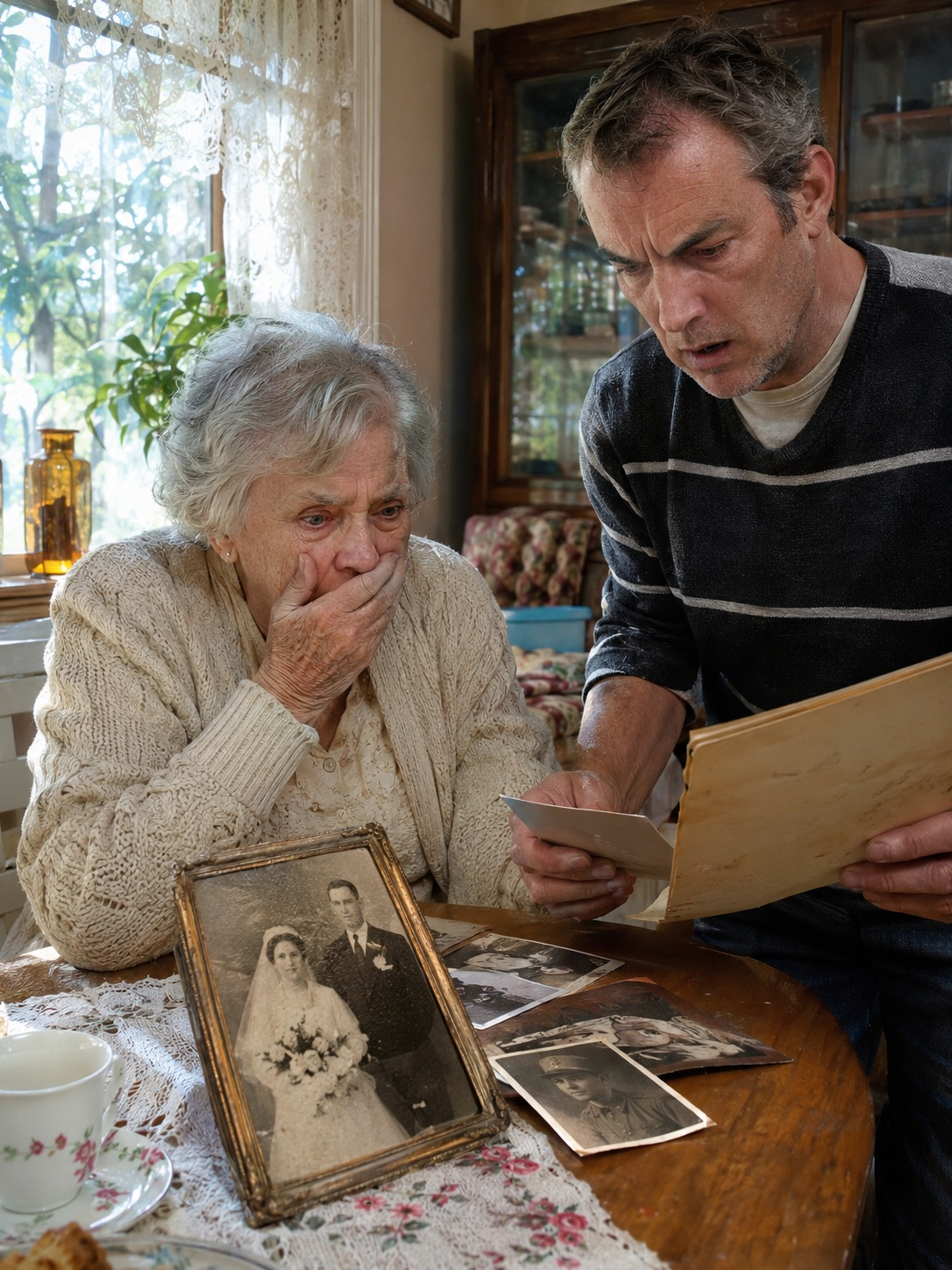
"Peter, get away from him!" I screamed into the phone.
Something crashed inside Walter's study.
My sister cried out.
Then I heard a man's voice, calm and frighteningly familiar.
"Mrs. Callahan, your husband left that photograph hidden for a reason."
I gripped the telephone so tightly that my fingers hurt.
"Who are you?"
The man didn't answer.
Instead, I heard Peter struggling to catch his breath.
"Get out of my father's house!"
A chair scraped across the floor.
Then Margaret shouted, "Don't touch him!"
My heart hammered against my ribs.
I was eighty years old, lying in a hospital bed with a mass growing inside my abdomen, while my son and the sister I had only just recovered were facing a stranger in my home.
And I could do nothing but listen.
"Peter!" I shouted. "Answer me!"
For several seconds, there was only static.
Then his voice returned.
"Mom, I'm okay."
I nearly collapsed with relief.
"What's happening?"
He sounded breathless.
"Someone came through the back entrance."
"Who?"
A pause.
Then Peter said, "He says he knew Dad."
The stranger spoke again.
"Tell your mother my name is Charles Voss."
I closed my eyes.
Charles Voss.
I had not heard that name in twelve years.
But I remembered it.
Walter had mentioned him shortly before his death.
Not as a friend.
Not as a business partner.
As a man he regretted trusting.
"Charles?" I whispered.
The man answered.
"Hello, Ruth."
A chill moved through me.
"You knew Walter?"
"Very well."
"Then why are you threatening my son?"
"I'm trying to stop him from making a mistake."
I felt anger rise through my fear.
"Breaking into my house is a mistake, Mr. Voss. Frightening my family is a mistake. If you have something to say, say it."
He was silent.
Then he spoke quietly.
"Ask Peter what he found on the back of the photograph."
I looked toward Beth.
She was already calling the police from her own phone.
"Peter," I said, "what does it say?"
My son hesitated.
"Mom, I haven't finished reading it."
"Then read it now."
Charles interrupted.
"Don't."
I sat upright despite the pain in my abdomen.
"Mr. Voss, you don't get to decide what I know."
There was a long silence.
Then Peter spoke.
"Mom, there's a name written beneath the picture."
My breath caught.
"Whose name?"
He swallowed.
"Clara Bennett."
I closed my eyes.
The woman buried in Margaret's coffin.
The woman whose death had been recorded under my sister's identity.
The woman I had mourned without ever knowing she existed.
Peter continued.
"The hospital wristband says Ruth Callahan. But Dad wrote Clara Bennett on the back."
I stared at the wall.
"Why?"
"I don't know."
Then Margaret spoke.
Her voice trembled.
"Ruthie, there's something else."
I gripped the phone.
"What?"
"The photograph was taken before Clara died."
My heart seemed to stop.
"What do you mean?"
Margaret began crying.
"She was alive when Walter took it."
I couldn't speak.
Charles Voss said something quietly in the background.
Then Peter shouted, "Don't come any closer!"
A door slammed.
Footsteps moved rapidly across the room.
And suddenly, the call ended.
I stared at the screen.
"Peter?"
Nothing.
I called again.
No answer.
I tried a second time.
Voicemail.
Beth stood beside me, pale and shaking.
"The police are sending officers."
I nodded.
But my hands wouldn't stop trembling.
"He's in danger."
Beth put her arm around me.
"We don't know that."
I looked at her.
"I heard them."
She didn't answer.
I pressed the phone against my chest.
For the first time since Walter died, I wished I could ask him a question and know that he would answer honestly.
Who was Charles Voss?
Why had he come into our home?
And why was he so frightened of a photograph showing a woman wearing my name?
Twenty minutes passed.
Then thirty.
Every minute felt like an hour.
I watched the clock above the hospital door.
Beth paced beside the window.
A nurse came in to check my blood pressure and found it dangerously elevated.
She asked what had happened.
Beth explained that the police had been called to our house.
The nurse looked concerned.
"Mrs. Callahan, you need to remain as calm as possible."
I stared at her.
"My son may be hurt."
Her expression softened.
"I understand. Let me contact Dr. Reeves."
She left.
I looked at Beth.
"Call Peter again."
She did.
No answer.
"Call Margaret."
Beth dialed the number Daniel Whitcomb had given us.
It rang.
Then someone answered.
"Hello?"
Beth nearly dropped the phone.
"Margaret?"
"Yes."
I reached for it.
"Give it to me."
Beth put the call on speaker.
"Margaret, where are you?"
My sister sounded frightened.
"I'm outside the house."
"Where's Peter?"
"He's with the police."
I closed my eyes.
Relief swept through me so suddenly that I began crying.
"Is he hurt?"
"No. He's all right."
"What happened?"
Margaret took a shaky breath.
"Charles left before the officers arrived."
I stared at the phone.
"He escaped?"
"Yes."
"How?"
"He went through the back door."
I remembered the old garden path behind our house.
Walter had installed a gate near the fence years earlier.
It opened onto a narrow alley.
Someone who knew the property could leave without being seen from the street.
Charles Voss had known exactly where to go.
"Margaret," I whispered, "why did he come?"
She hesitated.
"Because of the photograph."
"Then tell me what it means."
She was silent.
I could hear distant voices.
A police officer asking someone to step aside.
Then Peter took the phone.
"Mom?"
I began crying harder.
"Peter."
"I'm okay."
"Are you sure?"
"Yes."
"Did he hurt you?"
"No. He grabbed the photograph, but I pulled it away. We knocked over Dad's chair. That's what you heard."
I closed my eyes.
"Thank God."
"Mom, listen. The police are taking statements. I need to stay here a little longer."
"Did they find Charles?"
"Not yet."
I swallowed.
"Then don't stay alone."
"I won't."
"Promise."
"I promise."
He paused.
"Mom, there's something you need to know."
My heart quickened.
"What?"
"Charles Voss was listed as an outside consultant on Dad's old medical review."
I stared at the phone.
"How do you know?"
"He left a business card on the desk."
"What kind of consultant?"
"Medical records compliance."
I closed my eyes.
Another person connected to the hospital.
Another person connected to Walter's secret.
Peter continued.
"He told us Dad had misunderstood what happened to Clara Bennett."
I gripped the blanket.
"Misunderstood?"
"Yes."
"What did he mean?"
"He wouldn't explain."
I stared toward the window.
"Then why come here?"
Peter hesitated.
"Because he said someone had started releasing documents that could destroy innocent people."
I felt a wave of anger.
"Innocent people?"
"That's what he said."
"Was Clara innocent?"
Peter was silent.
"Was Margaret?"
Still nothing.
"And what about me?"
My voice broke.
"What about the woman who spent twenty years mourning her sister and twelve years carrying a medical condition nobody explained?"
Peter spoke softly.
"Mom, I know."
I wiped my tears.
"Come back when the police release you."
"I will."
The call ended.
I looked at Beth.
She sat beside me.
Neither of us spoke for a long time.
Then she asked a question I had been avoiding.
"Mom, do you think Dad knew Clara Bennett was wearing your name?"
I looked down at my wedding ring.
"Yes."
The answer came before I could stop it.
Beth stared at me.
"You're sure?"
I shook my head.
"No. But I think he knew something was wrong."
I looked toward the empty chair beside my bed.
Walter had always sat on my right.
At church.
At the movies.
At family dinners.
Even when we argued, he chose the chair beside mine.
I had spent twelve years missing that ordinary closeness.
Now I wondered how many secrets had sat beside me.
Dr. Reeves arrived shortly afterward.
He checked my blood pressure and asked whether I was experiencing chest pain, dizziness, or worsening abdominal discomfort.
I told him about the pressure in my stomach.
He examined me carefully.
Then he adjusted the monitoring plan and asked the nurse to repeat my blood pressure after I had rested.
"Mrs. Callahan," he said, "I know you're under enormous stress. But we need to protect your health while we investigate these records."
I nodded.
"Doctor, I need to ask you something."
"Of course."
"Could a hospital accidentally put one patient's name on another patient's wristband?"
He considered the question.
"Patient identification errors can occur. Hospitals have safeguards to prevent them, but no system is perfect."
"What if someone noticed the error?"
"Then it should have been reported and corrected."
"And if it wasn't?"
His expression became serious.
"That would require investigation."
I leaned forward.
"What if a woman died while wearing another patient's name?"
He looked at me.
"Is that what the photograph suggests?"
I nodded.
"Clara Bennett was wearing a wristband with my name."
Dr. Reeves sat down.
"Do you know when the photograph was taken?"
"Twenty years ago."
"Before her death?"
"That's what Margaret says."
He looked troubled.
"Then we need to establish whether the wristband was genuine, whether the photograph was correctly dated, and what the medical records show."
I nodded.
"Could that explain why my old pathology report was mixed with Margaret's?"
"Possibly. But the events occurred years apart, so we need to understand how the records became connected."
I looked at him.
"Doctor, do you believe this was an accident?"
He was silent for a moment.
"I believe we have evidence of serious inconsistencies. I don't yet know whether they resulted from error, negligence, or deliberate alteration."
I appreciated his honesty.
It was more than most people had given me.
He continued.
"There's something else I wanted to discuss with you."
My stomach tightened.
"My condition?"
"Yes."
I braced myself.
"The surgical team has reviewed your latest imaging. The mass appears to be a large, predominantly cystic ovarian growth. We still cannot determine whether it's benign without further evaluation, but we believe surgery is likely the best treatment."
I nodded.
"When?"
"We're completing the preoperative assessment. If the remaining results are acceptable, we may be able to proceed within the next few days."
I looked down at my abdomen.
For six months, I had watched it grow.
At first, I blamed my age.
Then my diet.
Then constipation.
I bought larger skirts.
I avoided mirrors.
I stopped attending church dinners because I was embarrassed when people asked whether I was feeling well.
Now I knew there was something real inside me.
Something that needed treatment.
"Doctor," I whispered, "am I going to die?"
He looked at me directly.
"Every operation carries risks, especially at your age. But we're planning carefully, and we have good reasons to believe treatment can help you."
I nodded.
I didn't need a promise.
I needed a plan.
He gave me one.
Then he stood.
"Try to rest. We'll continue the evaluation in the morning."
Before he left, I asked one more question.
"Have you found the missing pathology report?"
He hesitated.
"Not yet."
My heart sank.
"But Dr. Foster located a reference to the original specimen transfer."
I sat upright.
"What does it say?"
"It shows that the specimen was transferred for additional review."
"To whom?"
He looked at me.
"Northbridge Clinical Services."
I closed my eyes.
The company Margaret had mentioned.
The company connected to Walter's financial records twenty years earlier.
The company that existed before Meridian.
Dr. Reeves continued.
"We've requested the original transfer documentation."
I looked at him.
"Doctor, if that report proves someone knew about my condition twelve years ago, what happens?"
He answered carefully.
"We would review whether appropriate follow-up was recommended and communicated. If there was a failure, the hospital would need to address it through the proper clinical and administrative processes."
I nodded.
For the first time, I understood that finding the truth would not necessarily be simple.
There might be medical mistakes.
There might be deliberate lies.
There might be people who had acted out of fear.
And there might be people who had done something far worse.
But I was no longer willing to accept that the passage of time made those things unimportant.
Peter returned shortly after sunset.
Margaret came with him.
The moment she entered, I reached for her hand.
She sat beside me.
I studied her face.
There were new lines around her eyes.
A small scar near her chin that I didn't remember.
And a tiredness that seemed older than her years.
But she was here.
That mattered.
Peter placed a folder on the bedside table.
"The police photographed everything in Dad's study."
I nodded.
"Did Charles take anything?"
"No. Not that we can tell."
"The photograph?"
"I still have it."
He opened the folder.
Inside was a clear plastic sleeve.
He carefully removed a copy of the photograph.
I leaned forward.
Walter stood beside a hospital bed.
He looked younger.
His hair was still mostly dark.
He wore a gray suit and held a folded document in one hand.
On the bed lay a woman.
Her face was turned toward the camera.
She had pale skin, light brown hair, and a narrow face.
Her eyes were closed.
Around her wrist was a hospital identification band.
The name was visible.
RUTH CALLAHAN.
I stared at her.
She looked nothing like me.
"That's Clara?" I whispered.
Margaret nodded.
"Yes."
I studied the woman's face.
She looked exhausted.
Ill.
And terribly alone.
I felt a sudden sadness.
For twenty years, I had unknowingly visited her grave.
I had brought flowers.
I had whispered prayers.
I had told her things I thought I was telling Margaret.
Now I wondered whether anyone had ever visited Clara's grave knowing who she really was.
"Did she have family?" I asked.
Margaret looked surprised.
"Clara?"
I nodded.
"Yes."
She lowered her eyes.
"I don't know."
I looked at the photograph again.
"Someone must have loved her."
Peter sat beside me.
"Mom, there's more."
He turned the photograph over.
Walter's handwriting appeared beneath the date.
CLARA BENNETT — PATIENT IDENTITY DISCREPANCY. DO NOT DESTROY.
Below that was another line.
RUTH CALLAHAN WAS NOT PRESENT.
I stared at the words.
"Your father was documenting the error," Peter said.
I nodded slowly.
That was possible.
Walter had always kept meticulous records.
Receipts.
Contracts.
Warranty cards.
He even saved the instructions for appliances we no longer owned.
If he discovered a medical mistake, he might have photographed it.
But another question remained.
"Why was he there?"
Peter looked at me.
"What?"
"Why was Walter standing beside Clara's bed?"
Margaret's face changed.
I noticed immediately.
"Margaret?"
She looked down.
"Ruthie, Walter was trying to help her."
"How?"
She took a breath.
"Clara had been admitted under circumstances that were never properly explained to us."
I leaned closer.
"What circumstances?"
"She was transferred from another facility. Her records were incomplete. The staff believed she had been identified correctly."
"Until someone noticed the wristband."
Margaret nodded.
"Yes."
"Who noticed?"
She hesitated.
"Walter."
I stared at her.
"How?"
"Because he had come to see me."
I frowned.
"You were in the same hospital?"
"Yes."
My heart began pounding.
"At the same time?"
She nodded.
I looked at Peter.
He was listening carefully.
Margaret continued.
"Walter was visiting me when he saw a patient being moved into another room. He noticed the name on her wristband."
"Mine?"
"Yes."
I stared at her.
"Why would he notice that?"
"Because it was your name."
I shook my head.
"That's not enough."
Margaret looked confused.
"What do you mean?"
"Walter wasn't a doctor. He wouldn't have known whether the woman was supposed to be there."
She swallowed.
"He recognized the mistake because he'd already been asking questions about the records."
I felt cold.
"What questions?"
She looked at Peter.
Then back at me.
"He had discovered that several patients' identification numbers had been altered."
I stared at her.
"Several?"
She nodded.
"Not just Clara."
The room became quiet.
I looked at the photograph again.
The woman in the bed.
My name on her wrist.
Walter standing beside her.
I had thought the secret was about my sister.
Then I thought it was about my medical condition.
Now I understood that the hospital may have been involved in something larger.
"How many patients?" Peter asked.
Margaret shook her head.
"I don't know."
"Did Dad?"
"He suspected there were more."
I closed my eyes.
Walter had been a stubborn man.
If he believed something was wrong, he would keep digging.
I remembered him arguing with an insurance company over a denied claim for one of his employees.
He spent six months writing letters.
He refused to stop until they corrected the error.
That was Walter.
But this was different.
This involved medical records.
A dead woman.
My sister's identity.
And a secret that had lasted twenty years.
"Margaret," I whispered, "why didn't Walter go to the police?"
She looked at me.
"He tried."
I opened my eyes.
"What?"
"He contacted an attorney."
"Who?"
"Someone recommended by Daniel."
Peter leaned forward.
"Was it the Whitcomb firm?"
Margaret nodded.
"Yes."
I stared at her.
"Then what happened?"
She hesitated.
"The attorney told him the evidence wasn't complete."
"And?"
"He said they needed to preserve the records before making accusations."
I looked at the photograph.
"That's why Walter kept it."
"Yes."
I nodded slowly.
For the first time, part of the story made sense.
But not enough.
Not nearly enough.
"Margaret, you still haven't explained why I was told you died."
Her expression collapsed.
"I know."
"Then tell me."
She began crying.
"Ruthie, I didn't know what had happened until years later."
"Who told you?"
"Daniel and Eleanor."
"Did they explain the funeral?"
She nodded.
"What did they say?"
Margaret looked down.
"That Clara's death had been entered under my identity because of the records error."
I stared at her.
"And nobody corrected it?"
"Not publicly."
"Why?"
She looked at Daniel's name on Peter's notes.
"Because the hospital's administrators said the correction had to be handled through a confidential review."
I felt anger rise.
"A confidential review?"
She nodded.
"For years?"
"I know."
I shook my head.
"Margaret, that's not an explanation."
She began crying harder.
"I know it isn't."
I looked at her.
"Did Walter know you were alive when he arranged the funeral?"
She closed her eyes.
"Yes."
My heart broke.
There it was.
The answer I had been afraid to hear.
My husband knew.
He knew my sister was alive.
And he let me stand beside a coffin believing she was inside.
I looked away.
For several seconds, I couldn't speak.
Peter reached for my hand.
I pulled away.
Not because I was angry with him.
Because I needed a moment without anyone touching me.
I stared at the wall.
I remembered the funeral.
The flowers.
The closed coffin.
Walter standing beside me.
His arm around my shoulders.
I remembered crying so hard that I could barely breathe.
And he held me.
He told me Margaret was at peace.
He told me she hadn't suffered.
He told me we had to be strong.
All while knowing she was alive.
I felt sick.
"Mom?" Peter whispered.
I shook my head.
"Please."
He went silent.
I closed my eyes.
For fifty years, I had loved Walter.
I had trusted him.
I had built a life around him.
And now I was discovering that he had been capable of a lie so enormous that it changed the meaning of my memories.
I opened my eyes.
"Margaret."
She looked at me.
"Yes?"
"Did he ever tell you why he did it?"
She nodded slowly.
"What did he say?"
Her voice trembled.
"He said he had been told that if he revealed you were alive, they would take you away."
I stared at her.
"Who?"
She shook her head.
"He never gave me a name."
I looked toward Peter.
He was furious.
I could see it.
But he remained quiet.
Margaret continued.
"He believed the people involved could make records disappear. He thought they could make it impossible for you to prove what happened."
I swallowed.
"Then why didn't he tell me privately?"
She looked down.
"Because he was afraid you would try to find me."
I stared at her.
"Of course I would."
"I know."
"That's what sisters do."
She began sobbing.
I reached for her hand.
This time, I didn't pull away.
We sat together.
Two old women.
Separated by a lie.
Holding hands in a hospital room while the truth slowly destroyed the story we had been told about our family.
Later that evening, Peter received an email from an attorney named Rebecca Sloan.
She represented the medical records contractor currently holding some of the St. Agnes archives.
Peter had contacted the company earlier.
Now they had responded.
He opened the email.
His expression changed.
"What?" I asked.
He read silently.
Then looked at me.
"They located a sealed packet."
My heart quickened.
"Connected to Walter?"
"Yes."
"What does it contain?"
"They won't say until they verify the legal authorization."
I frowned.
"Why?"
"Because it includes protected medical information."
I nodded.
For once, that made sense.
People's medical records deserved privacy.
But I was tired of privacy being used as an excuse to keep me from understanding my own life.
Peter continued reading.
"The packet was deposited twelve years ago."
My heart pounded.
"By Walter?"
"Yes."
I looked toward Margaret.
She seemed surprised.
"Did you know about this?"
She shook her head.
"No."
Peter scrolled.
"There's a note."
"What note?"
He read aloud.
"Release to Ruth Callahan or her legally authorized representative upon confirmation of a qualifying medical event."
I stared at him.
"What qualifies?"
Peter read the next line.
"Abdominal enlargement, pelvic mass, or related surgical evaluation."
The room went silent.
I pressed my hand against my stomach.
Walter had known.
He had known there was a medical finding.
He had known it might become serious.
And he had left instructions for what should happen if I became ill.
But he had never told me.
I felt tears filling my eyes.
"Why didn't he just tell me?"
Peter looked at the screen.
"I don't know, Mom."
Margaret leaned closer.
"Maybe he thought the doctors would follow up."
I shook my head.
"Maybe."
But the word felt empty.
Walter had been gone twelve years.
Whatever he intended, I was the one living with the consequences.
Peter continued reading.
"The attorney says the packet can be released after they verify your identity and authorization."
I nodded.
"Then do it."
"Mom, they'll need you to sign."
"Bring me the paper."
He looked surprised.
I smiled bitterly.
"I've signed enough forms in my life. One more won't kill me."
He laughed softly.
Then his expression became serious.
"There's another line."
I leaned forward.
"What?"
"The packet includes a personal statement from Walter."
My heart stopped.
"A statement?"
"Yes."
"Written?"
"It doesn't say."
I looked toward the window.
For twelve years, I had wished I could hear my husband's voice again.
Now I might have the chance.
But I was no longer certain I wanted to.
Because every new message from Walter seemed to contain another piece of a truth he had refused to share while he was alive.
The next morning, Dr. Reeves confirmed that my surgical assessment was progressing.
The team wanted to proceed with treatment as soon as it was medically appropriate.
I was frightened.
But I was also ready.
The swelling had become more uncomfortable.
I was tired of waking in pain.
Tired of feeling as though my own body had become unfamiliar.
And tired of wondering whether I would live long enough to understand what had happened.
Margaret sat beside me while Beth helped organize my belongings.
Peter was speaking with the attorney.
I looked at my sister.
"Margaret, can I ask you something?"
She nodded.
"Anything."
"Did you ever see Walter after he became ill?"
Her expression changed.
"Yes."
I stared at her.
"When?"
"About two weeks before he died."
My heart tightened.
"Where?"
"At the care facility."
I looked at her.
"He visited you?"
She nodded.
"He came to say goodbye."
I felt tears filling my eyes.
Walter had been ill.
His heart was failing.
We knew his time might be limited.
But I hadn't known he was still visiting Margaret.
"What did he say?"
She looked down.
"He apologized."
I swallowed.
"For what?"
"For letting things go on so long."
I closed my eyes.
Margaret continued.
"He told me he had made arrangements to preserve the evidence."
"The blue box?"
"Yes."
"And the sealed packet?"
She shook her head.
"He didn't mention that."
I looked at her.
"Did he tell you he loved me?"
Margaret began crying.
"Yes."
I felt my throat tighten.
"What did he say?"
She reached for my hand.
"He said you were the best thing that ever happened to him."
A tear slipped down my cheek.
I hated how much those words meant to me.
Even now.
Even after everything.
Margaret squeezed my hand.
"He said he was afraid you would never forgive him."
I stared at her.
"Maybe he was right."
She nodded.
"Maybe."
We sat quietly.
Then she whispered, "Ruthie, I don't think he stopped loving you."
I looked down at my ring.
"Love wasn't the problem."
She nodded.
"I know."
"The problem was that he didn't trust me with the truth."
Margaret began crying again.
I squeezed her hand.
For a moment, I remembered us as girls.
Two sisters sharing a bedroom.
Whispering secrets after the lights went out.
Promising we would always tell each other everything.
We had broken that promise.
Both of us.
And now, at eighty, I was learning that some promises mattered more than we understood when we made them.
At three o'clock, Peter returned with a small padded envelope.
He looked exhausted.
But there was something different in his expression.
Determination.
"Mom, the attorney released part of the packet."
I sat upright.
"Part?"
"Yes. The portion Walter specifically authorized for you."
He placed the envelope on my bed.
I stared at it.
My name was written across the front.
RUTH CALLAHAN.
Walter's handwriting.
I touched the letters.
For a moment, I could almost see him sitting at his desk.
His reading glasses low on his nose.
His favorite pen in his hand.
Writing something he hoped I would never need to read.
"Open it," I whispered.
Peter carefully removed the contents.
There was a folded letter.
A small digital storage device.
And a printed medical report.
I looked at the report first.
My name appeared at the top.
RUTH CALLAHAN.
Date: twelve years earlier.
The same date as the missing pathology review.
I read slowly.
There were medical terms I didn't understand.
But one phrase stood out.
RECOMMEND FOLLOW-UP IMAGING AND GYNECOLOGIC CONSULTATION.
My heart began pounding.
I looked at Dr. Reeves, who had entered to discuss my care.
"Doctor."
He came closer.
I handed him the report.
He read it carefully.
His expression became serious.
"Mrs. Callahan, this appears to be the earlier recommendation we've been trying to locate."
I stared at him.
"Does it mean they knew?"
"It suggests that an abnormal finding was documented and follow-up was recommended."
"Was I ever told?"
He looked at me.
"That's what we still need to establish."
I shook my head.
"I wasn't."
He nodded slowly.
"Then we'll need to investigate how that recommendation was handled."
I looked down at the paper.
Twelve years.
Twelve years of a recommendation I never received.
Twelve years of believing my body was healthy.
Twelve years of wondering why Walter had seemed so worried about me before he died.
I felt anger rising.
Not only at the hospital.
At Walter.
He had known.
And he had left me a sealed packet instead of telling me.
I looked at Peter.
"What's on the storage device?"
He turned it over.
A small label was attached.
WALTER — PERSONAL STATEMENT.
My heart stopped.
Peter looked at me.
"Mom, do you want to hear it?"
I closed my eyes.
For twelve years, I had wanted one more conversation with my husband.
Now I had to decide whether I was ready for the truth.
I opened my eyes.
"Yes."
Peter connected the device to his laptop.
A single video file appeared.
The date was eleven days before Walter died.
He clicked it.
The screen went black.
Then Walter appeared.
He was sitting in his study.
His face looked thinner than I remembered.
His hair was white.
He wore the blue cardigan I had knitted for him one Christmas.
I covered my mouth.
"Oh, Walter."
He looked directly into the camera.
For several seconds, he said nothing.
Then he began.
"Ruthie, if you're watching this, then I failed to tell you something while I was alive."
My eyes filled with tears.
His voice.
I hadn't heard it in twelve years.
Not outside old family recordings.
And now he was speaking directly to me.
"I need you to understand that what happened to Margaret was never supposed to happen."
I gripped the blanket.
Walter continued.
"I believed the doctors. I believed the administrators. I believed the people who told me they could protect both of you."
He looked down.
Then back at the camera.
"I was wrong."
A tear slipped down my cheek.
He took a shaky breath.
"The woman named Clara Bennett was not supposed to be identified as Ruth Callahan. When I discovered the error, I tried to have it corrected."
He paused.
"But someone had already changed the records."
My heart pounded.
Walter looked exhausted.
"I kept copies because I knew the official documents could disappear."
Peter leaned closer.
Margaret covered her mouth.
Walter continued.
"Ruthie, the medical finding in your records was real. I was told it required follow-up, but I was also told the report might belong to another patient because of the identification problems."
I stared at the screen.
He lowered his eyes.
"I should have insisted on another examination. I should have told you everything. Instead, I trusted the people who promised to sort it out."
My tears fell freely.
Walter looked back at the camera.
"If you are ill now, then my silence may have cost you something I can never give back."
He paused.
"I am sorry."
I closed my eyes.
I had imagined hearing those words.
I had imagined how I would feel.
But I hadn't expected the anger.
The grief.
The love.
All at once.
Walter continued.
"There is something else you need to know."
I opened my eyes.
His expression changed.
"The records discrepancy was not limited to Margaret and Clara."
Peter leaned forward.
Walter looked directly into the camera.
"Another patient was involved."
My heart began pounding.
He paused.
Then said, "Someone whose identity was deliberately concealed."
The room went silent.
Walter looked frightened.
I had never seen him look that way.
He swallowed.
"I found evidence that the second identification number was used to hide a patient transfer."
Peter whispered, "Oh my God."
Walter continued.
"I don't know whether the person responsible will ever be held accountable. But I know where the original transfer record was kept."
He leaned closer to the camera.
"Ruthie, if you need the truth, ask Peter to look behind the photograph of our wedding."
I froze.
Our wedding photograph.
The one that had stood on the dining room table for decades.
The one visible in the anonymous photographs.
The one beside the blue lockbox.
Walter took another breath.
"There is a compartment in the frame."
Peter stood.
"Mom."
I stared at the screen.
Walter continued.
"Inside is a copy of the document that identifies the person who authorized the transfer."
My heart pounded.
Then he said something that made Margaret gasp.
"And Ruthie, please understand this before you read it."
He looked directly into the camera.
"The person who signed that authorization was someone you trusted."
The video ended.
For several seconds, nobody spoke.
I stared at the blank screen.
My husband had left me one final warning.
And the answer was hidden behind our wedding photograph.
Peter grabbed his phone.
"I'm calling the police. We need that frame preserved."
I nodded.
"Do it."
He dialed.
Margaret sat motionless beside me.
Her face had gone pale.
I looked at her.
"Margaret?"
She didn't answer.
"Do you know who signed it?"
She shook her head.
But I could see fear in her eyes.
Peter finished the call.
"The police are sending someone to retrieve the frame."
I nodded.
Then Beth's phone vibrated.
She looked down.
Her expression changed.
"What is it?" I asked.
She turned the screen toward us.
An unknown number had sent a photograph.
It showed Walter's wedding picture lying facedown on my dining room table.
The back of the frame had been removed.
A small folded document rested beside it.
Someone had already opened the compartment.
Beneath the photograph was a message.
YOU'RE TOO LATE.
Peter stared at the screen.
Then another message arrived.
THE ORIGINAL TRANSFER RECORD IS GONE.
My heart began pounding.
A third message appeared.
This one contained a short video.
Peter opened it.
The camera moved through my dining room.
Past the lace curtains.
Past the wooden table.
Toward Walter's study.
Then it stopped in front of the old oak desk.
The lower drawer was open.
The hidden compartment was empty.
A man's hand entered the frame.
He placed a small blue metal lockbox on the desk.
Then the camera moved closer.
The box was open.
Inside lay a single envelope.
Across the front, in Walter's handwriting, were four words.
FOR RUTH — THE TRUTH.
The man's hand reached toward the envelope.
He opened it.
Then the video stopped.
A final message appeared.
ASK PETER WHY HIS NAME IS ON THE DOCUMENT INSIDE.






Comments 0