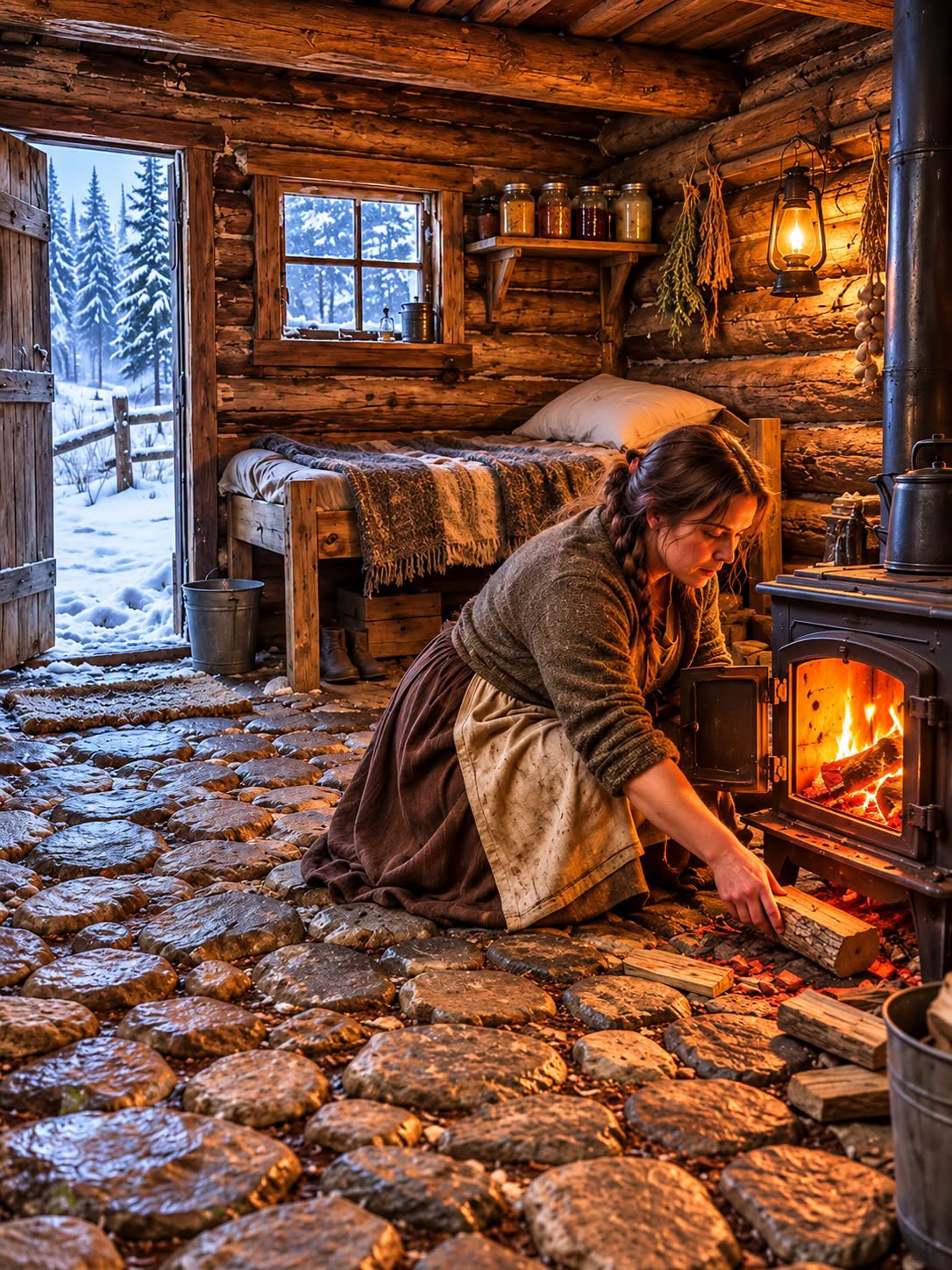
"Get away from that box!"
Jedediah Croft's voice shook the cabin.
Silas Black stood beside the exposed floor, holding his father's old document.
Four men waited behind him.
His wife clutched their children near the doorway.
And beneath us, Elias Mercer had just revealed something nobody in Sweetwater Valley had ever imagined.
There was a grave beneath the eastern chamber.
I stared at the wooden box between the stones.
"Whose grave?" I whispered.
The voice below answered.
"His name was Samuel Reed."
Jedediah closed his eyes.
Silas suddenly stepped forward.
"That's a lie!"
The old carpenter turned toward him.
"Then why are you so frightened?"
Silas said nothing.
I looked at the wooden box.
Tom had discovered it.
He had hidden the key.
And he had left instructions for me to find it.
But if there was a grave beneath our cabin, I needed to know who Samuel Reed had been.
I also needed to know why an entire valley had spent twenty years pretending he never existed.
The four men Silas had brought with him began exchanging uncomfortable looks.
One of them, a broad-shouldered ranch hand named Walter Briggs, lowered his shovel.
"I didn't come here to dig up graves."
Silas turned sharply.
"Nobody asked you to."
Walter looked toward the floor.
"You said we were recovering stolen property."
"We are."
"Then why is there a grave?"
Silas tightened his grip on the document.
"Because Elias is trying to frighten us."
The voice beneath the floor returned.
"Ask your employer what happened to Samuel's family."
Silas went pale.
His wife looked at him.
"Silas?"
He refused to meet her eyes.
I stepped toward the opening.
"Elias, who was Samuel Reed?"
There was a long pause.
Then he answered.
"Samuel was the first man who understood what Thomas Black intended to do with the spring."
Jedediah sat down heavily.
I looked at him.
"You knew Samuel?"
He nodded.
"Yes."
"Was he a surveyor?"
"No. He was a schoolteacher."
I frowned.
"Then why was he involved with the water system?"
Jedediah stared at the old stones.
"Because he owned the land where the eastern passage emerged."
I looked at the drawing.
The old property lines.
The red markings.
The hidden chamber.
Everything seemed connected.
Elias continued.
"Samuel had a small farm near the lower creek. His family had lived there for years. When Thomas Black began buying land, Samuel refused to sell."
"Why?"
"Because the spring supplied his fields."
I looked toward Silas.
His father's name seemed to hang in the air.
"Did Thomas try to take it?"
Elias answered quietly.
"He tried to take everything."
Jedediah finally began telling the story he had kept buried for twenty years.
Samuel Reed had been a quiet man.
He taught children at a small schoolhouse near the trading post.
His wife, Margaret, kept a garden and raised two sons.
They owned a modest farm.
Their property was not valuable because of its size.
It was valuable because the eastern water passage ran beneath it.
When Thomas Black began acquiring land in the valley, he realized that controlling the spring would give him enormous influence.
He approached Samuel with an offer.
Samuel refused.
Thomas increased the price.
Samuel refused again.
Then Thomas proposed a different arrangement.
He would pay for improvements to the water channel in exchange for exclusive rights to its use.
Samuel rejected that offer too.
He believed the spring belonged to the people who depended on it.
"Samuel was stubborn," Jedediah said.
I looked at him.
"Was he wrong?"
The old carpenter shook his head.
"No."
He paused.
"He was the only one who understood what was at stake."
According to Jedediah, Elias had helped Samuel prepare a written agreement establishing shared access to the water.
Several families signed it.
The agreement became the foundation of what was later called the Sweetwater Valley Water Cooperative.
But Thomas Black never accepted it.
He believed the arrangement threatened his plans.
Then, one autumn evening, Samuel disappeared.
His wife reported him missing.
His horse was found near the creek.
His tools were scattered beside the eastern passage.
Thomas told the community that Samuel had taken money and abandoned his family.
The story spread.
Margaret and her children eventually left the valley.
Nobody heard from them again.
I stared at Jedediah.
"Did you believe that story?"
He lowered his head.
"At first."
"And later?"
"Later, I knew better."
Elias explained what had really happened.
Samuel had discovered that Thomas intended to seal the eastern passage.
He had gone to confront him.
The argument became violent.
Several workers were present.
Jedediah had been among them.
Elias tried to stop the confrontation.
But Thomas had already made his decision.
During the struggle, Samuel fell against the stone structure.
Part of the old chamber collapsed.
The men believed he had died.
Thomas ordered them to seal the passage.
He claimed the water would otherwise destroy the foundation.
But Elias suspected that the collapse had been deliberately concealed.
He wanted to report what had happened.
Thomas threatened him.
He warned that if Elias spoke, he would be accused of causing the collapse himself.
The surveyor refused to remain silent.
A few days later, Elias disappeared.
I looked toward the chamber.
"Did you bury Samuel?"
The voice below was quiet.
"Yes."
My throat tightened.
"Was he dead?"
"By the time I reached him, he was."
I closed my eyes.
For twenty years, his family had believed he had abandoned them.
His children had grown up without knowing where their father was.
And beneath my cabin, his grave had remained hidden.
I looked at the old carpenter.
"Why didn't you tell the authorities?"
Jedediah's eyes filled.
"Because I was afraid."
He looked toward the floor.
"And because I helped build the wall that buried him."
Silas suddenly laughed.
It was a short, unpleasant sound.
"This is nonsense."
Nobody responded.
He held up the old document.
"There's no proof of any of this."
Elias spoke from below.
"Then open the box."
Silas looked toward the wooden chest.
"Why?"
"Because the second page contains the names of the men who sealed the chamber."
Silas's face changed.
I looked at the box.
"Does it contain the original agreement?"
"Yes."
"And the confession?"
"Yes."
Jedediah stood.
"We need to open it."
Silas moved between him and the box.
"No."
I stared at him.
"You said your father owned the property."
"He did."
"Then why are you afraid of a document?"
Silas looked toward his men.
None of them moved.
Walter Briggs slowly placed his shovel against the wall.
"I think I've heard enough."
The other two men followed.
Silas turned toward them.
"You're being paid to help me."
Walter shook his head.
"I'm not being paid to dig up a grave."
Silas's wife stepped forward.
"Give them the paper."
He looked at her.
For a moment, I thought he might refuse.
Then he unfolded the document and placed it on the table.
I noticed something immediately.
The paper was not an ownership deed.
It was a handwritten statement.
And at the bottom was Thomas Black's signature.
Jedediah read the statement aloud.
It described the original agreement between the landowners.
It also described Thomas Black's intention to acquire exclusive control of the eastern spring.
The document admitted that Samuel Reed had refused to surrender his rights.
It acknowledged that the eastern passage had been sealed during a confrontation.
And it contained a sentence that made Jedediah stop reading.
"Samuel Reed was buried beneath the stone chamber after the collapse."
Silence filled the cabin.
I looked toward Silas.
His wife had covered her mouth.
Walter Briggs stared at the floor.
Jedediah continued.
The final section contained the names of the men who had participated in the sealing of the passage.
Thomas Black.
Jedediah Croft.
Two hired workers.
And one additional name.
I leaned closer.
It was unfamiliar.
A name I had never heard before.
Then Elias spoke.
"Read the last line."
Jedediah swallowed.
He moved the paper toward the lantern.
The handwriting was different.
It appeared to have been added later.
The sentence read:
"The eastern chamber was sealed under the direction of Reverend Abernathy."
I felt my blood run cold.
The reverend had visited my cabin.
He had questioned my judgment.
He had stood beside Mr. Harlan during the inspection.
And he had supported the request to examine whether Sarah was safe in my care.
I looked toward Martha.
She had gone pale.
"That's impossible," she whispered.
Jedediah slowly lowered the paper.
"No."
He looked at the signature.
"That's exactly why Elias wanted this document found."
The next morning, Jedediah went to the trading post.
He wanted to locate the original county records.
I remained at the cabin with Sarah, Martha, and Silas's family.
Silas had not left.
He sat near the door, refusing to speak.
His wife stayed beside the children.
Finally, I approached him.
"Did you know about Samuel?"
He stared at the floor.
"No."
"Did your father ever talk about him?"
"Not directly."
"What did he tell you about the spring?"
Silas rubbed his face.
"He said it belonged to our family."
"Why?"
"Because he had invested money in the property."
"That doesn't make the water yours."
He looked up.
"You don't understand what it was like growing up in his house."
I waited.
"My father never forgave anyone who challenged him. He believed the valley owed him something."
"Did he tell you about Elias?"
Silas nodded.
"He said Elias had stolen documents and disappeared."
"Did you believe him?"
"For most of my life."
He looked toward the table.
"Then, after he died, I found his papers."
I felt a chill.
"What papers?"
"Letters. Old agreements. Maps."
"Why didn't you bring them to the county?"
Silas laughed bitterly.
"Because one of the letters said that if the original water agreement ever became public, my father's estate could be challenged."
I stared at him.
"So you wanted the key."
He nodded.
"I wanted the original records."
"To destroy them?"
He didn't answer.
His silence was enough.
That afternoon, Martha came to sit beside me.
She had been quiet since reading Reverend Abernathy's name.
"Elspeth, I need to tell you something."
I looked at her.
"What?"
"Several weeks ago, the reverend came to my house."
I waited.
"He asked whether I believed you were grieving too deeply to care for Sarah."
I felt my jaw tighten.
"What did you say?"
"I told him you were a devoted mother."
Martha lowered her eyes.
"He said the community needed to protect the child."
I remembered the inspection notice.
The county representative.
The threat of temporary placement.
"Did he mention the spring?"
"Yes."
My stomach tightened.
"What did he say?"
"He said the old water system was dangerous and that nobody should interfere with it."
I looked toward the floor.
"Did he know about the chamber?"
"I don't know."
She paused.
"But he asked whether Jedediah had been visiting your cabin."
I stared at her.
"Why?"
"He wanted to know whether Jedediah had found anything."
I felt a wave of anger.
The reverend had not simply questioned my judgment.
He had been watching our work.
I stood.
"Where is he now?"
Martha shook her head.
"I don't know."
Then she added something else.
"He was planning to leave Sweetwater Valley before Christmas."
Jedediah returned near sunset.
He carried a bundle of old papers.
His expression was grim.
"I found the county records."
I moved toward him.
"And?"
He placed the documents on the table.
"The original water agreement was never legally dissolved."
I stared at him.
"What does that mean?"
"It means Thomas Black never owned the spring."
Silas looked up.
Jedediah continued.
"The agreement remained valid. The water was supposed to be shared among the properties listed in the original survey."
"Then why did nobody know?"
"Because the records were removed."
He opened the bundle.
Several pages were missing.
But one remained.
It listed the properties.
It listed the water rights.
And it included a map of the eastern passage.
I recognized the line immediately.
It ran beneath my cabin.
I looked at the document.
Then I noticed another name.
Tom MacLeod.
His property had been included in the cooperative agreement.
He had not known when he built the cabin.
Or perhaps he had discovered it later.
I looked toward Jedediah.
"Why is my husband's name here?"
The carpenter examined the paper.
"Because Tom inherited the land from the original owner."
I frowned.
"Who?"
Jedediah pointed to a name written near the bottom.
Margaret Reed.
I felt the room tilt.
Samuel Reed's wife.
Tom had bought the property from her family.
Which meant the cabin had been built on land connected to the man buried beneath it.
I sat down.
For a long time, I couldn't speak.
Tom had never mentioned Margaret Reed.
He had told me the land was available.
He had told me Jedediah had inspected it.
But he had never explained that the property had belonged to the family of the missing schoolteacher.
I looked at the documents.
"Did Tom know?"
Jedediah nodded.
"He discovered it shortly before he became ill."
"Why didn't he tell me?"
"I think he wanted to understand the entire agreement first."
I touched the paper.
The name Margaret Reed seemed to glow beneath the lantern.
"Where is she now?"
Jedediah shook his head.
"I don't know."
Elias answered from beneath the floor.
"She's alive."
Everyone turned.
I moved toward the opening.
"Where?"
"South of the valley."
"How do you know?"
"Because Tom found her."
My breath caught.
"When?"
"Last spring."
I pressed one hand against the table.
"Did he speak to her?"
"Yes."
"What did she tell him?"
The voice below became weaker.
"She told him that Samuel had left something for their children."
I looked toward the wooden box.
"What?"
Elias paused.
Then he spoke.
"The original deed."
Jedediah stared at the floor.
"Where is it?"
"Not in the box."
I looked toward the chamber.
"Then where?"
Elias's answer came slowly.
"Inside the grave."
That night, I couldn't sleep.
The temperature outside had dropped again.
The wind rattled the shutters.
Sarah slept beside the stove.
I sat at the table reading Tom's letter.
Every sentence seemed to contain something I had missed.
He had known about Elias.
He had discovered the original agreement.
He had found Margaret Reed.
And he had hidden the key beneath the floor.
I wondered how much he had managed to accomplish before his illness became too severe.
I wondered whether he had known he was dying.
I wondered whether he had left the final discovery for me because he believed I would understand what needed to be done.
I looked toward the stones.
They were warm.
The stove was nearly empty.
Yet the cabin remained comfortable.
I thought about the families in the valley.
The ranchers burning furniture.
The children sleeping in their coats.
The elderly men struggling to keep their homes warm.
If the original water agreement could be restored, perhaps the spring could help them too.
But first, we needed to understand the grave.
And we needed to find Margaret Reed.
The next morning, Jedediah prepared to open the eastern chamber.
He insisted that we would not disturb the grave without proper help.
I agreed.
We would contact the county representative.
We would explain the documents.
And we would ask for someone to oversee the recovery of the original deed.
But before we could begin, a visitor arrived.
It was Reverend Abernathy.
He entered without removing his gloves.
His eyes immediately went to the papers on the table.
Then to the exposed floor.
Finally, he looked at Jedediah.
"I see you've opened it."
Jedediah stood.
"Yes."
The reverend's expression tightened.
"That was a mistake."
I stepped forward.
"Why?"
He ignored me.
"Close the chamber immediately."
Jedediah shook his head.
"Not until the truth is established."
The reverend looked toward the cradle.
Then at me.
"Mrs. MacLeod, I suggest you take your daughter and leave this matter to the men who understand it."
I stared at him.
"This is my home."
"Your home is built over a dangerous place."
"Then why did you help conceal it?"
His face changed.
For a moment, the room became completely silent.
Then Reverend Abernathy placed a folded document on the table.
"You have no idea what you're dealing with."
Jedediah looked at the paper.
His hands began to tremble.
I picked it up.
It was an old church record.
The ink was faded.
The date was twenty years earlier.
And beside the name Samuel Reed was a burial entry.
But the location was not the eastern chamber.
It was another place entirely.
A cemetery several miles outside Sweetwater Valley.
I looked at the reverend.
"Why does this say Samuel Reed was buried somewhere else?"
He didn't answer.
Then Elias spoke from beneath the floor.
"Because the man buried in the eastern chamber was not Samuel."
I turned toward the opening.
Jedediah dropped the lantern.
And the voice beneath our feet whispered:
"It was Reverend Abernathy's own brother."






Comments 0