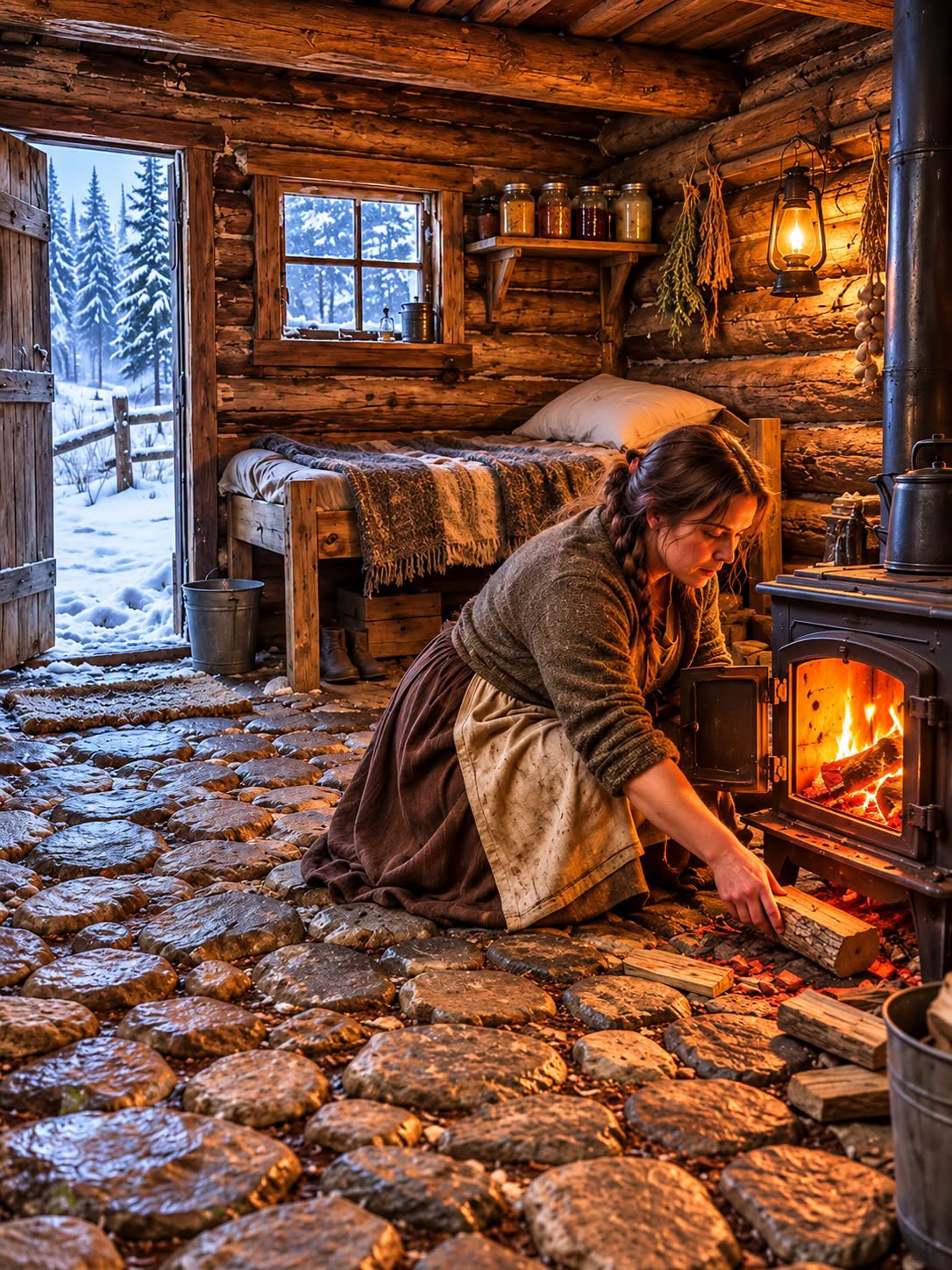
Jedediah Croft stumbled through my doorway and nearly dropped the bundle of firewood in his arms.
"Good Lord, girl! What have you done?"
I stood beside the door, one hand resting on its rough wooden frame.
Behind him, the Montana wind swept snow across the porch. His beard was white with frost, and his heavy boots carried enough snow to cover the stones near the entrance.
But he wasn't looking at the snow.
He was looking at the floor.
For a moment, neither of us spoke.
Then he looked toward my stove.
The fire was nearly gone.
Only a few red embers remained beneath the iron grate.
"Your chimney isn't smoking," he said.
"No, sir."
"And you've barely got a fire going."
"That's right."
He slowly turned toward me.
"Then why is it warm in here?"
I stepped aside and let him enter.
"Because the floor is doing its work."
Jedediah stared at me as though I had spoken in a language he had never heard.
I had imagined this moment many times during the months when the valley laughed at me. I had imagined the carpenter returning to admit he was wrong. I had even imagined Silas Black standing outside my door, asking me how to build the very floor he had mocked.
But I had never imagined Jedediah arriving with such fear in his eyes.
He had come expecting a tragedy.
Instead, he had found a warm cabin.
And that was only the beginning.
Three months earlier, nobody in Sweetwater Valley would have believed him if he had told them what he was seeing.
In September, I was still the foolish young widow who had torn apart a perfectly good house.
I was nineteen years old.
My husband, Tom, had been dead for only a few months.
My daughter, Sarah, was still an infant.
And I had decided to do something that every sensible person in the valley considered madness.
I had removed my wooden floor.
Not repaired it.
Not replaced a few damaged boards.
Removed every single plank.
I remembered the first morning clearly.
Sarah was sleeping in her cradle near the stove. The sunlight came through the little window above the bed, illuminating the dust in the air.
Tom's iron pry bar rested beside the wall.
I had held it for nearly ten minutes before I finally forced its flat end beneath the first oak board.
The wood resisted.
I pushed harder.
The board groaned.
Then, with a sudden crack, it lifted.
I stopped and stared at the dark earth beneath it.
That was the first moment I understood how much work I had given myself.
But I also knew there was no going back.
I had promised Tom.
And a promise was all I had left.
Tom had built our cabin with his own hands.
He had chosen every log, fitted every joint, and laid the oak floorboards himself.
He had been proud of that floor.
He used to say that a proper home needed strong walls, a solid roof, and a floor that would keep a family away from the frozen ground.
When he finished the cabin, he had stood in the middle of the room with his hands on his hips.
"Well, Ellie," he had said, "I believe we could survive just about anything in here."
I had laughed.
"You believe that because you built it."
"I built it because I believe it."
He had kissed my forehead.
"Whatever winter throws at us, we'll face it together."
I remembered those words more often than I wanted to.
The previous winter had been cruel.
Sarah was born in January, during a stretch of cold so severe that the water bucket froze overnight.
Tom fed the stove every two hours.
Sometimes he barely slept.
He would rise before the fire died, pull on his boots, and carry another armful of wood inside.
The stove roared.
The chimney smoked.
And still, ice formed along the inside edges of our windows.
I remember holding Sarah beneath three blankets while Tom checked the door for drafts.
He stuffed cloth into the gaps between the floorboards.
He hammered strips of wood against the walls.
He even hung another blanket over the window.
Nothing seemed to make enough difference.
The cold always found another way inside.
By March, Tom had developed a cough.
At first, he dismissed it.
"Just the winter air," he said.
But the cough grew worse.
By April, he could barely stand without becoming breathless.
A doctor from the neighboring settlement came to see him, but the journey through the muddy spring roads had taken too long.
Tom had pneumonia.
Three days later, he was gone.
I remembered sitting beside his bed, holding his hand while Sarah slept in her cradle.
His fingers were cold.
His breathing was shallow.
He looked toward our daughter.
"Promise me something," he whispered.
I leaned closer.
"Anything, Tom."
"Whatever happens to me, keep our little girl safe."
I pressed his hand against my cheek.
"I promise."
He tried to smile.
Then he closed his eyes.
I had not known how to live without him.
I only knew how to keep breathing.
After Tom died, the cabin became unbearably quiet.
Every object reminded me of him.
His coat still hung behind the door.
His tools remained beside the workbench.
The small wooden chair he had made for Sarah stood near the window.
Sometimes I caught myself turning toward the door when the wind rattled the shutters.
I expected him to come inside.
I expected to hear his boots.
I expected him to complain about the weather and ask whether I had eaten.
Then I would remember.
He wasn't coming home.
I had no time to remain lost in grief.
The coming winter would be worse than the last if I couldn't find a way to keep the cabin warm.
Tom had left me five cords of firewood.
Five.
The previous winter, we had burned eight.
And eight had not been enough.
I counted the remaining logs twice.
Then I counted them again.
I knew what would happen if the winter became as severe as the previous one.
I would have to burn the furniture.
Then the chairs.
Then the table.
And if that still wasn't enough, I would have nothing left to keep Sarah warm.
I refused to let that happen.
The answer came from a memory I had carried since childhood.
My father had been a stonemason in Scotland.
He worked on great lime kilns, enormous structures built from stone and heated by intense fires.
As a little girl, I sometimes waited near the kilns while he finished his work.
I remembered how the air remained warm even after the flames were gone.
Once, I pressed my palm against a large stone that had been heated by the fire.
It was warm.
Not burning.
Just warm.
I asked my father why.
He laughed softly.
"Because stone has a long memory for fire, lass."
I frowned.
"A memory?"
"Aye. Wood gives up its warmth quickly. But stone holds what it's given and returns it slowly."
I had never forgotten that sentence.
For months after Tom died, I thought about it whenever the stove burned through another stack of wood.
The stove heated the air.
But the air escaped.
It rose toward the ceiling, slipped through the roof, and disappeared through the chimney.
The floor remained cold.
The ground beneath the cabin remained cold.
And every time I fed the stove, I was heating a room that seemed determined to give that heat away.
What if I could make the floor hold some of it?
What if the stove could heat something that would release warmth long after the fire had died?
The idea sounded foolish even inside my own head.
But I had no better idea.
And I had a daughter to protect.
That morning, I kissed Sarah's forehead and placed her safely in her basket near the hearth.
Then I picked up Tom's iron pry bar.
The first plank took nearly an hour to remove.
By the time I finished, my hands were trembling.
A blister had opened beneath my right thumb.
I wrapped it with a strip of cloth and continued.
One plank.
Then another.
By evening, I had removed six boards.
The following morning, I removed more.
I worked whenever Sarah slept.
I worked while she watched me from her basket.
I worked until my back ached and my fingers became too sore to close properly.
Three days later, every floorboard was gone.
The cabin looked as though a storm had passed through it.
There was exposed earth beneath my feet.
Wooden boards leaned against the walls.
Dust covered everything.
I sat on an overturned bucket and stared at the empty floor.
For the first time, I wondered whether I had made a terrible mistake.
Perhaps Jedediah was right.
Perhaps I was destroying the only home my husband had ever built.
Then Sarah made a small sound from her cradle.
I turned.
She was awake, moving her tiny hands beneath the blanket.
I went to her and lifted her into my arms.
"Your father asked me to keep you safe," I whispered.
I kissed her forehead.
"I'm going to find a way."
The first person to discover what I had done was Martha, Tom's sister-in-law.
She arrived carrying a basket of fresh bread.
I was standing in the middle of the cabin, covered in dirt, when she opened the door.
She stopped.
Her eyes moved from the boards leaning against the walls to the exposed earth beneath my feet.
Then she looked at me.
"Elspeth."
I waited.
"What have you done?"
"I'm making the house warmer."
Martha stared at the ground.
"Warmer?"
She stepped forward, then quickly pulled her foot back.
"Good heavens. You've taken the entire floor out!"
"I know."
"You've opened your home to the frozen ground!"
"I'll put something better in its place."
She looked toward Sarah's cradle.
Then she looked at my hands.
The cloth wrapped around my thumb was stained with blood.
"Please tell me you know what you're doing."
I wanted to say yes.
I wanted to tell her that my father's knowledge would save us.
I wanted to sound certain.
But I couldn't lie.
"I know I have to try."
Martha placed the bread on the table.
For a moment, she seemed ready to argue.
Then she lowered her voice.
"People are going to talk."
I looked down at the earth.
"Let them."
She shook her head.
"Elspeth, you don't understand. They already think you've been acting strangely since Tom died."
I lifted my eyes.
"They can think whatever they want."
Martha glanced at Sarah again.
Then she said something that stayed with me long after she left.
"Just don't let your grief put that child in danger."
I said nothing.
But after the door closed, I stood beside Sarah's cradle for a long time.
I had already lost my husband.
I would not lose my daughter.
The following morning, I borrowed a wheelbarrow.
I pushed it downhill toward the creek.
The water was freezing.
The rocks beneath it were smooth from years of moving beneath the current.
I selected stones of different sizes, lifted them from the water, and placed them into the wheelbarrow.
Then I pushed the heavy load uphill.
My arms shook.
The wheels sank into the soft earth.
Several times, I had to stop and catch my breath.
But I kept going.
One trip.
Then another.
By the end of the day, my hands were raw.
The following morning, I went back.
I did not know how many stones I would need.
I only knew the cabin floor had to be covered.
I began excavating the earth beneath the cabin.
I laid a deep bed of gravel for drainage, remembering my father's warnings about moisture and the damage it could cause to stone and timber.
I leveled the sand.
I prepared shallow stone-lined passages intended to distribute warmth from the stove through the surrounding stone mass.
Then I began placing the river stones.
One by one.
Hundreds of them.
Every stone had to be selected, carried, and fitted.
The work was slow.
It was painful.
And every evening, when I finally sat down, I could barely lift my arms.
Sometimes I cried.
Not because I wanted to quit.
But because Tom should have been there.
He should have been standing beside me, telling me which stones to move.
He should have been laughing at my stubbornness.
He should have been holding Sarah while I worked.
Instead, I had only his iron pry bar, his unfinished promises, and the memory of something my father had said years ago.
By the time the first snow arrived, the floor was nearly finished.
I stood in the center of the cabin and looked down.
Gray stones.
Brown stones.
Dark stones polished smooth by the river.
They covered the entire floor.
I ran my fingertips over their surfaces.
For the first time in months, I felt a little hope.
Then someone knocked.
Three hard blows.
I turned toward the door.
When I opened it, Jedediah Croft stood outside.
He looked past me.
His eyes traveled across the cabin.
Then he saw the stones.
His expression darkened.
"Good Lord, girl."
He stepped inside.
"What have you done to Tom's house?"
I swallowed.
"I've made a warmer floor."
He stared at me.
Then he shook his head.
"You've made a terrible mistake."
He bent down and examined the stones.
His expression became even harder.
"Do you understand what moisture does to a wooden foundation?"
"I built a gravel bed for drainage."
"That isn't enough."
"I've thought about the foundation."
"You're nineteen years old," he snapped. "I've spent forty years building houses. You think you know better than me?"
I looked at the floor.
Then at Sarah.
"No," I answered quietly. "I think I have to try something different."
Jedediah straightened.
For several seconds, he said nothing.
Then he picked up his hat.
"Come winter, you'll understand."
He walked toward the door.
Before leaving, he looked back one last time.
"And when that floor fails, don't expect the valley to rescue you."
The door closed.
I stood alone in the cabin.
My daughter slept peacefully.
The stones lay beneath my feet.
And outside, the first snow continued falling.
I thought the worst thing that could happen was that Jedediah would be right.
I was wrong.
Because that evening, Martha returned.
And this time, she brought news that made my blood run cold.
Someone in Sweetwater Valley had begun discussing whether Sarah should be taken away from me.
Phần tiếp theo sẽ bắt đầu trực tiếp từ Chapter 2: The Promise I Made to a Dying Man, tiếp nối đúng thời điểm Martha tiết lộ rằng có người trong thung lũng muốn tách Sarah khỏi mẹ. Mạch truyện sẽ tiếp tục theo đúng thứ tự 15 chương, mỗi chương hướng tới khoảng 2.000 từ, và chỉ kết thúc hoàn toàn ở Chapter 15.






Comments 0