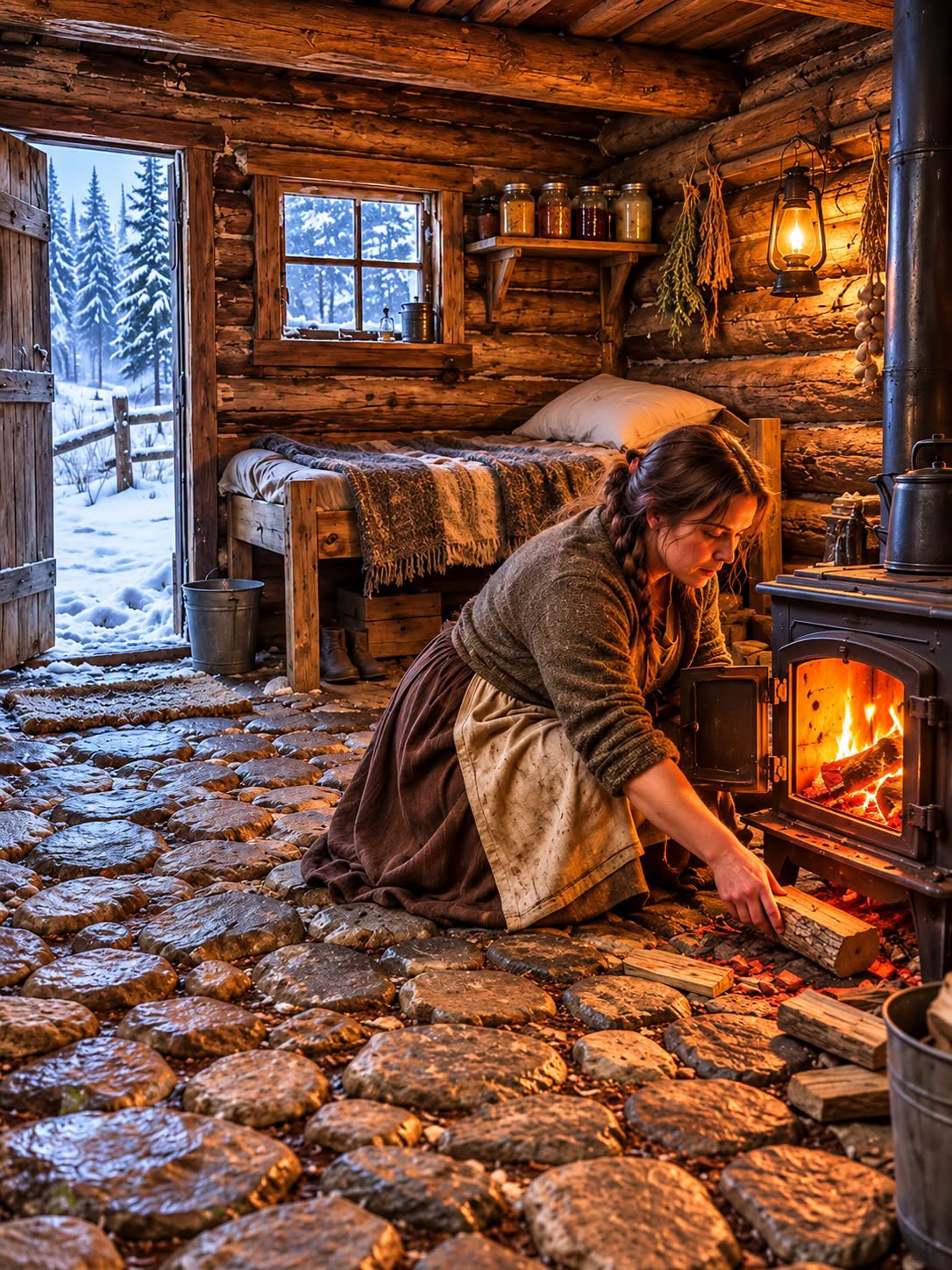
"Open the door, widow. I'm here to collect my father's property."
Silas Black stood outside my cabin with his hat pulled low and a crooked smile on his face.
Behind me, Jedediah Croft held the lantern beside the open stone chamber.
Sarah was asleep in her cradle.
Tom's warning remained folded inside my apron.
Do not trust the man who comes looking for the key.
I looked at Silas through the narrow opening of the door.
"What property?"
He laughed.
"Don't play foolish with me, Elspeth. You know exactly what I'm talking about."
"I don't."
"Then perhaps Jedediah can explain."
I glanced toward the old carpenter.
His expression had become hard.
"Silas," he said, "you need to leave."
Silas leaned against the doorframe.
"Still protecting secrets after all these years, Jedediah?"
The carpenter stepped forward.
"That property doesn't belong to your family."
Silas stopped smiling.
"According to whom?"
"According to the men who actually built this valley."
Silas looked past him toward the exposed floor.
Then his eyes settled on the dark opening.
For the first time, I saw genuine excitement in his expression.
"So it's true," he whispered.
He stepped inside without asking permission.
And I understood that the danger beneath my cabin had never been buried as deeply as I had believed.
Silas walked slowly across the cabin.
His boots stopped beside the exposed section of floor.
He crouched and examined the opening.
"Well, well."
Jedediah moved between him and the chamber.
"Don't touch anything."
Silas laughed.
"You still give orders as though you're the master of this valley."
"I'm telling you to leave."
"Not until I get what belongs to my family."
I tightened my grip on the folded letter.
"What are you looking for?"
Silas turned toward me.
"The survey records. The original property documents. And the key."
I felt my stomach tighten.
"Why would those things belong to you?"
"My father paid for them."
"Your father?"
"Yes."
He smiled again.
"Thomas Black was a businessman. He invested money in this valley long before your husband arrived."
Jedediah shook his head.
"Your father paid Elias to survey the spring. He didn't buy the water."
Silas's expression changed.
"That's an interesting distinction."
"It's the truth."
Silas stood.
"Truth is whatever can be proved, old man."
He looked toward the table.
I followed his gaze.
The brass key was lying beside Tom's drawings.
Before I could move, Silas reached for it.
I grabbed his wrist.
"Don't."
His eyes narrowed.
"Let go."
"No."
For a moment, neither of us moved.
Then Jedediah stepped forward.
"Silas, I won't warn you again."
Silas pulled his hand free.
He looked from the key to the old carpenter.
Then he gave a small, humorless laugh.
"Fine. Keep it."
He adjusted his coat.
"But understand something, Elspeth. My father spent twenty years trying to recover what was stolen from him."
I stared at him.
"What was stolen?"
"The spring."
He pointed toward the floor.
"Your cabin is sitting on something that could change the entire valley."
I looked at Jedediah.
He did not deny it.
Silas walked toward the door.
Before leaving, he turned.
"And when the county finds out what is beneath this house, they'll have questions about why a widow with no money is trying to control it."
The door closed.
I stood motionless.
Then Jedediah said something that frightened me more than Silas's threats.
"He isn't entirely wrong."
The first serious snowfall arrived two days later.
By then, Jedediah had reinforced the exposed section of floor and temporarily covered the opening to the underground chamber.
Elias remained below.
We had given him water and food through a narrow opening.
He refused to come out until Jedediah promised not to close the eastern passage.
I didn't understand why.
But the old carpenter said the man was frightened that the water channel would collapse if we disturbed it.
We had no choice but to wait.
Meanwhile, winter was tightening its grip on Sweetwater Valley.
The temperature dropped sharply.
The creek began freezing along its banks.
Snow covered the wheelbarrow I had used to carry the river stones.
The trees stood motionless beneath the white weight.
I checked the woodpile every morning.
Five cords had seemed inadequate when autumn began.
Now I was beginning to understand how quickly even a large supply could disappear.
The families around us were already burning through their reserves.
At the Colby ranch, men worked late into the evening cutting additional wood.
Silas's chimney smoked constantly.
Jedediah told me his own family had begun rationing fuel.
And Reverend Abernathy had started collecting blankets for children whose homes were too cold.
Yet my cabin remained comfortable.
The stove did not need to burn constantly.
The stones beneath the floor absorbed the warmth and released it gradually.
The drainage problem had complicated everything, but Jedediah had helped me correct the exposed section.
We had cleared the blocked passage and redirected the water away from the foundation.
I still checked the lower wall several times a day.
I refused to risk Sarah's safety.
But the floor was beginning to do what my father had promised stone could do.
It held warmth.
And every evening, when the stove settled into glowing embers, I remembered the words he had spoken beside the lime kilns.
Stone gives back slowly.
On December 8, the thermometer outside the trading post showed eighteen degrees below zero.
People began speaking about the coming winter as though it were an enemy marching toward them.
The next four days were worse.
The temperature fell to twenty-four below.
Then twenty-nine.
Then thirty-one.
The wind pushed snow through gaps in cabin walls and froze water in buckets before morning.
Inside my home, I kept a careful record.
I measured the temperature near the stove.
Then near the center of the floor.
Then beside the far wall.
I wanted to understand how evenly the stones released their warmth.
The results surprised me.
The stones closest to the stove warmed first.
The others followed.
After the fire died, the warmth continued spreading through the stone mass.
The cabin did not remain at the same temperature indefinitely.
But it cooled much more slowly than it had when the wooden floor was in place.
Sarah slept peacefully.
I used less wood than I had expected.
And for the first time, I began to believe that we might survive the winter without sacrificing the furniture.
Jedediah visited on the evening of December 14.
He entered wearing a heavy coat and stamping snow from his boots.
"How's the little one?"
"Sleeping."
He looked toward the stove.
"How much wood have you burned today?"
I told him.
He stared at me.
"That's all?"
I nodded.
He removed his gloves.
"At my place, we've burned nearly twice that."
I looked at him.
"Is your family warm?"
He hesitated.
"Not as warm as I'd like."
I poured him a cup of hot water.
He accepted it.
For a while, we sat quietly.
Then he looked toward the stone floor.
"I owe you something."
I glanced up.
"What?"
"An apology."
I wasn't expecting that.
He continued.
"I told you that you had ruined Tom's house. I said your work was foolish. I warned you that the floor would fail."
I looked at the stones.
"You were worried about the foundation."
"That doesn't excuse the way I spoke to you."
I held my cup between my hands.
"Thank you."
He nodded.
Then he looked toward Sarah.
"Tom would have been proud."
I felt my eyes sting.
I turned toward the cradle.
"He would have liked to see this."
Jedediah lowered his head.
For a moment, I thought he might say something else.
Instead, he asked:
"Have you heard anything from Elias?"
"Not today."
"Did he say why he refuses to leave the chamber?"
"He says he needs to protect the eastern passage."
Jedediah stared at the floor.
"That old fool."
I looked at him.
"You sound as though you know him."
He smiled faintly.
"We were friends once."
"What happened?"
His smile disappeared.
"That's a long story."
I waited.
But he didn't continue.
By December 18, the temperature had fallen to thirty-eight degrees below zero.
Sweetwater Valley was struggling.
The trading post closed early.
Several ranchers stopped sending workers into the surrounding hills.
People began sleeping in their clothes.
Children were kept near the stoves.
The church opened its meeting room for families who could no longer keep their homes warm.
I heard that two elderly men had become seriously ill after spending several nights in unheated cabins.
The valley had not seen such a prolonged stretch of cold in years.
And still, the smoke continued rising from nearly every chimney.
Except mine.
My stove burned only when I needed to recharge the stones.
I did not waste wood.
I kept the fire small and steady.
The floor held the warmth.
The cabin remained comfortable.
I was careful not to make a spectacle of it.
I didn't want Silas returning with more accusations.
But people noticed.
They noticed that I did not rush outside carrying armfuls of firewood.
They noticed that my chimney rarely smoked.
They noticed that Sarah was healthy.
And they began asking questions.
Martha came on December 19.
She stood in the doorway holding a basket.
"May I come in?"
I nodded.
She stepped inside.
Then she stopped.
"Good heavens."
I looked at her.
"What?"
"It's warm."
I gave a small smile.
"Yes."
She moved farther into the room.
Her eyes traveled across the stone floor.
Then toward the stove.
"How much wood have you burned?"
"Not much."
She crouched and touched the stones.
"They're warm."
I nodded.
Martha slowly stood.
"Elspeth, people are talking."
I sighed.
"About the floor?"
"About everything."
She placed the basket on the table.
"Jedediah has told several people that your floor is working."
I looked at her.
"He has?"
"Yes."
"Why?"
"Because he believes it."
I didn't know what to say.
Martha looked toward Sarah.
"May I hold her?"
I nodded.
She lifted the baby carefully.
For a moment, she seemed to forget everything that had happened between us.
"She's getting so big."
I watched them.
Then Martha said quietly:
"I'm sorry."
I looked at her.
"For the inspection?"
She nodded.
"I should have asked you before signing anything."
I remained silent.
"I was frightened, Elspeth. I thought I was helping. But I let other people decide what was best for your child."
I took a breath.
"You hurt me."
"I know."
"And I don't know if I can trust you yet."
Martha nodded.
"I understand."
She looked down at Sarah.
"But I hope one day you will."
I didn't answer.
Not because I wanted to punish her.
But because I had learned that trust could not be demanded.
It had to be earned.
The following morning, Jedediah arrived with troubling news.
"Silas is telling people your cabin is receiving heat from the underground spring."
I stared at him.
"What?"
"He says the stones aren't storing heat. He says there's some natural warmth beneath the house."
I shook my head.
"That's ridiculous."
"I know."
"Then why would anyone believe him?"
"Because people are desperate to understand why your cabin is warm when theirs are freezing."
I looked toward the floor.
The underground water was not a furnace.
The stones were storing heat from the stove.
But I could understand why the situation looked mysterious to people who had never studied how stone behaved.
"What does Silas want?" I asked.
Jedediah looked toward the door.
"He wants the spring."
I folded my arms.
"Why?"
"Because he believes the water has value."
"Can it be sold?"
"Not in the way he imagines."
Jedediah sat down.
"An underground water source can support farms, livestock, and other properties. If someone controls the channel, they may try to control access."
I thought of Elias.
Of the old dispute.
Of the missing survey records.
"Is that why he came here?"
"Yes."
I looked toward the floor.
"Then he knows about the second chamber."
Jedediah nodded.
"Probably."
I felt a growing sense of unease.
The spring was no longer simply a problem with drainage.
It had become something people were willing to fight over.
On December 20, Silas made another appearance.
This time, he did not come alone.
Two men stood behind him.
One carried a shovel.
The other held a rolled document.
I opened the door.
"What do you want?"
Silas smiled.
"We've come to inspect the property."
"Jedediah already inspected it."
"We're not here for Jedediah."
He held out the document.
"My father filed a claim concerning the old spring. I've brought proof."
I looked at the paper.
It bore an old signature.
Thomas Black.
And beneath it was a date from twenty years earlier.
I felt my stomach tighten.
"That doesn't prove ownership."
Silas shrugged.
"Perhaps not to you."
He looked toward the floor.
"But the county may see things differently."
I stepped in front of the doorway.
"You are not entering."
One of the men moved forward.
Silas raised his hand.
"Easy."
He looked at me.
"I'm not here to cause trouble."
"Then leave."
He smiled.
"There's something else."
He reached inside his coat and removed a small piece of paper.
It was a copy of an old survey.
I recognized the drawing immediately.
The eastern passage.
The old spring.
The underground chamber.
But there was something I had never seen before.
A second property line had been marked in red.
It crossed directly beneath my cabin.
Silas watched my expression.
"Now do you understand?"
I looked at the paper.
"What is this?"
"My father's claim."
"Your father never owned my land."
"No. But he claimed the water beneath it."
I stared at him.
Then I remembered Tom's letter.
The survey records.
The brass key.
The warning about the man who came looking for it.
Silas leaned closer.
"Give me the key, Elspeth."
"No."
His smile disappeared.
"Then perhaps the county will decide who has the right to keep it."
He turned and walked away.
The two men followed.
I closed the door.
My hands were shaking.
That night, the temperature dropped again.
The wind howled through the valley.
I fed the stove a small amount of wood and checked the floor.
The stones were warm.
Sarah was sleeping.
I opened Tom's wooden box and took out the letter.
I read the final lines again.
I love you both.
I pressed the paper against my chest.
Then I looked at the small brass key.
Tom had hidden it beneath the floor.
He had left instructions for me.
He had warned me about the person who would come looking for it.
And now Silas had arrived.
I wondered whether Tom had known exactly what would happen.
I wondered whether he had discovered the truth about the spring before he became ill.
I wondered why he had never told me.
I folded the letter and placed it back in the box.
Then I heard a sound outside.
A distant crack.
Like a tree splitting under the weight of ice.
I looked through the window.
The snow was falling harder.
The wind was pushing it across the ground in thick white sheets.
I checked the stove.
Then the cradle.
Everything was safe.
But something about the night made me uneasy.
I couldn't explain it.
The following morning, Martha arrived in a hurry.
Her cheeks were red from the cold.
She was carrying a small bundle of firewood.
"Elspeth!"
I opened the door.
"What happened?"
"It's Jedediah."
My stomach tightened.
"What about him?"
"His chimney has cracked."
I stared at her.
"Is his family all right?"
"They're safe, but the stove can't be used until the chimney is repaired."
I looked toward the woodpile.
"How much wood do they have?"
"Not enough to keep the house warm without the stove."
I immediately reached for my shawl.
"Where are they?"
"At the workshop."
I collected several blankets and a small basket of food.
Then I went with Martha.
The journey was difficult.
The wind was so strong that we had to lean forward as we walked.
Snow covered the road.
When we reached the workshop, Jedediah's wife was standing outside with their youngest grandson.
Both were wrapped in blankets.
The old carpenter looked exhausted.
He had tried to repair the chimney himself, but the cold had made the work impossible.
I looked at him.
"Come to my cabin."
He frowned.
"Elspeth, I can't impose on you."
"You can."
"I have a family."
"So do I."
He stared at me.
Then his expression softened.
"Thank you."
We brought his family back to my cabin.
It was crowded.
But there was warmth.
The stones held their heat.
The stove continued burning steadily.
And for the first time, Jedediah experienced the full effect of the floor under the same conditions that had defeated his own house.
He stood in the center of the room for a long time.
Then he looked down.
"Forty years," he whispered.
I turned toward him.
"What?"
He shook his head.
"Forty years of building houses, and I never understood this."
I looked toward Sarah.
She was sleeping peacefully.
I didn't answer.
Because there was something I wanted him to understand.
The stones had not replaced the need for knowledge.
They had simply given us another way to use what we already had.
By December 22, more families were struggling.
Several ranchers had begun burning furniture.
The trading post was running low on seasoned firewood.
People were frightened.
Then, just after sunset, someone came to my door.
It was Silas.
He stood outside with his coat pulled tightly around him.
For once, he wasn't smiling.
"Elspeth."
I looked at him.
"What?"
He glanced past me into the cabin.
His eyes stopped at the warm floor.
Then he looked at Jedediah's family.
"I need to talk to you."
I didn't move.
"About what?"
"My house is freezing."
I waited.
He swallowed.
"My stove has gone out."
I looked at him.
For months, he had mocked my work.
He had called me a witch.
He had threatened to take the spring.
Now he stood at my door asking for warmth.
"Why are you telling me?"
He looked down.
"Because I heard your cabin is still warm."
I glanced toward Jedediah.
The old carpenter said nothing.
Silas shifted his weight.
"My wife and children are cold."
For a moment, I felt anger.
Then I remembered Sarah.
I remembered Tom.
I remembered the promise.
I opened the door wider.
"Bring them here."
Silas looked surprised.
"You'll let us in?"
"I won't let children freeze because their father was foolish."
His face tightened.
But he nodded.
Silas returned an hour later with his wife and two young children.
They entered quietly.
His wife looked exhausted.
The children were wrapped in blankets.
I showed them where they could sit near the stove.
Martha brought them food.
Jedediah's wife offered them warm water.
Nobody mentioned the insults.
Nobody asked Silas to apologize.
For the moment, there were more important things than pride.
The children fell asleep within minutes.
Silas stood near the doorway.
He looked down at the stones.
Then at the stove.
Then at me.
"How much wood do you have left?"
"Enough for now."
He nodded slowly.
"I was wrong about this floor."
I didn't answer.
He looked toward Jedediah.
"You're right. The stones hold the heat."
Jedediah studied him.
"That doesn't mean the spring belongs to you."
Silas's expression hardened.
"Not tonight, Croft."
He turned away.
I thought the argument was finished.
Then his wife approached me.
She held something in her hand.
A folded piece of paper.
"Elspeth," she whispered, "I found this in Silas's coat while we were packing."
I looked at it.
"What's this?"
She glanced toward her husband.
Then lowered her voice.
"It's a letter from his father."
I unfolded it.
The paper was old.
The handwriting was unfamiliar.
But one sentence stood out immediately.
"If Elias Mercer ever returns, make certain he never reaches the eastern chamber."
I felt the room tilt.
I looked toward Jedediah.
He had read the sentence over my shoulder.
His face turned white.
Then, from beneath the floor, three heavy knocks echoed through the cabin.
Everyone froze.
A moment later, Elias's voice rose through the opening.
"Elspeth! Don't let Silas leave!"
I turned toward the doorway.
Silas was already reaching inside his coat.
And Jedediah suddenly shouted:
"Get away from him!"






Comments 0