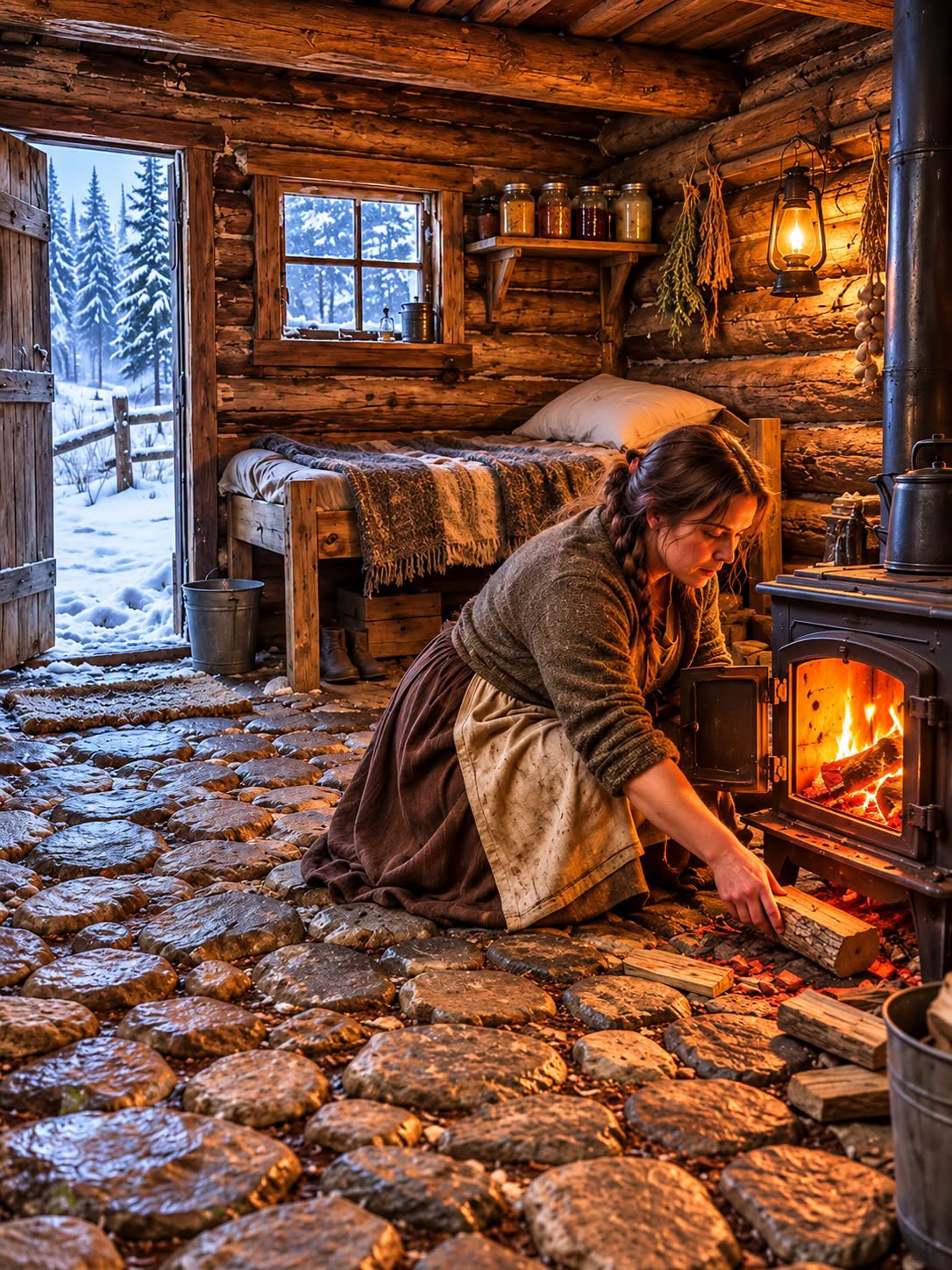
"Sarah should not have to suffer because of this."
The woman's voice came from behind Jedediah Croft.
I recognized it immediately.
Martha.
I opened the door just enough to see them both. Jedediah stood on the porch with his heavy coat buttoned to his throat. Martha was behind him, holding a small lantern.
Neither looked pleased to be there.
"What is this about?" I asked.
Jedediah removed his hat.
"We need to inspect the cabin."
I looked at Martha.
She lowered her eyes.
"Why?"
"Because there are concerns about the safety of your daughter."
I felt my stomach tighten.
"Sarah is sleeping."
"Then we'll keep our voices down," Jedediah replied.
I stepped away from the doorway.
They entered.
Jedediah immediately looked toward the stone floor. His eyes followed the uneven rows of gray and brown stones, stopping occasionally where the clay mixture met the wooden walls.
Martha went straight to Sarah's cradle.
She leaned over and checked the blanket.
"She's all right," I said.
"I can see that."
"Then perhaps you can both tell me why you've come."
Jedediah placed his hat on the table.
"I've been asked to determine whether this floor is creating a danger."
"By whom?"
He hesitated.
"Several members of the community."
I folded my arms.
"And if you decide it is dangerous?"
"Then you'll need to correct it."
"Put the wooden floor back?"
"Most likely."
I looked down at the stones.
Months of work lay beneath our feet.
Every stone represented another journey to the creek, another aching evening, another hour I had spent wondering whether I was making a terrible mistake.
Now Jedediah wanted to judge all of it in a few minutes.
"Very well," I said.
He seemed surprised.
I pointed toward the floor.
"Look."
Jedediah bent down and examined the stones.
He pressed his fingers against the joints.
He checked the edges near the walls.
Then he moved toward the stove.
"How much firewood have you burned since finishing this?"
"Not much."
"How much?"
"Less than half a cord."
He looked at me sharply.
"Since when?"
"Since I began testing the floor."
He frowned.
"That's not possible."
I didn't answer.
He walked to the woodpile and examined it.
Then he returned to the center of the room.
"You're telling me you've been heating this cabin with almost no wood?"
"I'm telling you the stove heats the stones, and the stones gradually release their warmth."
Jedediah gave a short, humorless laugh.
"Stones don't create heat, girl."
"I never said they did."
"Then what exactly are you claiming?"
"That they hold it."
He stared at me.
Martha looked between us.
"Elspeth, perhaps you should explain how you came up with this idea."
I glanced toward the window.
For a moment, I was no longer standing in my Montana cabin.
I was a little girl again.
I was back in Scotland, standing beside my father's work.
And I could almost hear his voice.
My father had hands that always smelled of stone dust.
Even when he washed them, a little gray remained beneath his fingernails.
He was a stonemason.
He worked long days building walls, repairing foundations, and constructing great lime kilns.
He was not a wealthy man.
Our home was small, and there were many winters when my mother worried about how much coal remained in the storage shed.
But my father never seemed frightened by cold weather.
He understood stone.
He knew which pieces would hold weight, which would split under pressure, and which would endure years of rain and frost.
When I was six, I once asked him why he spent so much time studying rocks before using them.
He laughed.
"Because, lass, a stone can tell you what it wants to be."
I thought he was joking.
"How can a stone talk?"
"It doesn't need a tongue."
He picked up a small gray piece from his workbench.
"Look at this one. See the lines?"
I nodded.
"Those lines tell me where it may break. If I ignore them, I'll waste the stone."
He placed it back.
"Everything has a nature. Wood, iron, stone, water. You must understand what something can do before you ask it to do something else."
I remembered that sentence years later.
But there was another lesson I remembered even more clearly.
It happened beside the lime kilns.
The first time I saw one of my father's kilns working, I thought the whole mountain had caught fire.
The structure was enormous.
It was built from thick stone and stood near the edge of a quarry.
My father explained that limestone was heated inside the kiln to produce quicklime.
The fire had to burn intensely.
The stone walls absorbed heat throughout the process.
I was fascinated.
I wanted to stand close enough to feel the warmth, but my father warned me not to approach the opening.
"Hot enough to burn you, Ellie."
I nodded.
Then I watched the flames.
The workers fed the kiln for hours.
The heat shimmered in the air.
The stone walls grew warm.
Eventually, when the work was finished, the fire was allowed to die.
I expected the warmth to disappear immediately.
But it didn't.
The following morning, my father took me back.
The flames were gone.
The workers had left.
Yet the stones were still warm.
I placed my small hand against the outer wall.
"Papa?"
"Aye?"
"Why isn't it cold?"
He smiled.
"Because stone has a long memory for fire, lass."
I looked at him.
"Does it remember forever?"
"Not forever."
He crouched beside me.
"Nothing keeps what it receives forever. But some things give it back slowly."
He picked up a piece of warm stone and placed it in my hands.
"Wood burns quickly. The warmth goes into the air, and the air moves away. But a great mass of stone can absorb heat and release it gradually."
I held the stone against my palm.
It was comforting.
I remember thinking that it felt like holding a little piece of summer.
My father watched me.
"Remember this, Ellie. The clever person doesn't always make more fire. Sometimes she finds a better way to use the fire she already has."
I was too young to understand the full meaning.
But I remembered.
Years later, I would understand why he had wanted me to remember it.
"Elspeth?"
Jedediah's voice brought me back to the cabin.
He was standing near the stove.
"You haven't answered my question."
I looked at him.
"Which question?"
"Where did you learn this?"
"My father."
"Your father?"
"He was a stonemason in Scotland."
Jedediah nodded slowly.
"What did he build?"
"Stone walls. Lime kilns. Foundations. Whatever work was available."
"And he told you stones could keep a house warm?"
"He told me they could store heat."
Jedediah looked down at the floor.
"That isn't the same thing."
"No. But it's a place to begin."
He crouched again.
This time, he didn't touch the stones immediately.
He studied the arrangement.
"How deep did you excavate?"
"Deep enough to remove the loose soil and prepare the drainage bed."
"How much gravel?"
I told him.
He looked toward the wall.
"And the sand?"
I answered that too.
His expression changed slightly.
"You actually considered drainage?"
"I told you I did."
"Who showed you how to build the channels?"
"No one. I worked from what I remembered and what I could observe."
He shook his head.
"You're taking a dangerous risk."
"Perhaps."
He looked up.
"Perhaps?"
I met his eyes.
"I would rather try something I understand than repeat something that already failed us."
For a moment, he said nothing.
Then he stood.
"Show me the channels."
I pointed toward the stove.
"They run beneath the stonework."
"All of them?"
"Not directly beneath every stone. I arranged them to distribute warmth through the surrounding mass."
He frowned.
"And you think that is enough to heat the whole cabin?"
"I think it helps."
"How much?"
"I don't know yet."
That answer appeared to disappoint him.
He turned toward Martha.
"See? She doesn't even know."
Martha looked uncomfortable.
"Jedediah, she has been working very hard."
"Hard work doesn't make a bad idea sound."
I felt the old anger rising.
But I held it back.
"Then test it," I said.
He looked at me.
"Test what?"
"The floor. Measure the temperature. Watch how quickly the stones cool. Compare it with the stove."
Jedediah stared at me.
I continued.
"You've spent forty years building houses. Surely you can tell whether something works better after you've examined it."
His jaw tightened.
Martha stepped between us.
"Perhaps that's enough for tonight."
Jedediah picked up his hat.
"I'll return when the weather gets colder."
"Why?"
"Because that's when we'll know whether this thing of yours is useful."
I looked at the nearly empty woodbox.
"Then perhaps you should return before the snow gets too deep."
He didn't respond.
He walked toward the door.
But Martha remained beside Sarah's cradle.
She watched the baby for a moment before turning to me.
"Elspeth, I wanted to tell you something."
I waited.
"People are saying the church may become involved if you refuse to cooperate."
My hands went cold.
"What does the church have to do with my daughter?"
"Nothing, officially."
"Then why are you telling me?"
"Because some people believe you need help."
I looked at Jedediah.
He was already outside.
I turned back to Martha.
"Do you believe that?"
She shook her head.
"I believe you're grieving. I believe you're tired. But I also believe you love Sarah."
"Then tell them that."
"I have."
She reached toward my hand.
"They don't listen to me either."
She left.
I closed the door.
And I stood there for a long time.
After that evening, I found myself thinking more about my father than ever before.
His lessons had seemed simple when I was a child.
He had never called them inventions.
He had never described them as discoveries.
He simply understood the materials he worked with.
Stone was not like wood.
Wood heated quickly and lost heat quickly.
A large mass of stone behaved differently.
The idea was not complicated.
But using it inside a frontier cabin was another matter entirely.
I had no instruments to measure heat accurately.
I had no books explaining how to calculate the amount of stone needed.
I had no trained engineer to help me determine how much warmth the floor could store.
I had only my father's memories, my own observations, and the growing pile of river stones.
That meant I needed to pay attention.
I began keeping notes.
Every morning, I wrote down the condition of the stove, the amount of wood burned, and how the floor felt beneath my feet.
I recorded the time when the fire was lit and when it was allowed to die.
I noticed that the stones closest to the stove warmed first.
The stones farther away warmed more gradually.
By evening, the difference was less noticeable.
I also began checking the areas near the exterior walls.
Those places were colder.
I knew the floor alone could not solve every problem.
The walls still needed to be sealed.
The roof still needed attention.
The windows still allowed drafts.
But the stones were doing something the old wooden floor had never done.
They were holding warmth after the fire weakened.
And that gave me hope.
One afternoon, I found a small wooden box beneath Tom's workbench.
It contained several old nails, a broken measuring tool, and a piece of charcoal.
I almost put it back.
Then I noticed a folded sheet of paper beneath the tools.
It was another drawing of the cabin.
I recognized Tom's handwriting.
He had sketched the stove, the floor, and a narrow space beneath the boards.
There were measurements along the edges.
Some of the writing was difficult to read.
I carried the paper to the window.
The afternoon light helped.
There were notes about airflow and the space beneath the floor.
I studied them carefully.
Tom had clearly been thinking about the problem of cold air entering through the floorboards.
I remembered him spending evenings beneath the cabin, checking the foundation.
He had once told me that the ground beneath a house could be just as important as its walls.
At the time, I hadn't understood.
Now I wished I had asked him more questions.
I placed the drawing beside my father's old lesson notes.
Two men had given me pieces of the answer without knowing what I would eventually do with them.
One had taught me to understand stone.
The other had taught me to understand the cabin.
I began comparing their ideas.
My father's knowledge explained how stone could store warmth.
Tom's drawing reminded me that the space beneath the floor had to be managed carefully.
The two ideas seemed to fit together.
I sat at the table for nearly an hour, studying the sketches.
Then I heard a knock.
This time, it was Martha.
She entered carrying a small sack of flour.
"I brought something for you."
"Thank you."
She noticed the papers spread across the table.
"What's all this?"
"Tom's drawings."
She leaned closer.
"Those were his?"
I nodded.
"I found them beneath his workbench."
Martha studied the sketches.
"He used to draw all sorts of things."
"Did he ever talk to you about the floor?"
She shook her head.
"Not much."
I showed her the narrow space beneath the boards.
"He was thinking about the cold coming through the floor before he died."
Martha looked at the drawing for a long moment.
Then she said something I had not expected.
"He was worried about winter before Sarah was born."
I looked up.
"What do you mean?"
"Tom told me he wanted to change something about the cabin. He said the floor was never quite right."
I leaned forward.
"What did he want to change?"
"I don't know. He didn't explain."
"Did he mention the foundation?"
Martha nodded.
"Once."
My heart began beating faster.
"What did he say?"
She tried to remember.
"He said he had found something beneath the cabin that didn't behave the way he expected."
I looked at Tom's drawing.
"What something?"
Martha shook her head.
"I don't remember."
I wanted to ask more.
But she had already moved toward the cradle.
"How is Sarah?"
"Fine."
Martha smiled faintly.
Then she looked back at the drawing.
"Perhaps Jedediah should see this."
I hesitated.
"Why?"
"Because Tom built this cabin with him."
I looked at the measurements.
For the first time, I wondered whether Jedediah knew something about the foundation that I didn't.
Perhaps Tom had asked him for advice.
Perhaps he had rejected the idea.
Perhaps the old carpenter had seen something years ago and forgotten.
I folded the paper carefully.
"I'll ask him."
Martha nodded.
But before she left, she turned toward me.
"Elspeth, there's another reason I came."
I looked at her.
"What now?"
"Silas has been telling people that your cabin is unsafe."
I sighed.
"I already know."
"No. You don't understand. He's been asking the ranchers to sign a statement."
"What kind of statement?"
"One saying that you're incapable of making decisions for Sarah."
I felt the room grow very still.
"How many have signed?"
"Four."
I stared at her.
"Four?"
She nodded.
"And Reverend Abernathy has agreed to speak with the county representative."
I looked toward Sarah.
She was awake now, moving her little hands beneath the blanket.
I went to her and lifted her carefully.
Her small fingers curled around mine.
I kissed her forehead.
"Nobody is taking you away," I whispered.
Martha watched me.
"Elspeth, you may need someone to speak for you."
I looked at the papers on the table.
Then I looked toward the door.
"Perhaps I already have someone."
"Who?"
I picked up Tom's drawing.
"Someone who helped build this cabin."
The next morning, I decided to visit Jedediah.
I wrapped the drawings in a piece of cloth and placed them inside my basket.
Sarah stayed with Martha.
The carpenter's workshop stood near the edge of the settlement.
I had been there many times with Tom.
The smell of fresh-cut wood reached me before I saw the building.
Jedediah was outside splitting a thick log.
He stopped when he noticed me.
"Elspeth."
"Good morning."
He rested his axe against the chopping block.
"What brings you here?"
I took the drawings from my basket.
"I found something of Tom's."
He looked at the papers.
Then he looked at me.
"What is it?"
"Drawings of the cabin."
His expression changed.
He took the folded paper.
For several seconds, he studied it without speaking.
Then he unfolded the second sheet.
His eyes moved across the measurements.
He stopped at the narrow space beneath the floor.
His face became unusually pale.
I noticed immediately.
"Do you recognize it?"
He didn't answer.
He turned the paper sideways.
Then he looked at the small mark near the foundation.
"Where did you find this?"
"Beneath his workbench."
Jedediah slowly raised his eyes.
"Elspeth, did Tom ever tell you why he wanted to change the floor?"
"No."
"Did he tell you what he found beneath the cabin?"
I felt my heartbeat quicken.
"Martha said he mentioned something."
Jedediah looked back at the drawing.
His fingers tightened around the paper.
Then he walked toward the workshop.
"Come inside."
I followed.
He placed the drawing on his workbench and moved several tools aside.
For a long moment, he examined the measurements.
Finally, he looked at me.
"There's something about this cabin you need to know."
I stepped closer.
"What?"
He opened a drawer and removed an old leather notebook.
Its edges were worn.
Dust covered the cover.
He turned several pages.
Then he stopped at a drawing that looked almost identical to Tom's.
Except this one had been made years earlier.
Jedediah placed the two drawings side by side.
His face had lost all its color.
"Tom didn't come up with this idea alone," he whispered.
I stared at him.
"What are you saying?"
He turned the old notebook toward me.
At the bottom of the page was a name.
A name I had never expected to see.
Jedediah placed one trembling finger beneath it.
"Before you put another stone into that floor, Elspeth, you need to understand what happened the first time someone tried this in Sweetwater Valley."
Then he turned to the next page.
And I saw a date written beside a warning in thick black ink.
"DO NOT BUILD OVER THE OLD SPRING."






Comments 0