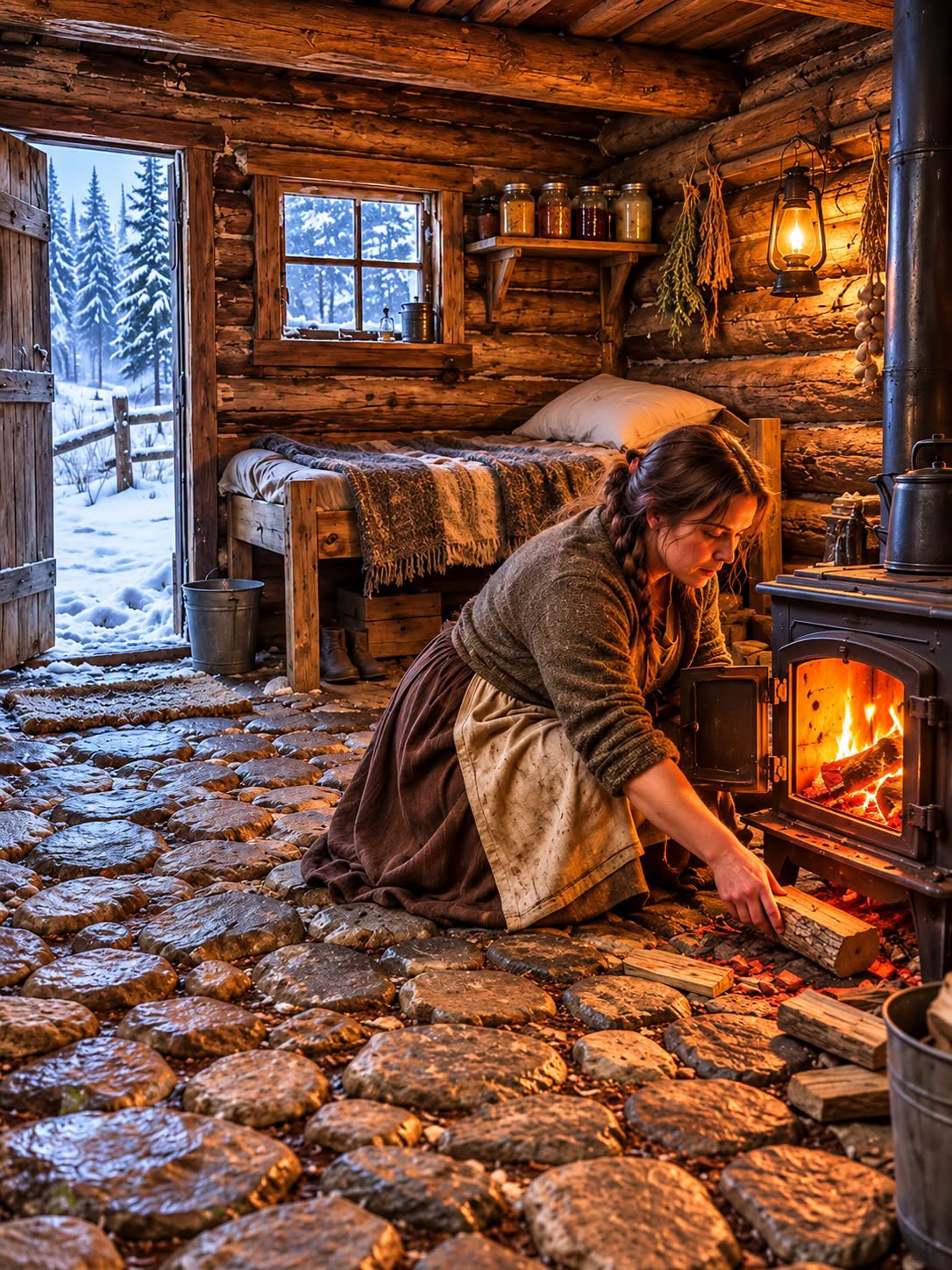
The underground chamber opened with a sound like thunder.
I grabbed the edge of the table as the floor trembled beneath my feet.
Jedediah shouted for everyone to move away from the eastern wall.
Clara Reed clutched the iron key.
Harlan stood frozen beside the doorway.
And beneath our cabin, after twenty years of darkness, the reserve room finally revealed its secrets.
A rush of warm air rose through the opening.
Then the water settled.
The iron wheel stopped turning.
For several seconds, nobody spoke.
I looked toward Clara.
"Is this what your grandmother wanted us to find?"
She nodded, tears gathering in her eyes.
"Yes."
She held up the photograph of Tom and Margaret.
"She said the truth had been buried long enough."
Jedediah raised his lantern.
The opening was wide enough for a person to enter.
Beyond it lay a stone chamber.
Its walls were lined with carefully fitted blocks.
An old iron pipe ran along the floor.
And at the far end stood a wooden cabinet, protected from moisture by a raised stone platform.
Daniel's voice came from below.
"Elspeth, you must go carefully."
I looked toward the opening.
"Can you reach us?"
"Not yet. The passage is still blocked."
Jedediah examined the chamber.
"We'll get you out."
Then Clara stepped forward.
"There is something you need to see first."
She pointed toward the cabinet.
A brass plate was fixed to its front.
Three names had been engraved into the metal.
Nathaniel Price.
Margaret Reed.
And Tom MacLeod.
My breath caught.
Tom had been there.
He had known this chamber would open one day.
And he had left something for me.
Jedediah and Silas entered the reserve room first.
They checked the stone supports and tested the floor before allowing anyone else inside.
Harlan remained near the doorway.
William stood beside his brother's hidden passage.
Clara held the second key.
I carried the lantern.
The cabinet opened with a heavy metallic click.
Inside were three oilcloth bundles.
The first contained the original cooperative agreement.
The second held the deed to the eastern spring.
The third contained a collection of handwritten statements.
Jedediah removed the first document.
He examined the signatures.
Then he smiled.
"This is it."
I looked at him.
"The original agreement?"
He nodded.
"Every property owner signed it. Every water right is recorded. Nothing was ever legally transferred to Thomas Black."
Clara opened the second bundle.
The deed was still intact.
It named Margaret Reed as the legal representative of the original landowners.
Her signature appeared at the bottom.
Beneath it were the signatures of Nathaniel Price and Elias Mercer.
And finally, there was another signature.
Tom MacLeod.
I touched his name.
He had not simply discovered the agreement.
He had helped restore it.
Clara looked at me.
"My grandmother told me that Tom came to see her shortly before he died."
I nodded.
"He never told me."
"She said he wanted to make sure the documents were protected before winter."
I looked toward the cabinet.
"Why did she give you the second key?"
Clara answered quietly.
"Because she trusted him. And because he told her you would finish what he started."
For the first time in months, I felt that Tom was still beside me.
Not as a memory of the man I had lost.
But as someone whose unfinished work was finally coming home.
The third bundle contained the truth about Nathaniel Price.
It was a detailed account written by Elias.
He described how Thomas Black had attempted to take control of the eastern spring.
He described Nathaniel's refusal.
He described the confrontation that had ended with Nathaniel's death.
And he named the men who had helped conceal the crime.
Charles Harlan.
Thomas Black.
Two hired workers.
And Reverend William Abernathy.
I looked at the reverend.
He had read the statement over my shoulder.
His face was wet with tears.
"I knew Thomas had arranged the burial," he whispered. "But I didn't know Nathaniel had been killed."
William stepped toward him.
"You knew enough."
The reverend lowered his head.
"Yes."
He did not defend himself.
He did not ask for forgiveness.
He simply stood beside the documents and accepted the truth.
Harlan, however, tried to leave.
Silas moved in front of him.
"You're not going anywhere."
Harlan glared at him.
"You have no authority to stop me."
Silas pointed toward the papers.
"Neither did my father. But he spent twenty years pretending otherwise."
Harlan reached for the door.
Jedediah blocked his way.
Then Silas spoke again.
"The county representative will hear everything. So will the sheriff."
Harlan looked around.
For the first time, he had nowhere to hide.
The next hours were spent opening the passage.
Jedediah and Silas worked together to remove the damaged stones.
Caleb helped reinforce the supports.
The water continued flowing through the eastern channel, but the pressure remained stable.
The reserve room was not a dangerous underground reservoir, as Harlan had claimed.
It was a carefully designed system.
The stone chamber absorbed and retained warmth from the surrounding ground.
The water channels helped distribute that warmth.
The original builders had intended the system to work alongside ordinary heating methods.
It was never supposed to replace a stove.
It was meant to reduce how much firewood a household needed.
I looked at the stones beneath my feet.
My father's lesson had not been wrong.
Stone held warmth.
But the old engineers had understood something more.
A house could be designed to keep the heat it produced rather than losing it immediately.
Tom had recognized that connection.
And I had discovered the same principle through necessity.
When Jedediah finally removed the last obstruction, Daniel Mercer emerged from the passage.
He was thin.
His hair was almost completely white.
His hands shook as he stepped into the lantern light.
But he was alive.
William rushed toward him.
"Daniel!"
His brother stared at him.
Then they embraced.
Neither spoke for a long time.
I turned away to give them privacy.
There were some moments that did not need an audience.
Daniel was carried to the bedroom and given warm broth.
He needed medical attention.
But the physician who arrived later confirmed that he had survived the ordeal.
He had been trapped in the reserve passage for twenty years.
A small natural air channel had kept him alive.
Water had reached him through an old maintenance pipe.
He had survived on stored provisions during the early years, and later on whatever he could gather from the accessible section of the chamber.
His survival had been extraordinary.
But the truth about Matthew Price was even more remarkable.
The second man Daniel had mentioned had not been another prisoner.
Matthew had been Nathaniel's son.
He had entered the chamber shortly after his father's disappearance, searching for the original deed.
Thomas's men had sealed the passage behind him.
Matthew had died during the collapse.
Daniel had later discovered his remains in a separate section.
He had kept the location secret because he feared Thomas would destroy the evidence if he knew.
Now the remains could finally be recovered and buried properly.
The mystery of the eastern chamber was no longer a rumor.
It was a documented crime.
And the men responsible could no longer hide behind the winter, the church, or the authority they had once controlled.
Three days later, the county sheriff arrived.
He examined the original documents.
He interviewed Daniel.
He questioned Jedediah.
He took statements from Silas, Clara, and William.
Harlan was arrested for his part in the concealment of the deaths and the falsification of property records.
The old church records were collected.
The original deed was authenticated.
And the county confirmed that the eastern spring belonged to the cooperative.
Silas voluntarily surrendered every document he had inherited from his father.
He also gave up the false property claims.
When the sheriff asked whether he understood the consequences, Silas answered simply.
"I understand. My father took something that never belonged to him. I won't continue doing it."
It was the first honest thing I had heard him say.
Reverend Abernathy resigned from his position.
He gave a complete statement about his involvement.
He also arranged for the church to help cover the costs of restoring the water system.
He did not ask the valley to forget what he had done.
He understood that forgiveness could not be demanded.
It had to be earned.
The hardest part of the winter came shortly afterward.
Temperatures dropped again.
Several families ran dangerously low on firewood.
The ranches struggled.
The trading post was nearly empty.
But something had changed.
Instead of fighting over the spring, the valley began working together.
Jedediah organized a group of carpenters.
Daniel advised them on the original water channels.
Silas brought timber from his family's remaining supply.
Caleb helped repair the old maintenance passages.
Clara contributed the Reed family's documents.
And I showed the women how I had built my stone floor.
I explained the gravel drainage bed.
The carefully leveled sand.
The importance of keeping moisture away from the timber foundation.
I showed them how to arrange the stones and how to direct warmth from a stove toward the stone mass.
Some families were skeptical.
Others were eager to learn.
But everyone listened.
For the first time, the people who had once laughed at me were asking for my advice.
Jedediah stood beside me during the first community demonstration.
He examined the finished floor and shook his head.
"Forty years I've been building houses," he said. "And I never thought to ask what the floor could do for the people living above it."
I smiled faintly.
"My father used to say that stone remembers fire."
Jedediah nodded.
"Then I suppose we should have listened to him sooner."
The cabin became the center of the valley's winter recovery.
Families came to learn.
Children watched as the stones were arranged.
The older women brought food.
The men brought tools and timber.
Martha organized a small group to help families who could not afford materials.
Nobody called me the river witch anymore.
One afternoon, a woman who had once laughed at my wheelbarrow stood beside me.
She looked at the floor.
"I owe you an apology."
I turned toward her.
"For what?"
"For believing the others."
I looked at the children warming their hands near the stove.
"You don't owe me anything."
She shook her head.
"I do. I was wrong."
I nodded.
"Then help the next family who needs it."
She smiled.
And she did.
Within weeks, several homes had improved their floors and foundations.
The valley's firewood supplies began lasting longer.
The community learned to maintain the water channels.
And the old reserve system became a shared resource rather than a source of conflict.
It was not magic.
It was knowledge.
Knowledge that had survived beneath the ground while the people above it had nearly forgotten how to use it.
In February, Clara and I traveled south to visit Margaret Reed's grave.
The roads were finally passable.
We carried flowers.
At the cemetery, Clara knelt beside the stone.
She placed one hand against the inscription.
"She waited a long time for this."
I stood beside her.
"She must have loved her family very much."
Clara nodded.
"She never stopped believing her father had been telling the truth."
She looked at me.
"She also never stopped talking about Tom."
I smiled.
"What did she say?"
"That he was a good man who kept his promises."
Clara removed a small envelope from her coat.
"My grandmother left this for you."
I opened it.
Inside was a short note.
Dear Elspeth,
When you read this, I hope the water has returned to the people who need it.
Tom told me about your little girl. He spoke of her with such love that I knew he would do anything to protect her.
I have lived long enough to see many people mistake kindness for weakness.
Don't let them make that mistake about you.
You carried stones when others carried doubts.
You kept your promise when others broke theirs.
And because of you, the truth will outlive the men who tried to bury it.
With gratitude,
Margaret.
I folded the letter carefully.
Then I placed it inside my coat.
For a long moment, Clara and I stood together beside the grave.
The winter wind moved gently through the trees.
And I felt something I had not felt since Tom died.
Peace.
By the beginning of spring, the county officially recognized the Sweetwater Valley Water Cooperative.
The eastern spring was placed under shared management.
No family could claim exclusive ownership.
Every household listed in the original agreement received access to the water.
The reserve chamber was repaired.
The old maintenance passages were reinforced.
And a permanent record of the original agreement was placed in the county archive.
Daniel recovered slowly.
He moved into a small house near his brother.
William visited him every day.
Their relationship was not repaired overnight.
Twenty years of silence could not disappear in a few conversations.
But they began again.
Daniel taught William how to read the old survey maps.
William helped him recover his strength.
And together, they began documenting everything they remembered about the underground system.
Jedediah became the valley's chief restoration carpenter.
He also made a promise to teach the younger builders what he had learned.
Silas sold part of his inherited equipment to help fund the restoration.
He kept a modest home for his family.
He never again claimed ownership of the spring.
His wife told me that he had become quieter.
More thoughtful.
And far less interested in making people afraid.
As for Harlan, he was tried for his crimes and sentenced according to the evidence.
Thomas Black's name was removed from the false property records.
His legacy in Sweetwater Valley was no longer one of wealth and authority.
It was a warning about what happened when greed was allowed to masquerade as leadership.
Spring arrived slowly.
The snow began melting.
The creek ran freely.
The cabin remained warm even when the stove was allowed to burn low.
The stones beneath the floor had become part of our daily lives.
I still checked the drainage.
I still recorded the temperatures.
And I still carried Sarah carefully across the room when she fell asleep beside the hearth.
She was growing quickly.
Soon she would be old enough to understand why her mother had spent an entire autumn carrying stones from a freezing river.
I had kept Tom's promise.
Our daughter was safe.
And the home he had built with his own hands had become something neither of us could have imagined.
One evening, I sat beside the window with Sarah in my arms.
The sun was setting over Sweetwater Valley.
A knock sounded at the door.
It was Jedediah.
He carried a small wooden box.
"I thought you might want this."
I opened it.
Inside was a brass plaque.
It read:
THE MACLEOD STONE FLOOR
Built in the winter of 1888 by Elspeth MacLeod.
A reminder that knowledge, patience, and courage can keep a family warm.
I looked up at him.
"Jedediah, I don't need a plaque."
He smiled.
"Perhaps not. But the valley does."
He placed it on the table.
Then he looked toward Sarah.
"Your mother has done something remarkable, little one."
Sarah reached toward the shiny brass.
I laughed softly.
For the first time in a long while, the sound came easily.
Years later, people would still tell the story of the young widow who replaced her wooden floor with river stones.
Some would remember the winter of 1888.
Others would remember the discovery of the eastern chamber.
But the people who had lived through those months remembered something more important.
They remembered a woman who had been mocked when she needed help.
A woman who had lost her husband and refused to surrender the promise she had made beside his deathbed.
A woman who had trusted an old lesson from her father when everyone around her insisted she was wrong.
And they remembered how one small cabin became the beginning of a valley-wide transformation.
Sarah grew up knowing the truth about her father.
She knew Tom had been kind.
She knew he had helped Daniel.
She knew he had believed that the spring belonged to everyone.
And she knew that her mother had kept their family together through the hardest winter Sweetwater Valley had ever known.
Every winter, we gathered beside the stove.
The stones beneath our feet remained warm.
Sometimes Sarah would place her palm against them and ask why they never seemed to forget the fire.
I would smile.
Then I would tell her what my father had once told me.
"Because stone has a long memory, lass."
She would laugh.
And I would remember the man who had first taught me that lesson.
Tom's promise had not ended with his death.
It had become a home.
A community.
A future for our daughter.
The winter of 1888 had nearly broken Sweetwater Valley.
Instead, it had taught us how to stand together.
And beneath the little cabin in Sweetwater Valley, the river stones continued to hold their warmth, long after the fire had gone out.






Comments 0