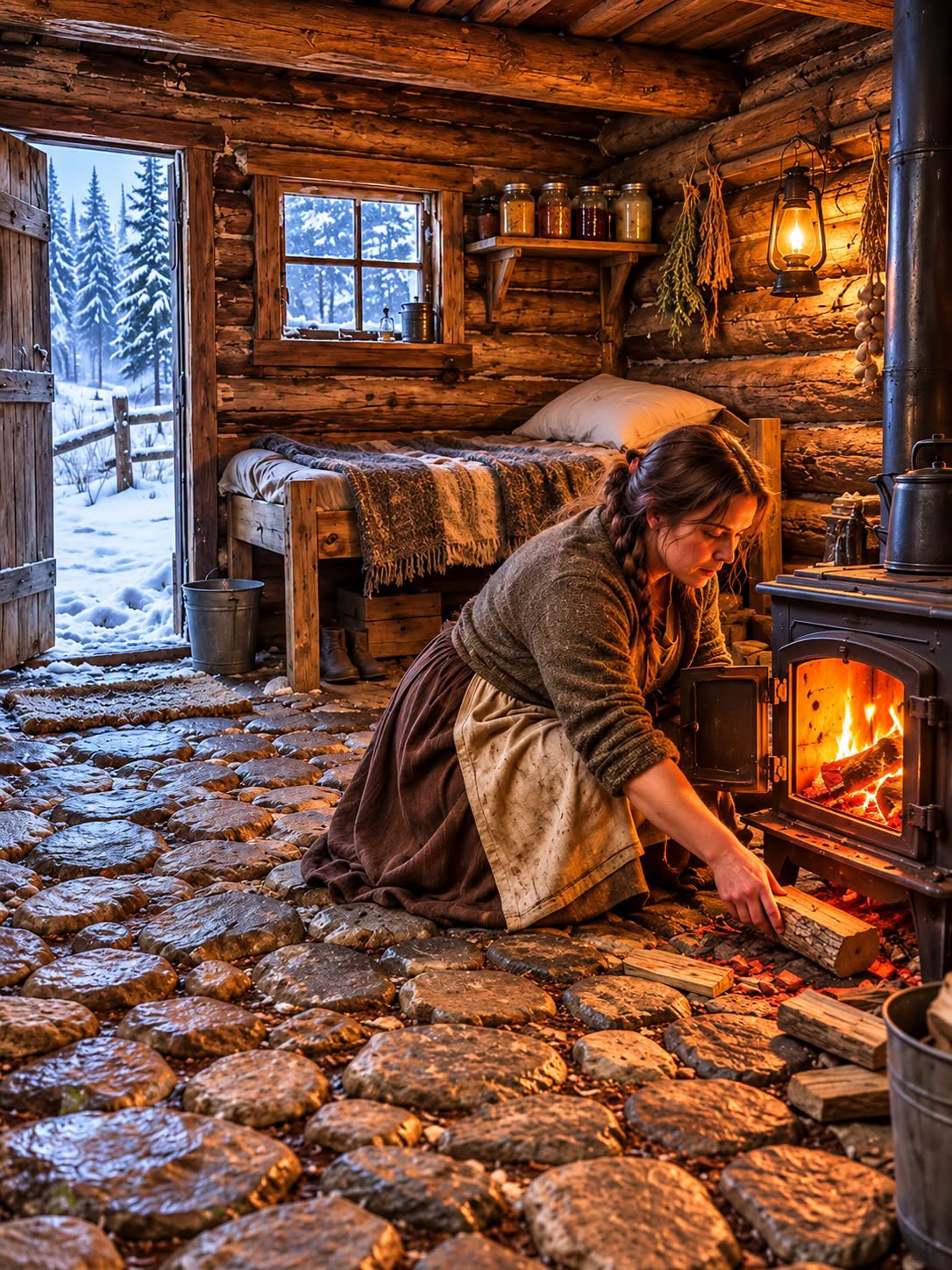
Martha stood in my doorway with both hands wrapped around the strap of her shawl.
"Elspeth, there's something you need to know."
I looked at her.
Sarah was sleeping in her cradle behind me. The last light of evening slipped through the little window, falling across the hundreds of river stones beneath my feet.
"What happened?"
Martha glanced toward the road before stepping inside.
"People have been talking."
I almost laughed.
People had been talking since the first day I removed the floorboards. They had talked when I carried stones from the creek. They had talked when Jedediah Croft inspected my work and declared it a disaster.
But something in Martha's expression told me this was different.
"What are they saying now?"
She took a breath.
"They think Sarah might be better off living somewhere else."
For several seconds, I couldn't understand the words.
I looked toward my daughter's cradle.
Then back at Martha.
"What do you mean, somewhere else?"
Martha lowered her voice.
"Some people believe you're not thinking clearly. They say Tom's death has changed you. They think you've become obsessed with this strange floor and forgotten what a mother is supposed to do."
My fingers tightened around the edge of the table.
"Who said that?"
"I don't want to make things worse."
"Who, Martha?"
She looked away.
"Silas Black has been talking at the trading post. Reverend Abernathy has heard the rumors. And Jedediah..."
She stopped.
I waited.
"Jedediah hasn't said he wants Sarah taken away. But he hasn't defended you either."
I felt something move inside my chest.
It wasn't grief.
It wasn't exhaustion.
It was fear.
A different kind of fear from the one I had felt when Tom was dying.
That night, I could lose something I still had.
"Are they planning to come here?" I asked.
Martha shook her head.
"Not yet."
"Then why are you telling me?"
"Because I thought you deserved to know before someone decides to make trouble."
I looked at Sarah again.
Her tiny chest rose and fell beneath the blanket.
I crossed the room and gently touched her cheek.
"Nobody is taking my daughter."
Martha moved closer.
"Elspeth, listen to me. I know you love that child. Nobody doubts that."
"Then why would they say such things?"
"Because they don't understand what you're doing."
I turned toward her.
"Do you understand?"
She hesitated.
That hesitation hurt more than I expected.
"I understand that you're trying," she answered.
Trying.
It was a small word.
A word people used when they weren't certain you would succeed.
I looked down at my hands.
They were rough, scratched, and swollen from carrying stones.
"Tom asked me to keep Sarah safe," I said. "I gave him my word."
Martha's expression softened.
"I know."
"No, you don't."
My voice remained quiet.
"I don't have the luxury of giving up because people think I'm foolish."
Martha reached for my arm.
"I don't want you to lose Sarah."
"Then help me."
She looked at the stone floor.
For a long moment, neither of us spoke.
Finally, she picked up her empty bread basket.
"I'll come back tomorrow."
I nodded.
She reached the doorway, then turned.
"Elspeth?"
"Yes?"
"Be careful. People can be cruel when they're frightened by something they don't understand."
Then she left.
I closed the door.
And for the first time since Tom died, I felt that the promise I had made to him was being tested by more than winter.
I sat beside Sarah's cradle until the room grew dark.
The oil lantern cast a small circle of light across the wooden walls.
I could hear the wind moving through the trees outside.
Every sound reminded me of the winter that had taken Tom.
I remembered the first time he coughed blood into his handkerchief.
He had tried to hide it.
I had been standing near the stove, preparing a little porridge, when I noticed him turn toward the wall.
"Tom?"
He folded the handkerchief quickly.
"What?"
"Let me see."
"It's nothing."
I crossed the room.
He tried to smile, but the color had disappeared from his face.
When he opened his hand, I saw the blood.
I remember the terrible silence that followed.
He sat down slowly.
I brought him water.
He thanked me as though I had done something extraordinary.
Then he asked whether Sarah was asleep.
That was Tom.
Even when he was suffering, he worried about our daughter.
He had always believed he could solve every problem by working harder.
If the roof leaked, he repaired it.
If the stove smoked, he cleaned the chimney.
If the door allowed cold air inside, he found another piece of wood and sealed the gap.
He never complained about the work.
But pneumonia was not a broken door.
It could not be repaired with a hammer.
The night before Tom died, I barely slept.
The doctor had already left.
He had given us a few instructions and promised to return if the weather allowed.
I knew what his expression meant.
Tom lay beneath several blankets.
His breathing sounded like paper being crushed.
I held a damp cloth against his forehead.
He opened his eyes.
"Ellie?"
"I'm here."
"Where's Sarah?"
"She's sleeping."
He nodded weakly.
"Good."
I tried to smile.
"You should sleep too."
He looked at me.
For a moment, his eyes seemed clearer.
"Do you remember the first winter we spent here?"
"Of course."
"I told you this cabin would keep us safe."
I swallowed.
"It did."
He slowly shook his head.
"Not enough."
I wanted to tell him not to speak.
I wanted to tell him he would recover.
But I could no longer pretend that everything would be all right.
He reached for my hand.
"Listen to me."
I leaned closer.
"Whatever happens, you must take care of Sarah."
"I will."
"Don't let her grow up believing she was born into a world that has nothing good left for her."
My eyes filled with tears.
"Tom, please."
He squeezed my fingers.
"Promise me."
I pressed his hand against my cheek.
"I promise."
He watched me for several seconds.
Then he looked toward the ceiling.
"I wish I had built a warmer house."
Those words broke something inside me.
I leaned over and kissed his forehead.
"You built us a home."
He closed his eyes.
I stayed beside him until the morning.
Three days later, he died.
I had never told anyone what Tom said about the house.
Not Martha.
Not the doctor.
Not even Jedediah Croft.
I had kept those words inside me because I knew how easily people could misunderstand them.
Tom had not failed us.
He had worked with everything he knew.
He had built the strongest cabin he could afford.
He had spent precious money on the cast-iron stove.
He had gathered firewood until his hands were covered in blisters.
He had done everything a husband and father was supposed to do.
But the winter had still been stronger.
And I could not accept that Sarah would face the same danger simply because everyone believed there was only one way to keep a home warm.
That was why I remembered my father.
That was why I had started looking at the stones differently.
And that was why I refused to put the old floorboards back.
The following morning, I woke before sunrise.
Sarah was still sleeping.
I wrapped her in a blanket, checked that she was comfortable, and placed her in the basket beside the hearth.
Then I went outside.
The air was cold enough to sting my face.
A thin layer of frost covered the grass.
I looked toward the creek.
The wheelbarrow stood beside the woodpile.
I had left it there the previous evening.
Its handles were worn smooth from my hands.
I pushed it down the narrow path.
The creek was shallow, and the water moved slowly between the stones.
I knelt near the bank.
The cold seeped through my dress.
I selected several smooth stones and placed them in the wheelbarrow.
One.
Two.
Three.
By the time the barrow was half full, my fingers had become numb.
I stood and looked uphill.
The cabin seemed very far away.
I thought of Tom.
Then I began pushing.
The first few yards were easy.
Then the ground rose.
The wheelbarrow became heavier.
Its wheels sank into the damp earth.
I stopped twice to catch my breath.
When I finally reached the cabin, I tipped the stones onto a growing pile beside the entrance.
My back hurt.
My fingers burned.
But I felt something else.
Purpose.
For the first time since Tom's death, I had a task that was not simply about surviving another day.
I was building something.
Something that might protect Sarah.
Something that might prevent another family from losing someone to the cold.
I went back to the creek.
And again.
And again.
By noon, I had made four trips.
On the fifth, I noticed two riders approaching along the road.
I recognized one of them.
Silas Black.
He was a trapper with a loud voice and a habit of making every conversation sound like an argument.
The other man was Reverend Abernathy.
I stopped pushing the wheelbarrow.
Silas looked at the stones piled beside my cabin.
Then he looked at me.
"Well, there she is!"
I said nothing.
He dismounted.
"How's the great construction project coming along?"
I wiped my forehead with my sleeve.
"Fine."
He laughed.
"Fine? You call that fine?"
The reverend remained mounted, watching quietly.
Silas walked toward the pile and picked up one of the stones.
"Tell me something, Elspeth. How many of these do you reckon you'll need before your house starts floating away?"
I held the wheelbarrow handles.
"Please put that down."
He turned the stone over in his hand.
"What's the matter? Afraid I'll steal your precious invention?"
"I don't want you damaging the work."
He dropped the stone.
It struck another with a sharp crack.
I looked at him.
He grinned.
"Careful, girl. Wouldn't want you getting upset."
Reverend Abernathy finally spoke.
"Silas, that's enough."
Silas shrugged.
"I was only asking."
The reverend turned toward me.
"Elspeth, may I speak with you?"
I nodded.
He dismounted and approached slowly.
"I've heard some concerns."
I knew what was coming.
"About my floor?"
"About your judgment."
I glanced at Silas.
He pretended to examine the wheelbarrow.
The reverend lowered his voice.
"People are worried about Sarah."
"Sarah is healthy."
"Nobody is questioning your love for her."
"Then what are they questioning?"
He looked toward the cabin.
"Whether this experiment is wise."
I took a breath.
"It's not an experiment."
"What would you call it?"
"A way to keep my daughter warm."
He folded his hands.
"Sometimes, grief makes people hold on to unusual ideas."
I stared at him.
"Did you come here to pray for Sarah or to tell me I'm not fit to raise her?"
His face changed.
"That isn't what I said."
"But it's what you meant."
Silas laughed behind him.
The reverend glanced over his shoulder.
"Silas, please."
Then he looked back at me.
"I hope you understand that the community has a responsibility to protect children."
I felt my stomach tighten.
"Sarah is my child."
"Of course."
"And she is safe with me."
He nodded, but his expression remained troubled.
"I sincerely hope so."
He returned to his horse.
Silas followed.
Before mounting, he turned toward me.
"Don't worry, river witch. We'll all come visit when your floor turns into an ice pond."
They rode away laughing.
I stood beside the wheelbarrow.
For a moment, I couldn't move.
Then I looked down at the stones.
I picked up the one Silas had dropped.
It had a small crack along its edge.
I set it aside.
Then I pushed the wheelbarrow inside.
That evening, Martha returned.
This time she brought no bread.
She carried a small bundle of Sarah's clothes.
I looked at the bundle.
"What's that?"
"Some things I thought you might need."
I took it from her.
"Thank you."
She didn't come inside immediately.
Instead, she stood on the porch and looked toward the road.
"Did the reverend visit today?"
I nodded.
"And Silas?"
"Yes."
Martha closed her eyes.
"I was afraid of that."
I placed the bundle on the table.
"Tell me what's happening."
She stepped inside and lowered her voice.
"There was a meeting at the trading post yesterday."
"About me?"
"About you and Sarah."
I felt the familiar tightness return to my chest.
"Who attended?"
"Silas. Reverend Abernathy. A few ranchers. And two women from the settlement."
"Did Jedediah go?"
"Yes."
I turned away.
Martha continued.
"They discussed whether you should be allowed to continue with this work. Some believe the floor could make the cabin damp. Others say you're putting Sarah in danger."
I looked at her.
"And what did Jedediah say?"
"He said the construction was unsound."
I swallowed.
"Did he say Sarah should be taken away?"
Martha hesitated.
"He said someone ought to inspect the cabin before winter."
"That's not an answer."
"No."
I stepped closer.
"Did he agree with them?"
Martha looked down.
"He didn't stop them."
For a moment, the cabin seemed smaller.
I could hear Sarah breathing softly in her cradle.
"Who would inspect us?"
"I don't know."
"Would they come here?"
"Possibly."
I turned toward the door.
Outside, the last daylight was disappearing.
The thought of strangers entering my home and judging whether I deserved to raise my daughter made my hands shake.
I had no money for a lawyer.
No family nearby who could protect me.
No husband to stand beside me.
All I had was the cabin Tom had built and the promise I had made beside his bed.
Martha came closer.
"Elspeth, I think you should consider putting the wooden floor back."
I looked at her.
"Would that make them leave us alone?"
"Perhaps."
"Would it keep Sarah warm?"
She didn't answer.
I shook my head.
"I can't."
Martha sighed.
"Then you must finish before the cold becomes unbearable."
"I will."
She looked toward the stones.
"How much longer?"
"A few weeks, if I can work fast enough."
"And if you can't?"
I looked at Sarah.
"Then I'll work faster."
Later that night, after Martha had gone home, I sat beside the stove with Tom's old iron pry bar resting across my knees.
I remembered the way he used to hold it.
He had a habit of tapping the handle against his boot whenever he was thinking.
Sometimes he would stand in the middle of the cabin, examining a problem for several minutes before deciding what needed to be done.
I wished I could ask him what he thought of my floor.
I wished I could hear him laugh at the idea.
I wished he could tell me whether I was being foolish.
Instead, I placed the pry bar beside the wall.
Then I opened the small wooden box where I kept his belongings.
Inside were a few letters, his wedding ring, and a folded piece of paper.
I had not looked at it since his death.
It was a rough drawing of the cabin.
Tom had sketched the walls, the windows, the stove, and the floorboards.
Near the stove, he had written several measurements.
I studied the drawing.
Then something caught my attention.
A small mark beneath the floor.
I brought the lantern closer.
Tom had drawn a narrow space beneath the boards.
Beside it were two words.
"Air passage."
I stared at the paper.
I had never noticed that detail before.
Perhaps it was an old construction note.
Perhaps he had intended to improve the cabin someday.
I traced the lines with my finger.
Then I looked toward the stone-lined passages beneath my new floor.
My father's words returned to me.
Stone holds what it has been given.
But Tom had been thinking about the space beneath the floor long before I had ever considered removing the boards.
I felt a strange mixture of sadness and hope.
Perhaps the answer had been waiting inside our cabin all along.
I folded the drawing carefully and placed it inside my apron.
Then I heard something outside.
A horse.
Not passing along the road.
Stopping.
I stood.
Sarah stirred in her cradle.
Someone climbed the porch steps.
There was a knock.
Three times.
I approached the door.
"Who is it?"
A man's voice answered.
"Open up, Elspeth. We need to talk about your daughter."
I froze.
Then he spoke again.
And this time, I recognized the voice.
It belonged to Jedediah Croft.
I reached for the latch.
But before I could lift it, another voice came from behind him.
A woman's voice.
And she said my daughter's name.






Comments 0