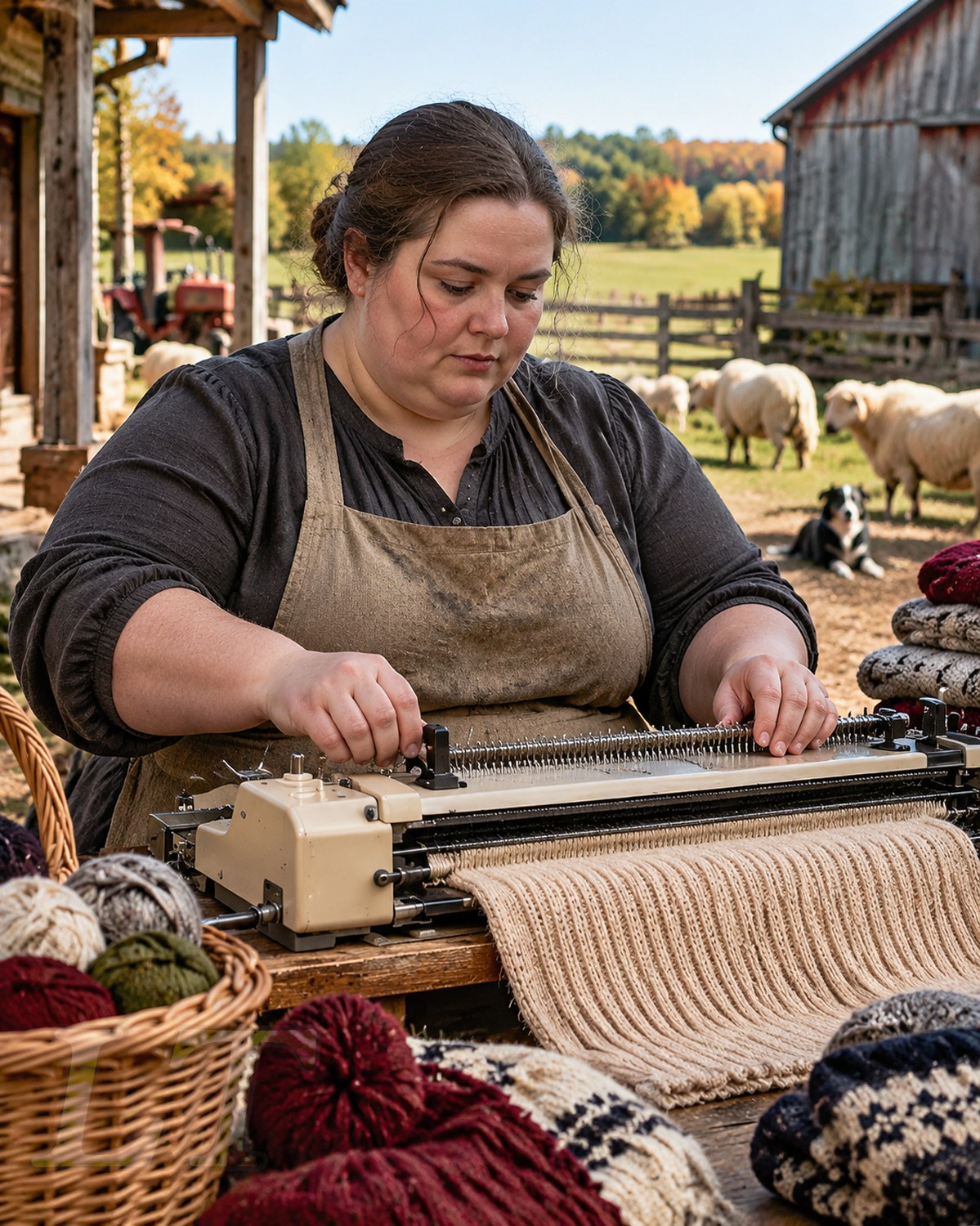
"Then show me the proof," I said, holding my hand against the knitting machine.
Mr. Harlan, the representative from Boston, opened his leather document case and removed a folded legal paper.
At the bottom was a faded red number: 47.
I recognized it.
The accusation was not what frightened me.
It was that number.
Three months earlier, I would have laughed if someone had told me that a piece of iron, purchased with twelve years of savings, could become the most important thing in my life.
I would have laughed even harder if someone had suggested that the same machine might someday bring a powerful Boston manufacturer to a lonely Vermont farmhouse to accuse me of theft.
But there I stood, with my hands still rough from wool and winter work, looking at a man who had traveled hundreds of miles to tell me that the only valuable thing I owned might not belong to me.
Mr. Harlan was a careful-looking gentleman with silver-gray hair, a charcoal wool suit, and the sort of expression that made every room feel like a courtroom.
He had arrived shortly after breakfast.
The snow on his boots had melted into dark patches on our kitchen floor.
He had examined our finished stockings, inspected my machine, and studied the business ledger in which I recorded every penny earned by the families of Reed Hill.
For nearly twenty minutes, I had believed he was a buyer.
That was the embarrassing part.
I had even brought out our finest pair of heavy winter stockings, the ones with reinforced heels and carefully closed toes.
I had told him about the lumber camp order.
I had explained how we inspected each fleece, how Josiah Pratt had adjusted his spinning frame to produce stronger yarn, and how the women of Reed Hill finished every stocking by hand.
He had listened politely.
Then he had told me he wasn't interested in buying anything.
Someone in Boston claimed the rights to my knitting machine.
And that person said I had stolen it.
Behind me, Tobias Reed made a sound that was almost a growl.
"That's a serious accusation to bring into another man's house."
Mr. Harlan turned toward him.
"I understand that, Mr. Reed."
"Then perhaps you ought to understand something else. Miss Clara purchased that machine with her own money."
"That is precisely what I intend to establish."
I kept my eyes on the document.
The number 47 had been written in red ink near the lower margin.
It was small enough that a careless reader might have missed it.
But I had spent twelve years in a Pennsylvania hosiery mill.
I knew the way factory clerks marked equipment.
I knew the difference between a manufacturer's serial number and an internal inventory number.
And I knew that the number on Mr. Harlan's paper was not the number stamped into the iron frame of my machine.
"May I examine that?" I asked.
Mr. Harlan hesitated.
Then he turned the paper toward me.
It was a formal notice claiming that a circular knitting machine matching the description of mine had been improperly removed from a Pennsylvania manufacturing establishment.
The notice named a Boston concern as the present holder of certain manufacturing rights.
It demanded that I cease commercial use of the machine until ownership could be established.
I read the document twice.
Then I looked at the signature.
Edwin P. Vale.
For a moment, I forgot the cold.
I forgot the stockings.
I forgot Tobias standing behind me.
Edwin Vale had been an office clerk at the hosiery mill near Germantown where I had worked.
He was the man who had once told me that women who asked too many questions usually found themselves without employment.
I had not thought of him in months.
I had hoped never to think of him again.
"Do you know this gentleman?" Mr. Harlan asked.
"I knew him."
"Then perhaps you can explain why he has identified this machine as missing property."
I looked up.
"Because he is either mistaken or lying."
Tobias stepped closer.
"Clara."
His voice carried a warning.
Not because he doubted me.
Because he knew how dangerous it could be for a woman without wealth or family influence to accuse a respectable businessman of dishonesty.
Mr. Harlan folded his hands.
"Miss Clara, I am not here to decide anyone's character. I am here to establish facts."
"Then we should begin with the correct facts."
I turned toward my machine.
It stood clamped to the kitchen table, its cream-painted housing scratched from years of careful use.
The iron cylinder was clean.
The needles were properly aligned.
A half-finished stocking hung beneath the mechanism.
I had spent so many hours beside it that I knew every sound it made.
A loose screw produced a faint rattle.
A bent needle caused a sharp metallic catch.
An uneven strand of yarn changed the rhythm of the crank.
To someone unfamiliar with knitting machinery, it was an ordinary piece of equipment.
To me, it was as recognizable as my own handwriting.
"Mr. Harlan," I said, "what number is recorded in your notice?"
He consulted the paper.
"Forty-seven."
"And what is the serial number of the machine you are accusing me of stealing?"
He looked at the iron housing.
"I assume it is the same."
"Then you should examine it."
I moved aside.
He bent toward the frame.
The manufacturer's number had been stamped into the metal near the lower mounting bracket.
It was partly obscured by years of use, but the figures remained legible.
2186.
Mr. Harlan straightened.
"That does not necessarily resolve the matter."
"No," I agreed. "But it means your document does not identify my machine."
He glanced down at the paper again.
For the first time since entering the farmhouse, his expression changed.
Only slightly.
A narrowing of the eyes.
A small tightening at the corner of his mouth.
But I noticed.
I had spent too many years watching supervisors decide whether a worker would receive her full wages not to recognize hesitation.
"Forty-seven may be an inventory designation," he said.
"It may."
"Then the difference proves very little."
"It proves that someone should have checked before calling me a thief."
Tobias moved to the opposite side of the table.
"That sounds reasonable enough to me."
Mr. Harlan closed the document.
"Miss Clara, I understand that this is distressing."
"I am not distressed, sir."
That was not entirely true.
My heart was beating hard enough to make my collar feel tight.
But fear was a luxury I had learned to keep private.
"I am interested in knowing who sent you and what authority you have to take my property."
"I have not said I intend to remove it today."
"Then why have you come?"
He studied me.
"To determine whether this matter can be resolved without involving the courts."
The word courts seemed to darken the room.
Tobias glanced toward the window.
Beyond the frost-covered glass lay the fields he had nearly lost that winter.
The hay had arrived only the previous evening.
Twenty-four sled loads.
Enough to keep the sheep alive until spring, provided we remained careful.
The men who had brought it over the ridge had survived temperatures that could freeze exposed skin in minutes.
They had worn stockings made by the women of Reed Hill.
Stockings knitted on the machine now being questioned.
Without that machine, we would not have filled the lumber camp order.
Without the lumber camp order, we would not have raised the money for hay.
Without the hay, Tobias would have been forced to sell much of his flock.
And without the sheep, there would be no wool to process when spring arrived.
Everything was connected.
That was what I had learned since coming to Vermont.
And now one stranger had walked into our kitchen carrying a document that threatened the entire arrangement.
"I have a bill of sale," I said.
Mr. Harlan's eyes sharpened.
"Do you?"
"Yes."
"May I see it?"
I hesitated.
Not because I was uncertain whether I had purchased the machine.
I remembered the purchase as clearly as I remembered my own name.
Ninety dollars.
Every dollar counted twice before I handed it over.
I remembered the weight of the coins.
I remembered the trembling in my hands.
I remembered walking away with the dreadful knowledge that I had traded nearly everything I possessed for a machine that might never earn a penny.
But I had not looked at the bill of sale since leaving Pennsylvania.
It was packed with my other papers.
And those papers were in the bottom of one of my trunks.
Upstairs.
"Of course," I said.
I turned toward the doorway.
Mr. Harlan raised a hand.
"Before you go, there is something else you should know."
I stopped.
He opened his document case again.
This time he removed a smaller sheet.
It bore the heading of a Boston manufacturing firm.
Beneath it was a statement concerning the use of patented mechanical equipment in commercial stocking production.
I read the first paragraph.
Then the second.
My stomach tightened.
The claim was no longer simply that I had taken a machine.
It suggested that even if I could prove I had purchased it, the right to use it commercially might still be disputed.
"That is absurd," Tobias said when I explained.
Mr. Harlan did not argue.
"Patent rights and ownership of a physical machine are not always the same matter."
I knew that much.
Factories had been fighting over mechanical inventions for years.
A machine could be bought and sold while the legal rights surrounding its design remained tangled in agreements most ordinary workers never saw.
But I had purchased my machine from a dealer who represented it as lawful equipment.
I had not stolen it.
I had not copied it.
I had not altered its essential mechanism.
And I had certainly not traveled hundreds of miles to Vermont with the intention of stealing anyone's invention.
"Who is making this claim?" I asked.
Mr. Harlan looked at the document.
"Edwin P. Vale, acting on behalf of the interests named here."
I felt my hands grow cold.
"Mr. Vale was a clerk."
"He is now associated with a manufacturing concern."
"Since when?"
"That is not information I was sent to discuss."
"Then perhaps you were sent with incomplete information."
His expression hardened.
"Miss Clara, I would advise you to be careful."
I looked directly at him.
"That is advice I have followed all my life."
For several seconds, neither of us spoke.
Then I went upstairs.
My trunk stood beside the narrow bed Tobias had given me when I first arrived.
The room was small, but it was mine.
That had mattered.
In Pennsylvania, I had slept in a laundress's back room, where the walls were damp and the window rattled whenever a wagon passed.
I had shared wash water.
I had counted candles.
I had mended the same winter dress until the original cloth was nearly impossible to recognize.
I had done all of it because I wanted something more than another twelve years of factory wages.
I wanted a business of my own.
Not a grand establishment.
Not a fortune.
Just enough work to live without begging permission from a man who believed my labor belonged to him.
I knelt beside the trunk.
Beneath folded clothing lay a packet of letters tied with cotton string.
There was the church correspondence that had brought me to Reed Hill.
There were notes concerning wool prices.
There was an old wage book.
And beneath those papers, wrapped in brown cloth, lay the envelope containing my machine's purchase documents.
I opened it.
The bill of sale was there.
So was the dealer's receipt.
And so was something I had almost forgotten.
A small handwritten note.
I unfolded it.
The paper had yellowed along the edges.
Across the top was the name of the dealer who had sold me the machine.
Below it were several lines written in hurried ink.
I remembered the man giving me the note.
He had seemed nervous.
At the time, I assumed he was worried about whether I could arrange transport for such a heavy machine.
Now I wondered whether there had been another reason.
I read the note once.
Then again.
The words did not accuse me of anything.
They did something far more troubling.
They suggested that the machine had passed through another owner's hands before reaching the dealer.
And the name of that owner was not Edwin Vale.
I heard footsteps on the stairs.
"Clara?" Tobias called.
"I'm here."
"Everything all right?"
I folded the note.
"Yes."
But before I could stand, I noticed another mark on the back of the receipt.
A red number.
47.
My breath caught.
The same number appeared on Mr. Harlan's legal notice.
I held the two papers together, staring at the ink.
The handwriting was unmistakably similar.
Someone had marked my receipt before I ever left Pennsylvania.
Someone who knew exactly which machine I had purchased.
And that person had left a trail connecting my lawful purchase to the accusation now waiting downstairs.
Tobias appeared in the doorway.
"Did you find it?"
"Yes."
He saw my face.
"What is it?"
I showed him the receipt.
Then the handwritten note.
He studied them in silence.
At last, he looked at me.
"Clara, who is this man?"
I opened my mouth to answer.
But before I could speak, a sharp knock sounded from downstairs.
Mr. Harlan called up from the kitchen.
"Miss Clara, there is one more name on the document. I believe you should hear it before we proceed."
I looked at Tobias.
He was already turning toward the stairs.
Then Mr. Harlan spoke the name.
And I nearly dropped the papers.






Comments 0