"Let her go!" I screamed.
The woman disappeared from the window.
One moment, her pale face had been pressed against the glass. The next, a dark arm had closed around her shoulders and dragged her backward into the night.
Margaret seized my wrist.
"Clara, don't go outside!"
I pulled away.
"Someone's hurting her!"
I ran toward the kitchen door.
Behind me, Margaret shouted for Tobias.
I had barely reached the porch when I heard a woman cry out near the woodpile.
Then came the sound of a struggle.
Boots scraping against frozen ground.
A heavy object striking wood.
And a man's voice.
"Keep quiet, damn you!"
I snatched the lantern from its hook and hurried down the steps.
The cold struck my face.
The yard was almost entirely dark.
Only a thin strip of moonlight showed between the clouds.
Near the woodpile, two figures struggled.
The woman was trying to pull away from a man in a heavy coat.
He held her by one arm.
With his other hand, he reached toward her mouth.
"Stop!" I shouted.
The man turned.
For an instant, the lantern illuminated his face.
I saw a narrow jaw.
A dark scarf.
And a scar running from the corner of his mouth toward his chin.
Then he released the woman and ran.
I heard him crash through the brush beyond the fence.
I started after him.
"Clara!"
Tobias's voice came from the barn.
He was running toward me with a lantern in one hand and a wooden handle in the other.
"Don't follow him!"
I stopped.
The woman had fallen to her knees.
I hurried to her.
"Are you hurt?"
She looked up.
Her face was pale beneath the blood on her temple.
"I don't think so."
Her voice trembled.
I helped her stand.
She was perhaps forty-five, though fear and exhaustion made her appear older. Her coat was torn at one shoulder, and her gloves were wet with snow.
Tobias reached us.
"What happened?"
"Someone grabbed her."
"Who?"
"I don't know."
He looked toward the fence.
"Which way?"
I pointed.
He took two steps.
Then the woman caught his sleeve.
"Please don't leave."
Tobias stopped.
Her eyes were wide with terror.
"He may not be alone."
Tobias looked toward the darkness.
Then he lowered the wooden handle.
"All right."
He turned to me.
"Get her inside."
I put my arm around the woman.
She leaned heavily against me as we crossed the yard.
Margaret stood in the doorway.
Samuel was behind her, holding the poker from the stove.
When he saw the injured woman, his expression changed.
"Good Lord."
Margaret moved aside.
We brought the stranger into the kitchen.
I helped her sit beside the stove.
Tobias closed the door and secured the latch.
For several moments, nobody spoke.
The woman stared at the floor.
Her hands shook so badly that she could not remove her gloves.
Margaret knelt beside her.
"Let me help."
She gently pulled off the gloves.
The woman's right wrist was bruised.
There was blood on her sleeve, but when Margaret examined it, she discovered that most of it had come from a cut near the elbow.
"That needs cleaning," Margaret said.
I brought warm water.
Samuel fetched clean cloth.
Tobias remained near the window.
He watched the yard.
I looked at the stranger.
"Who are you?"
She lifted her eyes.
"Eleanor."
My breath caught.
"Eleanor Price?"
She nodded.
The name seemed to settle over the kitchen.
Margaret slowly straightened.
Samuel lowered the cloth in his hand.
Tobias looked back from the window.
I stared at the woman.
For days, we had spoken about Eleanor Price as though she belonged to a distant world.
A widow who had invested her savings in machinery.
A woman whose money had disappeared into questionable accounts.
Someone whose name appeared on documents that Edwin Vale had allegedly altered.
Now she sat in Tobias Reed's kitchen, bleeding onto a folded towel.
"Mrs. Price," I whispered.
She shook her head.
"Please. Eleanor."
Margaret approached her.
"Eleanor, I'm Margaret Ellis."
The woman looked up sharply.
"I know who you are."
Margaret stopped.
"You do?"
Eleanor nodded.
"I've been looking for you."
Samuel stepped forward.
"And me?"
She studied his face.
Then her expression softened.
"Samuel Bell."
He looked startled.
"You remember me?"
"I remember the man who tried to tell the truth when everyone else wanted him to disappear."
Samuel lowered his eyes.
For a moment, I thought he might weep.
But Eleanor turned toward me.
"And you must be Clara."
"Yes."
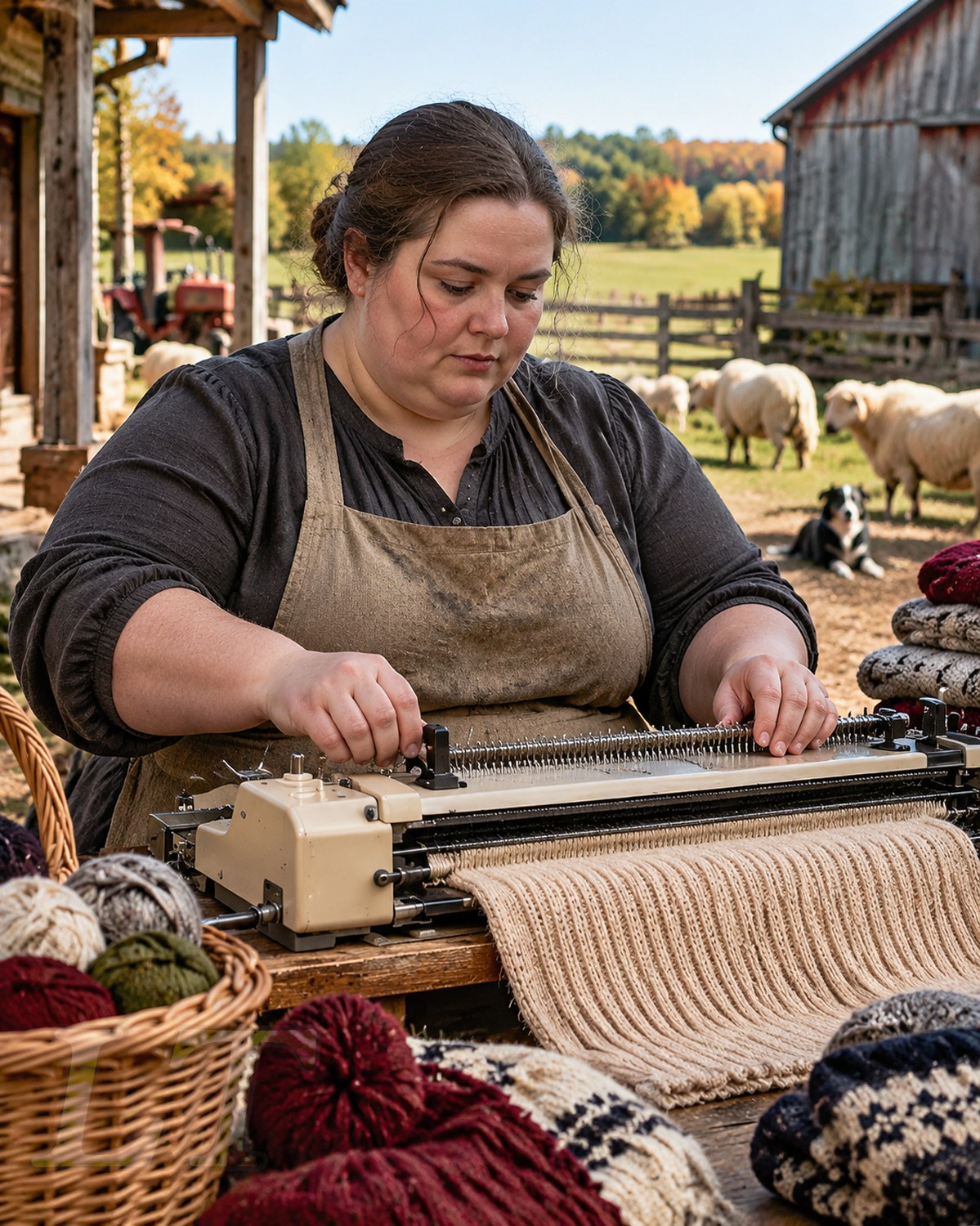
She looked at the knitting machine.
The iron cylinder stood on the table beside three finished pairs of stockings.
Eleanor stared at it for a long time.
Then she said, "I was afraid I wouldn't reach you."
I sat opposite her.
"Why?"
She looked toward the window.
"Because someone has been following me since I left Pennsylvania."
Tobias's face hardened.
"Who?"
"I don't know his name."
"Can you describe him?"
She nodded.
"Medium height. Dark coat. Scar near his mouth."
I looked at Tobias.
"The man outside."
"Likely."
Eleanor closed her eyes.
"I thought I had lost him at the stage stop."
Margaret finished cleaning the cut on her arm.
"How did you know where to find Clara?"
Eleanor opened her eyes.
"Because someone sent me a letter."
I leaned forward.
"Who?"
She reached inside her coat.
Her fingers trembled as she removed a folded envelope.
It was damp.
The seal had been broken.
She handed it to me.
I opened it carefully.
Inside was a short message.
If you still want the truth about the machinery accounts, come to Reed Hill in Vermont. The woman who bought machine 2186 may be the last person able to prove what happened.
There was no signature.
I looked at Eleanor.
"When did you receive this?"
"Nine days ago."
"Where?"
"At my boardinghouse in Philadelphia."
Samuel leaned closer.
"Do you recognize the handwriting?"
Eleanor shook her head.
"Do you?"
I examined the letters.
They were neat.
Carefully formed.
Almost too careful.
I had seen similar writing before.
On the threatening notes delivered to the farmhouse.
But the letters were not identical.
Whoever had written this message might have deliberately changed their hand.
Or it might have been an entirely different person.
"I don't know," I said.
Eleanor looked disappointed.
"I hoped you might."
I placed the letter on the table.
"Did you bring the document you showed me at the window?"
She looked toward her torn coat.
Then her face changed.
"Oh, no."
She searched one pocket.
Then another.
Her breathing quickened.
"It's gone."
Margaret touched her shoulder.
"What is?"
"The document."
"The one with your signature?" I asked.
Eleanor nodded.
"I had it in my hand when that man grabbed me."
Tobias moved toward the door.
"I'll look outside."
Eleanor caught his sleeve again.
"Please be careful."
He nodded.
Then he took the lantern and stepped into the yard.
I watched through the window as he searched near the woodpile.
The lantern moved slowly across the snow.
I turned back to Eleanor.
"What was the document?"
She looked at me.
"A copy of the original purchase agreement."
Samuel straightened.
"Between you and the mill?"
"Between my partnership and the equipment supplier."
Margaret leaned forward.
"Did it identify machine forty-seven?"
Eleanor nodded.
"And two other machines."
I stared at her.
"Two others?"
"Yes."
Samuel sat down.
His face had become very pale.
Eleanor looked at him.
"You didn't know?"
"No."
She folded her hands.
"I paid for three machines, Mr. Bell."
The kitchen fell silent.
I thought of the records we had found in the wooden box.
Machine forty-seven.
Serial number 2186.
Overlapping entries.
Payments.
Transfers.
But I had assumed Eleanor's dispute concerned one machine.
"Three?" I repeated.
She nodded.
"Three circular knitting machines. Enough to begin a small business."
I looked at my own machine.
One machine had cost me ninety dollars.
Three would have required a fortune by my standards.
"How much did you pay?"
Eleanor swallowed.
"Four hundred and eighty dollars."
I stared at her.
Four hundred and eighty dollars.
It was more money than I had ever held at one time.
"Was that all your savings?"
"Nearly."
Her voice grew quieter.
"My husband left me a little money. Not enough to live comfortably forever, but enough to attempt something useful."
She looked toward the stockings on the table.
"I wanted to employ widows."
Margaret lowered her eyes.
Eleanor continued.
"There were women in Philadelphia who could sew, spin, mend, and finish garments. Women who had children to feed. Women whose husbands had died in factories or on the railroads."
I listened without moving.
"I thought if I owned the machinery, I could pay them fairly."
Her mouth trembled.
"I thought ownership would protect us."
I felt a painful tightening in my chest.
Her dream had been so much like mine.
Not identical.
But close enough that I could almost see my own future reflected in her past.
"What happened?" I asked.
Eleanor looked at Samuel.
"The machines were never delivered."
He nodded slowly.
"I suspected as much."
"At first, the supplier claimed there had been a shipping delay. Then the mill claimed the machines had been transferred. Then I was told the equipment had been accepted by my partnership."
"But it hadn't," I said.
"No."
"Did you sign anything acknowledging delivery?"
"Never."
Samuel leaned forward.
"Then how did they prove it?"
Eleanor's expression hardened.
"They produced a receipt bearing my signature."
I stared at her.
"A forged signature?"
She nodded.
"Yes."
Margaret whispered something under her breath.
Eleanor continued.
"I challenged it. I hired an attorney. I wrote letters. I went to the offices myself."
"What happened?"
"The records supported their story."
She gave a bitter laugh.
"Everywhere I turned, someone showed me another document proving I had received machines I had never seen."
Samuel looked toward the wooden box.
"Because the records had been altered."
"Yes."
Eleanor's eyes filled with tears.
"But I couldn't prove it."
I thought of the women at the Germantown mill who had lost wages because a supervisor's written account was treated as more reliable than their own.
I thought of Samuel being accused of stealing tools.
Margaret losing her position.
And now Eleanor Price, whose entire future had been taken through a collection of papers.
I felt anger rise.
Not sudden anger.
A steady, heavy anger.
The kind that makes a person sit very still.
"Eleanor," I said, "did you ever meet Edwin Vale?"
She looked directly at me.
"Yes."
"Did he handle your account?"
"He claimed to."
"Did he sign the transfer papers?"
"Some of them."
I glanced at Samuel.
He nodded.
"That matches what I found."
Eleanor looked toward the machine again.
"Then you understand why I came."
I shook my head.
"Not entirely."
She took a breath.
"Because machine 2186 may have been used to create the false delivery record."
I felt my stomach tighten.
"How?"
She leaned forward.
"The supplier's records listed three machines by their manufacturer's serial numbers. But the mill's inventory used its own internal numbers."
"Like forty-seven," I said.
"Yes."
Samuel nodded slowly.
"That would allow Vale to confuse the records."
Eleanor looked at him.
"Exactly."
I stared at the machine.
The iron housing.
The crank.
The needles.
The bracket beneath the base.
It was difficult to believe that a machine could be made part of a fraud without ever leaving the factory.
But the more I listened, the more I understood.
A dishonest man did not need to steal the physical machine if he could steal its identity on paper.
He could sell the same equipment in the records.
Claim it had been transferred.
Charge for repairs.
And collect payments from people who never received what they bought.
"Then why does Vale want my machine?" I asked.
Eleanor looked troubled.
"Because the manufacturer's serial number can help establish which machine was where."
Samuel nodded.
"If the original records show that machine 2186 remained in Germantown after Eleanor supposedly received it, the delivery claim becomes harder to defend."
I felt a small surge of hope.
"Then my machine could help prove the fraud."
"Possibly," Samuel said.
"But only if we can establish its history."
I looked at Eleanor.
"Do you know who owned it before Margaret?"
She shook her head.
"Not yet."
The word yet caught my attention.
"You've been investigating?"
"For six years."
I stared at her.
Six years.
Six years of searching.
Six years of letters.
Six years of being told that the records were correct.
I thought of how quickly I had become discouraged after only a few days of threats.
Eleanor had endured far worse.
And she had still come to Vermont.
I reached across the table and touched her hand.
"We'll help you."
She looked at me.
For a moment, she seemed unable to speak.
Then she whispered, "Thank you."
The door opened.
Tobias returned.
Snow clung to his coat.
He carried something in his hand.
A folded paper.
Eleanor stood so quickly that her chair scraped against the floor.
"That's it!"
Tobias handed it to her.
"Found it near the woodpile."
She unfolded it.
The paper was torn along one edge.
But the writing remained legible.
She pressed it against her chest.
"Thank God."
Samuel leaned forward.
"May I see it?"
She nodded.
He examined the document.
Margaret moved beside him.
I watched their faces.
At first, Samuel appeared merely interested.
Then he became very still.
"Margaret."
She looked at the page.
Her eyes widened.
"What is it?" I asked.
Samuel pointed to a line near the bottom.
"This signature."
I leaned closer.
It was Edwin Vale's.
Beneath it was another name.
Silas Mercer.
I stared at the paper.
"Mercer?"
Samuel nodded.
"He witnessed the transaction."
I felt a chill.
The man who had warned me not to sell stockings.
The man who had questioned Mr. Cobb.
The man whose business interests were tied to local wool dealers.
His name appeared on a six-year-old machinery agreement in Pennsylvania.
I looked at Eleanor.
"Did you know him?"
She nodded slowly.
"He introduced me to the supplier."
Margaret covered her mouth.
Samuel stared at the document.
Tobias looked furious.
"That man has been lying to us from the beginning."
I thought of Mercer's careful smile.
His warning about established arrangements.
His claim that small producers often discovered they did not understand business.
Now I understood why he had been so interested in my machine.
He had not simply been protecting local wool prices.
He had been involved in the old transactions.
And if Eleanor could prove those transactions were fraudulent, Mercer might have as much to lose as Vale.
"We need to take this to a lawyer," I said.
Tobias nodded.
"Tomorrow."
Samuel looked at Eleanor.
"Do you have any other documents?"
She hesitated.
"Yes."
"Where?"
"Hidden."
I stared at her.
"Hidden where?"
She looked toward the window.
"Somewhere the man following me cannot reach them."
Margaret leaned forward.
"Eleanor, if you have evidence, we need to secure it."
"I know."
"Then tell us where it is."
Eleanor looked at me.
"I will. But first I need to know whether I can trust everyone in this house."
The words struck me.
I looked around the kitchen.
Tobias stood beside the door.
Margaret sat near the stove.
Samuel held the purchase agreement.
All of them had helped me.
All of them had stood against Vale.
But Eleanor had spent six years learning what betrayal could cost.
I could not blame her for being cautious.
"You can trust Tobias," I said.
She looked at him.
He nodded.
"I don't know much about machinery accounts, ma'am. But I know when a person has been wronged."
She studied him.
Then turned toward Margaret.
"I know you tried to help Samuel."
Margaret nodded.
"I did."
Eleanor looked at Samuel.
Her expression changed.
"And you."
Samuel met her eyes.
"I tried to expose the fraud."
"Yes."
She was silent.
Then she asked, "Why did you disappear?"
Samuel stiffened.
I looked at him.
He had told us he became ill after leaving Germantown.
He had explained that the mill believed him dead.
But Eleanor's question suggested there was more to the story.
Samuel folded the document carefully.
"I didn't disappear willingly."
Eleanor stared at him.
"Then why didn't you answer my letters?"
He looked startled.
"What letters?"
"I wrote to you after you left the mill."
Samuel shook his head.
"I never received them."
Eleanor's face hardened.
"Not one?"
"No."
She looked at Margaret.
"Did you know?"
Margaret shook her head.
"I didn't."
I felt unease growing.
Letters had gone missing before.
Samuel had written to the church about my machine.
That letter never reached me.
Now Eleanor claimed she had written to Samuel years earlier.
Those letters had vanished too.
Someone had been controlling more than machinery records.
Someone had been preventing people from finding one another.
Eleanor looked at Samuel.
"I wrote six times."
He stared at her.
"Six?"
"Yes."
His face went pale.
"I received nothing."
She sat slowly.
"Then someone intercepted them."
Nobody spoke.
I thought of the anonymous letter that had brought Eleanor to Vermont.
Whoever wrote it had succeeded where her earlier letters failed.
They had brought the people connected to the old machinery accounts together.
But why?
To help us?
Or to make us easier to find?
I looked toward the window.
The darkness beyond it seemed deeper than before.
Tobias moved to secure the shutters.
"We'll keep watch tonight," he said.
Margaret nodded.
"I'll stay with Eleanor."
Samuel rose.
"I can take the first watch."
Tobias shook his head.
"You need sleep."
"So do you."
"I've spent half my life watching sheep in bad weather. I can manage one more night."
I looked at him.
His face was tired.
The lines around his eyes seemed deeper.
I knew he was worried about the farm.
About the wool.
About the coming winter.
And now about the danger my machine had brought to his door.
"Mr. Reed," I said quietly, "I'm sorry."
He turned.
"For what?"
"For all this trouble."
He looked at me for a long moment.
Then he shook his head.
"Clara, the trouble was already there before you came."
"But it followed me here."
"Then perhaps it's time somebody stopped running from it."
I felt tears sting my eyes.
I looked away before he could notice.
The next morning, the farm woke beneath a hard frost.
Tobias had slept only a few hours.
Samuel looked exhausted.
Margaret prepared breakfast while I helped Eleanor change the dressing on her arm.
The wound was shallow.
Painful, but not serious.
The bruise around her wrist was darker.
She winced when I touched it.
"I'm sorry," I said.
"It's all right."
I wrapped the bandage carefully.
"Did the man say anything when he grabbed you?"
She hesitated.
"Yes."
"What?"
"He told me to give him the document."
"Did he mention Vale?"
"No."
"Mercer?"
She shook her head.
"Neither."
I tied the bandage.
"Then how did he know you had it?"
Eleanor looked at me.
"That's what frightens me."
I sat back.
She continued.
"I kept that paper hidden inside my coat. I didn't show it at the stage stop. I didn't tell anyone I had brought it."
I felt cold.
"Then someone knew before you arrived."
"Yes."
I thought of the anonymous letter.
The false brass cylinder.
The wooden box hidden in the wool.
Someone was arranging events around us.
Not merely reacting.
Planning.
Watching.
And perhaps waiting for us to uncover something we did not yet understand.
After breakfast, Tobias prepared the wagon.
We intended to visit the lawyer in St. Johnsbury.
Samuel placed the documents in a leather satchel.
Eleanor carried the purchase agreement beneath her coat.
Margaret packed food for the journey.
I went to the kitchen table.
My knitting machine stood ready.
I touched the crank.
Then I looked at the three pairs of finished stockings.
Three pairs.
That was all I had made since arriving on Reed Hill.
I felt a sudden, painful frustration.
I had come to Vermont to work.
To earn my living.
To help Tobias turn his wool into something valuable.
Instead, nearly every day had been consumed by threats, letters, and secrets.
I looked toward the window.
The fields were white.
The sheep stood near the barn.
Beyond them, the road curved toward the valley.
There were families waiting for winter.
Families who needed warm stockings.
Families who needed money.
And I was spending my days defending a machine that had not yet earned enough to repay a fraction of its cost.
I turned toward Margaret.
"After we see the lawyer, I want to visit Agnes Doyle."
She looked surprised.
"Why?"
"Because I promised her work."
Margaret smiled faintly.
"Then we should keep that promise."
I nodded.
"And I want to ask Josiah whether the yarn is ready."
"Good."
"And we need more wool."
"Yes."
I looked at her.
"Margaret, if this business is going to survive, we cannot wait for Vale to decide whether we're allowed to begin."
She touched my shoulder.
"Then we begin."
The words were simple.
But they steadied me.
We left shortly after sunrise.
The road to St. Johnsbury was rough.
The wagon wheels struck frozen ruts.
Eleanor sat beside Margaret.
Samuel held the satchel.
Tobias drove.
I watched the fields pass.
For a while, nobody spoke.
Then Eleanor asked, "Clara, why did you buy a knitting machine?"
I looked at her.
"Because I wanted to work for myself."
She smiled sadly.
"So did I."
I hesitated.
"Did you ever try again?"
"After losing the money?"
"Yes."
She looked toward the road.
"I worked as a seamstress. I took in mending. I kept accounts for a small shop."
"Did you ever buy another machine?"
"No."
"Why not?"
She was silent for a moment.
"Because I was afraid of losing everything again."
I understood.
Fear could be more expensive than any machine.
It could take years from a person's life.
It could turn a capable woman into someone who asked permission before making the smallest decision.
I looked at her.
"Perhaps you could work with us."
She turned.
"What?"
"Not immediately. We barely have a business yet."
She stared at me.
"But if we succeed, perhaps you could help with the accounts."
Her eyes filled.
"Clara, I don't know what to say."
"You don't have to say anything."
I smiled.
"Just think about it."
She looked down at her hands.
Then nodded.
"I will."
We reached St. Johnsbury near midday.
Reverend Hale's letter led us to a modest office above a merchant's shop.
The lawyer was a man named Nathaniel Brooks.
He was younger than I expected.
Perhaps thirty-five.
He wore spectacles and had a serious expression.
He listened while we explained the dispute.
Then he examined the papers.
For nearly an hour, he said very little.
He read the purchase agreement.
The copied inventory records.
The bill of sale for my machine.
The threatening notice.
The complaint prepared on Vale's behalf.
Finally, he removed his spectacles.
"Miss Clara," he said, "you have a stronger position than Mr. Vale would like you to believe."
I felt my breath catch.
"Do I?"
"Your bill of sale appears regular on its face. You purchased the machine from a dealer who represented himself as authorized to sell it."
I leaned forward.
"Then Vale cannot take it?"
Brooks raised a hand.
"I would not promise that. But a claim is not proof, and a complaint is not a seizure order."
Tobias nodded firmly.
"That's what I told them."
Brooks smiled.
"Then you were right to insist on proper authority."
I felt relief.
But the lawyer's expression remained serious.
"The larger problem is the old machinery transactions."
He looked at Eleanor.
"Mrs. Price, your documents suggest that you may have been defrauded."
She closed her eyes.
"I know."
"But proving it after six years will be difficult."
Her face fell.
Brooks continued.
"Not impossible. Difficult."
Samuel leaned forward.
"What would we need?"
"Original records. Reliable witnesses. Evidence establishing where the machines were physically located at the time of the alleged deliveries."
I looked at my machine.
Or rather, I imagined it sitting in Tobias's kitchen.
"Could the serial number help?"
"Certainly."
"And the copied records?"
"They may help us locate the originals or establish inconsistencies."
Eleanor looked at him.
"Can you represent us?"
Brooks hesitated.
"I can advise you and help prepare a response to the claim against Miss Clara's machine. The larger matter may require counsel in Pennsylvania."
I felt my heart sink.
Pennsylvania.
More travel.
More expense.
More delay.
Brooks seemed to understand.
"Let's begin with what we can do here."
He took out a clean sheet of paper.
"We should prepare a sworn statement identifying the machine, the purchase, and the circumstances of its arrival in Vermont."
I nodded.
"All right."
"And we should document every threat or attempted interference."
Tobias leaned forward.
"Someone broke into my house."
Brooks looked up sharply.
"Twice."
He listened carefully as we described the false brass cylinder, the missing packet, the wooden box, and the attack on Eleanor.
His expression grew grave.
"You must report these incidents to the constable."
"We will," Tobias said.
Brooks looked at me.
"And Miss Clara, I advise you not to surrender the machine voluntarily."
I almost laughed with relief.
"I had no intention of doing so."
He smiled.
"I suspected as much."
Then he looked at Eleanor.
"Mrs. Price, you mentioned that you possess additional documents."
She became very still.
"Yes."
"Where are they?"
She hesitated.
"Hidden."
Brooks folded his hands.
"Are they safe?"
"I believe so."
"Can you retrieve them?"
Eleanor looked at me.
Then at Samuel.
Finally, she said, "I can tell you where they are."
I leaned forward.
"Where?"
She swallowed.
"In Pennsylvania."
Samuel looked disappointed.
"Then we may need to send someone."
Eleanor shook her head.
"No."
We stared at her.
She continued.
"The documents are in a place I cannot safely enter."
Brooks frowned.
"Why?"
Eleanor looked toward the door.
"Because the man who stole my money still controls it."
I felt a chill.
"Vale?"
She nodded.
Brooks leaned back.
"Mrs. Price, if you are suggesting that the records remain in his possession, we will need to proceed through lawful means."
"I understand."
She looked exhausted.
"But there is something else."
I watched her carefully.
"What?"
Eleanor reached into her coat.
She removed a small key.
It was made of dark iron.
The head was shaped like a clover.
She placed it on the desk.
"This opens a cabinet in the old Germantown mill office."
Samuel stared at the key.
His face changed.
"Where did you get that?"
Eleanor looked at him.
"From someone who worked there."
"Who?"
She hesitated.
Then said, "A woman named Ruth."
Margaret straightened.
"Ruth?"
Eleanor nodded.
"Ruth Whitaker."
Margaret covered her mouth.
I knew the name.
Ruth Whitaker had been the mill's bookkeeper.
A quiet woman with narrow spectacles and a habit of carrying two pencils behind one ear.
She had worked in the office under Edwin Vale.
And she had disappeared from the mill shortly before Samuel was dismissed.
I stared at Eleanor.
"Ruth gave you that key?"
"Yes."
"When?"
"Three months ago."
Samuel leaned forward.
"Where is she now?"
Eleanor looked down.
"I don't know."
Margaret's face had gone pale.
Brooks looked between us.
"Is this woman an important witness?"
Samuel nodded.
"Very important."
I felt my heart begin to pound.
Ruth Whitaker had worked with the records.
She had access to the accounts.
She might know exactly how Vale had altered them.
And if she had given Eleanor a key, perhaps she had intended someone to recover the originals.
Brooks picked up the key.
"Then we need to find Miss Whitaker."
Eleanor nodded.
"Yes."
He placed it back on the desk.
"Do you have any idea where she might be?"
Eleanor hesitated.
Then she looked at me.
"I was told she had gone north."
I stared at her.
"North?"
"To Vermont."
The room fell silent.
Tobias leaned forward.
"Where in Vermont?"
Eleanor swallowed.
"Somewhere near Reed Hill."
I felt cold.
Ruth Whitaker.
The missing bookkeeper.
The woman who might know the truth.
She could have been living within miles of us.
Perhaps even watching the events unfold.
Brooks looked at Eleanor.
"Who told you that?"
She reached into her coat again.
This time she removed a folded letter.
The paper was old.
The ink had faded.
She opened it carefully.
Then she handed it to me.
I recognized the handwriting immediately.
It was the same careful hand that had written the anonymous letter directing Eleanor to Reed Hill.
My fingers tightened.
I read the first line.
Then the second.
The letter did not merely say that Ruth Whitaker had gone to Vermont.
It gave an address.
A farmhouse.
A road.
A name.
I stared at the final line.
Tobias leaned closer.
"Clara?"
I could barely speak.
"Mr. Reed."
He looked at me.
"What is it?"
I turned the letter toward him.
The address was his own farmhouse.
And beneath it, in faded ink, were the words:
Ask for the woman who lives upstairs.
Tobias went perfectly still.
Then he looked at me.
"Clara," he whispered, "there was a woman living in that room before you came."
I stared at him.
"What woman?"
His face had lost all color.
He reached for the letter.
Then he said her name.






Comments 0