"Get away from my machine!"
Edwin Vale turned toward the window.
For one terrible instant, his eyes met mine through the glass.
He stood in Tobias Reed's kitchen with a lantern in his hand, while smoke crept beneath the ceiling and my knitting machine lay overturned beside the table.
Then he smiled.
Not because he was pleased to see me.
Because he believed I was too late.
Behind the farmhouse, flames climbed the north wall of the barn.
The sheep were crying.
Above me, someone was pounding against the upstairs window.
And Tobias was running toward the burning building.
I struck the front door with both fists.
"Open it!"
Vale did not move.
I seized the iron handle and pulled.
Locked.
I stepped back and kicked the lower panel.
Pain shot through my ankle.
The door held.
"Clara!"
Tobias's voice came from the yard.
"Get away from the house!"
I looked over my shoulder.
He had reached the barn.
Smoke poured from beneath the roof.
Through the open doors, I could see the sheep crowded against the far wall, too frightened to move toward the opening.
Tobias seized a pitchfork and began tearing burning straw away from the entrance.
"Help me with the latch!" he shouted.
I turned back toward the house.
Vale was no longer at the window.
The lantern had disappeared.
Then I heard a crash upstairs.
Someone screamed.
I ran around the house.
The kitchen window stood partly open.
I seized a stone from beside the foundation and struck the glass.
It shattered.
I reached through the broken pane, found the catch, and pushed the window upward.
Smoke rolled into my face.
I climbed inside.
The kitchen was hot.
The overturned machine lay beside the table, one leg of its wooden stand broken.
A thin line of burning oil ran across the floor toward the wall.
Vale had deliberately spilled the lantern.
I seized the water bucket beside the stove and threw its contents across the flames.
The fire hissed.
For a moment, it seemed to retreat.
Then a burning strip of cloth fell from the curtain.
I pulled it down and stamped it beneath my boots.
"Vale!"
No answer.
I heard footsteps overhead.
I snatched the poker from beside the stove and ran toward the stairs.
Halfway up, smoke thickened.
I covered my mouth with my sleeve.
At the landing, the door to my room stood open.
Inside, Margaret Ellis was struggling against a man in a dark coat.
Charles Benton.
He had one hand around her wrist and the other pressed against her mouth.
Margaret saw me.
She twisted violently.
Benton turned.
I swung the poker.
It struck his forearm.
He cried out and released her.
"Run!" I shouted.
Margaret stumbled into the passage.
Benton lunged toward me.
I raised the poker again.
He caught it.
For an instant, we struggled in the smoke.
He was stronger.
But I had spent twelve years working machines that could tear a hand apart if a person lost her nerve.
I knew the value of a sudden movement.
I released the poker.
Benton stumbled backward.
I seized the heavy washbasin from the stand beside the door and threw it at his knees.
He fell.
I grabbed Margaret.
We ran.
At the bottom of the stairs, Samuel Bell appeared through the broken kitchen window.
"Clara!"
"Get Margaret outside!"
He caught her.
I turned back toward the stairs.
"Where's Eleanor?"
"Outside with Agnes and Will!"
"Ruth?"
"With them!"
I looked toward the upper landing.
"Then who's still upstairs?"
Samuel stared at me.
"Nobody."
I remembered the figure pounding at the window.
Margaret caught my arm.
"Clara, that was me."
I stared at her.
"Benton locked me in your room. I broke the latch, but he caught me before I reached the stairs."
The roof creaked.
A burning beam dropped into the passage.
Samuel seized my shoulder.
"Out!"
We climbed through the kitchen window.
Cold air struck my face.
Behind us, smoke poured from the broken glass.
The barn roared.
Tobias was still inside.
I ran toward it.
"Mr. Reed!"
No answer.
The sheep cried in terror.
Then I saw him.
He stood near the far wall, trying to force the animals toward the entrance.
The smoke was so thick that he could scarcely see.
I seized a wooden hurdle lying beside the fence.
Will Doyle appeared at my side.
"Miss Clara!"
"Help me!"
Together we carried the hurdle toward the barn.
Tobias saw us.
"Keep back!"
"Use this!"
I pushed the hurdle toward him.
He caught it.
Then he swung it behind the sheep, forcing them away from the burning wall.
The first ewe bolted.
Then another.
Then five more.
Suddenly the flock surged toward the doors.
I stepped aside.
Sheep poured into the yard.
Their wool was blackened with soot.
Their eyes were wild.
Will ran toward the gate.
"Over here!"
He waved his coat.
Agnes and Eleanor stood beside the stone wall, directing the animals toward the lower pasture.
Margaret counted aloud.
"Twenty-one! Twenty-two! Twenty-three!"
Tobias emerged from the smoke.
He coughed violently.
Then he turned back.
"There's still one inside!"
I seized his arm.
"The roof!"
He shook me off.
"She's trapped!"
I looked through the smoke.
Near the far corner, an old ewe lay against the feeding trough.
Her hind leg was caught beneath a fallen board.
Tobias ran toward her.
I followed.
"Clara!" he shouted.
But I was already beside him.
We lifted the board together.
The ewe struggled.
Tobias pulled her free.
Then the roof gave a terrible crack.
"Go!" I screamed.
We dragged the animal toward the doors.
A beam fell behind us.
Sparks burst across the floor.
We stumbled into the yard as part of the roof collapsed.
Tobias fell to his knees.
I dropped beside him.
For several moments, neither of us could breathe properly.
Then he looked at me.
"Clara."
I touched his face.
He was alive.
His eyebrows were singed.
His coat was burned.
But he was alive.
I wanted to embrace him.
I wanted to weep.
Instead, I heard Margaret shouting.
"Forty-four!"
I turned.
She stood beside the lower gate.
"Forty-five!"
A small lamb darted from behind the woodpile.
Will caught it.
"Forty-six!"
I closed my eyes.
All forty-six sheep.
Every one of them.
Then Tobias looked toward the farmhouse.
"Vale."
I turned.
Edwin Vale was running toward the road.
He carried a leather satchel beneath his arm.
Charles Benton stumbled after him, clutching his injured wrist.
The scarred man who had attacked Eleanor waited beside a wagon.
They were trying to escape.
"Stop them!" I shouted.
But the wagon was already moving.
Then a second wagon appeared at the bend.
Josiah Pratt stood on the driver's seat.
Beside him were Amos Whitcomb and two farmers from the valley.
They had seen the fire.
Josiah pulled his horse across the road.
Vale's driver tried to turn.
The wheels struck a frozen rut.
The wagon lurched sideways.
Benton fell against the rail.
The horse reared.
And the wagon overturned.
Men rushed forward.
Tobias rose unsteadily.
I caught his arm.
"Don't."
He looked at me.
"They tried to burn us out."
"I know."
"They nearly killed you."
"I know."
His face twisted with anger.
But he stayed beside me.
We watched as Josiah and Amos pulled the men from the overturned wagon.
Vale struggled.
He shouted about private property.
About unlawful detention.
About his rights.
Nobody listened.
When the constable arrived from the village, accompanied by two men who had heard the warning bell, Vale was sitting in the snow with his hands bound behind him.
Benton stood nearby, pale and furious.
The scarred man had attempted to flee through the orchard.
Will Doyle had seen him.
The constable's men caught him before he reached the woods.
I stood beside the farmhouse, trembling from cold and exhaustion.
The fire in the kitchen had been extinguished.
The upper floor was damaged by smoke, but the house still stood.
The barn was another matter.
Half the roof had fallen.
The north wall was black.
The hay stored inside had burned.
All of it.
I stared at the ruin.
The sheep were alive.
But they had nothing to eat.
Not enough for a week.
Perhaps not enough for three days.
Tobias came beside me.
He looked at the barn.
Then at the sheep.
His face seemed older.
"I don't know how we'll manage."
I took his hand.
"We will."
He looked at me.
"Clara—"
"We will."
I had no plan.
Not yet.
But I refused to let Edwin Vale finish what the fire had begun.
By morning, Reed Hill looked like a battlefield.
The snow had turned gray with ash.
The yard was filled with broken boards.
The sheep stood in the lower pasture, huddled against the cold.
The farmhouse smelled of smoke.
My machine lay on the kitchen table.
Samuel had helped me lift it from the floor.
One leg of the stand was broken.
Several needles were bent.
The crank had been damaged.
But the cylinder itself was intact.
I ran my fingers over the iron.
Serial number 2186 remained clearly visible.
Samuel examined the mechanism.
"She can be repaired."
I looked at him.
"Are you certain?"
He nodded.
"Yes."
I felt my throat tighten.
Margaret stood beside us.
"Then we'll repair her."
Eleanor opened the account book.
"And we'll record the cost."
I laughed unexpectedly.
They looked at me.
I could not help it.
We had nearly lost everything.
Yet Eleanor Price was still thinking about accounts.
Margaret was still thinking about work.
Samuel was still thinking about machinery.
And I was still thinking about stockings.
Perhaps that was how people survived.
Not by refusing to be frightened.
But by continuing to do what needed doing.
Reverend Hale arrived before noon.
He came with bread, blankets, and two men carrying tools.
When he saw the barn, he stopped.
"Dear God."
Tobias stood beside the gate.
"Morning, Jonathan."
The minister approached him.
"I heard what happened."
Tobias nodded.
"Then you've heard enough."
Reverend Hale looked troubled.
"Not quite."
He turned toward me.
"Miss Clara, Nathaniel Brooks sent word that you had found certain records."
I felt my heart tighten.
"Yes."
He looked at Tobias.
"I suppose you've seen my name."
Tobias nodded.
The minister sighed.
"Then we should speak."
We gathered in the kitchen.
Samuel placed Ruth Whitaker's ledger on the table.
Reverend Hale examined the final entry.
His face changed.
"One hundred and twenty dollars."
I watched him carefully.
"Do you know what it means?"
He nodded slowly.
"Yes."
Tobias folded his arms.
"Then tell us."
The minister sat down.
"Six years ago, a woman came to me asking for help."
"Ruth?" I asked.
"No."
He looked at Eleanor.
"A woman named Lydia Price."
Eleanor went pale.
"My sister."
I stared.
Eleanor gripped the table.
"Lydia came to Vermont?"
Reverend Hale nodded.
"She had been trying to recover money lost in a machinery transaction. She told me her sister had been cheated."
Eleanor's eyes filled.
"Lydia died five years ago."
"I know."
The minister lowered his head.
"She wrote to me before her death."
I looked at him.
"What was the money?"
"One hundred and twenty dollars entrusted to me for safekeeping."
Eleanor stared.
"What?"
Reverend Hale continued.
"Lydia believed that a portion of the stolen funds had been returned secretly by someone connected to the mill. She feared the money would be taken if it remained in Pennsylvania."
"Who returned it?" Samuel asked.
The minister shook his head.
"She never knew."
I looked at the ledger.
"Then why is your name recorded under Account 47?"
"Because Lydia insisted on a receipt. The person who transferred the money entered my name as custodian."
Eleanor covered her mouth.
"Where is the money now?"
Reverend Hale looked at her.
"In a savings account held for you."
For several moments, nobody spoke.
Then Eleanor began to cry.
Not because the money would restore everything.
It would not.
Four hundred and eighty dollars had been taken from her.
Years of work had been lost.
Her dream had been destroyed.
But one hundred and twenty dollars had survived.
A piece of her stolen future.
Reverend Hale reached into his coat.
He removed a folded bank statement.
"I have kept it all these years. Lydia asked me not to release the money until you could be found and its origin verified."
Eleanor took the paper.
Her hands trembled.
"I thought everyone had forgotten me."
The minister shook his head.
"Your sister did not."
I looked away.
My eyes burned.
Then Samuel placed the sealed letter addressed to Henry Ashcroft on the table.
"There's another matter."
Reverend Hale examined it.
"The transfer mark."
"You recognize it?" I asked.
He nodded.
"Ruth showed me the symbol years ago."
Samuel leaned forward.
"She said the letter was meant for Henry Ashcroft, or for you if he could not be reached."
The minister looked at the seal.
"Then perhaps we should open it."
I hesitated.
Ruth had asked us not to.
But the danger had passed from suspicion into violence.
Vale had attempted to destroy the machine.
He had set fire to the farm.
He had nearly killed us.
I broke the seal.
Inside were three pages.
The first was a letter from Ruth Whitaker.
The second contained a list of machinery transactions.
The third was a sworn statement signed by Henry Ashcroft himself.
I stared.
"Samuel."
He came beside me.
I handed him the statement.
He read it.
Then his face changed.
"Clara."
"What?"
"This is what we've been missing."
The statement explained that Henry Ashcroft had discovered irregularities in the machinery accounts shortly before his illness.
He had instructed Ruth to preserve copies of the original transfer register.
He had also authorized the lawful disposal of several older knitting machines, including serial number 2186, after they were removed from the mill's active equipment list.
Margaret Ellis had purchased that machine through an authorized sale.
Later, she sold it through the dealer from whom I bought it.
The chain of ownership was clear.
Vale had altered the internal records afterward, attempting to connect my machine to Eleanor's undelivered equipment.
Samuel read the final paragraph aloud.
"The machine bearing manufacturer's serial number 2186 was lawfully transferred and is not part of the equipment claimed by the Price partnership."
I closed my eyes.
For the first time since the threatening letters began, I felt the ground become solid beneath me.
My machine was mine.
Not because I had fought for it.
Not because Tobias had defended it.
But because I had bought it honestly.
And now the records proved it.
The weeks that followed were difficult.
Vale and Benton were held while the authorities investigated the fire and the attempted seizure of my machine.
The scarred man, whose name was Martin Greeley, admitted that Vale had hired him to follow Eleanor and recover the documents.
He also admitted entering the farmhouse and placing the false cylinder beside the machine.
It had been meant to frighten me into abandoning the business.
The threatening notes had come from Vale's associates.
The brass plate had been sent to confuse the ownership records and make me doubt my purchase.
The missing page from Ruth's notebook had been taken by Benton during an earlier search.
Ruth returned two days after the fire.
She had gone to meet Reverend Hale, hoping to explain the payment before we misunderstood it.
When she learned what had happened, she wept.
Then she went to Nathaniel Brooks and gave a full statement.
She admitted entering false figures under Vale's instructions.
She also provided the original copies she had preserved.
Her testimony helped establish how the fraud had worked.
The machinery numbered forty-seven had never been delivered to Eleanor.
Neither had the other two machines listed in her agreement.
Vale had used false delivery receipts, altered inventory numbers, and payments to brokers to conceal the theft.
Silas Mercer had received commissions for arranging the transactions and had helped maintain the false records.
When confronted with the evidence, he attempted to deny everything.
But Ruth's ledger contained dates.
Eleanor's agreement contained his signature.
And the records from Germantown matched the payments.
The case eventually reached the proper authorities in Pennsylvania.
Vale, Benton, and Mercer faced criminal proceedings.
Their attempts to seize my machine failed.
The false claim was withdrawn.
The machinery fraud was exposed.
And the people who had spent six years hiding behind papers could no longer pretend that the papers told the truth.
Mr. Harlan, the Boston representative who later arrived at Reed Hill during the deepest part of winter, brought the final ownership challenge.
He stood in our kitchen with a leather case and a cold expression.
He placed the disputed inventory sheet before me.
"The number forty-seven," he said, "is the foundation of our client's claim."
I looked at the red number on my receipt.
Then at Samuel's notebook.
Then at Henry Ashcroft's statement.
"Your client has confused an internal account with a machine," I said.
Harlan frowned.
"That is a serious allegation."
"Yes."
I placed the documents before him.
He read them.
His expression changed.
Then he asked who had preserved the original records.
"Ruth Whitaker," I said.
He looked up sharply.
I saw recognition in his face.
He had been told she was dead.
But Ruth was sitting beside the stove.
She stood.
"Mr. Harlan," she said, "I am prepared to testify."
He stared at her.
Then he closed his case.
He left without the machine.
Several days later, Nathaniel Brooks received written confirmation that the claim had been abandoned.
I folded the letter and placed it beside my bill of sale.
For the first time, I could close the drawer without fearing that someone would come to take what was inside.
But winning the legal battle did not feed forty-six sheep.
The fire had destroyed our hay.
Winter had arrived.
And the farm was still in danger.
The first heavy storm came three days after the barn fire.
Snow covered the roads.
The stream froze along its edges.
The sheep crowded into the temporary shelter the neighbors had built from salvaged boards.
Tobias counted the remaining feed.
Then he came into the kitchen.
"Clara."
I looked up from the machine.
"What?"
"We have enough for four days."
My hands stopped.
"Only four?"
He nodded.
I looked toward the window.
Snow fell steadily.
The hills were disappearing beneath white.
"Where can we find more?"
"Amos knows a farmer beyond the northern ridge who has hay to spare."
"How far?"
"Nearly twenty miles."
I stared.
"Can we bring it back?"
"Not with one wagon in this weather."
I thought for a moment.
"Then we need more wagons."
Tobias shook his head.
"Sleighs."
"How many?"
He hesitated.
"Perhaps twelve."
I stared at him.
"Twelve?"
"Enough to carry a winter's supply if the road holds."
I stood.
"Then we'll find twelve."
He gave a tired laugh.
"Clara, you can't simply ask twelve men to leave their farms in a snowstorm."
"Why not?"
He stared.
"Because—"
"Because it's difficult?"
"Because it's dangerous."
I nodded.
"Then we'll ask carefully."
He looked at me for a long moment.
Then he smiled.
"You're impossible."
"Perhaps."
I reached for my coat.
"Come on."
We went first to Amos Whitcomb.
He listened while Tobias explained the situation.
Then he nodded.
"I'll bring my sleigh."
Josiah Pratt offered another.
Mr. Cobb promised to ask two farmers who delivered goods to his store.
Reverend Hale organized the men from the church.
Agnes Doyle brought food.
Will volunteered to help load.
By evening, we had twelve sleighs.
Twelve teams.
And enough men to make the journey.
I stood in the churchyard as the drivers gathered beneath the falling snow.
Lanterns glowed along the line.
The horses stamped.
The runners creaked.
Tobias came beside me.
"Are you certain about this?"
I looked at the men.
At the sleighs.
At the road disappearing into darkness.
"No."
He smiled.
"Neither am I."
Then he took my hand.
We set out before dawn.
The snow was deep.
The wind cut across the open fields.
At the northern ridge, one sleigh became stuck in a drift.
The men dug it free.
Farther on, a runner cracked.
Josiah repaired it with a strip of iron and a length of rope.
At the frozen crossing, the horses hesitated.
Tobias went ahead on foot.
He tested the ice.
Then he guided the teams across one at a time.
I watched him from the sleigh.
His coat was white with snow.
His beard was rimed with frost.
He looked exhausted.
But he kept moving.
At last we reached the farmer's barn.
The hay was there.
Dry.
Golden.
Enough to save the flock.
We loaded the sleighs until each one carried as much as it safely could.
The farmer accepted payment in cash and a written promise for the balance.
Eleanor had helped us calculate what we could afford.
The first sales of stockings had provided part of the money.
Reverend Hale's congregation contributed more.
And Tobias promised wool from the spring shearing.
We returned through the storm.
The journey took nearly twice as long.
By the time Reed Hill came into view, the sky had darkened.
But the farmhouse windows glowed.
Margaret stood outside with a lantern.
Agnes and Will waited beside the temporary sheep shelter.
When the first sleigh reached the yard, they cheered.
I laughed.
Then I began to cry.
Twelve sleighs.
Twelve loads of hay.
A winter's chance.
Tobias climbed down beside me.
He looked at the hay.
Then at the sheep.
Then at the neighbors who had come through the storm.
He removed his hat.
For a moment, he could not speak.
At last he said, "I don't know how to thank you."
Amos Whitcomb laughed.
"Keep those sheep alive. That's thanks enough."
Josiah clapped him on the shoulder.
"And send us more wool for the mill."
The men laughed.
I looked at Tobias.
He was smiling.
A real smile.
Not the tired expression he wore when he was trying to reassure me.
A smile that reached his eyes.
And I knew the farm would survive the winter.
By spring, the knitting business had become something larger than I had imagined.
Josiah's mill produced yarn regularly.
Amos supplied wool.
Tobias's flock provided more.
Agnes Doyle supervised the finishing work.
Three other women joined her.
Will became our most reliable delivery boy.
Mr. Cobb sold our stockings in his store and began taking orders from neighboring villages.
Eleanor kept the accounts.
Margaret trained the women.
Samuel maintained the machines.
And I worked at the table where I had first placed my ninety-dollar purchase.
We bought a second machine.
Then a third.
Not through a mysterious dealer.
Not through an agent who refused to explain his records.
We purchased them openly, with proper bills of sale and witnesses.
Every serial number was recorded.
Every payment entered.
Every worker paid.
The women received wages they could count on.
The stockings were strong.
Warm.
Affordable.
And made from Vermont wool.
By the time the snow melted from the upper fields, we had sold more than three hundred pairs.
The profits paid for hay.
They paid for repairs to the barn.
They paid Agnes and the other women.
They paid Josiah for spinning.
And they left enough to begin saving for the next winter.
Eleanor received the one hundred and twenty dollars her sister had preserved.
Later, through the legal proceedings, she recovered additional money from the fraudulent machinery transactions.
Not all of it.
The years she had lost could not be returned.
But she had something she had once believed impossible.
A place in a business that belonged partly to her.
We made her a partner.
She cried when we signed the agreement.
Then she insisted on entering the transaction in the ledger herself.
Ruth Whitaker remained in Vermont.
She gave testimony when required.
She helped Nathaniel Brooks organize the records.
And when the legal matters were settled, she began teaching arithmetic and bookkeeping to the women who worked with us.
She said she wanted to spend the rest of her life making honest figures.
Samuel laughed when she told him.
"That's a worthy ambition."
Margaret agreed.
The two of them had spent years believing their reputations were ruined.
Now they worked together again.
Not under Edwin Vale.
Not under a supervisor who threatened them.
But among people who valued what they knew.
The new barn rose in May.
The neighbors helped raise the frame.
The roof was stronger than the old one.
The hayloft was larger.
Tobias insisted on adding a proper storage room for wool.
I insisted on a separate workroom for the machines.
We argued about the size.
He wanted twelve feet.
I wanted sixteen.
We settled on fourteen.
Then Samuel measured the machines and declared that sixteen would be better.
Tobias looked at me.
I smiled.
He shook his head.
"Outnumbered again."
I laughed.
The workroom was finished before the summer shearing.
It had broad windows.
A sturdy floor.
Shelves for yarn.
Tables for finishing.
And a small stove for winter.
Above the door, Will painted a sign.
REED HILL WOOLEN STOCKINGS
Beneath it, in smaller letters, he added:
MADE BY LOCAL HANDS
I stood before the sign for a long time.
Then I went inside.
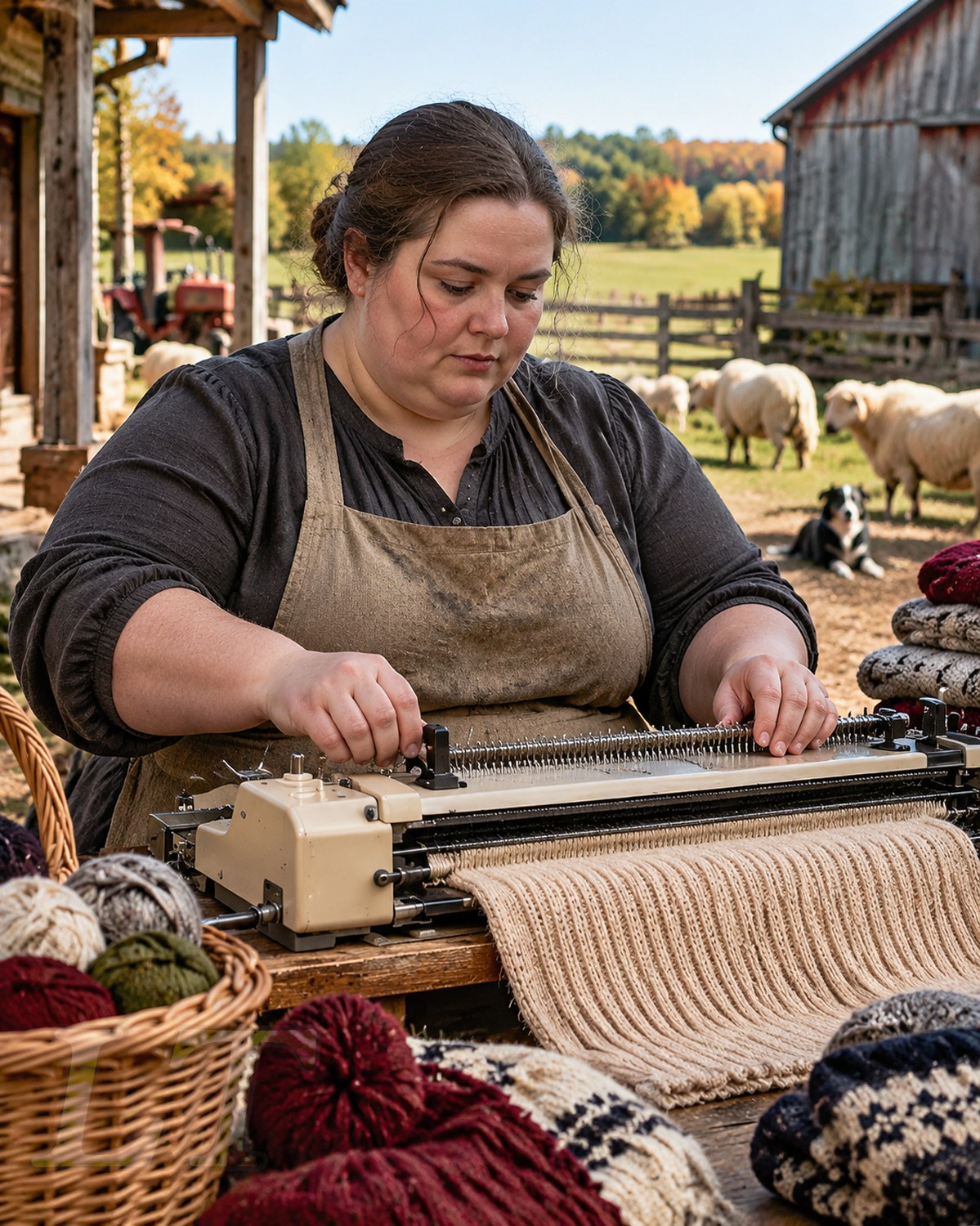
My first machine stood near the window.
Serial number 2186.
The same machine I had purchased with twelve years of savings.
The same machine Vale had tried to steal.
The same machine that had nearly burned.
Samuel had repaired every damaged part.
The crank turned smoothly.
The needles moved cleanly.
The yarn fed without catching.
I touched the iron housing.
Then I began to work.
The familiar clicking filled the room.
I smiled.
For the first time in years, the sound did not remind me of Germantown.
It reminded me of home.
One evening in late June, Tobias found me in the workroom after everyone else had gone.
The windows were open.
The air smelled of grass and fresh wool.
Outside, the sheep grazed beneath the long evening light.
I was finishing a pair of stockings when he entered.
"Still working?"
I looked up.
"Just one more pair."
He smiled.
"You said that an hour ago."
"Did I?"
"Yes."
I laughed.
He came beside the table.
For a moment, he watched the machine.
Then he said, "Clara, there's something I've been meaning to ask you."
I stopped turning the crank.
"What?"
He looked unusually nervous.
I had seen Tobias face a burning barn.
I had seen him guide horses across frozen water.
I had seen him stand against Edwin Vale.
But now he seemed unable to find the words he wanted.
I set down the work.
"Tobias?"
He looked at me.
"When you came here, I thought you would stay for a season."
I smiled.
"So did I."
"I thought you'd earn a little money and move on."
"I know."
He looked toward the window.
"I didn't think anyone would want to build a life on this farm."
My heart began to pound.
He continued.
"After Mary died, I stopped imagining much beyond the next winter."
I listened.
"Then you came with that machine."
I laughed softly.
"An inconvenient arrival."
"The most inconvenient woman I've ever met."
I smiled.
He took my hand.
"Clara, you saved this farm."
I shook my head.
"We saved it."
He nodded.
"Yes."
Then he looked directly at me.
"And I'd like to spend the rest of my life doing that with you."
My breath caught.
He reached into his pocket.
He removed a small ring.
It was plain gold.
Worn smooth.
He held it carefully.
"This belonged to my mother. Mary wore her own ring. I kept this one because I thought someday—"
His voice faltered.
I felt tears rise.
He swallowed.
"Clara, will you marry me?"
For a moment, I could not speak.
I thought of the girl I had been at fourteen.
Standing beside a knitting frame in Germantown.
Working twelve hours a day.
Saving pennies.
Dreaming of a machine she could call her own.
I thought of the woman who arrived in Vermont with ninety dollars and a stubborn belief that work could change her life.
I thought of the snow.
The fire.
The sheep.
The twelve sleighs.
The women who now earned their wages in the workroom.
And the man standing before me.
A man who had never asked me to become smaller so that he could feel larger.
A man who had opened his home to my machine.
A man who had stood beside me when everything seemed lost.
I took his hand.
"Yes."
His face changed.
"Yes?"
I laughed through my tears.
"Yes, Tobias Reed. I'll marry you."
He drew me into his arms.
I rested my head against his shoulder.
For a long time, neither of us spoke.
Outside, the sheep moved quietly through the pasture.
The evening wind stirred the curtains.
And the machine stood silent beside us.
Not abandoned.
Not forgotten.
Simply waiting until morning.
We were married in September.
Reverend Hale performed the ceremony beneath the apple trees beside the farmhouse.
Agnes made my dress.
Margaret helped with the flowers.
Eleanor organized the meal.
Samuel insisted on repairing the old church bell before the wedding.
Will Doyle carried the rings and nearly dropped them in the grass.
Everyone laughed.
Tobias wore his best coat.
I wore the plain gold ring that had belonged to his mother.
When Reverend Hale asked whether I would take Tobias as my husband, I answered before he had finished the question.
"Yes."
The congregation laughed again.
Tobias smiled.
Then he took my hand.
We promised to stand beside one another.
In hardship.
In prosperity.
In sickness.
In health.
I knew what those words meant.
We had already lived through enough to understand them.
After the ceremony, the neighbors gathered beneath the trees.
There was bread.
Roasted chicken.
Apple pie.
Fresh cider.
And more laughter than Reed Hill had heard in years.
Amos Whitcomb told everyone that he had known from the beginning we would marry.
Josiah Pratt declared that the real miracle was not the wedding but the fact that Tobias had agreed to a sixteen-foot workroom.
Samuel laughed until he coughed.
Margaret wiped her eyes.
Eleanor stood beside the table, smiling.
Ruth Whitaker watched the women from the workroom as they danced with their husbands and children.
For once, she looked entirely at peace.
Later, when the sun began to set, Tobias and I walked toward the new barn.
The sheep were settling for the night.
The fields glowed gold.
The farmhouse stood beyond the orchard.
The workroom windows reflected the evening sky.
Tobias stopped beside the gate.
"Mrs. Reed."
I looked at him.
"Yes?"
He smiled.
"How does that sound?"
I considered it.
"Rather well."
He laughed.
Then I took his hand.
"But I shall still be Clara at the workroom."
"Of course."
"And I shall still keep my own account book."
"Naturally."
"And I intend to buy another machine next year."
He sighed dramatically.
"I suspected as much."
I laughed.
He drew me close.
Then he kissed me.
The last light of the day lay across the fields.
And I thought of the first time I had stood on Reed Hill.
The farm had seemed small.
The barn had been failing.
The sheep had been hungry.
Tobias had looked at me as though he could not imagine what a woman with a knitting machine might accomplish.
I had not known either.
I had only known that I wanted a chance.
Now the barn stood strong.
The sheep were healthy.
The workroom was full of machines.
The women of the valley had wages of their own.
Eleanor had recovered part of what was stolen from her.
Margaret and Samuel had regained their good names.
Ruth had found a place where her knowledge could do good.
And the men who had tried to profit from dishonesty had been brought to account.
I looked toward the farmhouse.
The windows glowed.
The kitchen was warm.
Inside, the first machine I had ever owned waited beside the others.
Serial number 2186.
Ninety dollars.
Twelve years of savings.
A lifetime of hope.
Tobias squeezed my hand.
"Come inside, Clara."
I smiled.
"In a moment."
I looked once more across the fields.
The sheep moved quietly beneath the apple trees.
The barn stood firm against the coming winter.
Beyond it, the hills rose blue in the fading light.
I had come to Vermont believing that a machine might give me independence.
It had given me that.
But it had also given me work worth doing, friends worth trusting, and a home I had helped save.
I turned toward Tobias.
Then I walked with him toward the house.
And this time, when I opened the door, I knew I had come home.






Comments 0