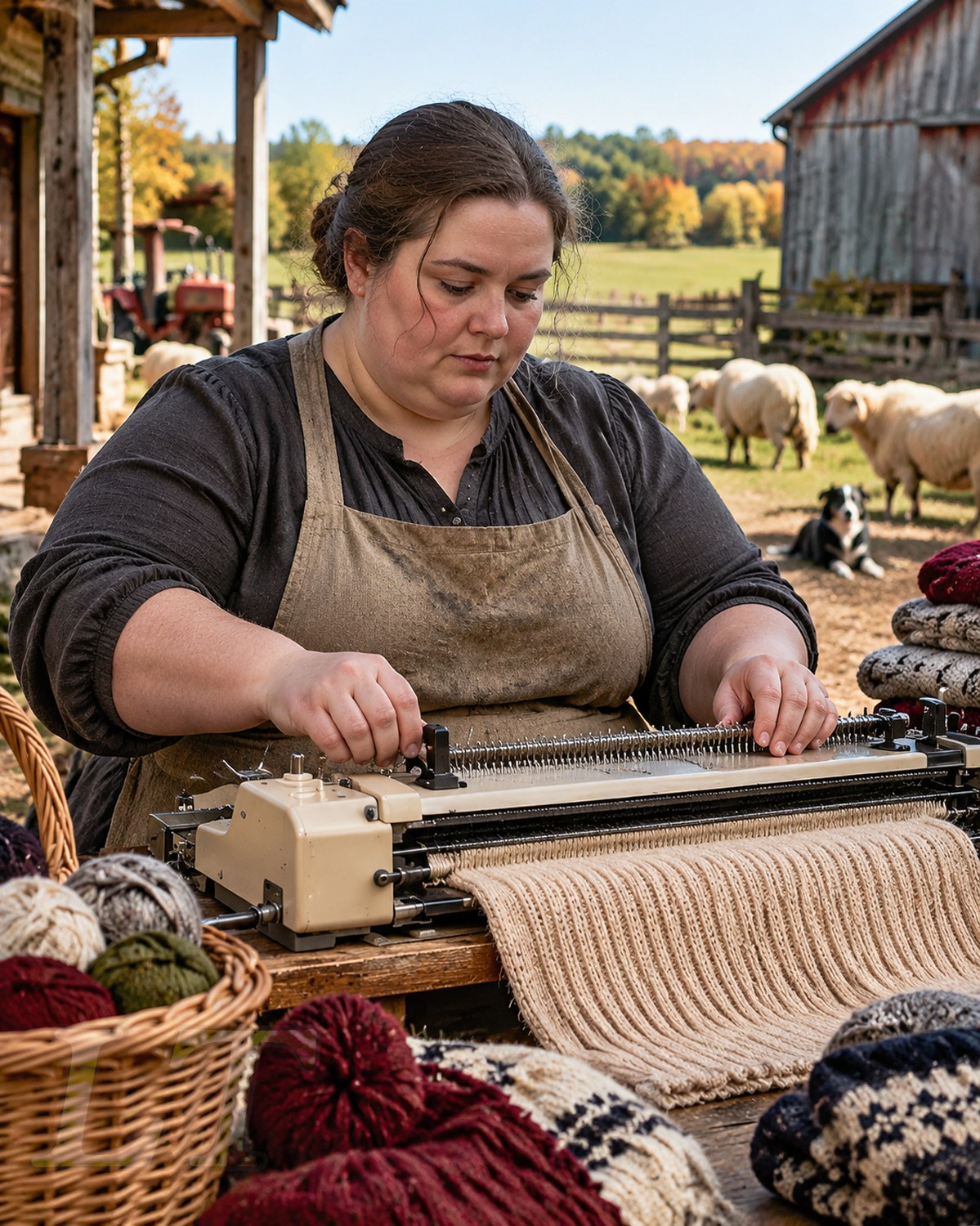
"Take your hands off that machine," Edwin Vale said. "It no longer belongs to you."
I stood beside the kitchen table, my fingers resting on the cold iron housing of the knitting machine I had purchased with twelve years of savings.
Outside, Tobias Reed stepped down from the farmhouse porch.
"Nobody's taking anything off my property until I know what gives them the right."
Vale smiled.
I remembered that smile.
It was the same one he had worn at the Germantown hosiery mill whenever a woman questioned a deduction from her wages.
He was older now. His dark hair had thinned around the temples, and his face had grown fuller. But his eyes were unchanged.
They still carried the quiet certainty of a man who believed that a document bearing his signature could turn a lie into the truth.
"Mr. Reed," he said, "I have no wish to cause a disturbance."
"Then you've made a poor start."
The taller man beside Vale unfolded a paper.
"My name is Charles Benton. I represent the legal interests of the manufacturing concern involved in this matter."
Tobias glanced at the document.
"Are you a sheriff?"
"No."
"A constable?"
"No, sir."
"Then you're standing in my yard telling me what you intend to take without being an officer of the law."
Benton's expression tightened.
"We are acting under legal instructions."
"That's not what I asked."
I almost smiled.
Tobias had a gift for making complicated men answer simple questions.
Vale stepped forward.
"Mr. Reed, perhaps Miss Clara should join us. She understands the seriousness of this matter."
I moved toward the doorway.
Margaret caught my wrist.
"Don't let him separate you from the others," she whispered.
I looked at her.
Her face was pale.
Samuel stood behind her, staring through the window as though he had seen something far worse than an old enemy.
"I won't," I said.
Then I stepped outside.
The cold struck my face immediately.
Vale turned toward me.
For a moment, he said nothing.
His gaze moved over my plain working dress, my apron, and the rough hands I had spent years trying to keep useful.
Then he looked toward the kitchen window.
"So," he said softly, "you finally bought yourself a machine."
"Yes."
"And brought it all the way to Vermont."
"Yes."
"How ambitious."
I folded my hands.
"What do you want, Mr. Vale?"
He gave a small laugh.
"Still impatient."
"Only with people who waste my time."
His smile disappeared.
Benton cleared his throat.
"Miss Clara, we have documentation indicating that the circular knitting machine currently in your possession may be subject to an unresolved ownership claim."
"Then show me the documentation."
He held out the paper.
I took it.
The heading referred to a legal complaint filed on behalf of a Boston manufacturing concern.
Below it were several paragraphs describing a disputed machine and requesting that it be preserved pending further examination.
I read every line.
Then I read the signature.
The paper had been prepared by an attorney.
But it was not signed by a judge.
There was no court seal.
No sheriff's endorsement.
No order directing the seizure of property.
I looked up.
"This is a notice of a complaint."
Benton hesitated.
"It is a formal legal document."
"That wasn't my question."
Vale's jaw tightened.
I continued.
"Where is the court order authorizing you to remove my machine?"
Benton glanced at Vale.
Then he said, "We had hoped to resolve this voluntarily."
Tobias gave a short, unpleasant laugh.
"Then you ought to have said so before announcing you were taking it."
Vale turned toward him.
"Mr. Reed, I suggest you consider the consequences of interfering with a legitimate investigation."
Tobias stepped closer.
"Mr. Vale, I suggest you remember whose land you're standing on."
For several seconds, the two men stared at each other.
I could see that Vale had not expected resistance.
At the mill, his authority had rarely been questioned.
Workers needed their wages.
Women feared dismissal.
Foremen feared losing their positions.
And the owners generally trusted the office records more than the people who operated the machines.
But this was not Germantown.
Tobias Reed did not depend on Edwin Vale for employment.
And I no longer worked under his supervision.
"Mr. Vale," I said, "I have a bill of sale."
His eyes returned to me.
"Do you?"
"Yes."
"Then perhaps you should have it examined by someone qualified to determine whether it is genuine."
"It bears the dealer's signature and identifies the machine by its manufacturer's serial number."
Vale's expression changed.
Only slightly.
But I noticed.
"Serial numbers can be altered," he said.
"So can inventory records."
The silence that followed was immediate.
Benton looked at Vale.
Tobias turned toward me.
And through the kitchen window, I saw Samuel Bell straighten.
Vale's eyes narrowed.
"What did you say?"
"I said inventory records can be altered."
He studied me carefully.
"That's a curious observation."
"Is it?"
"Especially coming from a woman who spent her career operating machinery rather than maintaining company accounts."
I felt the old anger stir.
For twelve years, men like Vale had treated a woman's knowledge as something that existed only when they found it convenient.
A woman could repair a machine.
She could operate it for twelve hours.
She could recognize defects that a supervisor failed to notice.
But if she questioned the records describing that machine, she was suddenly ignorant.
I kept my voice steady.
"I learned to read numbers before I learned to operate a knitting machine, Mr. Vale."
His mouth tightened.
"Then you should understand that ownership is established through records."
"Correct."
"And the records indicate that this equipment is disputed."
"Then I suggest we examine the original records."
Something moved across his face.
Not fear.
Not yet.
But irritation.
He had expected me to argue about fairness.
He had expected tears, perhaps.
Or an appeal to sympathy.
Instead, I was asking for documents.
"That can be arranged," he said.
"Good."
"But until the matter is resolved, you should cease using the machine."
"On whose authority?"
He stared at me.
I waited.
Finally, he said, "On the advice of counsel."
"Then I will consider that advice."
Benton shifted uncomfortably.
Vale looked as though he might say something unpleasant.
Before he could, the farmhouse door opened.
Margaret Ellis stepped onto the porch.
"Good morning, Edwin."
Vale turned.
For the first time since arriving, he seemed genuinely surprised.
"Margaret."
She descended the steps slowly.
Her face was composed.
But I knew her well enough to see the tension in her shoulders.
"I wondered how long it would take you to come looking," she said.
Vale recovered quickly.
"Miss Ellis. I wasn't aware you were in Vermont."
"Clearly."
His gaze moved toward the doorway.
Samuel appeared behind her.
Vale stopped smiling.
The three former employees stood facing one another in Tobias Reed's yard.
For a moment, the years seemed to disappear.
I could almost hear the old mill.
The clatter of machinery.
The bell marking the beginning of a shift.
The forewoman calling for finished stockings.
And Edwin Vale standing near the office door, deciding which worker would be punished for a shortage nobody could explain.
"Samuel Bell," Vale said quietly.
Samuel stepped forward.
"Edwin."
"I heard you were dead."
"So did I."
Vale's expression hardened.
"You always did enjoy making a spectacle of yourself."
Samuel did not answer.
Margaret folded her arms.
"That is enough."
Vale looked at her.
"You're in no position to instruct me."
"Neither are you."
Benton cleared his throat.
"Mr. Vale, perhaps we should confine ourselves to the purpose of our visit."
For the first time, I felt a measure of respect for the lawyer.
He seemed to understand that whatever old quarrel had followed us from Pennsylvania was not likely to be settled in a Vermont farmyard.
Vale adjusted his gloves.
"Very well."
He turned toward me.
"Miss Clara, I am prepared to offer a reasonable solution."
I said nothing.
"You surrender the machine voluntarily. My associates will arrange transportation. In return, we will consider withdrawing the complaint."
Tobias stepped forward.
"Consider?"
Vale ignored him.
"You will be spared the expense and embarrassment of legal proceedings."
I looked at the machine through the window.
It stood on the kitchen table beside baskets of wool.
I thought of Agnes Doyle.
Her five children.
Will's worn stockings.
Amos Whitcomb's damaged fleece.
Josiah Pratt's silent mill.
The twelve pairs Cobb had agreed to consider selling.
Every possibility we had begun to build depended on that machine.
I looked back at Vale.
"No."
He blinked.
"Excuse me?"
"No, Mr. Vale."
"You haven't heard the full proposal."
"I heard enough."
He lowered his voice.
"Clara, I advise you not to be foolish."
I remembered him saying those words to me when I was twenty.
I had asked why the mill deducted money from a worker whose machine had been defective before her shift began.
He had leaned across his desk.
"Don't be foolish, Clara."
The worker lost her wages.
I never forgot it.
Now I looked him directly in the eyes.
"I purchased my machine lawfully. I intend to keep it."
Vale's face reddened.
"You may find that intention difficult to maintain."
"Then I suppose we'll find out."
He took one step toward me.
Tobias moved between us.
"That's close enough."
Benton touched Vale's arm.
"Mr. Vale."
For several seconds, nobody moved.
Then Vale stepped back.
His expression became smooth again.
"Very well."
He turned toward Benton.
"We have delivered notice."
Benton nodded.
"Yes."
"Then our business here is concluded."
But before leaving, Vale looked at Samuel.
"You should have stayed out of this."
Samuel held his gaze.
"I tried staying out of things once."
Vale's mouth tightened.
"And how did that work for you?"
Samuel's damaged hand curled slowly.
Margaret stepped beside him.
"Leave, Edwin."
Vale looked at her.
Then he smiled.
"Goodbye, Margaret."
He climbed into the wagon.
Benton followed.
The driver gathered the reins.
As the wagon turned toward the road, Vale leaned out slightly.
"One last thing, Clara."
I looked at him.
"If you continue manufacturing stockings with disputed equipment, every pair you sell may become part of the claim."
Then the wagon rolled away.
I stood watching until it disappeared beyond the stone wall.
Only then did I realize how tightly I had been holding my hands.
My nails had pressed marks into my palms.
Tobias turned toward me.
"You all right?"
"Yes."
"That was a lie."
I looked at him.
He shrugged.
"Not a particularly convincing one."
I almost laughed.
Instead, I said, "I'm frightened."
He nodded.
"So am I."
The admission surprised me.
Tobias Reed rarely spoke about fear.
He spoke about hay.
Wool.
Fences.
Weather.
Prices.
Things a man could measure.
But fear was not something he usually allowed into conversation.
He looked toward the road.
"That man has money. Connections. Lawyers."
"Yes."
"And we have one machine and a barn full of wool."
"Yes."
He rubbed his jaw.
"Well."
I waited.
He looked at me.
"I suppose we'd better make that machine earn its keep before somebody finds a way to stop us."
For the first time that morning, I smiled.
Not because the danger had passed.
It had not.
But because Tobias had just made a decision.
He was no longer merely tolerating my plan.
He was standing beside it.
We returned to the kitchen.
Margaret closed the door.
Samuel sat heavily in a chair.
His face was gray.
I poured him water.
He accepted it with trembling hands.
"Samuel," I said, "what did Vale mean when he told you to stay out of this?"
Samuel stared into the cup.
"Exactly what he said."
"That's not an answer."
He looked up.
"I know."
Margaret stood beside the stove.
"Clara, we need to examine the machine."
I turned toward her.
"The bracket?"
She nodded.
"If Samuel hid something inside it, we need to know whether it's still there."
Tobias went to the cupboard and brought out his tools.
He placed them on the table.
"Then let's stop guessing."
Samuel rose slowly.
He examined the lower mounting bracket.
The newer screw stood out against the older iron.
He touched it.
"Someone has removed this."
"I know," I said.
"Recently."
"Yes."
He looked toward the window.
"Was the machine ever left unattended?"
I thought back.
The day Tobias took me to Cobb's store.
The afternoon we visited Amos Whitcomb.
The trip to Josiah Pratt's mill.
There had been several hours when nobody was inside the farmhouse.
"Yes," I said.
Samuel closed his eyes.
Margaret looked at him.
"Open it."
He hesitated.
Then he took the screwdriver.
The first screw came free.
Then the second.
The third resisted.
Samuel worked carefully, his damaged hand making the task difficult.
Tobias offered to help.
Samuel shook his head.
"I know where the pressure falls."
Finally, the fourth screw loosened.
He removed the bracket.
Beneath it was a narrow hollow in the iron base.
I leaned closer.
There was nothing inside.
No paper.
No metal cylinder.
No hidden packet.
Only dust.
Samuel stared at the empty space.
Margaret covered her mouth.
Tobias looked at me.
I felt the room tilt.
"Someone took it," I whispered.
Samuel nodded.
"Yes."
"What was it?"
He looked at the empty compartment.
"A small packet of documents."
"What documents?"
"Copies of transfer records. Payment entries. Machine numbers."
"Enough to prove Vale altered the books?"
"Possibly."
I gripped the table.
"Then someone has stolen the evidence."
Samuel did not answer.
I looked at the newer screw.
The scratched metal.
The empty hollow.
The threatening note.
The stranger who had asked about Pennsylvania.
Everything seemed to point toward the same conclusion.
Someone had entered Tobias Reed's farmhouse while we were away.
Someone had known exactly where to look.
And someone had removed the packet before Samuel arrived.
"Mercer," Tobias said.
I looked at him.
"You think he did it?"
"He knew about the machine. He knew when we were away. He lives close enough."
Margaret shook her head.
"We cannot accuse him without proof."
Tobias gave a bitter laugh.
"That didn't stop Vale."
"No," she said. "And we should not become like him."
I knew she was right.
But it was difficult to remain patient when the truth seemed to have been taken from beneath my hands.
Samuel replaced the bracket.
He did not tighten the screws immediately.
Instead, he examined the hollow again.
Then he frowned.
"What is it?" I asked.
He leaned closer.
"There are scratches inside."
"From the packet?"
"Perhaps."
He reached for the lamp.
The light revealed several thin marks along the inner wall.
Samuel touched them.
His expression changed.
"These weren't made by paper."
Tobias leaned over his shoulder.
"What made them?"
"Metal."
I looked at him.
"What kind of metal?"
Samuel did not answer immediately.
Then he said, "The packet was inside a small brass tube."
Margaret turned sharply.
"You never told me that."
"I didn't tell anyone."
"Why?"
"Because I thought the fewer people who knew, the safer it would be."
I felt anger rise.
"Samuel, that decision has not worked particularly well."
He looked ashamed.
"No."
I took a breath.
"Was the tube marked?"
He nodded.
"With my initials."
I remembered the notation in his notebook.
S.M.
"Then whoever removed it may still have it."
"Yes."
"Or may have passed it to Vale."
Samuel's face darkened.
"Yes."
I looked at Margaret.
She stood very still.
For a moment, I thought she was going to speak.
Instead, she turned toward the window.
I followed her gaze.
Outside, the sky had grown gray.
Snow was beginning to fall.
We had spent most of the day arguing with men who wanted to take my machine.
And we had discovered that the evidence which might have protected it was missing.
I felt exhausted.
But I could not afford to stop.
"Mr. Reed," I said, "we need to take the wool to Josiah."
He stared at me.
"Now?"
"Yes."
"Clara, you've just been threatened with legal action."
"I know."
"And someone has been inside this house."
"I know."
"And you want to go to the mill?"
I looked at him.
"If we stop working every time someone tries to frighten us, we will never finish a single pair of stockings."
He studied me.
Then he nodded.
"All right."
Margaret looked concerned.
"Clara—"
"I am not ignoring the danger. But the families on this hill still need work."
I picked up the basket of clean wool.
"And Tobias still needs to sell his fleece."
Samuel looked at me.
For a moment, I saw the old mechanic I remembered.
The man who had once told a frightened nineteen-year-old girl that she was capable of learning anything if she paid attention.
"You always were stubborn," he said.
"I learned from good teachers."
He smiled faintly.
We spent the afternoon at Josiah Pratt's mill.
Samuel examined the spinning frame.
He confirmed that the leather belt needed replacement and one spindle required repair.
Tobias offered to help.
Josiah found old parts stored beneath a workbench.
I watched the men argue over measurements.
For the first time in days, the argument was about something ordinary.
Something useful.
Something that could be fixed with tools and patience.
Margaret and I sorted wool while they worked.
She was quiet.
I knew she was thinking about Vale.
At last, I asked, "Are you afraid of him?"
She looked at me.
"Yes."
The answer surprised me.
Margaret had always seemed fearless.
At the mill, she had faced angry supervisors without raising her voice.
She had defended workers who could not defend themselves.
I had once believed nothing could frighten her.
"Why?" I asked.
She examined a handful of wool.
"Because I know what he is willing to do to protect himself."
I waited.
She continued.
"When Samuel was dismissed, I thought the truth would eventually come out."
"And it didn't."
"No."
"What happened to you?"
She looked away.
"I lost my position. Then I lost my room. Then I lost nearly every friend who was afraid of being associated with me."
I felt a painful tightness in my chest.
"Margaret."
She shook her head.
"Don't pity me. I survived."
"But you shouldn't have had to."
She looked at me.
"Neither should you."
We worked in silence.
Then she said something I would remember for years.
"Clara, people like Vale depend on honest people being too ashamed to defend themselves."
I looked at her.
"They make an accusation. Then they wait for you to become frightened enough to disappear."
I thought of the threatening note.
The legal complaint.
The missing evidence.
"And if you don't disappear?"
Margaret's expression hardened.
"Then they have to decide how far they're willing to go."
I looked toward the men repairing the spinning frame.
Samuel was explaining something to Tobias.
Josiah held a lantern.
The machinery stood silent, but for the first time in months, there was hope that it would run again.
I realized that our little enterprise was becoming more than a way to earn money.
It was becoming a reason for people to stand together.
That frightened me almost as much as Vale did.
Because if I failed, I would not fail alone.
By evening, the new belt was fitted.
Samuel adjusted the spindle.
Tobias helped turn the mechanism.
The spinning frame moved.
Slowly at first.
Then more steadily.
Josiah stared at it.
His eyes filled with tears.
He wiped them quickly.
"Well," he said, "I'll be damned."
Tobias laughed.
I smiled.
For a brief moment, I forgot the legal notice.
I forgot Vale.
I forgot the missing brass tube.
I watched the old machinery turn and felt something inside me settle.
We could still work.
We could still make stockings.
We could still build something worth defending.
Then Josiah stopped the frame.
"Come back tomorrow," he said. "We'll see what kind of yarn we can make."
I thanked him.
Tobias loaded the remaining wool into the wagon.
Samuel climbed beside him.
Margaret and I followed.
The road home was dark.
Snow drifted across the fields.
I wrapped my shawl tighter and watched the lantern swing from the wagon.
Nobody spoke much.
We were tired.
But it was the good kind of tired that comes after useful work.
When we reached the farmhouse, Tobias stopped the horse.
He frowned.
"What is it?" I asked.
He pointed toward the kitchen window.
A light was burning inside.
I stared.
We had extinguished the lamp before leaving.
Margaret gripped my arm.
"Clara."
Tobias climbed down.
"Stay here."
He took the lantern.
Samuel followed him.
I stepped from the wagon despite the warning.
The farmhouse door was closed.
No tracks were visible in the fresh snow except those leading from the road.
Tobias approached the porch.
He reached for the handle.
The door opened easily.
He looked back at us.
"Someone's inside."
My heart began to pound.
He pushed the door wider.
The kitchen was empty.
At least, it appeared empty.
The lamp stood on the table.
Beside it lay my knitting machine.
The lower bracket had been removed again.
Its screws were arranged in a neat row.
And on the table, where the machine's base had been opened, rested a small brass tube.
Samuel stepped forward.
His face went white.
"That's it."
I stared at the tube.
The initials S.M. were scratched into its surface.
The missing evidence had been returned.
But why?
I moved toward the table.
Tobias caught my arm.
"Wait."
I stopped.
He examined the room.
The stove was cold.
The windows were closed.
No one stood behind the door.
No one was hiding near the pantry.
Then Margaret noticed something.
A folded paper lay beneath the brass tube.
She pointed.
"Clara."
I leaned closer.
The paper bore my name.
I reached for it.
Tobias did not stop me this time.
I unfolded it.
There was only one sentence.
"If you want to know who really owns machine 2186, open the tube before midnight."
I looked at the clock.
It was nearly eleven.
Samuel stared at the brass cylinder.
Margaret whispered, "Don't."
I turned toward her.
"Why?"
She looked terrified.
"Because that isn't the tube Samuel hid."
I looked back at the table.
The initials were correct.
The size was correct.
The scratches looked old.
But Margaret was shaking.
Samuel stepped closer.
He examined the cylinder.
Then he slowly backed away.
"She's right."
Tobias looked between them.
"What are you talking about?"
Samuel's voice was barely audible.
"My tube had a screw cap."
I stared at the brass cylinder.
This one had no cap.
Only a narrow seam around its center.
I looked at the note again.
Open the tube before midnight.
Then I noticed something else.
A faint ticking sound.
It was coming from inside the brass cylinder.
Tobias reached for my arm.
"Clara, get away from the table."
But before I could move, the ticking stopped.
And something inside the tube clicked.






Comments 0