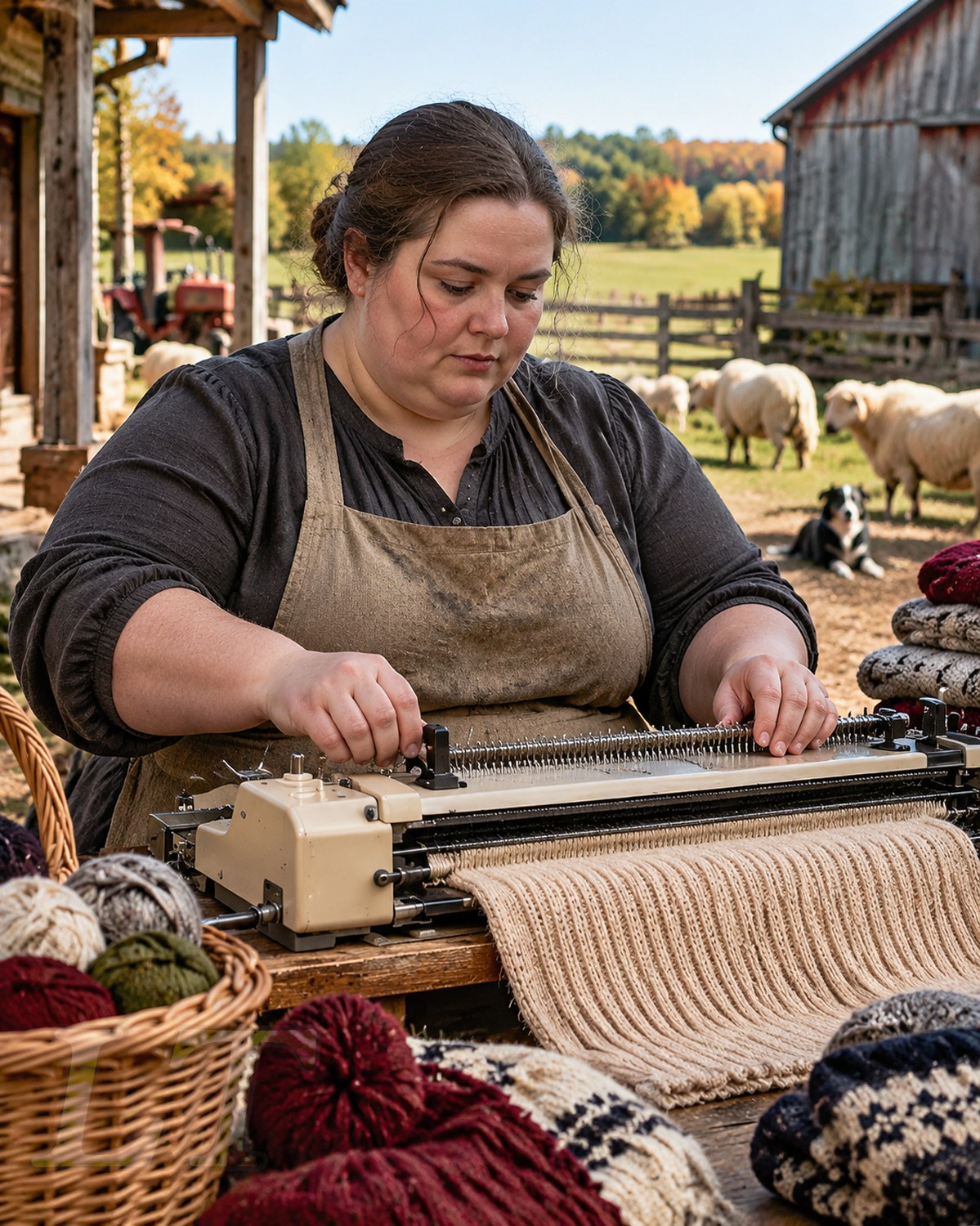
The first thing Tobias Reed said when he saw my knitting machine was that he had not hired a woman to bring more trouble into his house.
I remember standing beside the enormous wooden crate, my fingers stiff from the journey, while the November wind swept across the hills of northern Vermont.
I had traveled hundreds of miles with everything I owned packed into two trunks and one heavy crate of iron.
Tobias stood in the doorway of his farmhouse, looking at me as though I had arrived carrying a dead animal.
"What's in there?" he asked.
"A knitting machine, Mr. Reed."
He stared at me.
"A what?"
"A machine for making stockings."
He glanced toward the barn, then back at the crate.
"I wrote to the church asking for a hired woman. Someone who could cook, mend clothes, help with the sheep, and earn her keep. I didn't ask for a factory."
I could have been offended.
Perhaps another woman would have turned around and climbed straight back into the wagon.
But I had not spent twelve years working in a Pennsylvania hosiery mill, saving every spare penny, only to surrender at the first unkind sentence.
I lifted my chin.
"Your letter said you needed someone who could earn her keep."
"It said someone with two hands."
I looked past him toward the barn.
Through the open loft doors, I could see sacks of wool stacked nearly to the beams.
"Mr. Reed," I said quietly, "before this winter is over, there won't be a house on this hill that doesn't send for me."
He almost laughed.
I didn't.
My name is Clara, and I had come to Reed Hill with a machine, a plan, and ninety dollars' worth of hope.
I just didn't know how much that hope would cost me.
The Reed farm sat on a lonely ridge, surrounded by stone walls, bare maples, and fields that had been worked by the same families for generations.
Tobias was a broad-shouldered man of thirty-eight, permanently tired and inclined to believe that every unexpected event would eventually cost him money.
His wife had died several years earlier.
He rarely spoke about her.
But the house carried the evidence of her absence.
A cracked flowerpot stood on the kitchen windowsill.
A faded ribbon remained tied around the handle of a cupboard.
In the sitting room, a woman's sewing basket rested beneath a chair, untouched.
The farmhouse was not neglected exactly.
Tobias kept the roof sound and the stove working.
The floors were swept.
The animals were fed.
But there was a difference between a house being maintained and a house being lived in.
I had known that difference since childhood.
His sheep were his livelihood.
That year's harvest had been poor.
The summer drought had ruined much of his hay, and his wool remained unsold because the dealer in Barton offered only eleven cents a pound.
Tobias wanted thirteen.
Neither man would compromise.
And winter was coming.
I learned all this before I had unpacked my second trunk.
Tobias was not a man who enjoyed conversation, but he had a habit of explaining his troubles while pretending he was merely stating facts.
"The dealer thinks I ought to be grateful for eleven cents."
"Is that the best offer you've had?"
"It's the only honest offer I've had."
"How much wool is in the loft?"
"More than I can sell at a decent price."
"How many sheep?"
He looked at me.
"Why?"
"Because I asked."
He frowned.
"Forty-six, counting the young ones."
I nodded.
It was almost exactly the number I had expected.
His letter to the church had mentioned the flock.
That detail had persuaded me to come.
Eleven churches had received letters from me during the previous spring and summer.
Most had replied politely that no suitable employment was available.
Some had not replied at all.
Tobias's letter was the only one that mentioned sheep.
Not just a farm.
Not just housework.
Sheep.
To a woman who had spent twelve years watching raw wool become finished stockings, that distinction mattered.
I had seen what factories charged for finished goods.
I had seen what middlemen paid for raw materials.
And I had watched the distance between those two prices grow wider while workers' wages remained stubbornly small.
I did not believe I could change the entire textile trade.
But I believed I could change one small corner of it.
If I found the right place.
If I found the right people.
If my machine worked.
Those were three very large uncertainties to build a future upon.
That first evening, Tobias helped me drag the crate into the kitchen.
He complained about the weight.
He complained about the space it occupied.
He complained when I asked for a strong table.
But he did help.
That was something I noticed about him.
His words were often less generous than his actions.
We set the machine near the window, where daylight would be strongest.
I unpacked the iron cylinder, the crank, the yarn guides, and the carefully wrapped needles.
Tobias watched from beside the stove.
"That thing will take up half the room."
"Only until I find a better place."
"You'll find a better place when?"
"When it starts earning money."
He shook his head.
"You're very sure of yourself."
"No, Mr. Reed. I'm very sure I can't afford to be wrong."
He looked at me for a moment.
Then he went outside.
I spent the evening cleaning the machine.
The cylinder had collected dust during the journey.
One screw had loosened.
The crank needed oil.
I checked each needle by lamplight, running my fingertips along the metal until I was satisfied nothing had bent.
Every movement brought back memories of Pennsylvania.
The hosiery mill near Germantown had been noisy enough to make a person forget what silence sounded like.
I had entered its finishing room at fourteen.
My first task was closing stocking toes by hand.
The older women worked quickly.
Their fingers seemed to know what to do without instruction.
Mine did not.
I pricked myself so often that my fingertips remained sore for weeks.
The forewoman told me I would never last.
I lasted twelve years.
By nineteen, I was operating machines.
I learned to hear problems before they became visible.
A skipped stitch.
An uneven tension.
A damaged needle.
A poorly spun strand of yarn.
I learned which men understood the equipment and which merely understood how to shout at the women using it.
And I learned that the people who made the stockings were rarely the people who profited most from selling them.
For years, I saved whatever I could.
A few coins each week.
Sometimes nothing.
Sometimes enough to make me feel that my plan was finally becoming possible.
I slept in a laundress's back room.
I repaired my own clothes.
I declined invitations that would cost money.
I ate bread and soup when other workers bought meat.
Not because I believed poverty was noble.
There was nothing noble about going hungry.
I did it because I wanted to own the means of my own work.
When I finally counted ninety dollars, I felt richer than any mill owner.
The machine had cost every cent.
I knew the risk.
If it broke, I could not replace it.
If nobody bought my stockings, I would have no savings left.
If Tobias sent me away, I would have to find another place willing to accept both a hired woman and a heavy piece of machinery.
But I had made my choice.
And I had never been one to abandon a decision merely because it frightened me.
The next morning, I rose before daylight.
I found the barn by the light of a lantern.
The sheep were restless.
Their breath clouded the cold air.
I watered them, cleaned the pens, and checked the wool sacks stacked in the loft.
Some were tied properly.
Others had been left where moisture might reach them.
I made a note to speak to Tobias about that.
By the time he came in from milking, I had finished the chores and returned to the kitchen.
The machine was clamped to the table.
I had threaded a length of wool yarn through the guide.
Tobias entered carrying a pail.
He stopped.
"What's that noise?"
I turned the crank.
Click.
Click.
Click.
A narrow tube of knitted wool began to emerge beneath the cylinder.
He set down the pail.
"How did you do that?"
"Practice."
He came closer.
I continued turning.
The needles moved in a steady circle, catching and releasing the yarn.
Each loop joined the next.
The fabric lengthened.
Tobias leaned over the table.
"That's a stocking?"
"It will be."
"How long does it take?"
"That depends on the yarn, the size, and whether the machine behaves itself."
He watched another inch emerge.
"Seems faster than knitting by hand."
"It is."
"Then why doesn't everybody own one?"
"Because ninety dollars is more money than most people can risk."
He straightened.
"You paid ninety dollars for that?"
"Yes."
He looked at me as though I had confessed to purchasing a horse with three legs.
"Good Lord."
I smiled faintly.
"That was nearly my reaction when I handed over the money."
He did not smile back.
But he remained beside the table until I finished the stocking tube.
Then he asked how the heel would be shaped.
I showed him.
He asked how the toe would be closed.
I explained.
He asked whether the machine could use wool from his own sheep.
That was the question I had been waiting for.
"Yes," I said. "If the wool is prepared properly."
He glanced toward the barn.
"Properly costs money."
"Everything costs money, Mr. Reed. The question is whether it earns more than it costs."
He considered that.
Then he pulled out a chair.
"Tell me what you're thinking."
I did.
I told him about the difference between raw wool prices and finished stocking prices.
I told him how a good fleece could become yarn.
I told him about carding, spinning, knitting, and finishing.
I explained that one machine could produce more work than I could finish alone.
And I told him that the women on the hill might be willing to help if they were paid fairly.
He listened without interrupting.
When I finished, he rubbed his chin.
"Sounds like a great many things have to go right."
"They do."
"And if one goes wrong?"
"Then we find out why and correct it."
He looked toward the window.
"You make it sound simple."
"It isn't."
"Then why do you think you can do it?"
I rested my hand on the iron cylinder.
"Because I've spent twelve years learning what happens when people don't."
That answer seemed to trouble him.
He rose from the table.
"I've got fencing to repair."
"Of course."
At the doorway, he stopped.
"Clara?"
"Yes?"
"Don't use the good kitchen table for anything that'll damage it."
I glanced at the heavy iron clamp.
"Too late for that, I'm afraid."
He looked at the table.
Then at me.
For the first time, I saw the beginning of a smile.
It disappeared almost immediately.
But I had seen it.
That afternoon, I made my first complete pair of stockings in the Reed kitchen.
They were not beautiful.
The yarn was uneven.
One heel sat slightly higher than the other.
But they were strong.
I placed them beside the machine and waited for Tobias to return.
He examined them after supper.
"Who would buy these?"
"Someone with cold feet."
"That's most of Vermont."
"Then perhaps we have a market."
He gave a short laugh.
It was the first time I had heard him laugh.
I went to bed that night feeling something I had not felt in years.
Not certainty.
Not safety.
Possibility.
The next morning, Tobias announced that he needed to visit Cobb's general store.
I asked to accompany him.
He frowned.
"What for?"
"To see what people are buying."
"They buy flour, nails, lamp oil, and whatever else they can afford."
"Exactly."
He shook his head.
But when he harnessed the horse, he made room for me on the wagon seat.
I brought a notebook.
I also brought the pair of stockings I had made.
I did not yet know that a widow named Agnes Doyle would change the direction of my entire plan.
Or that a nearly abandoned carding mill would become essential to everything we attempted.
I only knew that the hill had wool, and people had cold feet.
Surely there was a way to bring those two facts together.
We reached Cobb's store shortly before noon.
Tobias went to speak with the proprietor.
I remained near the shelves of dry goods.
A woman entered with a young boy.
Her coat had been carefully mended.
The boy's boots were too large.
She picked up a pair of stockings and examined the price.
Thirty-five cents.
Her face changed.
She set them down.
Then she reached into her basket and counted the eggs she had brought to trade.
The proprietor glanced at them.
"That'll cover the flour, Mrs. Doyle."
She nodded.
The boy looked at the stockings.
"Ma, my feet get wet."
"I know, Will."
"Could we—"
"Not today."
Her voice was gentle.
That made it worse.
I watched her put the stockings back on the shelf.
Then I looked at the pair in my own basket.
Before I could speak, the store door opened again.
A man entered wearing a dark coat and carrying a ledger.
He spoke quietly to Mr. Cobb.
I heard only part of the conversation.
But one sentence made me turn.
"There's a new woman up at Reed's place with a knitting machine."
Mr. Cobb looked toward me.
The stranger followed his gaze.
Then he asked a question that made my blood run cold.
"Did she bring it from Pennsylvania?"






Comments 0