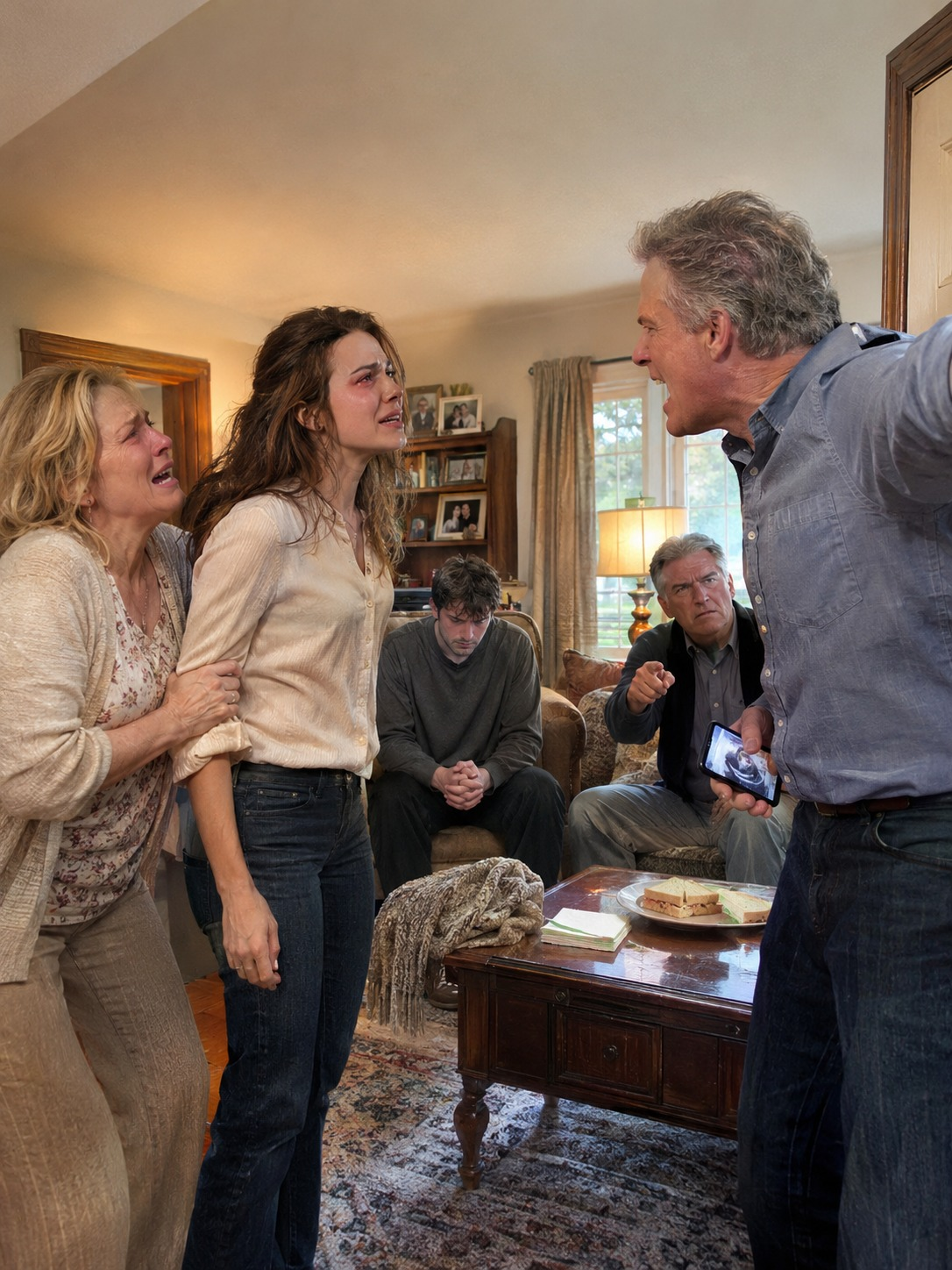
"Claire! I know you're in there. Open the door!"
My father's voice echoed through the narrow hallway outside my apartment.
I stood in my kitchen, holding my phone so tightly that my fingers hurt.
Thomas Whitaker was still on the line.
"Claire?" he asked. "What's happening?"
"My father's here."
There was a brief silence.
"At your apartment?"
"Yes."
"Did you invite him?"
"No."
Another knock rattled the door.
"Claire, don't make me stand out here all night!"
I looked toward the entrance.
My father lived four hours away.
He had driven all that distance after discovering I'd contacted my grandfather's attorney.
And now he was standing outside my apartment, demanding to be let in.
"Don't open the door if you don't feel safe," Mr. Whitaker said.
I swallowed.
"I don't think he'd hurt me."
Even as I said it, I remembered how he'd blocked the doorway at my parents' house.
How he'd threatened to disown me.
How he'd sent a photograph of a document bearing a signature I hadn't written.
I wasn't sure what he might do anymore.
"Claire," Mr. Whitaker said gently, "you don't have to prove anything to him tonight."
My eyes filled.
It was strange how often people outside my family had to remind me that I was allowed to make my own decisions.
"I'll come to your office tomorrow," I whispered.
"Good. I'll have the records ready."
"Thank you."
"And Claire?"
"Yes?"
"Please keep the documents your brother sent you somewhere safe."
I looked at my laptop.
"I will."
The call ended.
Dad knocked again.
This time, I heard him try the door handle.
It didn't move.
I was grateful I'd locked it.
"Claire!"
I walked slowly into the hallway.
There was a peephole in the door.
I looked through it.
My father stood beneath the fluorescent ceiling light, wearing the same blue shirt he'd worn during our confrontation.
His gray hair was disheveled.
His face looked tired.
But his eyes were sharp.
He was holding a manila envelope.
I didn't recognize it.
"Dad," I said through the door.
He stepped closer.
"Finally."
"What are you doing here?"
"We need to talk."
"You could have called."
"I did call. You stopped answering."
"Because you kept threatening me."
He sighed.
"Are we really going to do this through a door?"
"Yes."
His expression changed.
For a moment, he looked genuinely surprised.
I don't think I'd ever refused to open a door for him before.
"Claire, I'm your father."
"I know."
"Then let me in."
"No."
The word came out quietly.
But it felt enormous.
Dad stared at the door.
Then he laughed bitterly.
"So this is what it's come to."
I leaned against the wall beside the entrance.
"What do you want?"
He lifted the envelope.
"I brought paperwork. The things you've been asking about."
My heart began pounding.
"What paperwork?"
"The medical arrangements. The financial documents. Everything."
"Then leave them outside."
He frowned.
"What?"
"Slide them under the door, or leave them on the floor."
"Don't be ridiculous."
"Dad, I'm not opening the door tonight."
His face tightened.
"You're treating me like a criminal."
I closed my eyes.
I wanted to tell him that criminals weren't the only people capable of betraying someone.
But I didn't.
Instead, I asked the question that had been haunting me all day.
"Why did you tell Mr. Whitaker to destroy Grandpa's letter?"
Dad went completely still.
Through the peephole, I watched the color drain from his face.
Then he looked away.
"That man had no business involving you."
"It's a letter addressed to me."
"You don't know what you're talking about."
"Then explain it."
He rubbed his forehead.
"Your grandfather was confused near the end."
I felt something harden inside me.
Grandpa had been many things.
Stubborn.
Proud.
Occasionally forgetful about where he'd left his reading glasses.
But he'd been clear-minded when he died.
He still balanced his checkbook every Sunday.
He still corrected my grammar in birthday cards.
And he still remembered the names of every neighbor who'd lived on his street for the previous thirty years.
"Don't talk about Grandpa like that," I said.
Dad's expression sharpened.
"Excuse me?"
"He wasn't confused."
"You weren't there for everything."
"Neither were you."
The words escaped before I could stop them.
Dad took a step toward the door.
"Watch your tone."
I almost apologized.
The reflex rose so quickly that I could feel the word forming in my mouth.
Then I remembered the forged signature.
The bank statement.
The mortgage documents.
I swallowed the apology.
"Why is my name on a guaranty agreement?"
Dad's face changed again.
This time, he looked angry.
"Micah's been going through my private papers."
"He found a document with my name on it."
"That doesn't give him the right to steal from me."
"Did you sign my name?"
He stared at the door.
"Claire, you have no idea what I was dealing with."
"Then tell me."
He lowered his voice.
"Your grandfather left behind a complicated financial situation."
I frowned.
"Grandpa didn't have financial problems."
"You think you know everything because he gave you a few nice birthday cards?"
The cruelty of the remark caught me off guard.
I stepped away from the door.
Dad continued.
"I spent years keeping this family afloat. Years. While you were living your comfortable little life, I was making decisions nobody else had the courage to make."
I looked around my apartment.
The secondhand sofa.
The chipped kitchen table.
The bookshelf I'd assembled myself.
Comfortable little life.
I'd worked overtime to afford this place.
I'd sent money home almost every month.
I'd postponed buying a car because my family needed help.
And somehow, my father still believed I owed him more.
"Did you use Grandpa's money to pay the mortgage?" I asked.
He didn't answer.
"Dad?"
"You don't understand how finances work."
"I work with financial documents every day."
"That doesn't make you an expert."
"No. But I know what a guaranty agreement is."
He exhaled sharply.
"Your name was included as part of a temporary arrangement."
"Without my permission?"
"It was necessary."
I closed my eyes.
There was that word again.
Necessary.
Apparently, in my father's world, necessity meant he could decide what belonged to him.
My time.
My money.
My future.
And now my signature.
"Was my inheritance used for Micah's medical bills?" I asked.
He hesitated.
"Some of it."
My stomach dropped.
"Some?"
"We had other obligations."
"How much went toward his treatment?"
"Claire, don't start counting pennies."
"Thirty-eight thousand five hundred dollars isn't pennies."
His face reddened.
"That money helped keep a roof over your brother's head."
I stared at the door.
"So you used it for the house."
"I used it for the family."
"Without telling me."
"You agreed to help."
"I agreed to help with medical expenses."
He slammed his palm against the door.
I jumped.
"Everything was a medical expense back then! Keeping the lights on mattered. Keeping the house mattered. Your brother needed stability!"
I pressed my hand against my chest.
For a moment, I couldn't breathe.
Then I heard another door open in the hallway.
My neighbor, Mrs. Alvarez, stepped outside.
She was a retired school librarian in her seventies who lived across from me.
I heard her voice.
"Is everything all right out here?"
Dad turned.
"This is a private family matter."
Mrs. Alvarez didn't move.
"You're making quite a lot of noise for a private matter."
I almost smiled despite everything.
Dad straightened his shoulders.
"I'm trying to speak with my daughter."
"Then perhaps you should call her tomorrow."
He stared at her.
Mrs. Alvarez folded her arms.
"I think she heard you."
For several seconds, nobody spoke.
Then Dad looked back toward my door.
"This isn't over, Claire."
I closed my eyes.
"I know."
He placed the envelope on the floor.
"Here. Since you're so determined to believe strangers instead of your own father."
I heard his footsteps retreat.
Then the elevator doors opened.
And closed.
I waited.
Mrs. Alvarez knocked gently.
"Claire, honey?"
I approached the door.
"It's me."
I opened it a few inches.
She stood outside in a blue robe and slippers.
Her expression softened when she saw my face.
"Oh, sweetheart."
I hadn't realized I was crying.
"I'm sorry about the noise."
She shook her head.
"Don't apologize for someone else's behavior."
I looked down.
The manila envelope lay beside my doormat.
Mrs. Alvarez followed my gaze.
"Do you want me to stay while you look at that?"
I hesitated.
Then nodded.
"Would you mind?"
"Not at all."
She came inside.
I made tea neither of us really wanted.
Then we sat at my kitchen table.
The envelope was thick.
My name was written across the front in Dad's familiar block letters.
I opened it carefully.
Inside were several photocopied documents.
A page describing living kidney donation.
A hospital brochure.
A printed appointment calendar.
And a financial worksheet.
I spread them across the table.
Mrs. Alvarez watched quietly.
"Is this about your brother?" she asked.
"Yes."
"How is he?"
"Still sick."
"I'm sorry."
I nodded.
Then I examined the appointment calendar.
There was a date circled in red.
Three weeks away.
The same date Dad had shown me on his phone.
But the heading didn't say Surgery.
It said Consultation Request.
I stared at it.
A consultation.
Not an operation.
There was no surgeon's name.
No operating room.
No transplant center confirmation.
Just a date someone had circled.
I turned to the financial worksheet.
Several amounts were listed.
Travel expenses.
Temporary lodging.
Estimated household costs.
Then one line caught my attention.
Anticipated family contribution.
Beside it was an amount.
$25,000.
I felt my stomach tighten.
Mrs. Alvarez leaned forward.
"Are you all right?"
I pointed to the number.
"My father told me they'd already paid a deposit for surgery."
She frowned.
"Is that what this says?"
"No."
I looked through the remaining pages.
There was no receipt.
No proof of payment.
No signed hospital agreement.
Nothing showing that a surgeon had accepted a deposit.
Only estimates and handwritten notes.
Dad had brought me an envelope full of paper.
But none of it proved what he'd claimed.
I picked up the hospital brochure.
A paragraph near the bottom explained that potential living donors must undergo independent evaluation.
I read it twice.
Then I started laughing.
It wasn't a happy laugh.
It was the exhausted sound of someone discovering that the truth had been sitting in plain sight.
Mrs. Alvarez touched my hand.
"What is it?"
"My father brought me paperwork to prove he was right."
I held up the brochure.
"And it says exactly what I've been telling him."
She squeezed my hand gently.
"Then perhaps you should believe yourself."
I looked at her.
I wanted to.
I desperately wanted to.
After she left, I photographed every page.
Then I placed the originals back in the envelope and locked them in my desk drawer.
I also forwarded the photographs Micah had sent to a private email account and saved copies in secure storage.
For the first time, I began keeping a written timeline.
The family meeting.
The forged authorization.
Melissa's call.
The conversation with Micah.
The bank statement.
The guaranty agreement.
Dad's visit.
I wrote down exact dates and times wherever I could.
It felt strange documenting my own family.
But it felt worse knowing that my father had already been telling relatives a version of events that wasn't true.
The next morning, I woke to a message from Mom.
Your father came home very upset.
I stared at it.
Then another arrived.
He says you're accusing him of terrible things.
I typed slowly.
I asked him to explain documents with my name on them.
Mom replied:
He was only trying to protect this family.
I looked at the message.
For years, I'd believed that protecting the family meant protecting everyone.
Now I was beginning to understand that, in our house, it often meant protecting Dad from consequences.
I didn't respond.
Instead, I got dressed for my appointment with Thomas Whitaker.
I wore dark jeans, a white blouse, and the navy blazer I usually reserved for important meetings.
I wanted to feel prepared.
I wanted to look like someone who could handle difficult information.
But when I looked in the mirror, I still saw the frightened girl who had once given up her scholarship because her father said he needed her.
I took Grandpa's old letter from the drawer.
The one he'd written when I graduated.
I folded it and slipped it into my purse.
Then I left.
Whitaker's office was in a quiet downtown neighborhood.
The building looked almost exactly as I remembered.
Red brick.
White trim.
A small brass sign beside the entrance.
Inside, the receptionist greeted me and led me into a conference room.
Mr. Whitaker entered carrying a thick folder.
He looked older than I remembered.
His hair was almost completely white.
But his eyes were kind.
"Claire."
He shook my hand.
"Thank you for coming."
"Thank you for seeing me."
We sat across from each other.
He placed the folder on the table.
For a moment, neither of us spoke.
Then he said, "Before we begin, I want you to understand something."
I nodded.
"Your grandfather loved both you and Micah."
My throat tightened.
"I know."
"He understood that your brother had medical problems. He also understood that you had a habit of putting everyone else's needs ahead of your own."
I looked down.
Mr. Whitaker continued.
"He worried about that."
I swallowed.
"Grandpa never said anything."
"He did, actually. Just not always directly."
He opened the folder.
Inside were copies of estate documents.
A will.
Financial statements.
Correspondence.
And a sealed envelope.
My name was written across it.
Claire Bennett.
The handwriting was Grandpa's.
I stared at it.
Mr. Whitaker rested one hand on the folder.
"Your grandfather gave me specific instructions concerning this letter."
"What instructions?"
"That it was to remain sealed unless you personally requested a review of the inheritance arrangements or there was reason to believe you had been misled about them."
I felt tears gathering.
"He expected something like this?"
Mr. Whitaker sighed.
"He was concerned about your father's financial judgment."
I looked at the envelope.
"Did Dad know?"
"He knew your grandfather had concerns. He did not receive a copy of this letter."
I remembered Dad's visit.
His anger.
His demand that Whitaker destroy the envelope.
"Why did my father want it destroyed?"
Mr. Whitaker looked at me carefully.
"I can't tell you what your father was thinking. But I can show you what your grandfather wrote."
He slid the envelope toward me.
My hands trembled as I picked it up.
The paper was slightly yellowed.
The flap was sealed.
For several seconds, I couldn't bring myself to open it.
Then I remembered Grandpa's voice.
Don't spend your whole life trying to earn a place at a table where you already belong.
I carefully broke the seal.
Inside were two folded sheets of paper.
And a smaller envelope.
I unfolded the first sheet.
The letter began:
My dear Claire,
If you're reading this, something has happened that I hoped I could prevent.
My vision blurred.
I blinked away tears and continued.
You have always been generous with your brother, and I know you would do almost anything to help him. But I am afraid your father has come to see your kindness as something he can spend.
I stopped.
My chest ached.
Mr. Whitaker waited.
I read the next paragraph.
I have made arrangements to ensure that the money I leave you cannot be taken without your knowledge. I have also asked Thomas to preserve certain records concerning the family property.
I looked up.
"Family property?"
Mr. Whitaker nodded slowly.
"Keep reading."
I returned to the letter.
There is something about the house that your father may never have told you. It concerns a decision he made years ago, and it may explain why he has been so determined to control the family's finances.
My hands began shaking.
I unfolded the second sheet.
There was a date at the top.
Seven years earlier.
Beneath it, Grandpa had written:
If Richard tells you that you owe him everything, ask him what happened to the money he borrowed against the house.
I stared at the sentence.
Borrowed against the house.
The mortgage documents Micah had found.
The default notice.
The guaranty agreement bearing my forged signature.
Everything suddenly seemed connected.
I looked at Mr. Whitaker.
"What money?"
He opened another section of the folder.
"Your grandfather discovered that your father had taken out a substantial loan."
"How substantial?"
Mr. Whitaker hesitated.
"More than your inheritance."
My mouth went dry.
"How much more?"
He slid a document across the table.
It was an old loan statement.
The original amount was listed near the top.
$142,000.
I stared at the number.
My father had borrowed more than a hundred thousand dollars.
And somehow, years later, my name had appeared on a guaranty agreement connected to the house.
"What was the loan for?" I whispered.
Mr. Whitaker folded his hands.
"That's where the situation becomes complicated."
I looked at him.
"Please just tell me."
He nodded.
"Your father represented that the funds were needed for family expenses. But your grandfather questioned some of the transactions."
"What transactions?"
Mr. Whitaker reached for the smaller envelope.
"This contains copies of records your grandfather collected before his death."
He placed it in front of me.
I opened it.
Inside were three pages.
The first was a bank transfer confirmation.
The second was a handwritten note.
The third was a photograph of a check.
I looked at the check first.
It was dated several months before Grandpa died.
The amount was $60,000.
The payee was a company I'd never heard of.
I frowned.
"What's this business?"
Mr. Whitaker's expression became serious.
"That's one of the questions your grandfather wanted answered."
I looked at the company name again.
It meant nothing to me.
Then I noticed the signature on the check.
Richard Bennett.
My father.
Below it was a handwritten notation.
Investment repayment.
I looked up.
"Investment?"
Mr. Whitaker nodded.
"Your grandfather believed your father had become involved in a financial arrangement that was putting the family home at risk."
I stared at him.
"Did Grandpa confront him?"
"Yes."
"What happened?"
Mr. Whitaker hesitated.
"They had a serious disagreement."
I thought about the months before Grandpa died.
Dad had stopped visiting him as often.
He told us Grandpa was becoming difficult.
He said the old man was suspicious and stubborn.
I'd believed him.
Now I wondered whether Grandpa had simply started asking questions Dad didn't want to answer.
I looked at the handwritten note.
It contained several dates and amounts.
Then one name appeared near the bottom.
Dale Bennett.
Uncle Dale.
My stomach tightened.
"Why is Uncle Dale's name here?"
Mr. Whitaker leaned forward.
"Claire, I need you to look at the next page."
I turned it over.
There was a photocopy of an agreement.
Two signatures appeared at the bottom.
My father.
And Uncle Dale.
I stared at them.
"What did they do?"
Before Mr. Whitaker could answer, his office phone rang.
He glanced toward the desk.
The receptionist's voice came through the intercom.
"Mr. Whitaker, I'm sorry to interrupt."
He pressed the button.
"Yes?"
"There's someone here asking to see Ms. Bennett."
My heart stopped.
Mr. Whitaker looked at me.
"Who is it?"
The receptionist hesitated.
Then she said, "He says he's her brother."
I stood.
"Micah?"
Mr. Whitaker frowned.
"Is he expected?"
I shook my head.
"No."
The receptionist spoke again.
"Mr. Whitaker, he looks very unwell. He says it's urgent."
I grabbed my purse.
"Please let him in."
There was a pause.
Then the receptionist said something that made my stomach drop.
"He's not alone."
Mr. Whitaker straightened.
"Who is with him?"
The receptionist lowered her voice.
"There's an older man. He says he's Micah's uncle."
I froze.
Uncle Dale.
The same man whose signature was on the agreement in front of me.
The same man who had publicly called me selfish.
The same man who had helped my father pressure me into giving up a kidney.
Mr. Whitaker slowly closed the folder.
"Claire, stay here."
But before he could stand, the conference room door handle turned.
The door opened.
And Uncle Dale stepped inside, holding a folded document.
He looked directly at me.
Then he said, "Claire, there's something your grandfather never told you."
He placed the document on the table.
At the top was my name.
And beneath it were two words that made my heart stop.
BENEFICIARY CHANGE.






Comments 0