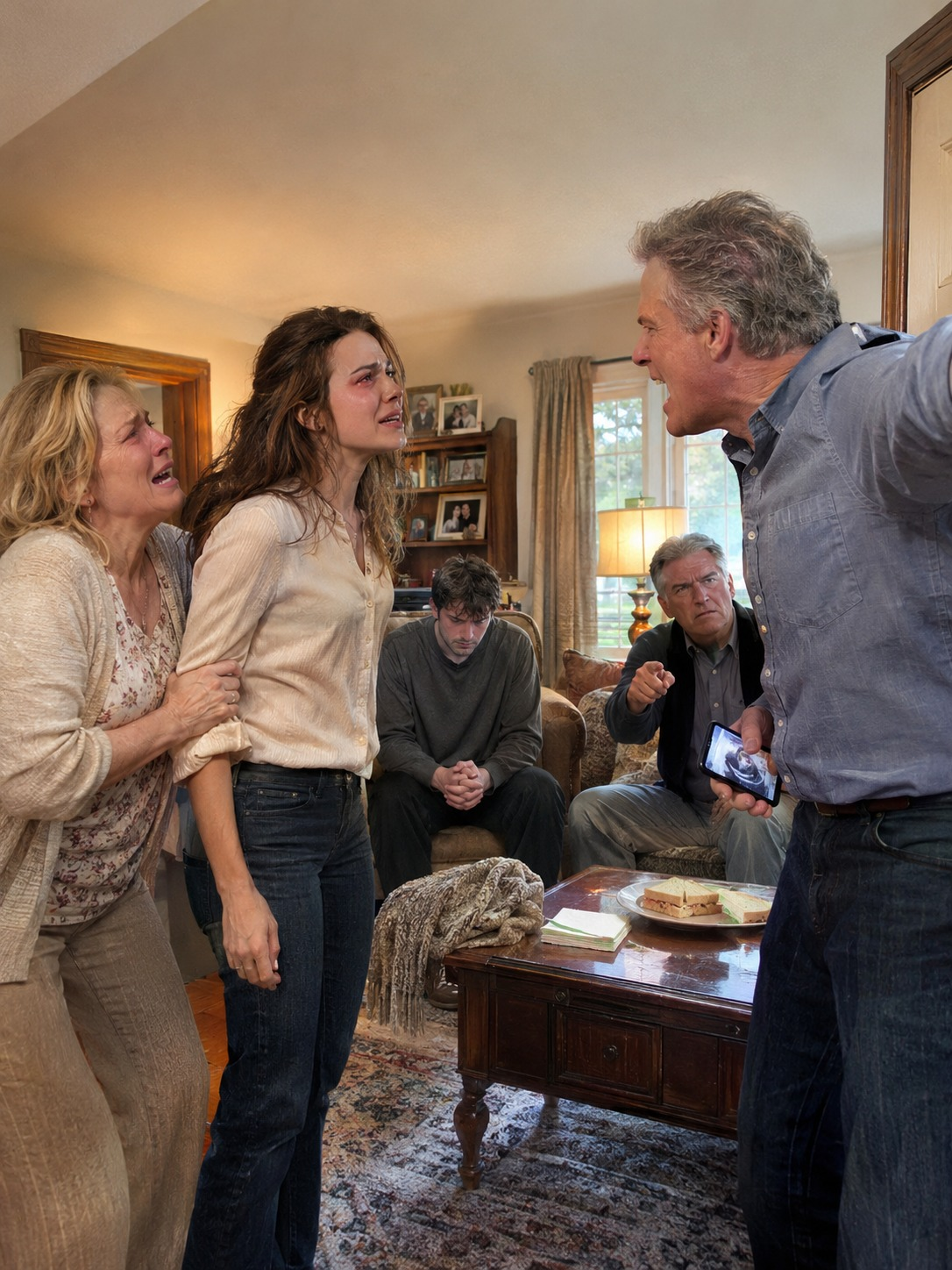
Someone screamed my name.
"Claire!"
The voice came through the recording, sharp and frightened.
Then I heard a crash.
My grandfather shouted something.
A door slammed.
And the recording stopped.
I sat motionless on my sofa, staring at the phone in my hand.
Micah was beside me. Jenna stood near the kitchen counter, her face pale.
For several seconds, nobody spoke.
Then I heard Aunt Linda breathing on the other end of the call.
"Linda," I whispered. "What happened?"
She didn't answer immediately.
"Please."
Her voice trembled.
"That scream was your mother's."
I closed my eyes.
"Why was she screaming my name?"
"Because your father had just told Samuel what he planned to do to you."
My stomach tightened.
"What plan?"
Linda took a shaky breath.
"He wanted to use your inheritance and your credit to cover the business losses. Samuel refused to help him. Your father said you would agree eventually because you always did whatever the family needed."
I stared at the wall.
The words sounded exactly like Dad.
"Grandpa wouldn't let him," I whispered.
"No."
Linda paused.
"Samuel told Richard that if he used your name without permission, he would report him."
I looked at the blue folder on my coffee table.
Grandpa had been trying to protect me.
Even when I didn't know I needed protecting.
"What happened next?"
"Your father became furious. He threw the red folder onto the table. Some of the papers scattered across the floor."
I remembered the photograph.
Dad standing on Grandpa's porch.
The red folder in his hand.
My name written across the cover.
Linda continued.
"Your mother saw a document with your signature on it. She knew you hadn't signed it. She started crying and shouted your name."
I covered my mouth.
"Then what?"
"Samuel told Richard and Eleanor to leave."
"Did they?"
"Yes."
I swallowed.
"And Grandpa?"
"He called me afterward."
My heart tightened.
"He told you what happened?"
"Some of it. He was upset, but he was speaking clearly. He said he was going to contact Thomas Whitaker and the lender the next morning."
I looked down.
"But he never got the chance."
Linda's voice softened.
"No. He suffered a cardiac event later that night. He was hospitalized and died afterward."
I closed my eyes.
For days, I'd been afraid there was something terrible about Grandpa's death that nobody would tell me.
Now I understood the truth.
There had been an argument.
There had been threats.
There had been financial wrongdoing.
But there was no evidence that Dad had physically harmed him.
Grandpa's death had been a medical tragedy.
The betrayal was what happened before it.
And what Dad had continued doing afterward.
"Why didn't you tell me?" I asked.
Linda began crying.
"Because your father threatened to sue me if I accused him of forging documents. Eleanor begged me not to make things worse while Micah was so sick."
I looked at my brother.
He was staring at the floor.
Linda continued.
"I should have told you anyway. I was wrong."
For once, I didn't feel the need to comfort the person apologizing.
I let her words stand.
"Where's Mom?" I asked.
"She's here."
"Is she okay?"
"She's safe. She's sitting beside me."
I took a shaky breath.
"Can I speak to her?"
There was a pause.
Then Mom's voice came through.
"Claire?"
"Hi, Mom."
She began crying.
"I'm sorry."
I closed my eyes.
"I know."
"No, sweetheart. You don't understand how sorry I am."
I looked at the documents covering my table.
The loans.
The forged signatures.
The trust.
The medical authorization.
"Then tell me everything," I said.
Mom took a long breath.
And finally, she did.
She admitted that six years earlier, Dad had convinced her to help him obtain money by signing my name to financial documents.
He'd told her the family would lose the house if she refused.
He'd promised that the loans would be repaid before I ever found out.
She admitted witnessing paperwork that falsely suggested I'd appeared in person.
She also admitted that Dad had brought her documents bearing Micah's name while he was seriously ill.
She said she hadn't personally signed every disputed document, but she'd known enough to understand that something was wrong.
"And the kidney authorization?" I asked.
Her voice broke.
"I signed your name."
"I know."
"I told myself it was only paperwork. Richard said the hospital needed financial information before Micah could move forward."
I felt anger rise.
"You knew I hadn't agreed."
"Yes."
"You knew I hadn't been tested."
"Yes."
"And you still signed it."
She began crying.
"Yes."
I sat in silence.
For years, Mom had asked me to understand Dad.
To understand his pressure.
His sacrifices.
His fear.
But nobody had asked him to understand what his decisions were doing to me.
"Mom," I said quietly, "I love you."
She sobbed.
"But I don't trust you."
There was a long pause.
Then she whispered, "I understand."
I wiped my cheeks.
"If we're going to have a relationship, you have to stop protecting him from the consequences of what he did."
"I will."
"And you need to tell the police everything."
"I already started."
"Then finish."
"I promise."
I looked at Micah.
He nodded.
Then I said something I'd never dared say to my mother before.
"I need time."
She cried softly.
"Take all the time you need."
After we ended the call, Micah sat beside me.
For a while, neither of us spoke.
Then he whispered, "We were never the problem."
I looked at him.
"No."
He swallowed.
"Dad made us feel like we were."
I reached for his hand.
"I know."
He leaned his head against my shoulder.
And for the first time in years, I felt like we were brother and sister again.
Not a patient and a potential donor.
Not a burden and a rescuer.
Just Micah and Claire.
Two people who loved each other.
Two people who had been lied to.
Two people who deserved the truth.
The next morning, Amanda Brooks met us at her office.
Mr. Whitaker joined by video call.
Detective Collins had already received copies of the recording and the financial documents.
Patricia Hale, the former trust company employee, had also provided a statement.
Her testimony helped explain what Grandpa had discovered.
She'd been reviewing unusual correspondence involving the trust when she noticed that notices supposedly acknowledged by Micah and me had been returned through channels associated with my father's address.
She'd raised concerns internally.
After Grandpa died, she continued asking questions.
Eventually, she resigned after repeated disagreements over how the records were being handled.
She had preserved copies of correspondence she was legally permitted to retain and later provided them to investigators.
The recording Aunt Linda possessed was a copy Grandpa had sent her after the argument.
It captured his confrontation with Dad and Mom's admission that my signature had been used without permission.
It didn't answer every financial question.
But it confirmed something important.
Grandpa had known about the wrongdoing.
He'd opposed it.
And he'd tried to stop it.
Amanda reviewed the evidence carefully.
Then she looked at me.
"Claire, we have several separate matters to address."
I nodded.
"The unauthorized loans, the property documents, the trust, and your inheritance."
"Yes."
She explained that each would require its own process.
The lenders would need to investigate the disputed accounts.
The property records would need formal correction.
The trust company would need to establish what funds remained and whether any distributions had been improperly made.
And the criminal investigation would proceed independently.
I listened.
For once, I didn't feel overwhelmed by the number of problems.
Because I wasn't being asked to solve them by sacrificing myself.
I was being given a path.
Amanda looked at Micah.
"You should also have independent legal representation for the documents bearing your name."
He nodded.
"I've made an appointment."
"Good."
Then she turned back to me.
"One more thing. The proposed financing against your parents' house has been suspended pending investigation."
I exhaled.
"So Dad can't complete the transfer tomorrow?"
"Not under the disputed application as it currently stands."
I closed my eyes.
Relief washed over me.
The two-hundred-and-ten-thousand-dollar transaction Dad had threatened me with was no longer moving forward.
At least that danger had been stopped.
Mr. Whitaker spoke from the screen.
"And the trust company has confirmed that the disputed trustee appointment and distribution requests are on hold."
I looked up.
"What about the money?"
"The company is conducting a formal accounting."
I nodded.
"Okay."
He smiled gently.
"Your grandfather's instructions are proving very important."
I looked at the blue folder.
Grandpa had tried to build protections around our future.
And those protections were finally being used.
The following weeks were difficult.
There were interviews.
Documents to review.
Forms to complete.
Phone calls that made my stomach tighten before I answered.
But the difference was that I no longer faced everything alone.
Amanda handled the legal questions.
Mr. Whitaker helped reconstruct Grandpa's estate records.
Detective Collins and the appropriate investigators gathered evidence.
Micah worked with his own attorney.
And Jenna made sure I remembered to eat dinner when I became buried in paperwork.
My father tried contacting me repeatedly.
At first, his messages were angry.
You're destroying this family.
Then they became desperate.
Claire, please. We can fix this privately.
Then came the apologies.
I never meant to hurt you.
I saved every message.
I didn't answer.
When Dad eventually agreed to speak through the attorneys, I felt something unfamiliar.
Not victory.
Relief.
I didn't have to explain myself to him anymore.
He could no longer demand that I fix the consequences of his choices.
The investigation established that Dad and Dale had used Harbor Ridge Development Group to pursue a failed real estate venture.
They'd borrowed against the family property.
They'd concealed losses.
And when the debts grew, Dad had used personal information belonging to Micah and me in applications we hadn't authorized.
The supposed irrevocable power of attorney bearing Micah's signature had not given Dad unlimited control. Investigators found evidence that it had been improperly executed, and it was formally challenged.
The life insurance beneficiary form Dale had brought to Whitaker's office was part of the same effort to rearrange financial protections. The insurer had not accepted the disputed change, so it had never redirected any proceeds.
The recent deed bearing my name was also challenged.
After reviewing the evidence, the parties responsible for the recording acknowledged the defects, and the property records were corrected through the appropriate legal process.
I was not an owner of my parents' house.
I had never agreed to become one.
And I was not responsible for saving it.
The credit accounts were harder.
The lenders required documentation and investigations.
But eventually, the unauthorized loans were recognized as fraudulent.
The accounts were removed from my credit reports.
Micah's disputed loan was corrected as well.
The first time I opened a clean credit report, I cried.
Not because a number had changed.
Because something stolen from me had finally been returned.
My name belonged to me again.
Three months after Detective Collins first came to my apartment, Amanda called with news about Grandpa's trust.
I was sitting at my kitchen table when she said, "Claire, the accounting is complete."
My heart began pounding.
"Okay."
"The original trust was funded with approximately four hundred and twenty thousand dollars."
"I remember."
"Legitimate expenses and market changes affected the balance over the years. But the recent disputed distribution requests were not completed."
I closed my eyes.
"And the money?"
"The trust still holds substantial assets."
I covered my mouth.
Amanda continued.
"The company has agreed to an independently supervised review of its administration. The disputed beneficiary notices and trustee appointment have been rejected. Neither your father nor your mother has authority to control the trust."
I began crying.
"What happens now?"
"The successor trustee arrangement is being corrected, and you and Micah will receive direct information about your beneficial interests."
I looked toward the living room.
Micah was reading.
He looked up when he heard me crying.
"Claire?"
I smiled through my tears.
"Grandpa's trust is still there."
He stood.
"What?"
"The money. Not all of it, but a substantial amount."
His eyes filled.
He crossed the room and hugged me.
I held him tightly.
Grandpa hadn't been able to stop everything.
But he'd protected more than we knew.
The separate thirty-eight-thousand-five-hundred-dollar inheritance was another matter.
Records showed that Dad had diverted much of it after obtaining control through documents I hadn't knowingly authorized.
Some had paid legitimate family expenses.
Some had gone toward business debts.
The money wasn't simply sitting in an account waiting to be returned.
But the financial investigation established the diversion.
Under a restitution agreement reached as part of the legal proceedings, Dad became responsible for repaying the improperly taken funds.
I didn't receive every dollar immediately.
But I received a documented right to repayment and an initial recovery from available assets.
For the first time, the loss had a name.
And someone other than me was responsible for making it right.
My father and Uncle Dale eventually faced criminal charges connected to the forged financial documents and fraudulent loan applications.
Both obtained legal representation.
Both ultimately entered guilty pleas to charges supported by the investigation.
The court imposed sentences that included restitution obligations and restrictions on their financial activities. Dad also received a custodial sentence.
I attended the hearing.
Not because I wanted to see him humiliated.
Because I wanted to hear him acknowledge what he'd done.
When the judge asked whether he understood the consequences of his plea, Dad answered quietly.
"Yes."
Then he looked toward me.
For a moment, I saw the man who had taught me to ride a bicycle.
The man who used to carry me upstairs when I fell asleep on the sofa.
The man who had also threatened to disown me because I wouldn't surrender a kidney without asking questions.
He looked older.
Smaller.
Human.
After the hearing, his attorney approached me with a letter.
I took it home before opening it.
Inside, Dad wrote that he had convinced himself every bad decision was justified because he was trying to protect the family.
He admitted that he'd used Micah's illness to pressure me.
He admitted that he'd lied about the transplant arrangements.
He admitted that he'd treated my love as something he could spend.
At the bottom, he wrote:
I know I don't deserve your forgiveness. I hope one day you'll have a life that isn't shaped by what I did.
I cried when I read it.
Then I placed the letter in a drawer.
I didn't write back.
Forgiveness was not a debt I owed him.
And I no longer confused love with permission to be hurt.
Mom cooperated fully with the investigation.
Her participation in the forged paperwork had legal consequences, including a court-supervised resolution that required accountability and cooperation.
She moved into a small apartment near Aunt Linda.
For the first time in decades, she lived separately from Dad.
She started counseling.
She found part-time work at a community library.
And she stopped asking me to pretend everything was fine.
We began speaking once a week.
Sometimes our conversations were awkward.
Sometimes I was angry.
Sometimes she cried.
But when I told her I needed to end a call, she respected it.
When I told her I wasn't ready to visit, she accepted that too.
Slowly, we began building something different.
Not the family we'd pretended to have.
Something more honest.
One afternoon, Mom said, "I used to think keeping the peace meant keeping everyone together."
I looked at her across a café table.
"And now?"
She smiled sadly.
"Now I think peace means nobody has to be afraid to tell the truth."
I reached across the table and touched her hand.
It wasn't complete forgiveness.
But it was a beginning.
Micah's medical journey continued.
His kidney disease hadn't disappeared when Dad's lies were exposed.
He still needed dialysis.
He still had difficult days.
But now he had accurate information and a treatment team he could speak with directly.
Dr. Reyes helped him work through the appropriate transplant evaluation process.
He learned about the deceased-donor waiting list, living-donor evaluation, and the medical requirements involved.
And for the first time, those conversations happened without Dad controlling the answers.
I eventually asked about becoming a living donor.
Not because anyone demanded it.
Not because I felt guilty.
Because I wanted to understand my options.
The transplant team explained the independent evaluation process and made clear that I could withdraw at any point.
I completed preliminary screening.
But further testing showed that donation wasn't the right medical choice for me.
I cried after receiving the news.
Micah hugged me.
"Claire, listen."
I shook my head.
"I'm sorry."
He held my shoulders.
"Stop."
I looked at him.
"You don't owe me a kidney."
My eyes filled.
He smiled.
"You've already given me something I needed."
"What?"
"The chance to make my own decisions."
I laughed through my tears.
Then he hugged me again.
Months later, Micah received a call from his transplant team.
A deceased-donor kidney had become available, and the team believed it was suitable for him after the required checks.
The surgery went ahead.
I sat in the hospital waiting room with Mom and Jenna.
I was terrified.
I prayed.
I paced.
I drank terrible coffee.
And when the surgeon finally came out and told us the transplant had gone well, I burst into tears.
Recovery wasn't instant.
There were medications.
Follow-up appointments.
Complications to watch for.
Days when Micah was exhausted.
But gradually, his health improved.
The first time he walked around the neighborhood without needing to stop and rest halfway, he called me.
"Claire?"
"Yeah?"
"I made it all the way around the block."
I smiled so hard my cheeks hurt.
"That's amazing."
He laughed.
"Next week, I'm trying two."
I cried after we hung up.
Happy tears.
The kind I hadn't cried in years.
A year after everything began, I moved into a small house of my own.
It wasn't luxurious.
It had two bedrooms, a narrow front porch, and a backyard that needed work.
But the mortgage was in my name.
The paperwork was mine.
Every signature was mine.
I had used my savings, my improved financial position, and a lawful distribution from Grandpa's trust to make the purchase.
I hadn't needed anyone's permission.
Jenna helped me paint the kitchen.
Micah assembled the furniture.
Mom brought a box of dishes and asked before putting anything away.
On moving day, I found Grandpa's photograph among my belongings.
He was standing beside me at graduation, smiling proudly.
I placed it on the mantel.
Then I opened the blue folder one last time.
Inside was his letter.
I want you to have a chance to build a life that belongs to you.
I sat on the floor and cried.
Not because I was frightened.
Not because someone had threatened to abandon me.
But because I finally understood what Grandpa had wanted.
He hadn't left me money so I could rescue everyone else.
He'd left it so I could have choices.
And now I did.
That evening, we had dinner on the back porch.
Micah looked healthier than I'd seen him in years.
Mom laughed at something Jenna said.
The sun was setting behind the trees.
For once, nobody was arguing about money.
Nobody was demanding a sacrifice.
Nobody was telling me I owed them my future.
Micah raised his glass of lemonade.
"To Claire."
I laughed.
"Don't start."
He smiled.
"To the sister who refused to let us keep living a lie."
Mom lifted her glass.
Jenna did too.
I looked at the people around me.
The family I had chosen to keep close.
The relationships that were healing.
The life I'd worked so hard to reclaim.
Then I raised my glass.
"To Grandpa," I said.
Everyone grew quiet.
I looked at his photograph through the open doorway.
"To the man who believed I deserved a future of my own."
We drank.
Later, after everyone had gone home, I stood on the porch beneath the warm evening sky.
The house was quiet.
My phone rested on the table beside me.
There were no threatening messages.
No urgent demands.
No documents waiting for my signature.
I thought about the woman I'd been when Dad first demanded my kidney.
She'd been frightened of disappointing everyone.
She'd believed love meant giving until there was nothing left.
She'd thought saying no made her selfish.
I wished I could reach back through time and hold her hand.
Tell her that she was allowed to ask questions.
That she was allowed to protect herself.
That she was allowed to love her brother without surrendering her body or her future.
And that a family worth keeping would never require her to disappear.
I stepped inside and closed the front door.
Then I turned the lock.
Not because I was afraid of who might come knocking.
But because this was my home.
My life.
My choice.
I walked into the kitchen, where a small framed note sat beside Grandpa's photograph.
I'd written it myself on the day I moved in.
Love is something we give freely. It is never something another person has the right to take.
I smiled.
Then I turned off the lights and went upstairs.
Tomorrow, I would go to work.
Next weekend, Micah and I would plant flowers in the backyard.
Mom was coming for dinner on Sunday.
There were ordinary days ahead.
Birthdays.
Holidays.
Good news.
Difficult moments.
A whole future waiting to be lived.
And for the first time in my life, I wasn't afraid of it.
I had my brother.
I had people who loved me.
I had a home.
And, finally, I had myself.






Comments 0