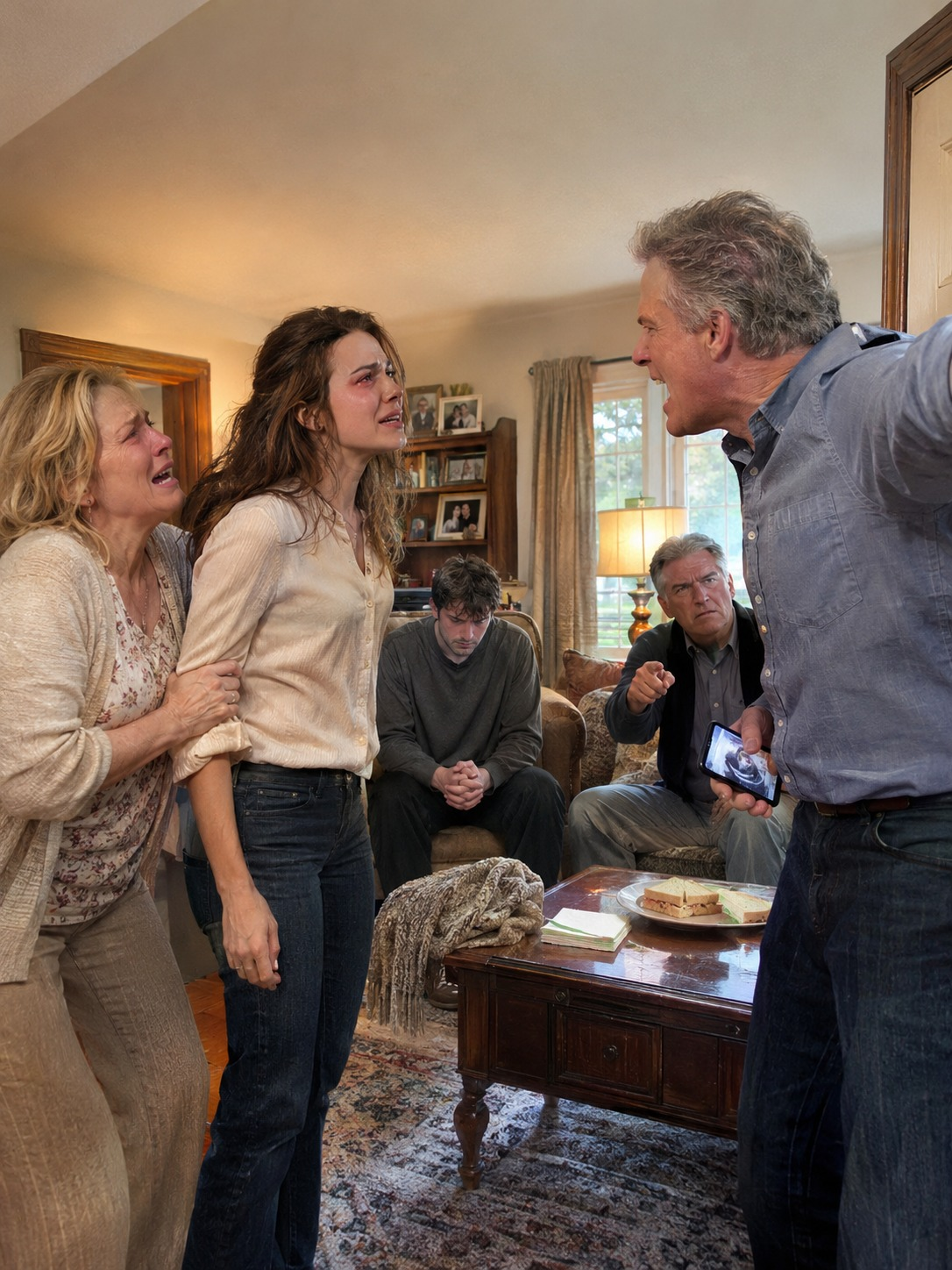
My father had sent me a photograph of a document that appeared to authorize the removal of one of my kidneys.
My name was written at the bottom.
I had never signed it.
And the message beneath the photograph was still glowing on my phone.
Too late to refuse.
I sat in my car outside my parents' house, staring at those four words until they stopped looking like English.
Through the windshield, I could see the living room window. The curtains were partly open. Someone moved behind them, but I couldn't tell who.
For one ridiculous moment, I expected my father to come outside, knock on the window, and tell me it had all been a misunderstanding.
He had done that before.
Not with something this serious, but with smaller things. He would say something cruel, watch me fall apart, and later insist that I'd misunderstood his intentions.
He never apologized.
He explained.
And somehow, by the end of those conversations, I was usually the one saying sorry.
My phone vibrated again.
Dad.
You need to come back inside and finish this conversation.
I looked at the photograph.
The document had a hospital name across the top, followed by several lines of printed text. The picture was slightly crooked, as though Dad had photographed the paper on the kitchen counter.
Near the bottom was a signature line.
Claire Bennett.
The letters were carefully formed, almost like someone had practiced writing them.
My real signature was nothing like that.
I signed my name quickly, with a looping C and a final stroke that usually ran beneath the last few letters.
This signature looked like something from an elementary school handwriting worksheet.
I enlarged the image.
A date appeared beside the signature.
It was yesterday's date.
Yesterday, I had been sitting at my desk at work, answering emails and eating leftover pasta from a plastic container.
Yesterday, I hadn't spoken to my father.
Yesterday, I certainly hadn't authorized anyone to remove an organ from my body.
My stomach twisted.
I typed a response.
Who signed that?
Three dots appeared almost immediately.
Then disappeared.
Then appeared again.
Finally, Dad replied.
We took care of the paperwork. Stop making everything difficult.
I read it twice.
Then I took screenshots of the entire conversation.
I didn't know exactly why.
I just knew I didn't want those messages to disappear.
I saved the photographs, including the one showing the document, in a separate folder on my phone.
Then I called him.
He answered on the second ring.
"Claire."
"Who signed my name?"
He exhaled loudly.
"Are you still sitting outside?"
"Answer my question."
"Your mother is beside herself."
"Dad."
"Your brother is sitting in there wondering whether his own sister cares if he lives."
I closed my eyes.
"Who signed my name?"
His voice dropped.
"You're getting worked up over something you don't understand."
"Then explain it."
"It's preliminary paperwork."
"Why does preliminary paperwork have my signature on it?"
"Because we needed to move things forward."
I stared at the steering wheel.
"Did you forge my signature?"
Silence.
Then he laughed.
Not because he thought anything was funny.
It was the short, irritated laugh he used when he wanted me to feel foolish.
"Don't use words like that."
"What word should I use?"
"Your mother signed some forms so we wouldn't lose the appointment. That's all."
I felt something cold move through my chest.
"Mom signed my name?"
"She did what any mother would do to save her son."
I looked toward the house.
The woman who had held my arm and begged me not to leave had apparently signed my name to a medical document without asking me.
"That isn't her decision."
Dad's voice sharpened.
"Do you understand what's at stake here?"
"Yes. My brother's health. And mine."
"You're talking like a stranger."
"No, Dad. I'm talking like a person who has the right to know what happens to her body."
He was quiet for a moment.
Then he said, "I don't recognize you anymore."
Those words hurt.
I hated that they still hurt.
After everything that had happened in the living room, after the threats and the document and the signature, some small part of me still wanted him to say he was proud of me.
I pressed my forehead against the steering wheel.
"I'm going home."
"Claire, if you drive away—"
I ended the call.
My hands were shaking again.
I waited until they steadied before starting the engine.
As I pulled out of the driveway, I caught a glimpse of my mother standing behind the front window.
She held a tissue against her mouth.
For one second, our eyes met.
Then I drove away.
The four-hour trip home felt longer than the drive to my parents' house.
Every few miles, my phone lit up on the passenger seat.
Mom called.
Dad called.
Uncle Dale called.
I let the calls go unanswered.
At a gas station halfway home, I stopped for coffee and checked my messages.
Mom had written:
Please don't punish Micah because you're angry with your father.
A few minutes later:
We can talk about the paperwork when you calm down.
Then:
Your brother doesn't have the luxury of waiting.
I stood beside my car, holding a paper cup of coffee that was too hot to drink.
I wanted to explain that I wasn't punishing Micah.
I wanted to tell her I was frightened.
I wanted my mother to understand that agreeing to a kidney donation wasn't the same as agreeing to lend someone money or drive them to an appointment.
But I knew how the conversation would go.
She would cry.
I would comfort her.
Then she would ask whether I was ready to help my brother.
My fear would become an inconvenience.
My questions would become selfishness.
And eventually, the conversation would return to what everyone else wanted.
I put the phone away.
By the time I reached my apartment, it was nearly ten.
I lived on the second floor of a modest building on the edge of town.
It wasn't fancy.
The kitchen was small, the bedroom barely fit my queen-size bed, and the refrigerator made a strange clicking noise every few hours.
But the apartment was mine.
I paid the rent.
I chose the furniture.
Nobody could tell me where to sit or when I was allowed to leave.
That night, those ordinary facts felt unusually important.
I dropped my keys on the counter and locked the door.
Then I sat at the kitchen table and opened my laptop.
I searched for information about living kidney donation.
I had never seriously researched the process before.
I'd thought about it, of course.
When Micah's condition worsened, I sometimes wondered whether I could help him medically.
But wondering wasn't the same as agreeing.
I read about blood tests, tissue compatibility, kidney function assessments, psychological evaluations, and independent donor advocates.
I learned that potential living donors underwent extensive medical screening.
I learned that transplant teams were supposed to evaluate whether a person was making the decision voluntarily.
I learned that a donor could withdraw from the process.
I kept reading.
One sentence appeared again and again across different transplant-center websites.
Living donation must be voluntary.
I stared at those words.
Voluntary.
Not negotiated at a family meeting.
Not decided by parents.
Not purchased with a deposit.
Not enforced by threatening to disown someone.
I returned to the photograph Dad had sent.
The hospital name at the top was partially obscured by glare.
I could make out the word Regional and what appeared to be Transplant Services.
I searched the phrase.
Several results appeared, but none matched the document exactly.
Maybe the photograph was too blurry.
Maybe the form came from a private office.
Maybe there was some explanation I hadn't considered.
I wanted there to be one.
I wanted my father to be mistaken rather than dishonest.
At eleven thirty, my phone rang.
Micah.
I answered immediately.
"Hey."
"Hey, Claire."
His voice sounded tired.
I could hear a television playing quietly in the background.
"Are you okay?" I asked.
He gave a small laugh.
"That's kind of a loaded question."
I closed my laptop.
"How are you feeling?"
"Same as usual. Tired."
"I'm sorry."
"Yeah."
A long silence followed.
Then he said, "Dad's really upset."
I looked toward the dark kitchen window.
"I know."
"He says you walked out."
"I did."
"He says you refused."
"I said I needed to talk to a doctor before making a decision."
Micah didn't answer.
"Did he tell you that part?"
"He said you were asking a lot of questions."
I almost smiled.
Apparently, questions had become a family offense.
"Micah, I need to ask you something."
"Okay."
"Have you actually been told I'm a match?"
He hesitated.
"That's what Dad said."
"Did your doctor say it?"
"I don't know."
"Have you seen any test results?"
"No."
I rubbed my forehead.
"Then how can anyone know?"
"I figured they had some way of checking."
"Without taking my blood?"
"I don't know, Claire."
His voice rose slightly.
Then he coughed.
I immediately felt guilty.
"Sorry. I'm not trying to upset you."
"I know."
Another silence.
I could hear him breathing.
"Do you want me to donate?" I asked.
The question came out more quietly than I'd intended.
He didn't answer right away.
Finally, he said, "I want to stop being sick."
My eyes filled.
"I know you do."
"I'm so tired, Claire."
His voice cracked.
"I can't plan anything. I can't work. I can't even go away for a weekend without thinking about treatment."
I pressed my fingers against my mouth.
"I know."
"Everybody keeps telling me things will get better. And every time I start believing them, something happens."
I wanted to reach through the phone and hug him.
I wanted to take away the exhaustion in his voice.
I wanted to give him the life he'd lost.
But I couldn't promise him my kidney.
Not without understanding what it meant.
"Micah, I love you."
"I know."
"And I'm going to learn everything I can."
He was quiet.
Then he said, "Dad told me you were the only chance I had."
My throat tightened.
"Did your doctor tell you that?"
"No."
"Then we need to find out what's actually true."
He sighed.
"I don't want everyone fighting because of me."
"You're not causing this."
"I feel like I am."
"You're sick. That's not something you chose."
He swallowed audibly.
"Neither is being my sister."
I closed my eyes.
That sentence hurt more than anything Dad had said.
Because Micah wasn't threatening me.
He was simply telling me how helpless he felt.
We talked for another ten minutes.
Mostly about ordinary things.
His dialysis schedule.
A woodworking video he'd watched.
A neighbor who had offered to help repair the old fence.
For a little while, he sounded like my brother again.
Before hanging up, he said, "I hope you and Dad figure things out."
I didn't know what to say.
"So do I."
After the call, I sat alone in the kitchen.
I thought about the wooden boats we used to make.
About the scholarship I'd surrendered.
About the car I'd given up.
About every time I'd been told that family came first.
Then I looked at the photograph of the signed document.
For the first time, I wondered whether my parents had ever understood the difference between asking for help and demanding ownership.
The next morning, I woke to seventeen missed calls.
Six from Mom.
Four from Dad.
Two from Uncle Dale.
The rest were from relatives I rarely spoke to.
There were messages, too.
My cousin Rebecca wrote:
I heard what happened. I can't believe you'd back out after promising Micah.
I sat upright in bed.
Promising?
I typed:
I never promised anything.
She responded almost immediately.
Your parents said the surgery was arranged and you changed your mind at the last minute.
I stared at the message.
Then another arrived.
They said you signed the papers.
My chest tightened.
I opened the photograph again.
The signature.
The date.
The hospital heading.
My father hadn't merely used the document to threaten me.
He had apparently used it to convince other people that I'd agreed.
I called Rebecca.
She answered breathlessly.
"Claire, I really don't want to get involved."
"Then please just tell me what you heard."
She hesitated.
"Your mom called Aunt Linda yesterday."
"And?"
"She said the transplant was all arranged. She said everybody had been celebrating because Micah was finally going to get better."
I closed my eyes.
"Rebecca, I haven't even been tested."
"What?"
"Nobody has taken my blood. Nobody has evaluated me. I haven't spoken to a transplant coordinator."
"But your dad said—"
"I know what he said."
Silence.
Then Rebecca asked, "Are you sure?"
I almost laughed.
"Am I sure nobody has tested me?"
"That's not what I meant."
"I know."
She sighed.
"Look, I don't know what's going on. But Uncle Dale posted something this morning."
"What did he post?"
"You should probably see it yourself."
A minute later, she sent me a screenshot.
It was a public social media post.
Uncle Dale had written about selfish people who accepted everything their families gave them but disappeared when someone needed saving.
He hadn't used my name.
He didn't have to.
Several relatives had already commented.
One wrote that some people only understood sacrifice when they were the ones receiving it.
Another said she was praying for Micah and hoping certain family members would find their conscience.
I scrolled through the comments.
Then I saw one from my father.
We did everything we could. Some decisions are beyond a parent's control.
I stared at it.
My father had spent the previous afternoon telling me that my decision was absolutely within his control.
Now he was presenting himself as a helpless parent.
My phone buzzed.
Mom.
This time, I answered.
"Claire, thank God."
"Mom, why are you telling people I agreed to donate?"
She went quiet.
"Who told you that?"
"Rebecca."
"Oh, honey. People misunderstand things."
"Did you tell Aunt Linda the surgery was arranged?"
"We were hopeful."
"Did you tell her I'd signed paperwork?"
A pause.
"We believed you would do the right thing."
"That's not what I asked."
Her breathing became uneven.
"Your father has been under tremendous pressure."
"Mom, did you sign my name?"
She started crying.
I closed my eyes.
"Please don't cry instead of answering."
That made her cry harder.
"I was only trying to help your brother."
I gripped the phone.
"Did you sign it?"
She whispered, "Your father said it was necessary."
My stomach dropped.
"Necessary for what?"
"I don't know all the details."
"Then why did you do it?"
"Because he said we couldn't lose the date."
I stared at the wall.
For a moment, neither of us spoke.
Then I asked, "Which hospital?"
"What?"
"Which hospital is supposed to perform this surgery?"
She hesitated.
"Your father has the information."
"Mom."
"Claire, please."
"Just tell me the name."
There was a rustling sound.
I heard her moving away from the phone.
Then a man's voice in the background.
Dad.
"Who are you talking to?"
Mom whispered something I couldn't hear.
His voice became louder.
"Give me the phone."
A second later, he was speaking directly into my ear.
"Claire, I've had enough of this."
"I want the hospital's name."
"You're upsetting your mother."
"Then tell me the hospital's name."
"Come home and we'll discuss it."
"No."
His breathing changed.
"You think you're so smart now?"
"I think I deserve to know where someone claims I'm having surgery."
He didn't answer.
Then he said something that made my skin prickle.
"You've already made this more complicated than it needed to be."
"What does that mean?"
"Nothing."
"Dad."
"Go to work, Claire."
The call ended.
I sat motionless on the edge of my bed.
I had asked one simple question.
Which hospital?
My father had threatened me, insulted me, and ended the conversation rather than answer it.
I looked at the photograph again.
This time, I noticed something I had missed.
Near the bottom of the page, just above the signature line, was a small printed reference number.
I enlarged it until the numbers blurred.
Then I adjusted the brightness.
There were eight digits.
And beside them, in tiny letters, were the words:
Patient Financial Authorization.
I frowned.
That wasn't the same as donor consent.
I searched the phrase.
Most of the results concerned payment responsibilities and financial agreements.
I looked back at the document.
Why would a financial authorization require my signature?
And why had Dad called it a living donor authorization?
I was still staring at the screen when an unfamiliar number called.
The area code matched my parents' hometown.
I almost ignored it.
Then I answered.
"Hello?"
A woman spoke.
"May I speak with Claire Bennett?"
"This is Claire."
"My name is Melissa. I'm calling regarding a document submitted under your name."
I stood so quickly that my knees struck the edge of the bed.
"What document?"
There was a brief pause.
"Before we continue, I need to verify that I'm speaking with the correct person."
I looked at the photograph on my phone.
The forged signature.
The reference number.
My father's message.
"Who are you calling from?" I asked.
The woman gave the name of a local medical billing office.
Then she said, "Ms. Bennett, there's something concerning about the paperwork we received."
My heart began pounding.
"What is it?"
She lowered her voice.
"The person who submitted it claimed to have your permission."
"I didn't give anyone permission."
Silence.
Then I heard papers moving.
"That's what I was afraid of," she said.
I gripped the phone.
"Why?"
She hesitated.
"Because your name isn't the only one on this document."
I stopped breathing.
She turned another page.
Then she said, "There's a second signature, Ms. Bennett. And I need to ask you whether you recognize the name written beside it."
I pressed the phone harder against my ear.
"Whose name?"
She began to read it aloud.
And the moment I heard the first name, my blood ran cold.






Comments 0