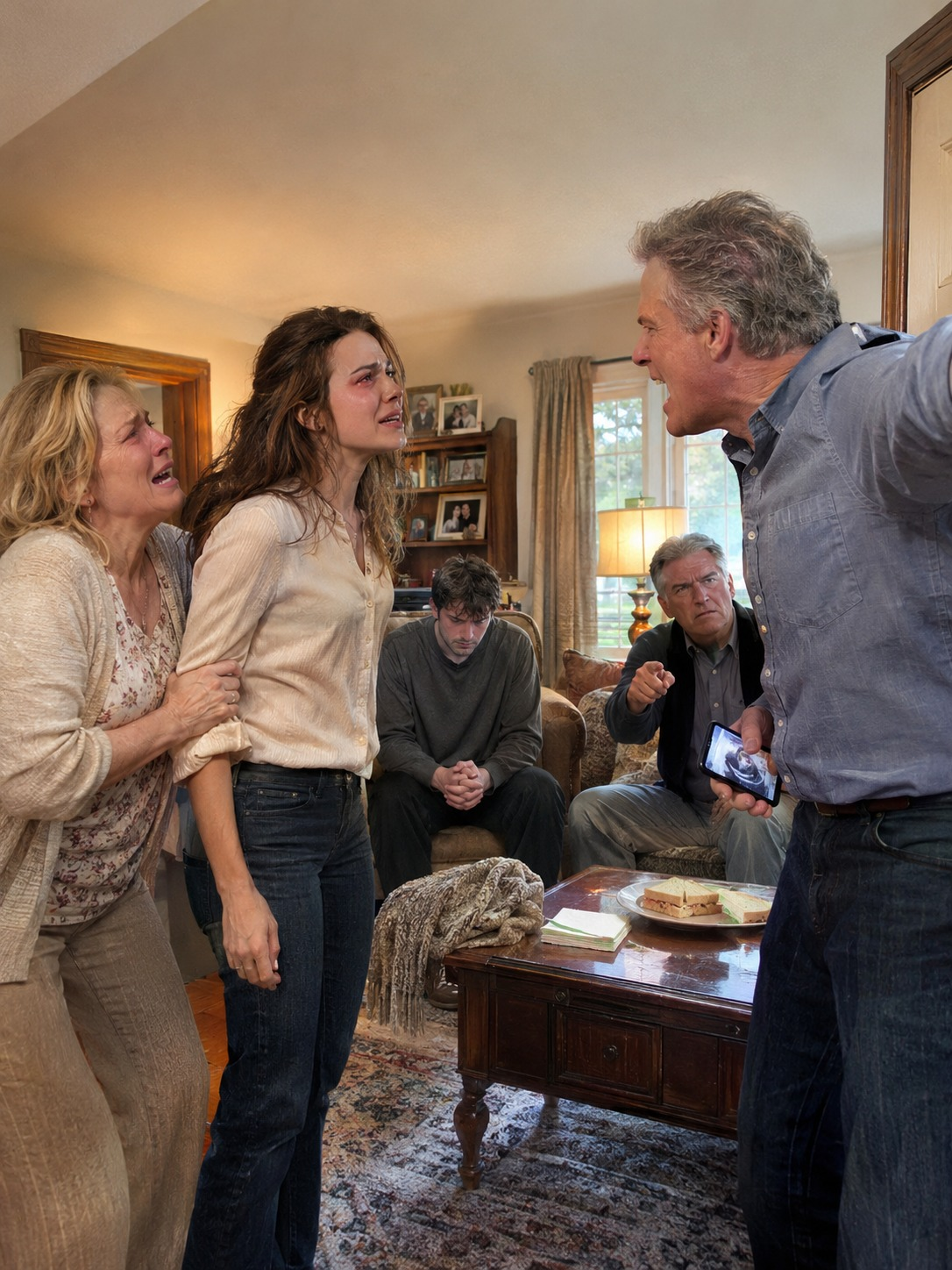
"You're not leaving until you agree to save your brother!" my father shouted, blocking the front door.
He raised his phone, showing me a photograph of Micah in a dialysis chair.
A date was written beneath the photograph.
It was three weeks away.
That was when I realized my father had already made a decision about my body.
I just hadn't been invited to make it.
My mother was crying behind me. Her fingers were wrapped around my left arm so tightly that I could feel her nails through the fabric of my blouse.
"Please, sweetheart," she whispered. "Don't make this harder than it already is."
I looked down at her hand.
Then I looked at my father.
"Dad, I haven't even spoken to a doctor."
His expression hardened.
"You don't need to. I've handled everything."
Those five words should have frightened me more than they did.
Instead, they sounded familiar.
My father had been handling things for me for as long as I could remember.
He handled which college I attended.
He handled which jobs were appropriate for me.
He handled how much money I contributed to the family.
And now, apparently, he had decided to handle which organs I was allowed to keep.
Three hours earlier, I had pulled into my parents' driveway after a four-hour drive, expecting an uncomfortable but ordinary conversation about medical bills.
My younger brother, Micah, had been sick for years.
At twenty-nine, he had already endured more medical appointments, needles, medications, and hospital visits than most people faced in a lifetime.
An inherited kidney condition had gradually destroyed his kidney function.
Dialysis kept him alive, but it had taken almost everything else.
He had once been the kind of person who could spend an entire Saturday building a beautiful dining table from rough lumber.
He loved the smell of fresh sawdust.
He loved making things with his hands.
When we were children, he built little wooden boats from scraps he found in Grandpa's workshop.
We floated them on the lake behind our grandparents' property.
Mine always sank.
His always sailed.
He used to laugh and tell me that I needed to stop choosing the prettiest pieces of wood and start choosing the ones that actually floated.
I thought about those afternoons whenever Mom called to tell me how badly he was doing.
I thought about them when I sent money.
And I thought about them when I gave up things I wanted because Micah needed something more.
For almost two years, I'd been transferring money into my parents' account every month.
Sometimes it was two hundred dollars.
Sometimes five hundred.
Once, when Mom said Micah needed a reliable car to get to treatment, I sent nearly everything I'd saved for my own used vehicle.
Dad called me generous.
Mom called me an angel.
Micah thanked me with tears in his eyes.
I took the bus to work for another eleven months.
That was how our family operated.
Micah needed.
I gave.
Dad approved.
And for a little while, I felt loved.
When I arrived that afternoon, the front door was unlocked.
Mom met me in the hallway.
She looked older than she had during my last visit.
Her blonde hair was messy, and the skin around her eyes was swollen.
"Oh, honey," she said, pulling me into a hug.
I hugged her back.
"Is Micah okay?"
She didn't answer immediately.
That was the first thing that made my stomach tighten.
"Everyone's in the living room," she said.
I followed her.
Dad stood beside his favorite chair.
Uncle Dale sat on the loveseat with his elbows resting on his knees.
Micah was in the armchair near the window, wearing a charcoal-gray sweater.
He looked pale.
His shoulders were slumped.
His hands were folded together.
On the coffee table sat a plate of sandwiches.
Nobody was eating.
I remember noticing that the bread had started curling at the edges.
It was such a small detail.
But something about those untouched sandwiches made me feel as though everyone had been waiting for a performance to begin.
Dad pointed toward an empty chair.
"Sit down, Claire."
My name is Claire Bennett.
I was thirty years old.
I had a steady job, my own apartment, and enough experience paying bills to know that being an adult meant making difficult decisions.
Yet when my father used that voice, I still felt sixteen.
I sat.
"What's going on?"
Dad clasped his hands.
"We've finally got some good news about your brother."
I turned toward Micah.
He didn't look up.
Dad continued.
"The doctors have found a way forward. A living donor transplant."
For one brief second, hope rushed through me.
"That's wonderful."
Mom started crying harder.
Dad nodded.
"It is. But there's something we need from you."
I looked between them.
"What?"
He leaned forward.
"You're the only compatible donor in the family."
The room went silent.
I waited for him to explain.
He didn't.
"How do they know that?" I asked.
Dad frowned.
"What do you mean?"
"I mean, how do they know I'm compatible?"
"From the family medical workup."
"But nobody tested me."
He waved one hand.
"They know enough."
I stared at him.
I knew very little about transplantation, but I knew enough to understand that doctors didn't decide someone was a compatible kidney donor simply because they were related.
"Did the hospital contact you about me?"
"Claire, don't start."
"I'm asking a question."
"And I'm giving you an answer."
Mom reached for a tissue.
"The surgeon has already agreed to hold a date next month," she said. "We've put down a substantial deposit."
I turned toward her.
"A deposit?"
She nodded.
"We couldn't risk losing the opportunity."
Dad added, "We've already made arrangements for Micah's recovery."
My eyes moved toward my brother.
"Micah?"
He shifted slightly.
"Yeah?"
"Did you know about this?"
He looked at Dad.
Then at Mom.
Then down at his hands.
"I knew they were trying to figure something out."
"Did you know they were asking me to donate a kidney?"
He swallowed.
"I knew it was a possibility."
A possibility.
The word echoed in my head.
My parents had apparently paid money, chosen a date, and begun preparing for a surgery involving my body.
And the person whose life they claimed I was saving was calling it a possibility.
I took a slow breath.
"Okay. I need to talk to the transplant team."
Dad's jaw tightened.
"Why?"
"Because this is major surgery."
"Healthy people live perfectly normal lives with one kidney."
"Then a doctor can explain that to me."
Uncle Dale sighed.
"If I were a match, you wouldn't have to ask me twice."
I turned toward him.
"Then I hope you'd get the chance to make that decision yourself."
His eyebrows rose.
"That's a pretty selfish attitude."
There it was.
Selfish.
The word my father had used whenever I wanted something that didn't benefit the rest of the family.
When I was eighteen, I received a full scholarship to a university six hours away.
I had worked for years to earn it.
I remember running into the kitchen with the acceptance letter, laughing so hard I could barely speak.
Dad read the letter.
Then he asked how I could possibly move away when Micah was beginning to have health problems.
I gave up the scholarship.
At twenty-four, I was offered a promising position in another state.
It paid almost twice my salary.
Dad asked whether I planned to abandon my brother.
I declined the offer.
When Grandpa died and left me a small inheritance, I wanted to use it toward a down payment on a home.
Dad reminded me how much Micah's medical care cost.
The money disappeared into family expenses.
Each time I surrendered something, Dad praised me.
He called me loyal.
He called me dependable.
He said he was proud of the woman I'd become.
And I held on to those compliments because they were the closest thing to unconditional approval I knew.
Now he was asking for something I could never earn back.
An organ.
"I love Micah," I said carefully. "You know that."
Dad nodded.
"Then prove it."
The words landed harder than a slap.
I looked at my brother.
His eyes were wet.
"Micah, tell me what you want."
He stared at the carpet.
"I want to get better."
"Of course you do."
"I want my life back, Claire."
His voice cracked.
I felt tears gathering in my own eyes.
"I want that too."
He nodded slowly.
"I wouldn't blame you if you couldn't do it."
For a moment, relief washed through me.
Then he added, "I guess I'd just always wonder whether things could've been different."
I sat very still.
He hadn't demanded my kidney.
But somehow his words made me feel as though I was already responsible for every bad thing that might happen next.
Dad took out his phone.
He began showing me photographs.
Micah smiling in his workshop.
Micah hiking in the mountains.
Micah laughing at a friend's wedding.
Then Micah in a dialysis chair.
His skin looked gray.
His eyes were closed.
Dad held the screen inches from my face.
"Which version of your brother do you want to keep alive?"
I pushed the phone gently away.
"That's not fair."
"Life isn't fair."
"Neither is asking me to agree to surgery without even speaking to a doctor."
Dad stood.
The movement was sudden enough that Mom flinched.
"I have spent weeks arranging this," he said.
I stood too.
"Then you should have talked to me first."
His face reddened.
"After everything this family has done for you?"
I almost laughed.
Not because anything was funny.
Because I couldn't remember the last major decision I'd made without considering what my family would think.
"I need time," I said.
Dad moved toward the front door.
"No."
I stared at him.
"No?"
"You're not walking out of here until we settle this."
Mom came around the coffee table.
She took my arm.
"We'll take care of you after surgery," she whispered. "Every expense. Every appointment. You won't have to worry about a thing."
I looked at her.
"Mom, I'm worried about having surgery I haven't agreed to."
Her face crumpled.
"Don't say it like that."
"Like what?"
"Like we're asking you to do something terrible."
I looked toward the plate of untouched sandwiches.
The family photographs.
The familiar curtains.
The room where I'd opened birthday presents and watched Christmas movies.
Everything looked exactly as it always had.
Except now I understood that four people had discussed my body and reached a decision before I arrived.
"Please let go," I told Mom.
She tightened her grip.
Dad folded his arms.
"If you leave, you're choosing yourself over your brother."
My heart pounded.
For one terrible second, I wanted to apologize.
I wanted to sit down.
I wanted to promise I'd do whatever they asked so my mother would stop crying and my father would look at me with pride again.
Then I looked at Micah.
He was staring at his folded hands.
He didn't tell Dad to move.
He didn't tell Mom to let go.
He didn't say that I deserved to speak with a doctor.
And something inside me finally became quiet.
I gently removed my mother's hand.
"I love you all," I said. "But I'm not agreeing to surgery today."
Dad stepped closer.
"Then don't expect to walk back into this family."
I moved toward the door.
He didn't move.
For a moment, we stood face-to-face.
Then I stepped around him and reached for the handle.
The door opened.
I walked outside.
Behind me, Mom sobbed.
Dad shouted something about selfishness.
I kept walking.
I reached my car and climbed inside.
My hands shook so badly that I dropped my keys between the seats.
I sat there for several minutes before I could retrieve them.
Then my phone vibrated.
A message from Dad.
I expected another threat.
Instead, there was a photograph attached.
It showed a printed document with a hospital name at the top.
Beneath it was a line labeled:
LIVING DONOR AUTHORIZATION
And at the bottom, where my signature should have been, someone had written my name.
I enlarged the photograph.
The handwriting looked nothing like mine.
Then another message appeared.
Dad had written only four words.
"Too late to refuse."
I stared at the screen.
And for the first time that afternoon, I wasn't afraid of disappointing my father.
I was afraid of what he had already done.






Comments 0