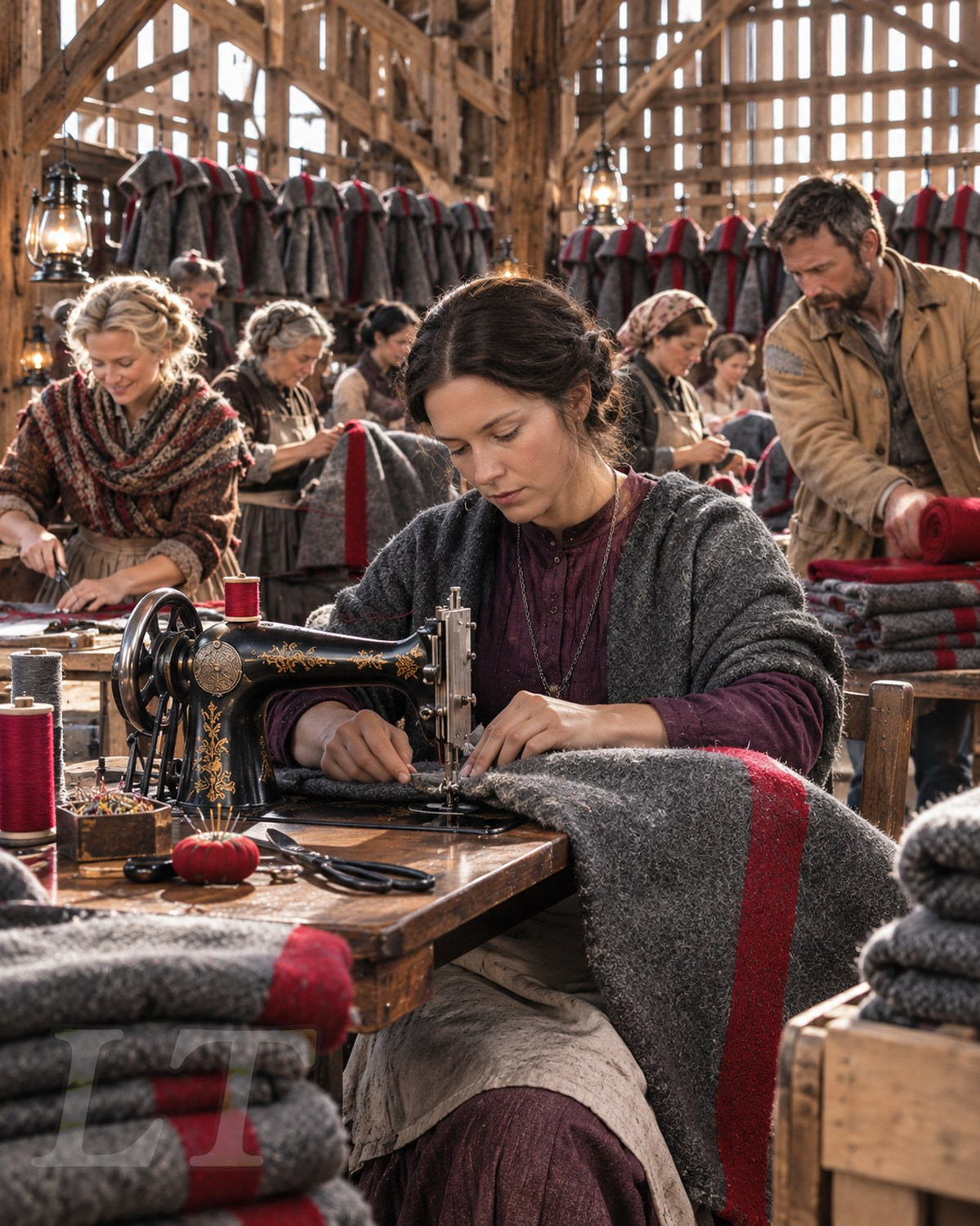
The railroad telegram trembled in Ezra Pell's hands.
Halvor stood beside the general store counter, reading the message for the second time.
Odessa watched his expression change.
"What does it say?" she asked.
Ezra removed his spectacles and rubbed his eyes.
"The bridge north of Omaha has suffered additional damage. Freight traffic has been suspended indefinitely. The shipment will not be delivered according to schedule."
"How long?" Halvor asked.
Ezra looked down at the telegram.
"They're saying several weeks. Perhaps longer."
"And the coats?"
"Still on the train."
Odessa felt a chill that had nothing to do with the weather.
"How many families are waiting?"
Ezra closed his ledger.
"Thirty-seven families have already paid deposits. More than ninety people are expecting winter coats. Two hundred blankets were ordered alongside them."
"Children?"
"Twenty-three children at the schoolhouse alone. That's not counting the little ones living outside town."
He placed the telegram on the counter.
"I've been running this store for twenty-six years, Mrs. Ingram. I've never seen anything quite like this."
Halvor folded his arms.
"Can you get another shipment?"
Ezra gave a tired laugh.
"From where? Every merchant within a hundred miles is trying to secure winter supplies. The eastern rail lines are backed up, and the freight companies won't promise delivery dates."
He lowered his voice.
"Some of these families have already spent money they cannot afford to lose."
Odessa looked at the names written in the ledger.
She recognized several.
Dagny Lindquist.
The Rooney family.
A farmer named Thomas Bell, whose wife had recently given birth.
There were children whose measurements had been recorded months earlier.
Beside several names, Ezra had written the word PAID.
Odessa slowly closed the ledger.
"Mr. Pell, I need to ask you something."
He looked at her.
"Go ahead."
"Those gray blankets in your storeroom. The ones you purchased at the government sale. Are they still available?"
Ezra stared at her.
"Every last one."
"Would you consider selling them?"
"To you?"
"Yes."
He glanced toward Halvor.
"Your husband knows about this?"
Halvor answered before Odessa could.
"She told me about the blankets."
Ezra raised his eyebrows.
"And what did you think?"
Halvor hesitated.
"I thought it was a considerable undertaking."
Odessa looked at him.
"That's one way of describing it."
Ezra gave a short laugh, but his expression quickly became serious again.
"Mrs. Ingram, those blankets aren't particularly attractive. They're heavy, rough, and difficult to sell. That's why I've had them sitting in the storeroom for two years."
Odessa nodded.
"I know."
"Then why do you want them?"
She looked toward the children playing outside the window.
"Because they don't need to be attractive. They need to be warm."
Ezra followed her gaze.
For several seconds, he said nothing.
Then he opened his ledger again.
"Come with me."
The storeroom smelled of dust, old wood, and wool.
Ezra unlocked the back door and led them inside.
Stacks of gray blankets occupied nearly an entire wall.
Some were folded neatly.
Others remained tied in bundles with old rope.
Odessa approached the nearest pile and unfolded one.
The fabric was thick and coarse, with a tightly woven surface.
She examined the corners, checked the edges, and rubbed the wool between her fingers.
"These are stronger than they look."
"They were made for government use," Ezra explained. "Nobody wanted them when I put them on the shelves."
Odessa lifted one edge.
"Have any been damaged by moisture?"
"Only a few at the bottom. The rest are dry."
She examined another.
Then another.
Her eyes began moving more quickly.
She was no longer looking at unwanted blankets.
She was imagining sleeves, hoods, collars, linings, and reinforced seams.
"How many usable blankets do you have?"
"Two hundred and sixty, as I told you."
"And what would you charge?"
Ezra named a price.
Halvor immediately frowned.
"That's too much."
Ezra shrugged.
"It's what I paid."
Odessa remained quiet.
She was calculating.
If each blanket yielded enough material for a certain number of coat panels, she could produce dozens of garments. But she would need additional fabric for linings, thread, buttons, and suitable patterns.
She also needed help.
A great deal of help.
"I can pay your original cost," she finally said.
Ezra looked surprised.
"All of them?"
"All the usable blankets."
"And when would you pay?"
"Once we agree on the quantities and the terms."
Halvor stepped closer.
"Odessa, that's a lot of money."
She looked at him.
"I know."
"We haven't even discussed whether we can afford the work."
"I know that too."
He lowered his voice.
"We cannot take on another debt."
Odessa didn't argue.
Instead, she turned toward Ezra.
"Would you allow me until tomorrow to work out the numbers?"
Ezra nodded slowly.
"Tomorrow morning."
On the ride home, Halvor remained unusually quiet.
The wagon wheels creaked along the uneven road.
Odessa held a small piece of gray wool in her lap.
Finally, Halvor spoke.
"Do you understand what you're proposing?"
"Yes."
"Two hundred and sixty blankets."
"Yes."
"That's an enormous amount of material."
"I noticed."
He looked at her.
"Odessa, I'm serious."
"So am I."
He tightened his grip on the reins.
"I have debts. The ranch needs repairs. The cattle need feeding. I cannot afford to gamble what little we have left."
She turned toward him.
"I'm not asking you to gamble the ranch."
"Then what are you asking?"
"Give me a chance to organize the work. I'll find women willing to help. I'll calculate the material. I'll speak with the families. And I'll make sure nobody spends money they cannot afford."
Halvor shook his head.
"That's a lot of responsibility."
"Someone has to take it."
He glanced at the gray fabric in her hands.
"And if you fail?"
Odessa looked across the prairie.
"Then I'll have tried to make something useful out of a difficult situation."
He said nothing more.
But when they reached the ranch, he helped her down from the wagon without being asked.
That evening, Odessa spread her calculations across the kitchen table.
She had made columns for fabric, thread, lining, buttons, labor, and estimated production.
The numbers were imperfect.
She knew that.
She would need to test the material before committing to the entire supply.
She also needed to determine whether the blankets could be cut without wasting too much fabric.
Halvor entered carrying two cups of coffee.
He placed one beside her.
"You've been working on that for hours."
"Only a little while."
He glanced at the papers.
"How many coats?"
"That's what I'm trying to determine."
She showed him the measurements.
"I want them long enough to cover the hips. The children's coats will have deep hoods and reinforced cuffs. Adults will need wider shoulders and longer sleeves."
Halvor studied the drawings.
"You've thought about this."
"I've been thinking about it since I saw those children in town."
He pulled out a chair.
"Show me."
Odessa looked surprised.
He sat down.
She moved the papers closer.
For the next twenty minutes, they discussed the amount of fabric required for each garment.
Halvor knew more about practical clothing than she expected.
He understood how quickly a ranch coat could wear through at the elbows.
He knew which parts of a garment needed extra reinforcement.
He also knew that clothing had to be comfortable enough to work in.
"Don't make the sleeves too narrow," he said. "People need room to move."
Odessa wrote it down.
"And the collars?"
"High enough to cover the neck. Especially for the children."
She smiled.
"You're becoming quite involved."
Halvor looked at the drawings.
"Somebody has to make sure you don't sew everybody into a straightjacket."
She laughed.
It was a small moment.
But something between them had shifted.
For the first time, Halvor wasn't treating her sewing as an inconvenience.
He was helping her plan.
The following morning, Odessa returned to Plum Bluff.
She visited the schoolhouse first.
Miss Clara Whitmore, the teacher, was arranging books on a shelf when Odessa entered.
Clara was a woman in her early thirties, with brown hair pinned neatly behind her head and a tired but friendly face.
"Mrs. Ingram! What brings you here?"
"I wanted to ask about the children's winter clothing."
Clara looked toward the classroom.
Twenty-three pupils attended the school.
Their ages ranged from five to thirteen.
Several were wearing thin jackets.
One little girl had wrapped a knitted scarf around her head because she didn't own a proper winter hat.
Clara noticed Odessa looking.
"We've been trying to help them."
"How many need coats?"
Clara considered the question.
"At least twenty-three."
"All of them?"
"Some have coats, but they're too small or badly worn. A few children have nothing suitable for the coming winter."
Odessa took out her notebook.
"Would you be willing to help me collect measurements?"
Clara looked confused.
"Measurements?"
"I may be able to make coats."
The teacher stared at her.
"All twenty-three?"
"I don't know yet. But I'd like to try."
Clara's expression softened.
"Mrs. Ingram, that would mean more than you realize."
Odessa looked around the classroom.
A little boy was trying to pull his sleeves over his fingers.
Another child was sharing a scarf with his younger sister.
She remembered her own childhood.
She remembered her mother sewing late into the night.
And she remembered how it felt to walk outside wearing something that wasn't warm enough.
"Let's start with the smallest children," she said.
By noon, Odessa had collected the first measurements.
She also had a list of families who needed assistance.
Some were ranchers.
Others were railway workers.
Several were widows.
A few families had recently arrived in Nebraska and had not yet managed to establish themselves.
Odessa returned to Pell's Mercantile with her notebook.
Ezra was waiting behind the counter.
"Well?"
"I'd like to purchase the blankets."
He raised his eyebrows.
"All of them?"
"All the usable ones."
He opened his ledger.
"Then we should discuss payment."
Odessa placed her notebook on the counter.
"I also have another proposal."
Ezra looked at her suspiciously.
"What now?"
"I would like you to supply the necessary thread, buttons, and lining material at your original wholesale cost."
He leaned back.
"That's a lot of supplies."
"I know."
"And what do I get in return?"
Odessa considered her answer.
"First, you'll have a chance to recover the money tied up in those blankets. Second, the town will have winter coats before the weather becomes dangerous. Third, every family that receives a coat will know where the materials came from."
Ezra rubbed his chin.
He wasn't a sentimental man.
But he was a practical one.
And he understood that the arrival of winter without supplies could become a serious problem for his customers.
"How many coats can you make?"
"I don't know yet."
"That's not very reassuring."
"I would rather tell you the truth than promise something I cannot deliver."
Ezra studied her.
Then he closed the ledger.
"All right. I'll give you until the end of the week to organize your plans. But I want a clear list of what you need."
Odessa smiled.
"Thank you."
He pointed toward the storeroom.
"And Mrs. Ingram?"
"Yes?"
"Don't forget those blankets are heavy. You'll need help moving them."
She laughed.
"I suspect I will."
When Odessa returned to the ranch, she found Halvor repairing a gate.
Colm was working beside him.
Both men stopped when they saw her wagon approaching.
"How did it go?" Halvor asked.
"Better than I expected."
She climbed down and showed him the notebook.
"I spoke with the teacher. Twenty-three children need coats."
Colm looked up.
"Twenty-three?"
Odessa nodded.
"And several other families need help."
Colm glanced toward the barn.
"Are you really going to make all those coats?"
"I'm going to try."
He looked thoughtful.
"Could I help?"
Odessa smiled.
"Of course."
Halvor straightened.
"First, let's figure out how we're moving those blankets."
She looked at him.
He continued working on the gate.
"I'll take the wagon into town tomorrow."
Odessa stared at him.
"You will?"
"Someone has to bring the material back."
For a moment, she didn't know what to say.
Then she smiled.
"Thank you."
Halvor shrugged.
"Don't thank me yet. I haven't seen how many blankets two hundred and sixty actually look like."
Colm laughed.
The next morning, they began preparing the barn.
Halvor cleared an unused corner near the loft.
Colm carried old crates outside.
Odessa swept the floor and measured the available space.
They needed tables for cutting fabric, chairs for sewing, storage for finished garments, and a place where the women could work without standing in the cold.
The barn was large, but its upper loft was drafty.
Odessa inspected the windows.
Several had broken panes.
Others had gaps around their frames.
"This won't work," she said.
Halvor looked up.
"What's wrong?"
"The wind will come straight through here."
He examined the window.
"I can repair it."
"And the door?"
"I'll fix that too."
Odessa looked at him.
"You've thought about this."
He gave her a faint smile.
"Someone has to make sure the sewing machine survives the winter."
She laughed.
Then she noticed Colm standing near the entrance.
He was holding the new gray coat Odessa had made for him.
"What's that?" she asked.
Colm turned it around.
"I was wondering something."
"What?"
He pointed to the red stripe.
"Could you put one of these on every coat?"
Odessa approached him.
"Why?"
He shrugged.
"It looks good."
Halvor smiled.
"That's a sensible reason."
But Odessa was thinking about something else.
She looked at the red fabric.
Then toward the window.
Outside, the prairie stretched across the horizon.
In winter, snow could erase fences, roads, and even the shapes of familiar buildings.
A person wearing a gray coat might become almost invisible.
She touched the stripe.
"Perhaps we should."
That afternoon, Ezra Pell sent a message through the stationmaster.
He had located the freight receipt from the original purchase.
The blankets could be sold at their original cost, provided the payment arrangement was agreed upon before the end of the week.
Odessa read the message twice.
Then she looked at her calculations.
The project was becoming real.
But it was also becoming larger.
She would need more than one sewing machine.
She would need women who knew how to cut fabric.
She would need volunteers who could prepare the linings.
She would need people to sort, fold, and distribute the finished coats.
And most importantly, she would need the families themselves to participate.
She didn't want the town to become dependent on one woman.
She wanted them to work together.
That evening, she sat beside the Singer machine and began writing invitations.
Six women to start.
Perhaps more if the work proved manageable.
She wrote to Dagny Lindquist.
Then to Mrs. Bell.
Then to a widow named Margaret Hayes who lived near the church.
She placed the letters in a small envelope.
Halvor watched from the kitchen doorway.
"Who are those for?"
"Women who might help."
He nodded.
"Do you think they'll come?"
"I hope so."
He looked at the invitations.
"People are tired, Odessa. They've got their own families to care for."
"I know."
"Some might think you're asking too much."
She set down her pen.
"Then I'll ask them for only one afternoon."
Halvor considered that.
"One afternoon?"
"One afternoon to see whether we can make something worthwhile together."
He nodded.
Then he reached for his coat.
"I'm going to check the north pasture."
Odessa returned to her letters.
She had just finished sealing the final envelope when she heard a wagon approaching.
It wasn't Halvor's.
The wheels stopped directly outside the house.
Someone climbed down.
Then came three hurried knocks.
Odessa opened the door.
Dagny Lindquist stood on the porch, her face pale and her eyes swollen from crying.
But she wasn't alone.
Behind her stood Ezra Pell.
And in his hands was a folded document with the names of every family who had already paid for winter clothing.
"Mrs. Ingram," Dagny whispered.
Odessa stepped aside.
"What's happened?"
Dagny looked at Ezra.
He unfolded the document.
Then he delivered the news.
"There's something you need to know before you buy those blankets. The families who paid for the missing shipment have just received a demand for their money back..."






Comments 0