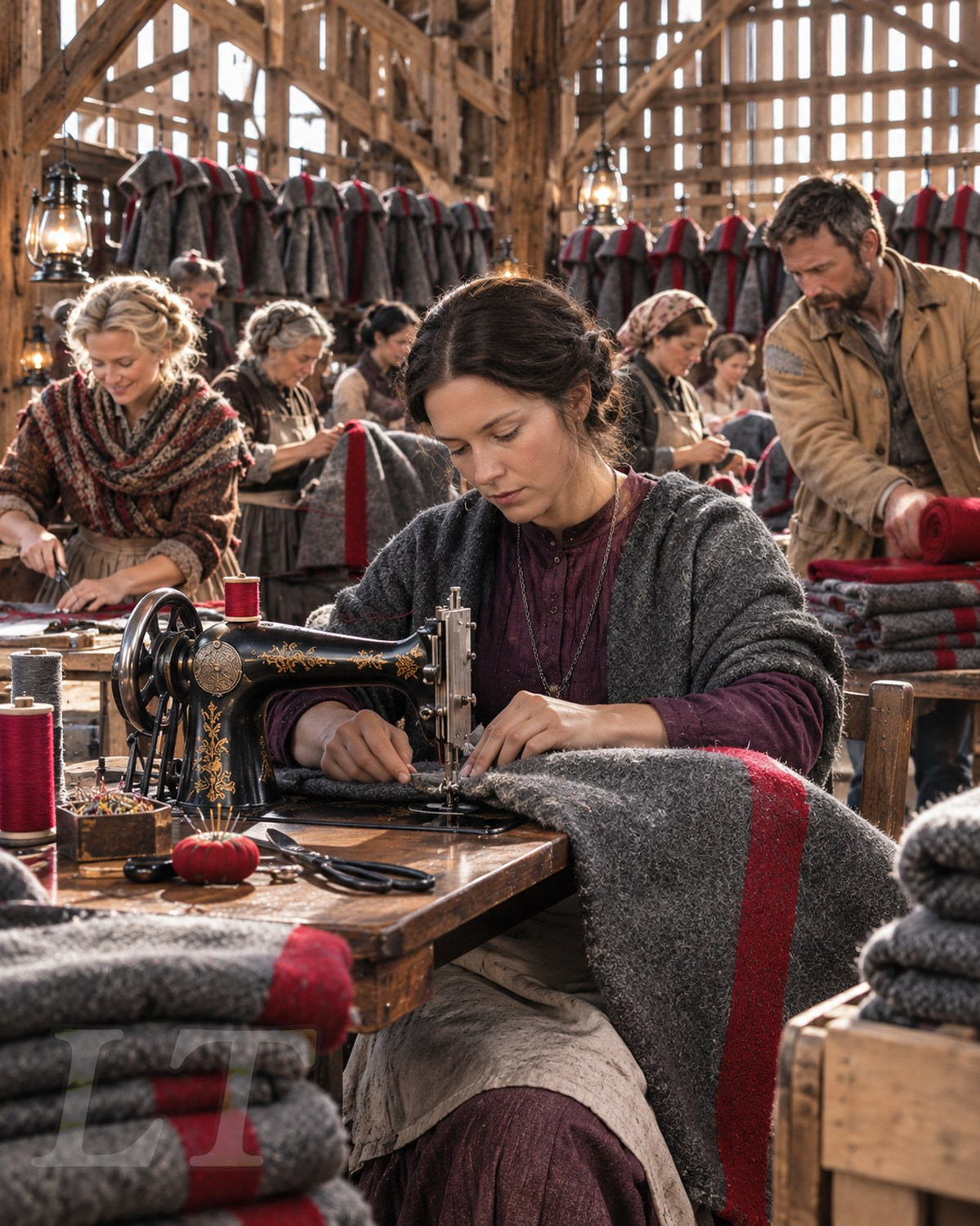
"Those two hundred and sixty blankets may not legally belong to Mr. Pell."
Silas Crowe's words silenced the entire barn.
Odessa slowly lowered the piece of wool she had been holding.
Halvor stepped between the stranger and his wife.
"What exactly are you accusing him of?"
Silas opened his leather document case and removed a folded paper.
"I'm not accusing anyone, Mr. Ingram. I'm explaining the situation before this becomes considerably more complicated."
"Then explain it."
Silas adjusted his collar.
"The blankets were originally purchased through a government surplus auction. Mr. Pell acquired them under a commercial agreement that included certain resale restrictions. The supplier has recently discovered that the original transfer was improperly recorded."
Ezra Pell, who had arrived moments earlier, immediately stepped forward.
"That's nonsense. I have the original purchase receipt."
Silas turned toward him.
"Your receipt confirms payment. It does not necessarily confirm unrestricted ownership."
Ezra's face reddened.
"Two years I've owned those blankets. Two years they've sat in my storeroom. Nobody has complained."
"Nobody had reason to examine the transaction until now."
Odessa looked at the document.
"Who is the supplier?"
Silas named a company based in Omaha.
"And what do they intend to do with the blankets?"
"Recover the merchandise or negotiate a new commercial agreement."
Halvor folded his arms.
"And what does that have to do with my wife's sewing project?"
Silas looked toward the Singer machine.
"Mrs. Ingram appears to be organizing the conversion of those materials into finished garments. If the blankets are subject to a disputed ownership claim, cutting them into coats could create additional legal difficulties."
The women exchanged worried looks.
Dagny stopped arranging the fabric.
Margaret slowly put down her scissors.
Odessa remained still.
She had worked too hard to allow a stranger to frighten six women into abandoning their work without understanding the facts.
"Mr. Crowe," she said, "we haven't cut the entire supply. We've only tested one damaged blanket."
"Then I suggest you stop until the matter is resolved."
"And the families waiting for winter coats?"
Silas closed his document case.
"That is not my responsibility."
Halvor's expression hardened.
"It becomes everybody's responsibility when children are involved."
Silas gave him a polite, almost dismissive smile.
"I understand your concern, sir. But business agreements must be respected."
He placed a second document on the table.
"Mr. Pell will receive formal correspondence within forty-eight hours."
Then he turned and walked toward his wagon.
Nobody spoke until the sound of his wheels disappeared down the road.
Ezra stood beside the cutting table, staring at the document.
"I've never heard of any resale restriction," he said.
Halvor looked at him.
"Can they take the blankets?"
"I don't know."
Odessa approached.
"Do you still have the original agreement?"
Ezra nodded.
"At the store."
"Then we need to examine it."
He looked at her.
"Mrs. Ingram, perhaps you should suspend the project."
The words hurt more than Odessa expected.
She glanced toward the women.
Dagny looked frightened.
Margaret had folded her hands tightly.
Ruth was staring at the unfinished coat pattern.
Odessa understood their concerns.
They had families.
They had responsibilities.
Nobody wanted to become involved in a legal dispute over materials they had never owned.
But she also knew what would happen if they stopped.
The shipment wouldn't suddenly arrive.
The children wouldn't suddenly receive coats.
And winter wouldn't wait for a company in Omaha to settle its paperwork.
"I won't ask anyone to take a risk they cannot afford," Odessa said.
She looked at Ezra.
"But I would like to see the agreement before we make a decision."
Ezra nodded.
"Come to the store tomorrow morning."
That evening, Halvor found Odessa sitting beside the Singer machine.
The barn was quiet.
The women had gone home, taking their unfinished work with them.
A single gray blanket remained spread across the table.
Odessa was examining its edge.
Halvor approached.
"You should eat something."
"I'm not hungry."
"You haven't eaten since noon."
She looked up.
"I keep thinking about those children."
He pulled out a chair.
"So do I."
Odessa touched the wool.
"Mr. Crowe spoke as though the coats were already a problem."
"He was trying to frighten us."
"Perhaps."
Halvor leaned forward.
"Listen. Whatever happens with those blankets, we'll find another way."
She smiled faintly.
"With what money?"
He didn't answer immediately.
The ranch was still struggling.
The bank still expected its payment.
The cattle needed feed.
And the barn needed repairs.
He had spent years trying to keep his property from falling apart.
He couldn't pretend there were unlimited resources.
But he also couldn't ignore the determination in his wife's face.
"We'll work something out," he repeated.
Odessa looked at him.
"You don't have to carry this with me."
He shook his head.
"I know."
Then he reached across the table and covered her hand with his.
"But I don't intend to leave you carrying it alone."
The following morning, Odessa accompanied Halvor to Pell's Mercantile.
Ezra was waiting behind the counter with a thick folder.
He spread the original purchase agreement across the desk.
The paper was yellowed around the edges.
Several signatures appeared at the bottom.
Odessa examined the clauses carefully.
She wasn't a lawyer, but years of handling receipts, contracts, and business payments had taught her to read documents closely.
One paragraph caught her attention.
It referred to the government auction.
Another described the transfer of ownership.
Then she noticed a handwritten notation beside the signature.
"What's this?" she asked.
Ezra leaned forward.
"Where?"
She pointed.
"Here. It says the blankets were transferred in full upon payment."
Ezra nodded.
"That's what I've been telling you."
"But this paragraph refers to a separate inventory record."
He frowned.
"I don't remember receiving one."
Odessa read the sentence again.
The document mentioned an inventory attachment that was supposed to accompany the purchase.
Without it, the supplier might argue that the transfer was incomplete.
"Do you have the attachment?"
Ezra shook his head.
"I was given the main agreement and a receipt."
"Who delivered them?"
"A freight agent from Omaha."
"Do you remember his name?"
Ezra opened another ledger.
After several minutes, he found an entry.
"Thomas Vickers."
Odessa wrote the name down.
Halvor looked at the paper.
"Can we contact him?"
Ezra shook his head.
"He left the company last year."
"Where is he now?"
"I don't know."
Odessa examined the agreement once more.
Then she noticed something else.
A small stamp appeared at the bottom of the final page.
It contained a date and a number.
She copied both into her notebook.
"Mr. Pell, may I take this to the justice of the peace?"
Ezra hesitated.
"Why?"
"I want someone familiar with these agreements to explain whether the missing attachment actually invalidates your purchase."
He considered the suggestion.
Then he nodded.
"All right. But bring it back."
Odessa carefully folded the document.
Justice Samuel Whitcomb examined the agreement that afternoon.
He was an elderly man with silver hair, a neat white beard, and spectacles that rested low on his nose.
He had served Plum Bluff for nearly fifteen years.
He read the document twice.
Then he looked at Odessa.
"This is an unusual situation."
"Can the company take the blankets?"
"Not simply because someone claims there is a missing attachment."
He tapped the paper.
"Mr. Pell has a signed agreement and evidence of payment. Those facts matter."
Odessa felt a little relief.
"But?"
Samuel removed his spectacles.
"The original auction conditions may contain language that changes the interpretation. We need to see them."
"Can we obtain a copy?"
"Perhaps. The government auction office should have a record."
"How long will that take?"
He sighed.
"Several days. Possibly longer."
Odessa looked down.
Several days seemed insignificant to a lawyer.
To a mother with children waiting for winter coats, several days could matter enormously.
Samuel noticed her expression.
"Mrs. Ingram, I understand your urgency. But don't destroy or distribute disputed property until the ownership question is settled."
She nodded.
"I understand."
Then he leaned forward.
"There's something else."
"What?"
"If those blankets were purchased in good faith, and the seller transferred ownership, the company may have difficulty reclaiming them."
Odessa looked up.
"Then we might have a chance."
"A reasonable chance. But I would not promise anything yet."
She thanked him and left.
When Odessa returned to the ranch, she found Halvor carrying furniture into the barn.
The kitchen table was standing beside the Singer machine.
Two chairs had been placed near the window.
A wooden cabinet stood against the wall.
She stopped in the doorway.
"What are you doing?"
Halvor looked over his shoulder.
"Moving the table."
"Why?"
"The kitchen is too crowded."
Odessa stared at him.
He continued carrying a chair.
"And the barn loft needs another work surface."
She stepped inside.
"Halvor, you don't have to do this."
"I know."
He placed the chair beside the table.
Then he examined the window.
"The women can't work comfortably in here if the wind keeps coming through."
He picked up a hammer.
"I'll seal the remaining gaps."
Odessa looked around.
He had already covered the broken section of the wall with boards.
He had moved several storage boxes.
He had even repaired the loose floorboards near the entrance.
"How long have you been working?"
"Since sunrise."
She shook her head.
"You were supposed to be checking the cattle."
"Colm's handling that."
"Halvor."
He turned.
"What?"
She smiled.
"You've moved the kitchen table."
He looked at it.
"Seems like the right place for it."
She walked toward him.
Then she gently touched his arm.
"Thank you."
He nodded.
But there was something else he wanted to say.
He looked at the Singer machine.
"When you arrived at the station, I thought that crate was going to ruin everything."
Odessa laughed softly.
"I remember."
"I thought you were bringing trouble into my life."
"And now?"
He looked at the women’s chairs, the cutting table, and the gray blankets.
"Now I think I might have been wrong."
By the following week, the barn loft had become a proper workshop.
Halvor had repaired the windows.
Colm had helped carry the heavier furniture.
The women brought their own sewing baskets and small tools.
Dagny organized the fabric.
Margaret inspected seams.
Ruth prepared patterns.
Ellen sorted buttons and thread.
Odessa operated the Singer machine.
Even though the ownership dispute remained unresolved, they continued preparing the materials that were already legally available for testing.
They didn't cut the disputed blankets.
Instead, they practiced using smaller scraps and donated fabric.
Odessa showed the women how to reinforce elbows and shoulders.
She demonstrated how to attach a hood without creating uncomfortable folds around the neck.
She also explained the importance of leaving enough room for children to wear thick shirts underneath.
One afternoon, Colm entered carrying a stack of wooden boards.
"Where do you want these?"
Odessa pointed toward the back wall.
"Over there, please."
He placed them down.
Then he noticed a small coat hanging beside the Singer.
"Another sample?"
Odessa nodded.
"This one is for a little girl."
Colm examined it.
The coat was smaller than his, with a high collar and a deep hood.
The red stripe ran down the back.
"Looks warm."
"That's what matters."
He smiled.
"Could I ask something?"
"Of course."
"Why do you put the red stripe on the back instead of the front?"
Odessa stopped working.
She considered the question.
"Because people usually look at the person walking away from them during a storm."
Colm nodded.
"That makes sense."
"And if someone falls or becomes separated from their family, the person searching for them needs something visible."
Colm looked at the stripe again.
"That's clever."
Odessa smiled.
She hadn't realized how important that little detail might become.
The next afternoon, Dagny brought a letter from her husband.
He had spoken with several neighboring ranchers.
They were willing to donate flannel scraps, buttons, and old fabric.
One man had offered to lend them a second sewing machine.
Another had offered to transport finished coats to families who lived too far from town.
Odessa read the letter twice.
"That's wonderful."
Dagny smiled.
"People are beginning to talk about the workshop."
"Good things?"
"Mostly."
Odessa looked up.
"Mostly?"
Dagny hesitated.
"Some people think you're doing this because you want to make a name for yourself."
Odessa placed the letter on the table.
"That's their opinion."
"I told them they were wrong."
"Thank you."
Dagny lowered her voice.
"But there's something else. I heard Silas Crowe has been asking questions in town."
Odessa's expression changed.
"What kind of questions?"
"About your husband. About the ranch. About the sewing machine."
"Why would he ask about the machine?"
Dagny shook her head.
"I don't know."
Odessa returned to her work.
But she couldn't stop thinking about the expensive coat, the leather document case, and the way Silas had looked at the Singer machine.
Something about his visit had felt wrong.
Two days later, Halvor rode into town to speak with Ezra.
Odessa stayed at the ranch, finishing the sample coat.
Colm was repairing a broken gate when she heard the sound of a wagon approaching.
She looked through the barn window.
A black carriage had stopped outside the property.
A man stepped down.
Silas Crowe.
Odessa wiped her hands and walked toward the entrance.
"Good afternoon, Mr. Crowe."
He removed his hat.
"Mrs. Ingram."
"Is there something you need?"
"I came to discuss the ownership matter."
She folded her arms.
"We're waiting for the auction records."
Silas smiled.
"I understand."
He glanced inside the barn.
The Singer machine stood near the center of the loft.
Several coats hung from wooden pegs.
The red stripes were clearly visible.
Silas looked at them for a long moment.
Then he turned toward Odessa.
"Your project has attracted considerable attention."
"That's good."
"Perhaps. But I have another proposal."
"What kind?"
He opened his leather case.
"An agreement that could resolve the entire matter."
Odessa studied him.
"What would it require?"
"Your cooperation."
She waited.
Silas removed a single sheet of paper.
Then he placed it on the table.
Odessa looked down.
Her name appeared at the top.
Halvor's name appeared beneath it.
And beside both names was a clause that made her blood run cold.
The company was demanding ownership of the Singer sewing machine as compensation for the disputed blankets.
Odessa slowly raised her eyes.
"Why does your company want my machine?"
Silas closed his case.
"Because, Mrs. Ingram, I believe you have something far more valuable than two hundred and sixty old blankets..."
He reached into the case again and removed a second document.
This one bore the signature of a man Odessa had never expected to see mentioned in Nebraska.
Her father's name.






Comments 0