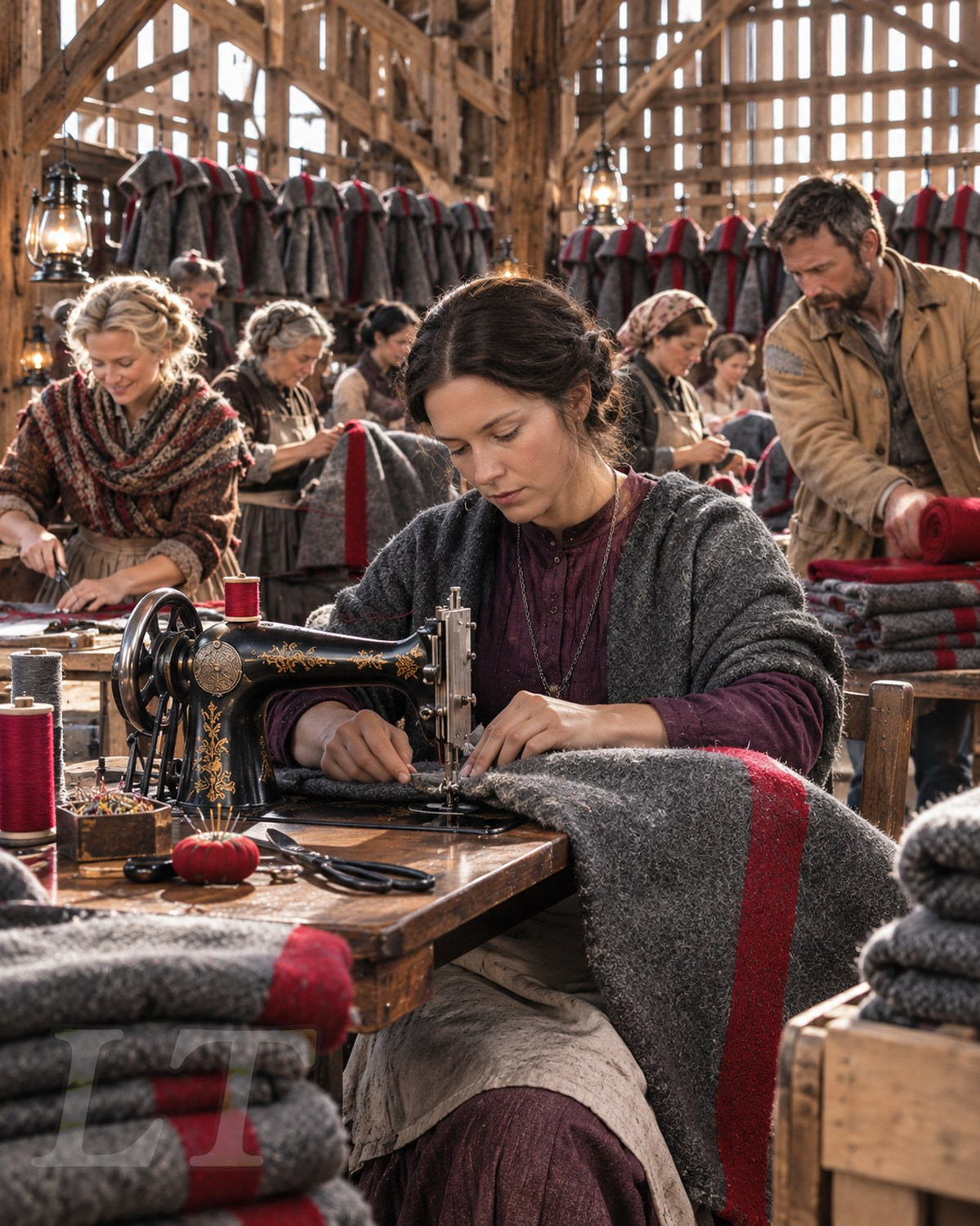
The package beside Odessa's Singer machine was wrapped in brown paper and tied with a piece of ordinary twine.
She stopped at the barn doorway.
Nobody was supposed to be working there before breakfast.
Odessa approached cautiously and noticed a small handwritten note tucked beneath the string.
"For the machine. Thought you might need these."
There was no signature.
She untied the package.
Inside were several spools of thread, a small pair of scissors, two packets of needles, and a neatly folded piece of red flannel.
Odessa picked up the red fabric.
It was good material, thick enough to withstand repeated washing and cold weather.
She ran her fingers across it.
Then she looked toward the barn entrance.
Halvor was standing outside, pretending to inspect a broken fence post.
"Did you leave this here?" she called.
He didn't turn around immediately.
"Leave what?"
Odessa held up the package.
Halvor glanced over his shoulder.
"Colm said you were running low on supplies."
"Did he?"
"He mentioned it."
She smiled.
"And the red flannel?"
Halvor shrugged.
"Couldn't tell you."
But Odessa noticed something.
The man who had complained about the size of her sewing machine had quietly purchased supplies for it.
She didn't embarrass him by asking again.
Instead, she folded the fabric carefully and returned to her work.
"Thank you, Halvor."
He nodded.
Then he went back to the fence.
For the first time since their marriage, Odessa felt that perhaps she hadn't made a mistake by coming west.
To understand why she guarded that machine so fiercely, one had to understand Milwaukee.
Odessa had spent eight years there, working as a seamstress in a small tailoring establishment on the edge of the commercial district.
She had arrived as a young woman with little money, no living parents, and a collection of debts she had inherited after her mother's death.
Her father had been a tailor.
He died when Odessa was seven.
Her mother continued his work, repairing coats, hemming dresses, and sewing shirts for families who could afford to pay.
Odessa learned to handle a needle before she could properly write her name.
By twelve, she was already earning money.
Most of it went toward the household.
When her mother became ill, Odessa began working longer hours.
She remembered one particular winter when her mother couldn't stop coughing.
The boardinghouse room was cold.
The landlord had threatened to remove their stove if the overdue rent wasn't paid.
Odessa had spent three evenings repairing a wealthy merchant's wife's coat.
The woman complained about the price.
She wanted the work done faster.
She wanted better stitching.
And she wanted a discount.
Odessa remembered standing beside the woman's polished front door, holding the finished garment while her own fingers were cracked from the cold.
The merchant's wife had inspected the stitching.
"Acceptable," she said.
Then she handed Odessa a few coins.
Odessa walked home with the money hidden inside her glove.
Her mother was asleep when she returned.
The next morning, the coughing became worse.
By the following month, her mother was gone.
Odessa was nineteen.
The funeral expenses became another debt.
It took her years to repay them.
After that, she never again expected life to become easier simply because she worked hard.
She continued sewing.
One coat became ten.
Ten became a hundred.
Over eight years, she estimated that she had made approximately eleven hundred coats.
Some were expensive wool garments for prosperous families.
Others were modest winter jackets for children.
She knew how to reinforce elbows, replace linings, repair seams, and make worn fabric last another season.
But there was one thing she had never been able to do.
Keep the best of her work for herself.
The customers owned the coats.
The shop owner collected the payments.
Odessa received her wages.
And every winter, she returned to her rented room wearing the same old shawl.
It had been repaired so many times that the original fabric was almost impossible to recognize.
The Singer machine changed that.
She had first seen one in a shop window.
The polished black body and gold decorations had caught her attention.
The machine was beautiful, but its price seemed impossible.
She began making payments.
Five dollars a month.
For three years.
Sometimes she skipped meals.
Sometimes she walked instead of paying for street transportation.
Whenever the shop owner offered extra work, she accepted it.
There were months when she thought she would never finish paying.
Then, one afternoon, the final receipt arrived.
Odessa held it against her chest.
The machine was hers.
Not the shop owner's.
Not a customer's.
Hers.
She could take it anywhere.
She could choose her work.
She could decide whose clothes deserved her attention.
That was why she had brought it to Nebraska.
Not because she intended to turn Halvor's ranch into a commercial tailoring establishment.
But because she had finally acquired something that belonged entirely to her.
In the weeks following her arrival, Odessa settled into the rhythms of ranch life.
She learned when Halvor went to check the cattle.
She learned how Colm preferred his coffee.
She discovered which floorboard creaked outside the bedroom.
And she learned that Halvor spoke very little when he was worried.
That last discovery proved especially useful.
One evening, he returned from town carrying a stack of unpaid bills.
He placed them on the kitchen table.
Odessa noticed his expression.
"Bad news?"
"Nothing new."
He sat down and rubbed his forehead.
"The bank wants another payment before the end of the month."
"Can you manage it?"
"Probably."
He didn't sound convinced.
Odessa continued stirring the soup.
After a moment, she asked, "Would it help if I earned some money?"
Halvor looked up sharply.
"No."
The answer came too quickly.
She turned toward him.
"I wasn't suggesting anything unreasonable."
"I said no."
"Why?"
He pushed the bills into a neat stack.
"Because I brought you here to be my wife, not to work yourself into the ground."
Odessa considered his words.
Then she sat across from him.
"Halvor, I have worked since I was twelve. Sewing isn't something I do because I have no other choice. It's something I know how to do."
"That's different."
"How?"
He didn't answer.
She continued quietly.
"I don't want to spend your money without contributing anything. And I don't want to sit in this house while knowing there are things I could help with."
He looked toward the stove.
"I can provide for my family."
"I never said you couldn't."
For several seconds, the only sound was the bubbling soup.
Then Halvor picked up his fork.
"We'll talk about it another time."
Odessa knew that meant the discussion was over.
She let it go.
But she didn't abandon the idea.
The following afternoon, Colm arrived at the ranch with a sack of feed over his shoulder.
He was struggling with the weight.
Odessa noticed the torn sleeve of his jacket again.
"Colm, have you eaten?"
"Not yet, ma'am."
"Come inside."
"I've still got work."
"Your cattle won't disappear because you eat a meal."
He smiled.
"Yes, ma'am."
While he ate, Odessa examined his jacket.
She had already repaired the worst of the sleeve, but the lining was almost completely gone.
"How old are you?" she asked.
"Nineteen."
"And how long have you worked for Halvor?"
"Almost two years."
"Do you have family nearby?"
Colm looked down at his plate.
"No, ma'am."
Odessa didn't press him.
She understood that some questions could hurt more than they helped.
When he finished eating, she handed him the repaired jacket.
He inspected the stitching.
"That's better than new."
"Not quite. The fabric is still worn."
"It's better than anything I've had in a long time."
He put it on.
Then he stood awkwardly near the door.
"Thank you."
Odessa smiled.
"You're welcome."
As he stepped outside, Halvor entered through the opposite door.
He had heard part of the conversation.
"You've taken a liking to that boy."
Odessa folded the remaining fabric.
"He's a good young man."
"He's quiet."
"So am I, sometimes."
Halvor gave a faint smile.
Then he looked at the repaired jacket.
"Did you make that?"
"I repaired it."
"Looks good."
"It needed attention."
He nodded.
For a moment, Odessa thought he might say something more.
Instead, he picked up his hat and went outside.
A week later, Odessa accompanied Halvor into Plum Bluff.
It was her first proper visit to town since the wedding.
The settlement was small, with a railway station, a general store, a blacksmith's shop, a church, and a schoolhouse.
People greeted Halvor as he passed.
Some nodded.
Others stopped to ask about his cattle.
A few women looked curiously at Odessa.
She understood the curiosity.
News traveled quickly in small towns.
And the rancher's new wife had already become a subject of conversation.
At Pell's Mercantile, she noticed several children standing near the entrance.
One little boy wore a coat that was much too short.
A girl beside him had wrapped a thin shawl around her shoulders.
Another child wore a hat with a hole near the crown.
Odessa slowed her steps.
"Halvor?"
He stopped.
"What is it?"
"Those children."
He followed her gaze.
"They're from the families east of the creek."
"Don't they have proper winter clothing?"
"Some do. Some don't."
She watched the little girl pull her shawl closer.
The fabric barely covered her arms.
Odessa felt something familiar tightening inside her chest.
She had seen that expression before.
The quiet embarrassment of a child who knew other people had more than she did.
Inside Pell's Mercantile, the merchant was arguing with a delivery clerk.
Ezra Pell was a heavyset man in his fifties, with thinning gray hair and spectacles that constantly slipped down his nose.
"Where are my supplies?" he demanded.
The clerk shook his head.
"Railroad bridge is still damaged. The shipment from Omaha hasn't moved."
"How long?"
"Nobody knows."
Ezra slammed a ledger onto the counter.
"I ordered ninety coats and two hundred blankets. Families have already paid deposits."
Halvor approached.
"Still no news?"
"Not a word."
Ezra looked exhausted.
Odessa stepped closer.
"What kind of coats did you order?"
"Heavy winter coats. Children's sizes, women's sizes, men's sizes. The usual."
"And the blankets?"
"Two hundred. More, actually."
She looked toward the empty shelves.
"How long have you been waiting?"
"Long enough to lose my patience."
Odessa considered that.
Then she noticed a small notice pinned to the wall.
A list of winter orders.
Names.
Sizes.
Payments.
Some families had paid in advance.
Others were waiting for credit.
She read through the list slowly.
There were far more children than she had expected.
When she stepped back outside, Halvor was already waiting beside the wagon.
"You've been quiet," he said.
Odessa looked toward the schoolhouse at the far end of the street.
"I was thinking."
"About what?"
"Those children."
Halvor sighed.
"There's nothing we can do about the railroad."
"Perhaps not."
"Ezra's shipment will come eventually."
"Perhaps."
He opened the wagon door.
Odessa climbed inside.
But she continued looking toward the schoolhouse.
She had spent eight years making expensive coats for people who already owned warm houses.
Now she was standing in a town where children were preparing for winter without proper clothing.
For the first time in years, she felt that her sewing might have a purpose beyond earning wages.
That night, Odessa sat beside her Singer machine.
She had placed the small piece of red flannel on the table.
The fabric reminded her of the little girl in town.
She imagined children walking through snow with coats too thin to protect them.
She imagined mothers wrapping old blankets around their shoulders.
She imagined families waiting for a shipment that might not arrive in time.
Then she looked at the machine.
There was still plenty of thread.
Plenty of needles.
And, if she could find suitable material, enough skill to make something useful.
She began writing down measurements and possible designs.
Long coats.
Heavy hoods.
Reinforced sleeves.
Warm linings.
She worked until the lantern burned low.
When Halvor entered the room, he found her surrounded by scraps of paper.
"What are you doing?"
"Planning."
"For what?"
Odessa looked up.
"I think I might have found a way to help the town."
He studied the papers.
Then he noticed the list of children's names she had copied from Ezra Pell's order sheet.
"Odessa, what exactly are you planning?"
She reached for the red flannel.
And before she could answer, someone struck the front door three times.
Halvor turned toward the sound.
Then a woman's frightened voice came through the darkness.
"Mr. Ingram! Please! It's my son..."






Comments 0