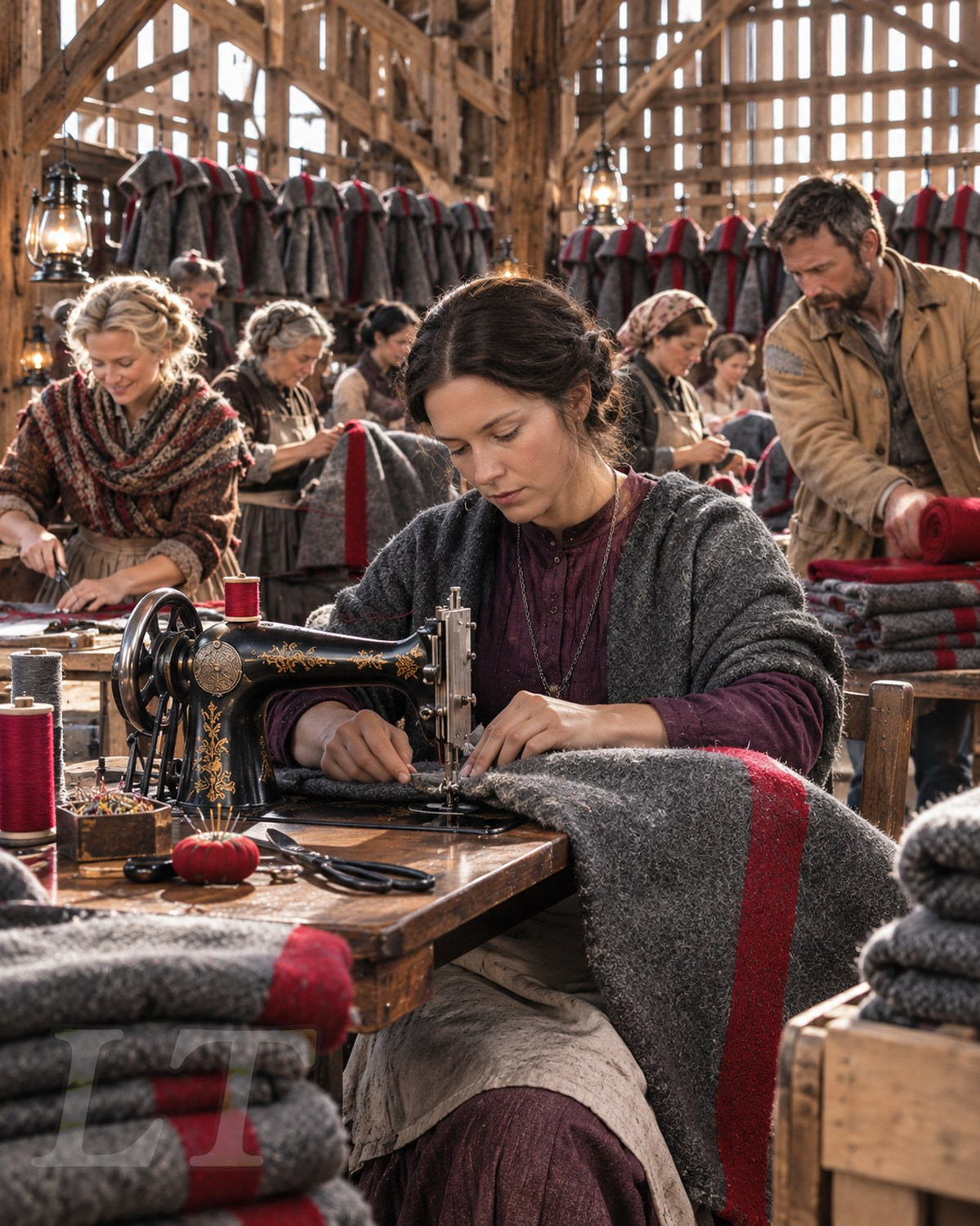
Two porters dropped the enormous wooden crate onto the railroad platform.
"Careful! There's a whole sewing machine in there!"
Odessa Brandt hurried down the train steps.
Halvor Ingram stared at the crate, then at the woman who had just arrived to become his wife.
He looked at the wooden box again.
"Good Lord. What have I gotten myself into?"
The stationmaster, Walter Briggs, rubbed his forehead.
"Mr. Ingram, I believe your bride has brought the entire contents of a furniture store."
Odessa heard him.
She smiled politely, adjusted the collar of her wool coat, and walked toward the three men struggling with the ropes.
"Please don't drag it across the platform," she said. "The cabinet inside is delicate."
Halvor removed his hat.
He was thirty-four years old, tall and broad-shouldered, with a weathered face, tired eyes, and a beard that had begun showing a few premature gray hairs. His brown ranch coat had been patched at the elbows, and his boots carried the dried mud of eleven miles of Nebraska prairie.
He had expected a small suitcase.
Perhaps a hatbox.
Maybe a modest trunk containing a few dresses and whatever personal belongings a woman might consider necessary when marrying a stranger.
He had not expected a wooden crate nearly the size of a coffin.
"Miss Brandt?" he asked.
"Odessa Brandt," she answered, extending her hand. "And you must be Mr. Ingram."
He shook her hand awkwardly.
There was something about her that immediately surprised him. She wasn't trembling, wasn't nervously looking around, and didn't seem particularly frightened by the prospect of marrying a man she had never met.
She looked directly into his eyes.
"Did you have a pleasant journey?" he asked.
"Long, but comfortable enough."
Halvor glanced at the crate.
"And that?"
"My sewing machine."
He waited.
She waited.
Finally, he asked, "You brought a sewing machine?"
"Yes, sir."
"All the way from Chicago?"
"From Milwaukee originally. It traveled with me to Chicago before the final journey."
Halvor slowly lowered his hat.
"I see."
He didn't see at all.
The stationmaster approached them with a folded freight receipt.
"Mr. Ingram, the railway company says this crate requires a separate freight charge. You'll need to sign here."
Halvor took the paper and examined the amount.
His expression changed.
"Miss Brandt, did you know how much it would cost to transport this thing?"
"Yes."
"And you paid it?"
"Every cent."
He looked at her small leather suitcase, then at the enormous crate.
Something uncomfortable began forming in his chest.
He had written to Chicago newspapers because he needed a wife. Someone willing to share the difficult life of a Nebraska rancher.
He had been honest in his advertisement.
He couldn't promise luxury.
He couldn't promise wealth.
He could only offer a modest home, a hardworking husband, and a place where two people might build something together.
He had imagined a woman who understood those conditions.
He had never imagined a woman arriving with expensive machinery.
"Miss Brandt," he began carefully, "perhaps there's been some misunderstanding."
Odessa's expression remained calm.
"What kind of misunderstanding?"
"I wrote for a wife."
"Yes. I read your advertisement."
"Not a business."
She glanced at the crate.
Then she looked back at him.
"Fortunately, Mr. Ingram, a sewing machine doesn't require a separate place at your dinner table."
The stationmaster coughed into his fist.
Halvor didn't laugh.
"That's not what I mean."
"I understand what you mean."
"Do you?"
"I believe so."
Odessa folded her hands in front of her.
"If you don't want me, I'll return east. I won't make a scene, and I won't demand anything from you. But I'd like one day to show you what I can do."
Halvor studied her face.
There was no pleading in her voice.
No attempt to manipulate him.
Only a quiet confidence that seemed strangely out of place on a railway platform in a town where most people measured wealth by the number of cattle they owned.
"One day?" he repeated.
"One day."
He looked at the crate again.
Then he put on his hat.
"Fine. But the machine stays in the barn."
Odessa nodded.
"The barn will do very well."
They were married that morning.
The ceremony took place in the small office of Justice of the Peace Samuel Whitcomb, with Walter Briggs serving as witness.
There were no flowers.
No wedding music.
No elaborate celebration.
Halvor wore his best shirt, although one button was missing near the collar. Odessa wore a modest dark dress with a carefully repaired lace collar and a small brooch that had belonged to her mother.
When the justice asked whether Halvor accepted Odessa as his wife, he hesitated for a fraction of a second.
Then he answered.
"I do."
Odessa gave her answer without hesitation.
"I do."
The justice signed the certificate.
And just like that, two strangers became husband and wife.
Outside, the freight boy had finished securing the enormous crate to Halvor's wagon.
Odessa climbed onto the passenger seat, holding her little suitcase against her knees.
Halvor took the reins.
"Eleven miles," he said.
"I don't mind."
"The road isn't comfortable."
"I've traveled worse."
He glanced at her.
She was looking toward the open prairie.
For the first time since arriving, she seemed to relax.
The town disappeared behind them as the wagon rolled north.
Halvor's ranch stood on a modest stretch of Nebraska land, with a two-room wooden house, a large barn, a cattle enclosure, and several weathered outbuildings.
It was not an impressive property.
The roof needed repairs.
The barn doors hung unevenly.
A section of fencing had collapsed during the previous spring.
And the cattle herd was considerably smaller than it had been two years earlier.
Halvor had lost nearly a third of his animals during the previous winter.
The bank had extended his loan, but the interest continued accumulating.
He had no money for unnecessary purchases.
And now he had a wife with an enormous sewing machine.
When they arrived, a thin young man emerged from the barn.
"Afternoon, Mr. Ingram."
"Afternoon, Colm."
The boy was nineteen, with a narrow face, untidy brown hair, and the slightly guarded expression of someone who had learned not to expect too much from other people.
He noticed Odessa.
Halvor climbed down.
"Colm Rooney. This is Odessa. My wife."
Colm straightened.
"Ma'am."
"How do you do, Colm?"
"Fine, ma'am."
His gaze moved toward the wooden crate.
"What's that?"
"My sewing machine," Odessa answered.
Colm looked impressed.
"That's a big one."
"She seems determined to make sure everyone knows it," Halvor muttered.
Odessa pretended not to hear.
Together, the three of them unloaded her suitcase and arranged for the crate to be moved inside the barn.
Halvor showed her a dry corner away from the cattle stalls.
"There. It won't get wet."
Odessa examined the floor.
The corner was dusty, but the boards were solid. There was a small window, although the glass was cracked.
She smiled.
"It will be perfect."
Halvor wasn't convinced.
"There's not much room."
"I don't need much."
"You'll find the house more comfortable."
"Then perhaps we can move it later."
He nodded, relieved that the discussion appeared to be over.
The first evening was uncomfortable.
Halvor gave Odessa the bedroom and carried his blanket to the wooden bench beside the stove.
She watched him arrange his bedding.
"You don't have to sleep there," she said.
"It's your room."
"It's our room now."
He stopped.
For several seconds, neither spoke.
Then he looked down at the blanket.
"I've slept there before."
Odessa understood that he wasn't ready for anything more.
She didn't argue.
Instead, she unpacked her suitcase and placed her mother's brooch on the small bedside table.
There were only three dresses, two pairs of stockings, a hairbrush, and a small bundle of letters.
That was nearly everything she owned.
She sat on the edge of the bed and listened to Halvor moving around the kitchen.
The house was quiet.
She had imagined this moment many times during the months of correspondence.
A home.
A husband.
A place where she could finally stop living out of rented rooms.
But the reality felt colder than she had expected.
Still, she had not crossed half a continent to surrender at the first sign of difficulty.
The next morning, Odessa began exploring the house.
The curtains were faded.
One chair had a broken seat.
Several shirts hung on a peg beside the kitchen door, each with a missing button or torn seam.
She found a basket of old fabric near the stove.
Then she discovered a tablecloth with a long tear across one corner.
By noon, she had repaired the tablecloth and two shirts.
Halvor returned from the cattle enclosure and stopped in the doorway.
"What happened to those?"
"Nothing. They needed mending."
He examined his shirt.
The stitching was remarkably neat.
"You did this?"
"Yes."
He looked at the basket.
"You've been busy."
"I didn't want to sit idle."
He nodded.
Then his eyes moved toward the barn.
"Have you opened that crate yet?"
"Not yet. I wanted to make sure the cabinet could be carried without damaging it."
"All right."
He hesitated.
"There's something I should tell you."
Odessa looked up.
"I've got debts. More than I'd like. Last winter was hard, and the cattle haven't recovered. I can't promise you'll have everything you might want."
"I didn't expect everything."
"I also can't afford to support a business."
Odessa placed the repaired shirt on the table.
"Mr. Ingram, I didn't marry you because I expected you to make me wealthy."
He looked uncomfortable at the reminder of the distance between them.
"Then why did you answer my advertisement?"
She considered the question.
"Because you asked for honesty and goodwill. Those are things I can offer."
He looked at her for a long moment.
Then he nodded.
"All right."
He turned toward the door.
But Odessa stopped him.
"Halvor?"
It was the first time she had used his given name.
He looked back.
"Yes?"
"I would like to bring the sewing machine into the house eventually. The barn will become too cold once winter arrives."
He glanced toward the window.
"Winter is still some distance away."
"Not as far as you think."
He didn't answer.
Three days later, Odessa finally opened the crate.
Colm helped her remove the wooden boards.
Inside lay the black Singer treadle sewing machine, its gold floral decorations still gleaming beneath a thin layer of packing paper.
The cabinet was made of polished dark wood.
There were spare bobbins, needle bars, small tools, and several carefully wrapped accessories.
Odessa touched the machine gently.
For a moment, she forgot the ranch, the awkward marriage, and the uncertain future.
This machine had carried her through eight years of work.
It had paid for her survival.
And it represented something she had never possessed before.
Ownership.
Colm watched as she inspected the mechanism.
"Does it really work?"
Odessa smiled.
"Of course."
She placed the machine on the wooden stand, arranged the treadle, and carefully threaded the needle.
Then she pressed her foot against the pedal.
The wheel began turning.
The needle moved.
A familiar mechanical rhythm filled the barn.
Colm's face brightened.
"That's something."
"Would you like to see?"
He nodded.
Odessa picked up a small piece of scrap fabric and stitched a straight line.
Then she folded the fabric and showed him the seam.
Colm examined it with genuine admiration.
"My mother used to sew," he said quietly.
Odessa looked at him.
"Did she?"
He nodded.
"Before she died."
She didn't ask anything more.
Instead, she handed him the small piece of fabric.
"Keep it."
He accepted it carefully.
"Thank you, ma'am."
From the barn doorway, Halvor watched them.
He had come outside intending to repair a broken fence.
Instead, he found Colm smiling at a machine he had initially considered an unnecessary expense.
He watched Odessa guide another piece of fabric beneath the needle.
For the first time, he began wondering whether he had misunderstood the woman he had married.
But he still couldn't imagine what she intended to do with that machine.
And Odessa hadn't yet told him.
That evening, as she prepared supper, Odessa noticed Colm standing near the kitchen door.
He was wearing the same old jacket.
The left sleeve had a hole in it, and the lining was hanging loose.
She had seen it earlier, but now that the evening air was turning colder, she noticed something else.
The boy was trying to hide his bare wrist inside the torn sleeve.
"Colm?"
He looked up.
"Yes, ma'am?"
"May I see your jacket?"
He glanced down.
"It's all right."
"I didn't ask whether it was all right."
He gave an embarrassed smile.
Odessa held out her hand.
Reluctantly, he removed the jacket.
She examined the damage.
The elbow was nearly worn through, the lining had separated from the outer fabric, and the left sleeve was badly torn.
"This needs more than a small repair."
"I know."
"How long have you been wearing it?"
Colm shrugged.
"Long enough."
Odessa looked at him.
Then she folded the jacket over her arm.
"I'll see what I can do."
"You don't have to, ma'am."
"I know."
He hesitated.
"Thank you."
When Halvor entered the kitchen a few minutes later, he found Odessa examining the torn sleeve beneath the lamplight.
"That's Colm's jacket," he said.
"Yes."
"He'll need a new one eventually."
"Perhaps."
Halvor placed his gloves on the table.
"Odessa, you don't have to spend your time repairing every torn thing on this ranch."
She looked up.
"I know."
He studied her expression.
There was something different in her eyes.
Something he hadn't seen on the railway platform.
A quiet determination that made him suspect she had already begun planning something much bigger than a repaired jacket.
Odessa carefully folded the fabric and placed it beside the sewing machine.
Then she looked toward the window.
Outside, the first cold wind of the season rattled the loose barn door.
She knew the boy needed more than a repaired sleeve.
And she knew that before winter arrived, there would be many more people who needed something the ranch could not afford to buy.
But the following morning, when Odessa walked into the barn to begin Colm's coat, she discovered that someone had left an unfamiliar package beside her Singer machine...






Comments 0