Halvor stared at the document.
His name appeared beneath Elias Brandt's original signature.
For several seconds, he seemed unable to understand what he was seeing.
"That's impossible," he whispered.
Nathaniel Brandt stood so abruptly that his chair scraped against the courtroom floor.
"That document is fraudulent!"
The judge struck his desk.
"Mr. Brandt, you will remain seated."
Edmund Brandt placed both hands on the witness stand.
"It is genuine. I watched Elias prepare it. I was there when he signed it, and I witnessed the agreement myself."
Odessa turned toward her husband.
"Halvor, did you know my father?"
He shook his head.
"I never met him."
Edmund nodded.
"That is true. Elias never met Halvor personally. But he knew his father, August Ingram."
The name made Halvor look up.
"My father?"
"Yes. August owned a small freight business in Nebraska. He helped Elias arrange the transportation of sewing equipment and wool shipments. When Nathaniel began stealing from the partnership, August offered to help your father establish an independent business."
Edmund explained that Elias had wanted to establish a manufacturing and sewing cooperative in the West. He intended to give the business to the people who needed it most, rather than allow Nathaniel to control it.
August Ingram had agreed to become a trustee.
When August died, his rights passed to Halvor.
The agreement did not make Halvor a personal debtor or require him to pay Nathaniel anything. It made him a legal beneficiary of the original business arrangement.
Nathaniel had known about the agreement.
That was why he had spent years trying to locate the original documents.
But he had never expected them to end up in Odessa's sewing machine.
Edmund placed another paper before the judge.
"This is the original transfer record. It confirms that Elias retained his ownership interest for his wife and daughter, while August Ingram was appointed trustee for the western cooperative."
The judge examined the seal.
Then he compared it with the document Nathaniel had presented.
The difference was unmistakable.
Nathaniel's agreement was a forgery.
And the truth was finally in the courtroom.
The hearing continued for several hours.
Thomas Vickers testified about the missing business funds.
Ezra Pell admitted that Nathaniel had paid him to deliver the package to Elias's house.
Dr. Silas Whitcomb's written confession was presented alongside his original medical notes.
Margaret Doyle described the events she had witnessed that night.
Edmund confirmed the authenticity of the original partnership agreement.
Finally, the judge addressed Nathaniel directly.
"Mr. Brandt, the evidence indicates that you misappropriated partnership funds, concealed commercial records, submitted a fraudulent ownership agreement, and attempted to obtain property that did not legally belong to you."
Nathaniel's attorney requested additional time.
The judge refused to dismiss the inquiry.
He ordered the disputed assets protected and referred the suspected financial fraud and falsification of records for criminal investigation.
Nathaniel's confidence disappeared.
He looked toward Odessa.
"You have no idea what you've done."
Odessa stood.
"Yes, I do."
She glanced at the papers.
"I have finally stopped you from taking what belongs to other people."
Nathaniel looked toward Halvor.
Then he turned to Edmund.
"You should have stayed away."
Edmund's expression remained calm.
"I stayed away long enough."
The sheriff approached Nathaniel and escorted him from the courtroom.
For the first time in years, he could no longer use money, threats, or carefully prepared documents to silence the people who knew the truth.
Odessa watched him leave.
She didn't feel victorious.
She felt relieved.
Her father could finally rest without his name being used to justify another man's greed.
The legal proceedings continued over the following weeks.
Nathaniel's forged agreement was formally rejected.
The original business records established that he had diverted partnership funds for his own benefit.
The court recognized Odessa's inheritance rights and Halvor's position as trustee under the original agreement.
The Singer sewing machine was confirmed as Odessa's property.
Her payments to the Milwaukee dealer were recognized as genuine, and the earlier commercial transaction did not invalidate her ownership.
The disputed wool blankets were also released after the supplier failed to establish a valid claim against Ezra Pell's purchase.
Ezra voluntarily surrendered the profits from the questionable transactions and cooperated with the investigation.
His testimony helped establish the chain of events surrounding Elias's death.
Dr. Silas Whitcomb admitted that he had falsified the death certificate under Nathaniel's pressure.
Although the exact poison could no longer be conclusively identified, the evidence established that Elias had suffered suspicious symptoms after receiving the package delivered by Ezra.
Nathaniel was eventually convicted of financial fraud, document forgery, and conspiracy connected to the theft of the partnership assets.
His involvement in Elias's death remained a separate criminal matter, but his role in arranging the delivery and concealing the medical evidence was formally documented.
Silas lost his medical standing.
Ezra faced consequences for his involvement but continued cooperating with the authorities.
And the Brandt business records were finally restored to their rightful owners.
Odessa received the inheritance her father had protected for her.
But she made a decision that surprised everyone.
She did not want a luxurious home in Milwaukee.
She did not want to spend the rest of her life collecting profits from a business she had never operated.
She wanted to build the cooperative Elias had imagined.
And she wanted to build it in Nebraska.
When Odessa returned to Plum Bluff, the entire town gathered outside Pell's Mercantile.
Dagny Lindquist was the first to embrace her.
"Well?"
Odessa smiled.
"We won."
The women cheered.
Ezra came forward, looking uncertain.
"Mrs. Ingram, I owe you an apology."
Odessa looked at him.
"You do."
He lowered his head.
"I know."
She allowed the silence to remain for a moment.
Then she said, "You cannot change what happened to my father. But you can help make sure the people of this town never suffer because of another man's greed."
Ezra nodded.
"I will."
He offered the use of his storeroom for additional fabric and supplies.
Odessa accepted, but she insisted that every purchase and donation be recorded openly.
There would be no hidden accounts.
No secret agreements.
No single person controlling everything.
The cooperative would belong to the people who worked in it.
The first meeting took place in the barn loft.
Twenty-three women attended.
Halvor had spent the previous week repairing the roof, strengthening the floor, and installing additional windows.
Colm helped carry benches from the ranch house.
Thomas brought the original business records.
Edmund traveled from Milwaukee to witness the establishment of the cooperative.
And Clara Whitmore sat beside Odessa.
The room smelled of fresh lumber, wool, and machine oil.
Odessa stood before the women.
"I came to Nebraska with one sewing machine and a small trunk," she began.
Dagny smiled.
"I remember the crate."
Everyone laughed.
Odessa continued.
"I thought I was bringing the only thing I owned that nobody could take away from me. I didn't understand that I was also bringing something that could belong to an entire community."
She placed her father's original agreement on the table.
"This cooperative will provide work, training, and winter clothing. Every woman who contributes will receive fair payment. Every family that cannot afford a coat will be considered without shame."
She looked around the room.
"We will keep our accounts open. We will make our decisions together. And no child in Plum Bluff will have to face winter wearing a coat that cannot keep them warm."
The women began applauding.
Then Halvor stepped forward.
He placed a small wooden sign beside the Singer machine.
It read:
THE BRANDT-INGRAM COMMUNITY WORKSHOP.
Odessa touched the lettering.
Her father's name.
Her husband's name.
And the place where their lives had finally come together.
Winter arrived in Nebraska with bitter winds.
The railroad shipment from Omaha remained delayed longer than expected, but the cooperative was no longer dependent on it.
The women had organized their own supply system.
Farmers donated wool.
Merchants contributed buttons and thread.
Families brought old garments that could be repaired or transformed.
Ezra arranged regular deliveries.
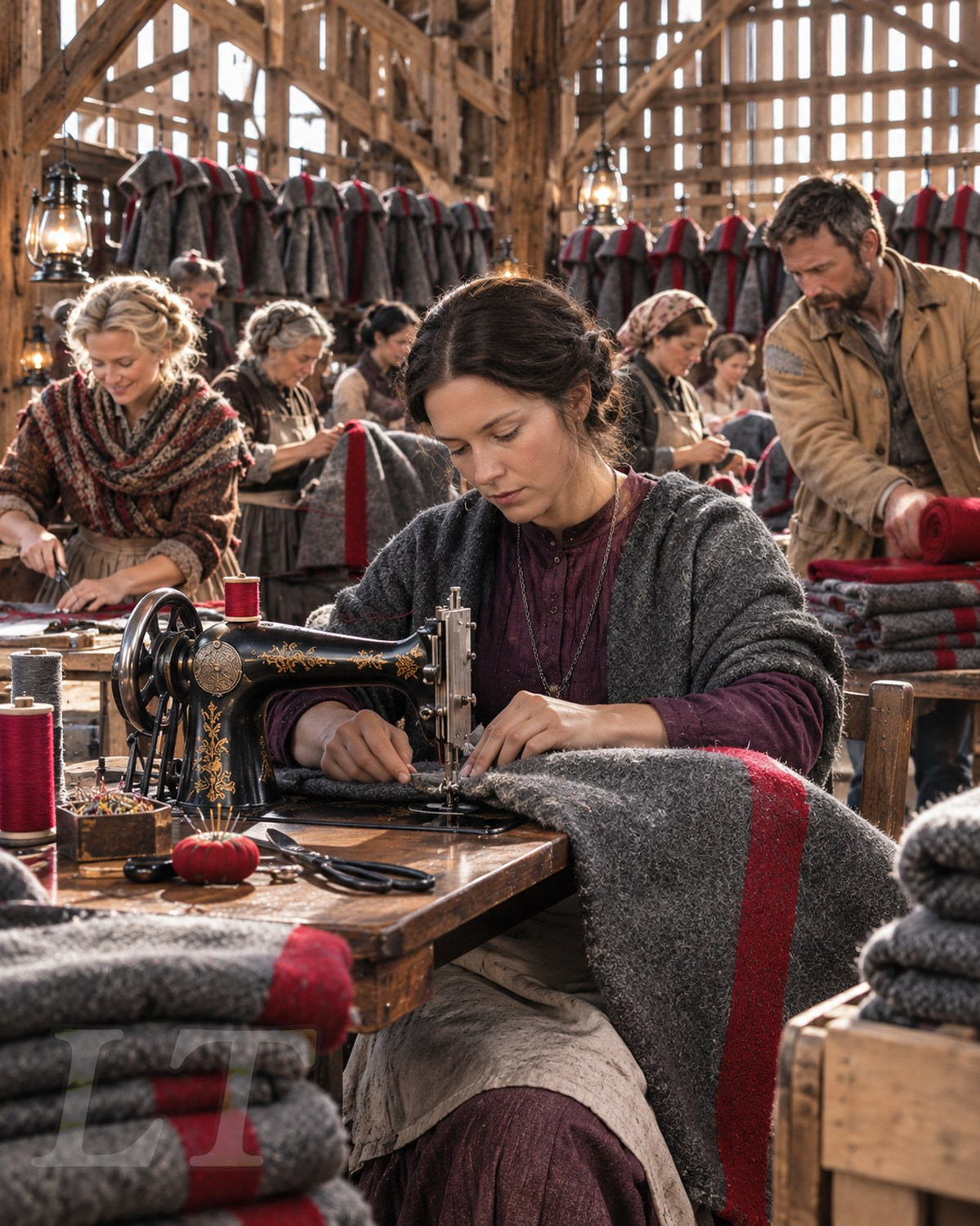
The workshop began producing coats, blankets, gloves, and children's clothing.
The red-striped gray coats became especially popular.
Odessa insisted that every coat intended for children traveling through snow carry the distinctive red marking on the back of its hood.
The idea had begun as a simple precaution.
Now the entire town understood its importance.
Colm supervised the distribution of finished garments.
He also became the first young man trained to operate the sewing equipment.
At first, some townspeople laughed when they saw him working beside the women.
Colm ignored them.
He had once worn a torn jacket with a hole through its sleeve.
Now he helped make coats for children who had never owned anything warm enough for a Nebraska winter.
One afternoon, a little boy tried on his first finished coat.
He looked down at the red stripe.
"Will I be easy to find in the snow?"
Odessa smiled.
"Very easy."
The boy ran toward his mother.
And Odessa remembered the night Halvor had found Colm beneath the snow.
She silently thanked the idea that had saved him.
Clara remained in Plum Bluff.
She rented a small room near the workshop and gradually became part of the community.
Odessa did not immediately call her mother.
The relationship required time.
There were questions that needed answers, memories that hurt, and years that could not be recovered.
But Clara never demanded forgiveness.
She helped sort fabric, repaired children's clothing, and quietly supported the women whenever they needed assistance.
One afternoon, she brought Odessa a small wooden box.
Inside were several letters from Elias.
They were letters he had written during Odessa's childhood but never managed to deliver.
Odessa opened the first.
My little girl,
I hope you are growing strong. I hope you are learning to read and that you still enjoy watching your mother sew.
One day, I will tell you why I had to stay away. Until then, remember that you were never forgotten.
Odessa held the letter against her chest.
She read every page.
Some contained stories about his tailoring work.
Others described the house he hoped to build.
In one, he mentioned a garden with apple trees.
In another, he described a large kitchen where Clara and Odessa could work together.
The final letter ended with a promise.
I will come home to you.
Odessa cried.
Clara sat beside her.
"I'm sorry," she whispered.
Odessa took her hand.
"I know."
It was not the same as getting her childhood back.
But it was the beginning of something honest.
Halvor's ranch also began to recover.
The cooperative provided a steady source of income, and the money inherited through the original business agreement allowed him to settle his outstanding debts.
He repaired the barn, replaced the damaged fencing, and purchased additional cattle.
But the greatest change was not financial.
The house no longer felt like a place where two lonely people happened to live together.
It had become a home.
Halvor no longer slept on the bench beside the stove.
Odessa's belongings occupied the bedroom.
Her father's photograph stood on the mantel.
And the sound of the Singer machine filled the evenings.
One night, Halvor found her sitting beside the window, repairing a small child's coat.
"You know," he said, "when I first saw that enormous crate at the station, I nearly sent you back."
Odessa laughed.
"I remember."
"I thought you had brought enough equipment to open a factory."
She looked at him.
"And now?"
He walked over and kissed her forehead.
"Now I think that crate was the best thing that ever arrived at my ranch."
She smiled.
"Better than your new cattle?"
"Much better."
She laughed again.
Then he placed a small velvet box on the table.
Inside was a simple gold ring.
"I know we married quickly," he said. "And I know our beginning wasn't exactly romantic. But I would choose you again, Odessa Brandt Ingram. Every single time."
Her eyes filled.
"You don't need to ask me twice."
He slipped the ring onto her finger.
And this time, when he kissed her, there was no uncertainty between them.
By the following spring, the cooperative had grown beyond anything Odessa had imagined.
Women from neighboring districts traveled to learn sewing techniques.
Several widows found reliable employment.
Young girls learned to mend clothing and operate the machines.
The business expanded to include quilts, work garments, and durable winter coats.
The town established a small emergency clothing fund.
Every year, before the first snowfall, the cooperative delivered warm garments to families who needed them.
The red-striped coats became a familiar sight throughout the district.
Colm, now twenty years old, managed deliveries and trained new apprentices.
Ezra became a trusted supplier, although he never forgot the mistake he had made.
Thomas returned to Milwaukee after helping establish the cooperative's legal structure.
Edmund continued overseeing the remaining business matters.
And Justice Samuel Whitcomb ensured that the original documents were preserved in a secure legal archive.
Nobody could secretly claim the business again.
On October 2, 1889, exactly two years after Odessa stepped off the train at Plum Bluff, the town gathered in the newly completed workshop.
The building had large windows, sturdy wooden floors, and enough space for several sewing machines.
A small American flag hung beside the entrance.
Above the main door was a wooden sign:
BRANDT COMMUNITY SEWING WORKS.
Odessa stood beside Halvor.
Clara sat in the front row.
Dagny, Margaret, and the other women filled the benches.
Ezra stood near the back.
Colm had brought several children who had received coats during the previous winter.
Odessa looked around the room.
She remembered the enormous wooden crate.
The suspicious stationmaster.
Halvor's patched coat.
The two-room ranch house.
The cold barn.
The first coat she had made for Colm.
And the storm that had nearly taken twenty-three children.
She had arrived believing she needed a home.
Instead, she had helped build one for an entire town.
Halvor stepped beside her and offered his hand.
She took it.
The applause began.
Odessa looked toward the children.
Each wore a warm gray coat with a bright red stripe down the back.
They were laughing.
They were safe.
And they would never have to wonder whether anyone cared enough to keep them warm.
Later that evening, after the guests had gone, Odessa returned to the original Singer machine.
It stood in a place of honor near the front window.
She ran her fingers across its polished wooden cabinet.
For years, she had believed it represented freedom because it was something she had earned herself.
Now she understood that its greatest value had never been the money it could make.
It had given her a way to turn loneliness into friendship, hardship into opportunity, and a frightened little town into a community that looked after its own.
Halvor entered carrying two cups of coffee.
"Ready to go home?"
Odessa smiled.
"Almost."
She placed her father's final letter inside the small drawer beneath the machine.
Then she switched off the lantern.
Outside, the Nebraska evening was peaceful.
Halvor held the door open.
Odessa stepped beside him, wearing the gold ring he had given her.
For the first time in her life, she no longer had to choose between belonging somewhere and being free.
She had both.
And in the home she had built with the man who once almost sent her away, there was always room for one more person, one more coat, and one more chance.






Comments 0