The rider held out the envelope.
"Are you Odessa Brandt?"
She stood beside Halvor's wagon, her fingers tightening around the reins.
"Yes. Who sent you?"
The man removed his hat.
"He asked me to deliver this personally. Said you would understand when you saw the handwriting."
Odessa accepted the envelope.
The paper was thick, expensive, and sealed with dark red wax.
Her father's name appeared across the front.
Elias Brandt.
For several seconds, she simply stared at it.
Halvor climbed down from the wagon.
"Open it."
She broke the seal.
Inside was a single sheet of paper.
Odessa,
Your father left unfinished business. His brother has been searching for you for years. He knows about the Singer machine, and he knows where the original purchase records are hidden.
Do not sign anything presented by Nathaniel Brandt.
He is not the only person who has a claim to your father's estate.
There was no signature.
Odessa read it again.
Then she turned the paper over.
Three words had been written at the bottom.
Ask your mother.
Her face went pale.
"My mother is dead," she whispered.
Halvor took the letter.
He read it carefully.
"Whoever wrote this knows about your family."
"And knows something my mother never told me."
He looked toward the ranch house.
"Then perhaps it's time we found out what she was keeping from you."
That night, Odessa opened her wooden trunk again.
She placed every letter from her mother on the bed.
There were eleven in total.
Some contained ordinary family news.
Others mentioned bills, sewing work, and the difficulties of keeping their small household running.
She had read them countless times.
But now she examined every sentence differently.
She searched for names.
Dates.
References to her father's business.
Anything that might explain the mysterious documents.
Halvor sat nearby, silently turning the pages of the letter from Omaha.
"Do you remember your uncle?" he asked.
Odessa shook her head.
"I was too young. My mother said he lived somewhere in Illinois. She never spoke about him."
"Did your father have brothers?"
"She mentioned one older brother, but she always changed the subject whenever I asked."
Halvor placed the letter down.
"Perhaps your uncle wasn't dead after all."
Odessa looked at him.
"Why would my mother lie?"
He didn't answer.
She picked up a small envelope from the bottom of the trunk.
It was addressed to her in her mother's handwriting.
Unlike the others, it had no date.
The envelope was sealed.
Odessa hesitated.
"Why didn't I open this before?"
Halvor looked over.
"Perhaps you weren't ready."
She carefully broke the seal.
Inside was a small brass key.
There was also a note.
My darling girl,
If the day ever comes when someone claims your father's property, take this key to the old tailor's shop on Water Street in Milwaukee. Ask for the locked cabinet behind the cutting table.
Your father left something there for you.
I wanted to protect you from the trouble surrounding his brother. I hope you never need this key.
Mother.
Odessa read the note twice.
Then she closed her eyes.
Her father had left something behind.
Something important enough for her mother to hide.
And now somebody wanted the Singer machine.
The next morning, Odessa showed the letter to Halvor.
He examined the brass key.
"Water Street. Milwaukee."
She nodded.
"That's where my father worked."
"How far is it?"
"Several days by train."
Halvor looked toward the window.
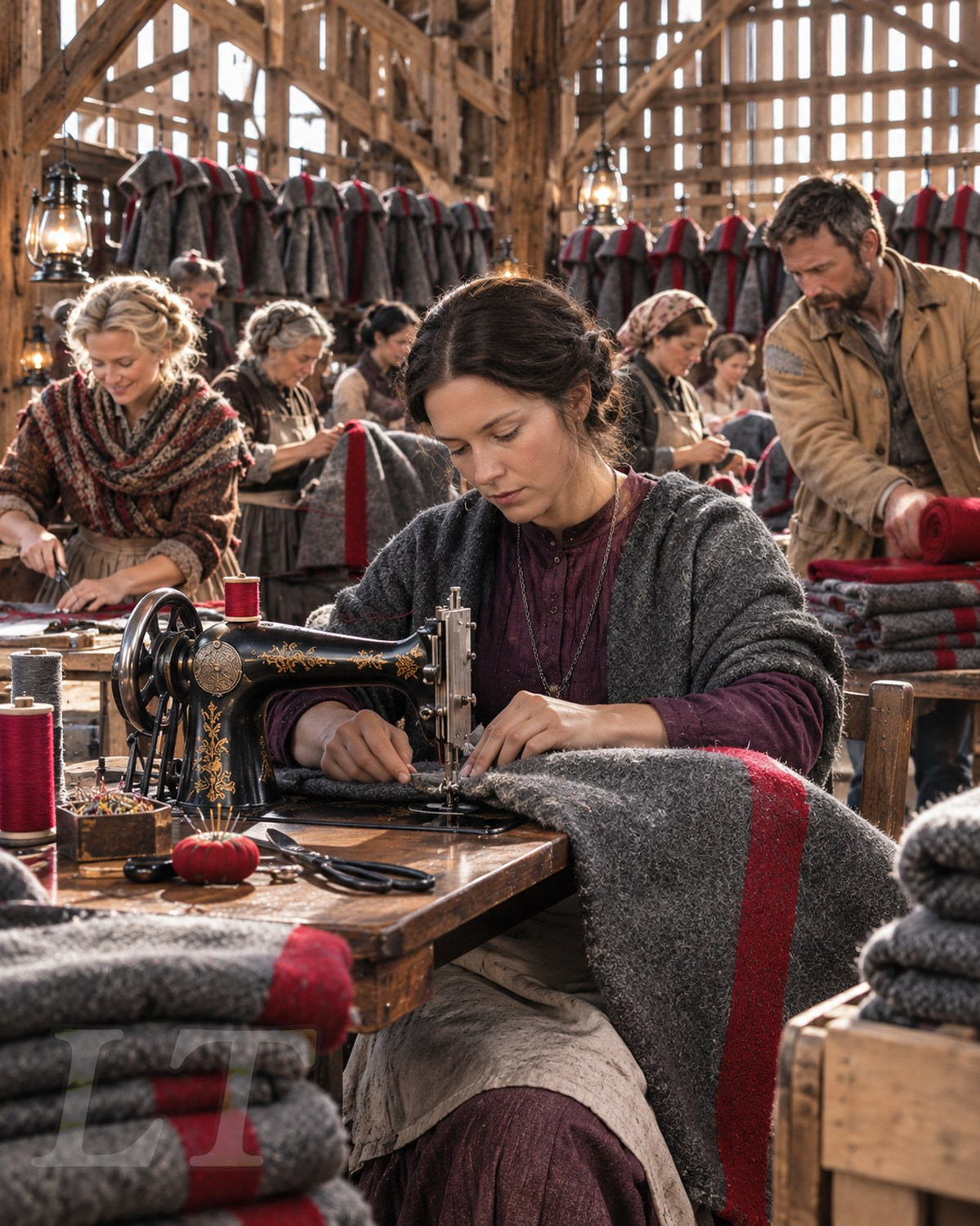
The barn workshop was already filled with women preparing fabric.
The first sample coats were almost complete.
The children still needed winter clothing.
And the legal dispute over the blankets remained unresolved.
He understood what she was thinking.
"You cannot leave right now."
Odessa looked at him.
"I know."
"Those women need you."
"I know."
He placed the key on the table.
"But we also need answers."
She looked down.
For a long moment, neither spoke.
Then Halvor said something she hadn't expected.
"I'll go."
Odessa raised her eyes.
"What?"
"I can take the train to Milwaukee, find the shop, and bring back whatever your father left."
She shook her head.
"You don't know my family."
"I know enough."
"But what if the cabinet is gone?"
"Then I'll find out who bought the building."
"What if your name gets involved in this dispute?"
Halvor gave a faint smile.
"My name is already involved. I'm your husband."
Odessa reached for his hand.
"Thank you."
He squeezed her fingers.
"But there's one condition."
She waited.
"When I come back, you tell me everything you remember about your father. Even the smallest detail."
She nodded.
"I will."
Meanwhile, Silas Crowe was having a very different conversation in Omaha.
He sat across from Nathaniel Brandt in a private office above a commercial warehouse.
Nathaniel was sixty-one years old, with neatly combed silver hair, a narrow face, and an expensive black suit.
He looked like a man accustomed to getting what he wanted.
Silas placed a folder on the desk.
"She received the letter."
Nathaniel opened it.
"From whom?"
"The delivery man couldn't identify the sender."
Nathaniel's jaw tightened.
"Then someone else knows."
Silas nodded.
"Apparently."
Nathaniel examined a copy of the Singer purchase receipt.
"Did she show any interest in the machine?"
"She refused to sign the agreement."
"Of course she did."
Nathaniel placed the paper down.
"How much does she know?"
"She knows her father's name appeared on the original auction documents. She also knows the machine's ownership is disputed."
"Does she know about the cabinet?"
Silas hesitated.
"I don't believe so."
Nathaniel stood and walked toward the window.
Outside, freight wagons moved between the warehouses.
"That machine is not worth much by itself," he said.
Silas looked confused.
"Then why insist on taking it?"
Nathaniel turned.
"Because Elias was a careful man. He would never have allowed a valuable document to remain unsecured."
"You believe the papers are hidden inside the machine?"
"I believe my brother was foolish enough to think he could hide everything from me."
Silas opened another folder.
"There is also the matter of the blankets."
Nathaniel returned to his desk.
"Those blankets are a distraction. If the sewing machine changes hands, the rest becomes considerably easier."
"And if Odessa refuses?"
Nathaniel smiled without warmth.
"Then we'll make her understand what refusing costs."
Back in Plum Bluff, Odessa continued organizing the workshop.
She had decided not to tell the women everything.
There was no reason to frighten them before she understood the situation.
Instead, she explained that the ownership dispute was being investigated.
The women agreed to continue using donated materials.
Dagny was especially determined.
She had brought several pieces of old flannel from home.
"My youngest has outgrown two dresses," she explained. "I thought we could use the fabric for lining."
Odessa examined it.
"This is lovely."
"It's worn in places."
"We can work around that."
Margaret arrived shortly afterward.
She brought a box of buttons.
Then Ellen came with thread.
By noon, the workshop was busy again.
The Singer machine moved steadily.
Odessa watched the women working.
She realized something important.
The workshop no longer depended entirely on her.
The women were learning to organize the work themselves.
They were beginning to trust one another.
And even if the legal dispute became worse, the idea could survive.
She felt proud.
Then Dagny approached with a folded newspaper.
"Mrs. Ingram, have you seen this?"
Odessa looked at the page.
It was an advertisement from an Omaha company.
A notice announced the recovery of government surplus merchandise.
The advertisement listed several items.
Among them were two hundred and sixty gray wool blankets.
Odessa read the notice twice.
The date was from the previous week.
"Where did you get this?"
"My husband found it at the station."
Odessa looked at the bottom.
There was a name.
Nathaniel Brandt.
Her uncle had publicly claimed the blankets.
That afternoon, Ezra Pell arrived at the ranch.
He looked angry.
"Mrs. Ingram, we have a problem."
Odessa met him at the barn entrance.
"What happened?"
He handed her a letter.
The Omaha company had issued a formal demand.
It required him to return the blankets within five days.
If he failed, the company would seek an injunction preventing their use or sale.
Ezra rubbed his forehead.
"I spoke with the justice of the peace. He says the company may have grounds to stop the project until ownership is established."
Odessa looked at the letter.
"Can they take them immediately?"
"Not without proper proceedings. But they can make things difficult."
Halvor had been preparing to leave for Milwaukee.
He approached them.
"What do they want?"
Ezra handed him the notice.
Halvor read it.
Then he looked at Odessa.
"Perhaps we should stop cutting the material."
She nodded.
"I agree."
Ezra looked devastated.
"What about the children?"
"We'll continue using donated fabric and whatever materials are not part of the dispute."
He lowered his voice.
"Mrs. Ingram, I don't know how to thank you for trying."
She looked at him.
"Don't thank me yet."
She handed the letter back.
"We haven't finished."
That evening, Halvor prepared for his journey.
He packed a small bag, a spare shirt, and the brass key.
Odessa placed her father's photograph inside his coat pocket.
"Show this to anyone who might recognize him."
Halvor examined the photograph.
"Your father looks like a serious man."
"He was. But he laughed more than I do."
Halvor smiled.
"That's difficult to imagine."
She playfully pushed his shoulder.
Then her expression became serious.
"Be careful."
"I will."
"And don't sign anything."
"I won't."
She looked toward the Singer machine.
"Whatever you find, don't let anyone take it."
Halvor nodded.
"I promise."
They stood together beside the barn door.
For the first time since their marriage, they were about to spend several days apart.
Odessa had become accustomed to his quiet presence.
She had learned the sound of his footsteps, the way he placed his hat beside the door, and how he always checked the stove before going to bed.
Now the house would feel different.
He kissed her forehead.
"I'll be back before you know it."
Two days later, a letter arrived from Milwaukee.
Odessa recognized the handwriting immediately.
It was Halvor's.
She opened it beside the kitchen table.
Odessa,
I found the building. It is still standing, although the original tailor's shop is now occupied by a furniture dealer.
The owner remembers your father.
He also remembers the cabinet.
Odessa continued reading.
The key fits.
Her hands began trembling.
I haven't opened the cabinet yet. The shopkeeper says something was placed inside shortly after your father's death.
He also told me something I think you should know.
Odessa swallowed.
Your father did not die owing money to his brother.
She read the sentence again.
Then she reached the final paragraph.
The shopkeeper recognized the name Nathaniel Brandt. He says Nathaniel came to the shop the night your father died and demanded the cabinet key.
Odessa stopped breathing for a moment.
She looked toward the window.
Outside, Colm was carrying firewood.
Everything appeared ordinary.
But the letter had changed everything.
Her father had not simply left behind an unfinished business arrangement.
Someone had been searching for something since the night he died.
And now that person was trying to take her machine.
That night, Odessa sat alone in the barn.
The Singer machine stood beneath the lantern.
She ran her fingers across its polished surface.
She remembered the three years she had spent paying for it.
The meals she had skipped.
The long evenings she had worked by candlelight.
The day she had finally received the receipt.
She had believed the machine represented freedom.
Now she wondered whether it had been connected to her father's unfinished business all along.
A soft knock came from the barn door.
Colm stepped inside.
"Mrs. Ingram?"
She quickly folded the letter.
"Yes?"
"There's a man outside."
"Who?"
"I don't know."
Colm looked nervous.
"He says he's a relative of yours."
Odessa stood.
"Did he give you his name?"
The boy shook his head.
"He asked whether Mr. Ingram was home."
Odessa walked toward the door.
"Where is he?"
"Waiting beside the gate."
She looked outside.
A black carriage stood in the yard.
A tall man was standing beside it.
He wore a dark overcoat and carried a silver-topped walking stick.
His face was older than the photograph she remembered.
But the eyes were unmistakable.
Odessa stepped onto the porch.
The stranger removed his hat.
"Odessa."
She couldn't move.
He looked at her with a faint, almost familiar smile.
"My dear niece. I believe it's time we discussed your father's estate."
Then he extended his hand.
And behind him, a second man stepped down from the carriage carrying a small wooden box bearing the name Elias Brandt...






Comments 0