Thomas Vickers stared at the name on the paper.
"That man is still alive."
Odessa gripped the letter.
"Who is he?"
Thomas glanced toward Halvor before answering.
"Dr. Silas Whitcomb. He was the physician who attended your father during his final illness."
Odessa went pale.
"Justice Whitcomb?"
"No. His older brother. They both practiced medicine in Milwaukee, although Silas eventually moved west."
Halvor leaned closer.
"What did he have to do with Nathaniel?"
Thomas lowered his voice.
"Everything."
The lantern flickered above them.
Odessa looked down at the letter again.
Her father had died when she was seven.
For years, she had believed he had succumbed to a sudden illness. Her mother had told her that the doctor came too late and that nothing could have been done.
Now she was learning that the physician who signed the death certificate might have helped her uncle steal her father's business.
"Are you telling me my father was murdered?" she whispered.
Thomas shook his head.
"I cannot prove that. But I can tell you that the official account of his death never matched what I witnessed."
Halvor stepped forward.
"Then tell us what happened."
Thomas sat on the wooden bench.
And for the first time since arriving in Nebraska, he began speaking about the night Elias Brandt died.
It had been a cold evening in Milwaukee.
Elias had spent the afternoon reviewing business accounts when he discovered that several thousand dollars were missing.
He immediately suspected Nathaniel.
The brothers argued in the office.
Thomas had been present.
Nathaniel insisted the money had been used to purchase additional equipment.
Elias demanded receipts.
Nathaniel refused.
The argument became so heated that a clerk from the neighboring office came to investigate.
Eventually, Nathaniel stormed out.
Elias remained behind, visibly shaken.
"He told me he was going to see a lawyer the following morning," Thomas explained. "He intended to dissolve the partnership and report the missing money."
Odessa listened without moving.
"What happened afterward?"
"Your father went home. I left shortly after him."
Thomas rubbed his hands together.
"At around ten o'clock, I received a message that Elias had collapsed. When I arrived, Dr. Whitcomb was already there."
"Was my mother with him?"
"Yes. She was crying."
Thomas paused.
"The doctor told her Elias had suffered a sudden heart attack. He said there was nothing anyone could have done."
Odessa swallowed.
"Was that true?"
"I don't know. But I remember something strange."
"What?"
"Your father was conscious when I arrived."
Halvor frowned.
"You said he had collapsed."
"He had. But he was still able to speak."
Thomas looked directly at Odessa.
"He asked for the business ledger. He wanted me to make sure Nathaniel never got it."
Odessa's fingers tightened around the letter.
"Did you?"
Thomas lowered his head.
"I tried."
The following morning, Thomas continued.
He had gone to the office and discovered that the original ledger was missing.
Nathaniel claimed Elias had destroyed it.
The physician signed the death certificate.
The police recorded the death as natural.
And within three weeks, Nathaniel had presented documents transferring several business assets into his own name.
Thomas had challenged the transfer.
But he lacked the original ledger and could not prove the missing money.
"I should have fought harder," he said.
Odessa looked at him.
"You were only one man."
"I was supposed to protect your father."
"You couldn't have known what would happen."
Thomas shook his head.
"Your father trusted me with everything."
Halvor placed a hand on his shoulder.
"Then help us finish what he started."
Thomas looked up.
For the first time, he seemed relieved.
"I will."
The next morning, Odessa visited Justice Samuel Whitcomb.
She brought the letter and asked whether he knew his brother.
Samuel examined the document carefully.
"Silas Whitcomb," he said. "He practiced medicine in Milwaukee before relocating to Omaha."
"Do you know where he lives?"
"Not precisely. But I know he has maintained professional connections with several physicians in Nebraska."
Odessa placed the death certificate on the desk.
Samuel compared the signature.
"This appears genuine."
"Could the death certificate have been falsified?"
The justice leaned back.
"It is possible for a document to be authentic while the information contained in it is inaccurate."
Odessa nodded.
"How do we prove it?"
Samuel removed his spectacles.
"We would need medical records, witness statements, and ideally the testimony of someone who examined your father that night."
"Thomas Vickers was there."
"Then his testimony matters."
Samuel returned the document.
"But Mrs. Ingram, I want you to understand something. An accusation this serious must be supported by evidence. Do not confront anyone without proper preparation."
Odessa thanked him.
As she stood to leave, he called her back.
"One more thing."
She turned.
"Your uncle Nathaniel has already contacted my office."
Her stomach tightened.
"What did he want?"
"He requested copies of the documents concerning your father's estate."
"Did you give them to him?"
"No."
Samuel looked toward the window.
"But he also asked whether you had discovered the name of the physician who signed the death certificate."
Odessa froze.
"Why would he ask that?"
Samuel's expression became grave.
"Because he knows exactly what you're investigating."
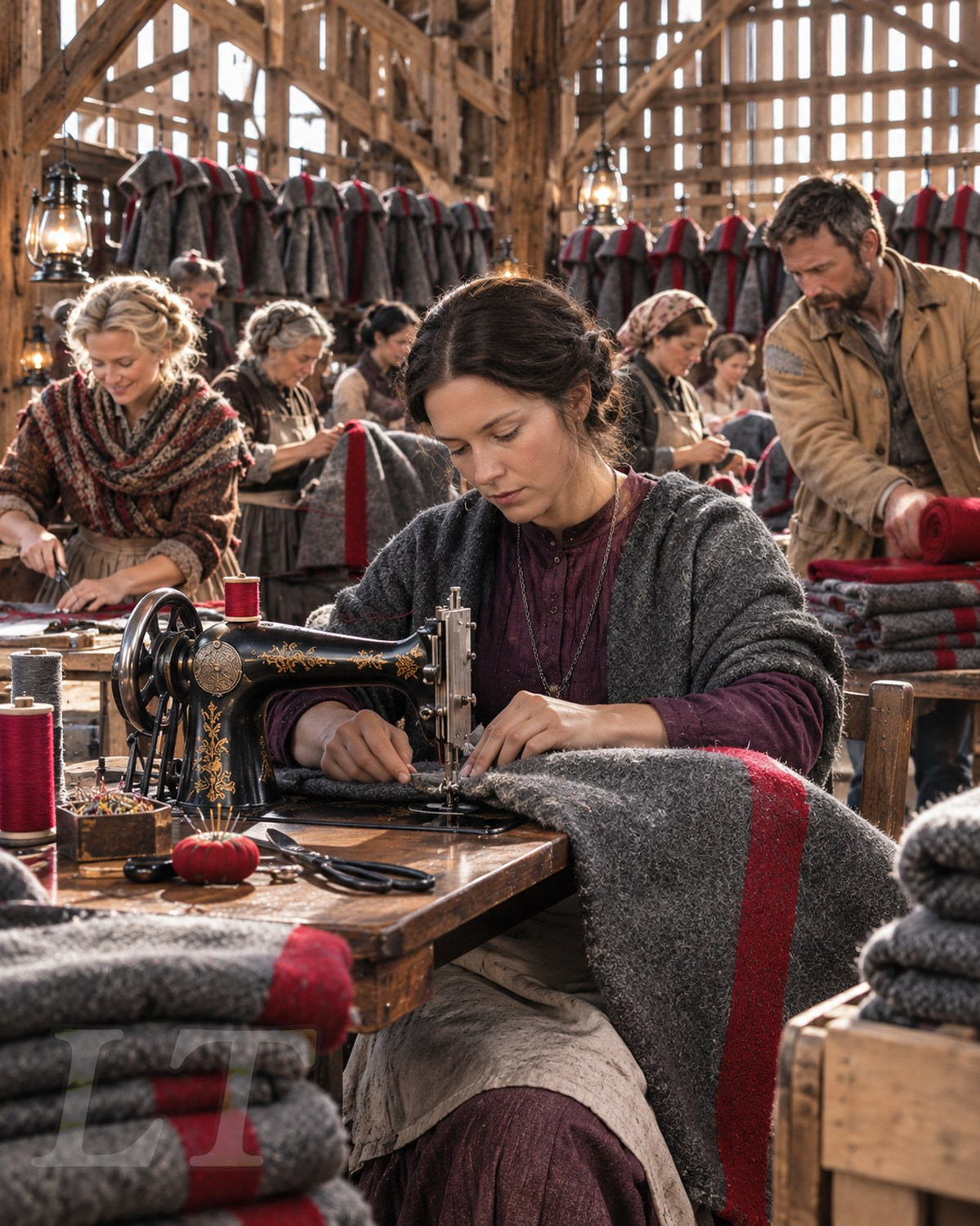
Back at the ranch, the workshop was busier than ever.
The women had completed twenty-seven coats using donated fabric and materials that were not subject to the ownership dispute.
Dagny was organizing the finished garments.
Margaret inspected the seams.
Ruth was cutting patterns for the younger children.
Odessa entered carrying a basket of thread.
Dagny immediately noticed her expression.
"Bad news?"
"Not exactly."
Odessa explained what Thomas had revealed.
The women listened quietly.
When she finished, Margaret shook her head.
"Some people will do anything for money."
Dagny looked toward the Singer.
"Is that why your uncle wants the machine?"
"Possibly."
Ruth folded a piece of fabric.
"Then we should make sure he never gets it."
Odessa smiled faintly.
"I intend to."
Colm entered carrying a bundle of wood.
"Mrs. Ingram, the north window needs another board."
"Thank you, Colm."
He placed the wood down.
Then he noticed the papers on the table.
"Is that about the sewing machine?"
Odessa nodded.
Colm looked uncomfortable.
"Can I tell you something?"
"Of course."
"Yesterday, I saw a man near the barn."
Halvor, who had just entered, immediately turned.
"What man?"
"I don't know. He was standing by the fence. When he noticed me, he walked away."
Odessa frowned.
"What did he look like?"
"Dark coat. Tall. He had a walking stick."
Halvor exchanged a glance with her.
Nathaniel.
He had been watching the ranch.
That afternoon, Halvor inspected the barn.
He checked the doors, windows, and locks.
He also moved the Singer machine away from the front window.
Odessa watched him.
"Do you think Nathaniel would actually try to take it?"
Halvor tightened a bolt.
"I think a man who points a gun at an elderly witness is capable of almost anything."
She looked toward the machine.
"Then perhaps we should hide the documents somewhere else."
Thomas, who was sitting at the table, shook his head.
"No. Your father deliberately chose that cabinet."
"Why?"
"Because nobody would think to search inside a sewing machine that appeared to belong to an ordinary working woman."
Odessa looked at the Singer.
Her father had understood the value of appearances.
He had hidden the evidence in the one object his brother would never expect a poor young seamstress to possess.
But there was still a question.
Why had Nathaniel allowed her to buy it?
Thomas answered before she asked.
"Because he believed you would never discover the connection."
Odessa felt a chill.
"And when he realized I had the machine?"
"He began looking for it."
Two days later, a telegram arrived from Milwaukee.
It was addressed to Thomas.
He opened it in front of Halvor and Odessa.
The message was from Walter Finch, the elderly shopkeeper.
It contained only a few lines.
Found additional correspondence in the cabinet. Elias wrote to Silas Whitcomb three days before his death. Letter mentions an urgent meeting and a warning about Nathaniel.
Thomas read the telegram twice.
"There's more."
Odessa leaned forward.
"What does it say?"
He continued.
The original letter is damaged but readable. It contains the words: 'If anything happens to me, the doctor must tell the truth.'
Halvor looked at Odessa.
"That's enough to justify finding Silas."
Thomas nodded.
"Yes. And I know someone who may be able to locate him."
The following day, Thomas left for Omaha.
He planned to contact the medical association and request information about Silas Whitcomb.
Odessa remained at the ranch.
She had too much work to abandon the workshop.
The children still needed coats.
The railroad shipment remained delayed.
And Ezra Pell was facing increasing pressure from the company demanding the blankets.
But Odessa had begun to notice something.
People were talking.
Not about the legal dispute.
About the workshop.
Families were arriving with donations.
A local carpenter offered to build additional cutting tables.
A church group sent flannel scraps.
Even several men who had initially doubted Odessa's plan began volunteering to transport finished coats.
The project had become something larger than she had imagined.
And the red stripes were becoming its unmistakable symbol.
On January 3, 1888, Ezra Pell arrived with unexpected news.
He had received a letter from the Omaha supplier.
The company was willing to withdraw its demand for the blankets under one condition.
Odessa would have to surrender the Singer machine.
Halvor read the offer.
Then he laughed bitterly.
"They still haven't given up."
Ezra looked worried.
"They're offering to release the blankets immediately if she signs."
Odessa placed the letter on the table.
"And if I refuse?"
"They'll proceed with the legal action."
She considered the offer.
The blankets could produce enough coats for dozens of families.
But the machine was hers.
It was also the only object that contained the original ownership records.
She looked at Halvor.
He shook his head.
"Don't sign."
Odessa nodded.
"I won't."
Ezra sighed.
"I thought you might say that."
He placed another paper on the table.
"This came with the offer."
Odessa unfolded it.
At the bottom was Nathaniel's signature.
Above it was a sentence that made her blood run cold.
If Odessa Brandt refuses, the company will pursue a claim against the entire Ingram property.
Halvor read it.
His face hardened.
"He's threatening the ranch now."
Odessa folded the paper.
"Then he has made his decision."
That evening, Thomas returned from Omaha.
He looked exhausted.
But he carried a leather folder.
"I found Silas Whitcomb."
Odessa stood immediately.
"Where?"
"In a private residence outside the city."
"Did he agree to speak?"
Thomas nodded.
"He did. But he gave me something first."
He opened the folder.
Inside was a handwritten statement signed by the physician.
It described the night Elias Brandt died.
Thomas placed it on the table.
Odessa began reading.
According to the statement, Elias had not suffered a natural heart attack.
He had been conscious when the physician arrived.
He had complained of severe abdominal pain and difficulty breathing.
The doctor had suspected poisoning.
But before he could complete an examination, Nathaniel had arrived with a signed authorization demanding that the body be released to the family.
Silas had refused.
Then Nathaniel had threatened to destroy his medical career.
The physician claimed he had been frightened.
He had signed the death certificate under pressure.
Odessa slowly lowered the paper.
"My father was poisoned?"
Thomas nodded.
"Silas believes he was."
Halvor clenched his fists.
"Did he identify the substance?"
"Not conclusively. But he kept his original examination notes."
Odessa looked at the folder.
"Where are they?"
Thomas hesitated.
"With him."
"Then we need to bring him here."
Thomas shook his head.
"He refuses to leave Omaha until he has protection."
Halvor looked toward the door.
"We can arrange that."
Thomas nodded.
"But there's something else."
He removed a second document.
It was a letter from Nathaniel, dated two days after Elias's death.
The letter contained a payment instruction.
A substantial sum had been transferred to a private account belonging to Silas Whitcomb.
Odessa stared at the signature.
Her uncle had paid the doctor.
And the payment had been made before the estate documents were transferred.
For the first time, the evidence was beginning to form a complete picture.
Then Thomas turned over the final page.
A handwritten note appeared on the back.
It was not from Nathaniel.
It was from Silas.
I have kept the original medical record hidden for five years. But I cannot keep it any longer.
Below that sentence was another line.
The person who delivered the poison to Elias was not Nathaniel.
Odessa looked up.
"Who was it?"
Thomas swallowed.
He pointed to the final name.
And Odessa suddenly recognized the handwriting.
It belonged to someone who had been working beside her in Plum Bluff.
Someone who knew about the Singer machine.
Someone who had visited the ranch repeatedly.
Ezra Pell.






Comments 0