"Every family who paid for those coats is demanding their money back," Ezra Pell said.
Odessa stared at the document in his hands.
Dagny Lindquist stood beside him, twisting her gloves nervously.
"How much money are we talking about?" Odessa asked.
Ezra opened the paper.
"Nearly three hundred dollars in deposits. Some families paid everything upfront. Others borrowed money from relatives because they believed those supplies would arrive before winter."
Halvor stepped closer.
"And now?"
"Now they want their money returned."
Ezra lowered his voice.
"I don't blame them. They've waited long enough. But if I refund everyone immediately, I'll have trouble keeping the store open."
Odessa examined the names on the document.
She recognized the Lindquist family.
She recognized the Bells.
She recognized the Rooneys.
Then she noticed something else.
Several families had paid for children's coats months earlier.
Those children were still waiting.
"Mr. Pell," she said carefully, "how much money do you have available to purchase replacement supplies?"
Ezra gave her a tired look.
"Not enough to replace ninety coats, two hundred blankets, and everything else that was supposed to arrive."
"Then perhaps we shouldn't try to replace the shipment."
Halvor turned toward her.
"Odessa."
She looked at him.
"I'm not suggesting we spend money we don't have."
Ezra folded his arms.
"What are you suggesting?"
She glanced toward the barn, although it was several miles away.
"The blankets in your storeroom."
Ezra sighed.
"We've already discussed those."
"Yes. But now we have a reason to put them to use."
He shook his head.
"Mrs. Ingram, I appreciate your determination, but those blankets won't magically become ninety coats."
"No," Odessa replied. "They'll become something better if we use them properly."
Halvor studied her face.
He recognized that expression now.
She had already made up her mind.
And when Odessa Brandt made up her mind, she rarely abandoned an idea simply because somebody told her it was difficult.
Ezra led them into his office.
He placed the document on the desk and began explaining the financial situation.
The original order had included ninety winter coats, two hundred blankets, and several smaller items.
Families had paid deposits totaling almost three hundred dollars.
Ezra had used part of that money to secure the shipment.
The railroad delay had created another problem.
The supplier in Omaha had refused to guarantee a replacement delivery date.
And the railway company had not agreed to reimburse the merchant for the damaged transportation arrangements.
"People think I'm keeping their money," Ezra said.
"Are you?" Halvor asked.
Ezra looked offended.
"Not a cent."
He opened his ledger.
"Every payment is recorded. Every order is listed. I've spent twenty-six years building this business. I'm not going to ruin my name over a shipment that never arrived."
Odessa understood.
Ezra wasn't a wealthy man.
His store was the center of the community, but much of his money was tied up in merchandise, outstanding accounts, and credit extended to local families.
If he returned every deposit immediately, he might lose the ability to purchase the supplies that kept his business operating.
"What if we offered the families something else?" Odessa asked.
Ezra looked up.
"Something else?"
"Handmade winter coats. Made from your surplus blankets."
He leaned back.
"How many?"
"I don't know yet."
"That's the problem."
Odessa took out her notebook.
"I would like to test the material first. If it works, we can calculate how many coats we can produce."
Ezra looked at Halvor.
"Does she always work like this?"
Halvor gave a small smile.
"Apparently."
Odessa ignored them.
"There's something else. I don't want the families to feel they're being forced to accept something they didn't order. We should explain the situation honestly and let them choose."
Ezra nodded slowly.
That was reasonable.
He looked down at the list of names.
"Some of these people have children who cannot wait until spring."
"Then we should begin immediately."
He studied her for a long moment.
Finally, he reached for the storeroom key.
"Come along. I'll show you exactly what you've gotten yourself into."
The two hundred and sixty blankets occupied almost the entire rear wall of Ezra's storeroom.
They were government-surplus wool blankets, originally purchased at a public sale.
Most were charcoal gray.
Some were lighter.
A few had faded patches from years of storage.
They weren't beautiful.
They weren't fashionable.
And they certainly weren't the kind of merchandise that attracted wealthy customers.
But Odessa saw something different.
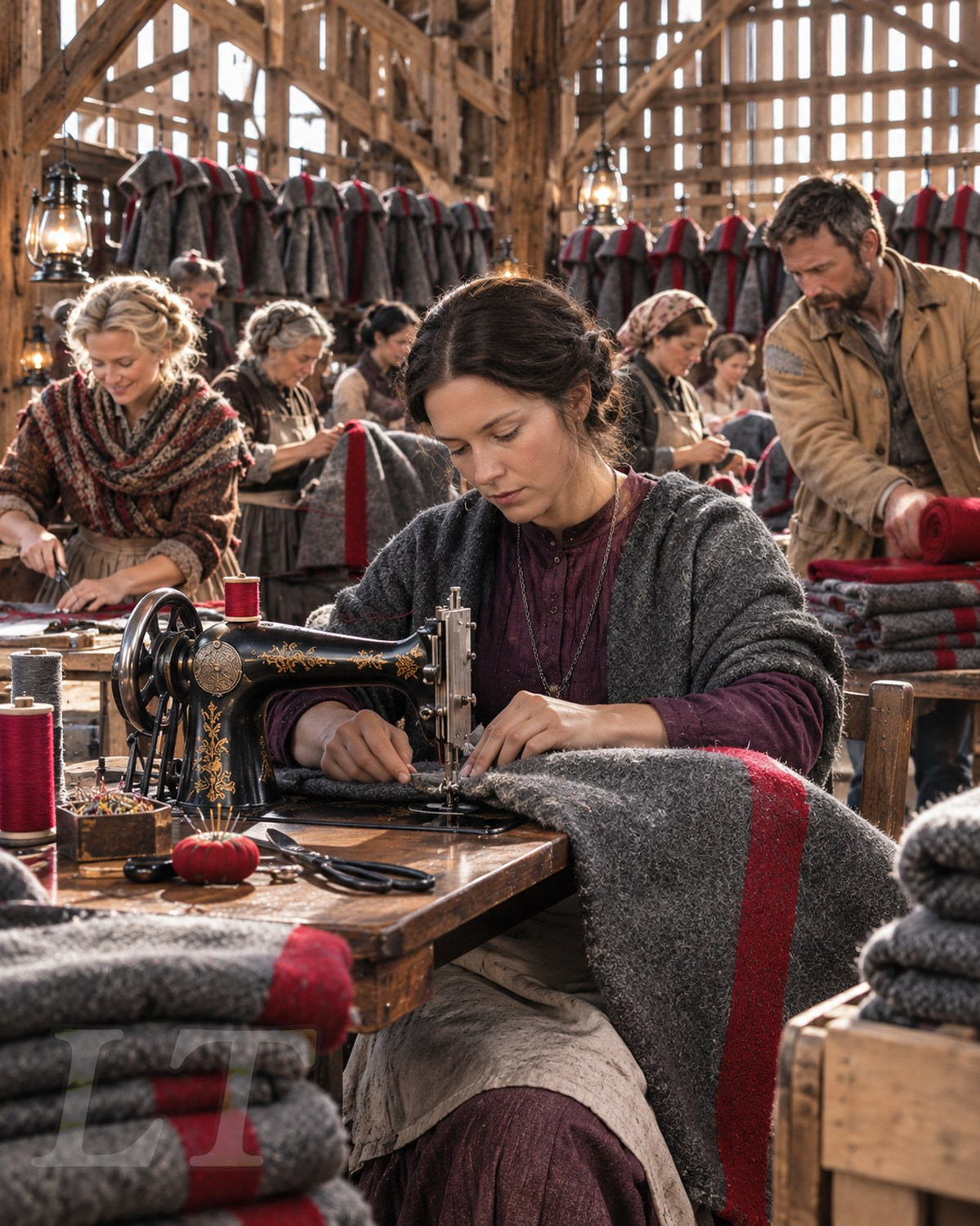
She unfolded one blanket across a long wooden table.
Then another.
She examined the thickness, the weave, and the condition of the edges.
"These are good," she murmured.
Ezra crossed his arms.
"They've been sitting there for two years."
"Because people were looking at them as blankets."
"And you aren't?"
"I'm looking at them as material."
She measured the first blanket.
Then she measured the second.
She took out her pencil and began making notes.
The fabric was heavy enough to provide warmth.
It could withstand repeated use.
And although it wasn't particularly soft, it could be lined with donated flannel.
Odessa began calculating the number of pieces required for each coat.
A long adult coat needed a substantial amount of material.
Children's coats required less, but they needed additional reinforcement because children often played outdoors and wore through their elbows and knees.
She drew several patterns.
Then she stopped.
"Mr. Pell, do you have any smaller pieces of flannel?"
"Some. Not much."
"Would you be willing to sell them at cost?"
He nodded.
"We can discuss that."
"And buttons?"
"Plenty."
"Thread?"
"Depends on how much you need."
Odessa smiled.
"More than you probably want to hear."
For the first time that morning, Ezra laughed.
They spent nearly two hours examining the blankets.
Odessa separated them into three groups.
The first contained the strongest blankets, suitable for adult coats.
The second contained slightly thinner material that could be used for children's garments.
The third contained damaged blankets that would need to be cut into smaller sections for cuffs, collars, pockets, and reinforcement.
She wrote everything down.
When she finished, Ezra examined the list.
"You're proposing to use all two hundred and sixty?"
"If the condition is as good as the samples, yes."
"And you believe you can make enough coats?"
"I believe we can make a considerable number."
He shook his head.
"That's not quite the same thing."
"No," she agreed. "But I won't promise more than I can deliver."
Halvor had remained quiet throughout the inspection.
Now he stepped forward.
"How much space will you need?"
Odessa looked at him.
"Quite a bit."
"How many tables?"
"At least three."
"Chairs?"
"Six to start."
He nodded.
"I can arrange that."
Ezra looked between them.
"Have you two already decided?"
Halvor glanced at his wife.
"We're discussing it."
Odessa smiled.
It was the closest thing to an agreement she had received from him.
Before leaving the store, Odessa asked Ezra to bring out the first blanket from the damaged pile.
She wanted to test the fabric on her Singer machine.
He found one with a torn corner and several worn patches.
Odessa examined it carefully.
"This will do."
She folded it over her arm.
Ezra watched her.
"You're taking that home?"
"Only to make a sample."
"How long?"
"Two days."
He nodded.
"All right."
Then he handed her another folded piece of fabric.
"This is some old flannel. Nobody wants it because the color has faded."
Odessa opened it.
The fabric was a muted burgundy.
She smiled.
"Perfect for lining."
Ezra raised an eyebrow.
"You really can make something out of anything, can't you?"
Odessa looked at the material.
"My mother used to say that a good seamstress never wastes fabric."
For a moment, her expression changed.
She remembered her mother sitting beside a small window, carefully saving even the smallest pieces of cloth.
Odessa folded the flannel.
"I suppose I learned from the best."
That afternoon, she returned to the ranch.
Halvor helped unload the blankets.
He carried the largest one into the barn while Colm cleared a space near the workbench.
"What are all these for?" Colm asked.
"Winter coats," Odessa replied.
The boy looked at the pile.
"All of them?"
"Eventually."
Colm whistled.
"That's a lot of sewing."
"Yes."
He looked toward the Singer machine.
"Are you going to make them all yourself?"
Odessa laughed.
"I would need several lifetimes."
Halvor placed the last blanket on the table.
"That's why she's planning to recruit help."
Colm looked interested.
"I could help."
Odessa turned toward him.
"You already have enough work."
"I can still do something."
She considered his offer.
"Perhaps you could help prepare the fabric. But you'll need to learn how to cut it properly."
Colm nodded eagerly.
"All right."
Halvor shook his head.
"Don't let him near the good scissors."
Colm grinned.
"Yes, sir."
For the next hour, they sorted the blankets.
Odessa inspected every piece.
Colm removed the old bindings.
Halvor moved the heavier bundles into the loft.
The barn gradually began looking less like a storage building and more like a place where something important might happen.
That evening, Odessa prepared her first sample.
She selected a blanket from the strongest pile and spread it across the cutting table.
She had already drawn the pattern.
The coat would be long enough to cover the hips.
The sleeves would be wide.
The collar would rise high around the neck.
The hood would be deep enough to protect the ears and the back of the head.
She reinforced the shoulders.
She strengthened the elbows.
Then she added a thick lining.
The machine worked steadily beneath her hands.
Halvor sat nearby repairing a leather strap.
Colm was sorting buttons into small wooden boxes.
The barn was quiet except for the rhythm of the Singer and the occasional sound of the lantern chain moving in the draft.
After nearly three hours, Odessa finished the first coat.
She held it up.
It was plain.
No decoration.
No unnecessary trimming.
Just thick gray wool, a burgundy lining, and strong seams.
Halvor approached.
"That's better than I expected."
Odessa smiled.
"Thank you."
He touched the sleeve.
"Feels warm."
"It should."
Colm examined the collar.
"Can I try it?"
"Not yet. It's too large for you."
He laughed.
"I was only asking."
Odessa folded the coat over a chair.
Then she reached for the red flannel.
She measured five inches across.
She cut a long strip.
Halvor watched her.
"Another stripe?"
"Yes."
"On every coat?"
"That's what I'm considering."
He looked toward Colm's coat hanging nearby.
"Because of the snow?"
Odessa nodded.
"Because I don't want anyone disappearing in it."
Halvor looked at the red fabric for a long moment.
Then he nodded.
"Make it visible."
The next morning, Odessa went into town to speak with the women she hoped would join her.
She began with Dagny Lindquist.
Dagny was standing outside her house, shaking a rug.
When she saw Odessa approaching, she immediately put it down.
"Mrs. Ingram!"
"Good morning."
"Have you spoken to Mr. Pell?"
"I have."
"And?"
Odessa explained the plan.
She told Dagny about the surplus blankets, the coats, and the possibility of turning the barn into a workshop.
Dagny listened carefully.
When Odessa finished, she looked toward the neighboring fields.
"How many women do you need?"
"Six to begin with."
Dagny didn't hesitate.
"I'll help."
Odessa smiled.
"Thank you."
"I can't promise I'm good at sewing."
"That's all right. There are plenty of other things to do."
Dagny looked relieved.
"I can cut fabric, prepare linings, and help with the children."
"That would be wonderful."
Then Dagny lowered her voice.
"There's something else you should know."
Odessa waited.
"Some women are angry with Mr. Pell. They think he should refund everything immediately."
"I understand."
"They may not believe your plan is genuine."
Odessa nodded.
"Then we'll show them what we're doing."
Dagny looked at her.
"You really think this will work?"
Odessa smiled.
"I think it's worth trying."
Over the following days, Odessa visited several homes.
She spoke with Margaret Hayes, a widow who had once worked in a clothing shop.
She spoke with Ellen Foster, whose husband repaired wagons.
She also approached Ruth Callahan, a mother of four who was particularly skilled at cutting fabric.
Not everyone agreed immediately.
Some women were worried about their own children.
Others didn't trust the idea of working without knowing whether the coats would be completed.
A few were simply exhausted.
Odessa listened to every concern.
She didn't promise money she didn't have.
She didn't promise that every family would receive a coat immediately.
Instead, she explained exactly what they could accomplish if they worked together.
And slowly, people began volunteering.
Dagny offered to organize the materials.
Margaret agreed to inspect finished seams.
Ellen volunteered to prepare buttons and linings.
Ruth offered to teach the others how to cut the thick wool without wasting it.
By the end of the week, Odessa had six women willing to help.
Six women.
One sewing machine.
Two hundred and sixty blankets.
And a town that desperately needed warm clothing.
Ezra Pell agreed to sell the blankets at his original purchase cost.
He also offered thread, buttons, and lining material on credit, with payment to be settled after the first coats were completed.
But he insisted on one condition.
Every family that had paid for the original shipment would receive an honest explanation.
Odessa agreed.
They arranged a meeting at the schoolhouse.
Parents gathered after lessons ended.
Some looked worried.
Others looked angry.
Ezra stood near the front with his ledger.
Odessa stood beside him.
She explained the damaged railroad bridge, the missing shipment, and the proposed replacement plan.
A man near the back raised his hand.
"What guarantee do we have that you'll actually finish these coats?"
Odessa looked directly at him.
"None, sir. Not yet."
The room became quiet.
She continued.
"But I can show you the first coat. I can show you the material. And I can show you the women who have volunteered to help."
Dagny stepped forward.
"So have I," she said.
Margaret followed.
Then Ellen.
One by one, the women stood beside Odessa.
The atmosphere changed.
A mother holding a small child raised her hand.
"Will you make one for my daughter?"
Odessa smiled.
"If we have enough material and the measurements are right, we'll do our best."
The woman looked down at her little girl.
"She's five."
"Then she'll be one of the first measurements we take."
A murmur passed through the room.
For the first time, the plan felt possible.
That evening, Halvor returned from the northern pasture and found the barn loft completely rearranged.
Three tables stood near the windows.
Six chairs had been placed around them.
A long wooden bench held folded blankets.
The old broken window had been repaired.
And a lantern hung from the central beam.
He stopped at the entrance.
Odessa was standing on a stool, trying to reach a wooden shelf.
"Careful," he called.
She turned.
"I've got it."
The stool shifted.
Halvor crossed the room and caught her arm.
"That's what everyone says just before falling."
She laughed and stepped down.
He looked around.
"You've done quite a bit."
"We're starting tomorrow."
He examined the tables.
"Six women?"
"Six to begin with."
"And the children?"
"We'll take measurements this weekend."
Halvor nodded.
Then he looked toward the Singer machine.
Its polished black body reflected the lantern light.
He remembered the day it had arrived.
He remembered thinking the enormous crate was an unreasonable burden.
Now the machine stood at the center of a project that might keep dozens of families warm.
He looked at Odessa.
"I owe you an apology."
She turned.
"For what?"
"For thinking that machine was a waste of space."
Odessa smiled.
"Perhaps you were simply waiting to see what it could do."
He nodded.
Then he reached into his coat pocket and placed something on the table.
It was a small leather purse.
Odessa looked at it.
"What's that?"
"Some money. Not much."
She opened it.
There were several dollars inside.
"Halvor..."
"It's for the supplies."
"But we agreed—"
"I know what we agreed."
He looked slightly uncomfortable.
"I've been saving it for the barn repairs. Those can wait."
Odessa closed the purse.
For a moment, she couldn't find the right words.
Then she reached for his hand.
"Thank you."
He squeezed her fingers.
The first official workshop session was scheduled for the following morning.
Odessa had barely slept.
She had spent the evening preparing patterns, checking needles, arranging thread, and labeling the blankets.
At sunrise, she entered the loft and lit the lanterns.
The Singer machine waited on the table.
The first gray blanket lay folded beside it.
She touched the red flannel strip.
Then she heard voices outside.
The women were arriving.
Dagny came first, carrying a basket of sewing supplies.
Margaret followed with a bundle of old cloth.
Ellen brought two loaves of bread.
Ruth arrived with a pair of heavy scissors and a measuring tape.
Soon all six women were inside.
For the first time, the barn was filled with conversation, laughter, and the sound of people working toward the same purpose.
Odessa stood near the table.
"Before we begin," she said, "I want everyone to understand something."
The women looked up.
"We aren't making these coats because we expect anyone to praise us. We're making them because there are children in this town who need to be warm."
Dagny nodded.
Odessa continued.
"Every coat must be strong. Every seam must hold. And every person who receives one should know that someone cared enough to make it properly."
Margaret smiled.
"Then let's get started."
Odessa placed the first blanket on the table.
She unfolded the pattern.
Ruth picked up the scissors.
Dagny prepared the lining.
And the Singer began its familiar rhythm.
For several hours, everything went smoothly.
Then, shortly before noon, a loud knock came from the barn entrance.
Halvor stepped outside.
A man stood beside a wagon.
He was dressed in an expensive black overcoat, with polished boots and a neatly trimmed mustache.
He held a leather document case.
"Mr. Ingram?"
"Yes."
"My name is Silas Crowe. I'm representing the company that supplied the missing winter shipment."
Halvor's expression hardened.
"What do you want?"
Silas glanced past him.
He could see the women working inside.
He could see the gray blankets.
And he could see the black Singer machine.
He slowly opened his document case.
"I'm afraid your wife's little sewing project has become a matter of considerable financial concern."
Halvor stepped forward.
"What are you talking about?"
Silas removed a folded legal notice.
Then he looked directly toward Odessa.
"Because, Mrs. Ingram, those two hundred and sixty blankets you intend to turn into coats may not legally belong to Mr. Pell..."






Comments 0