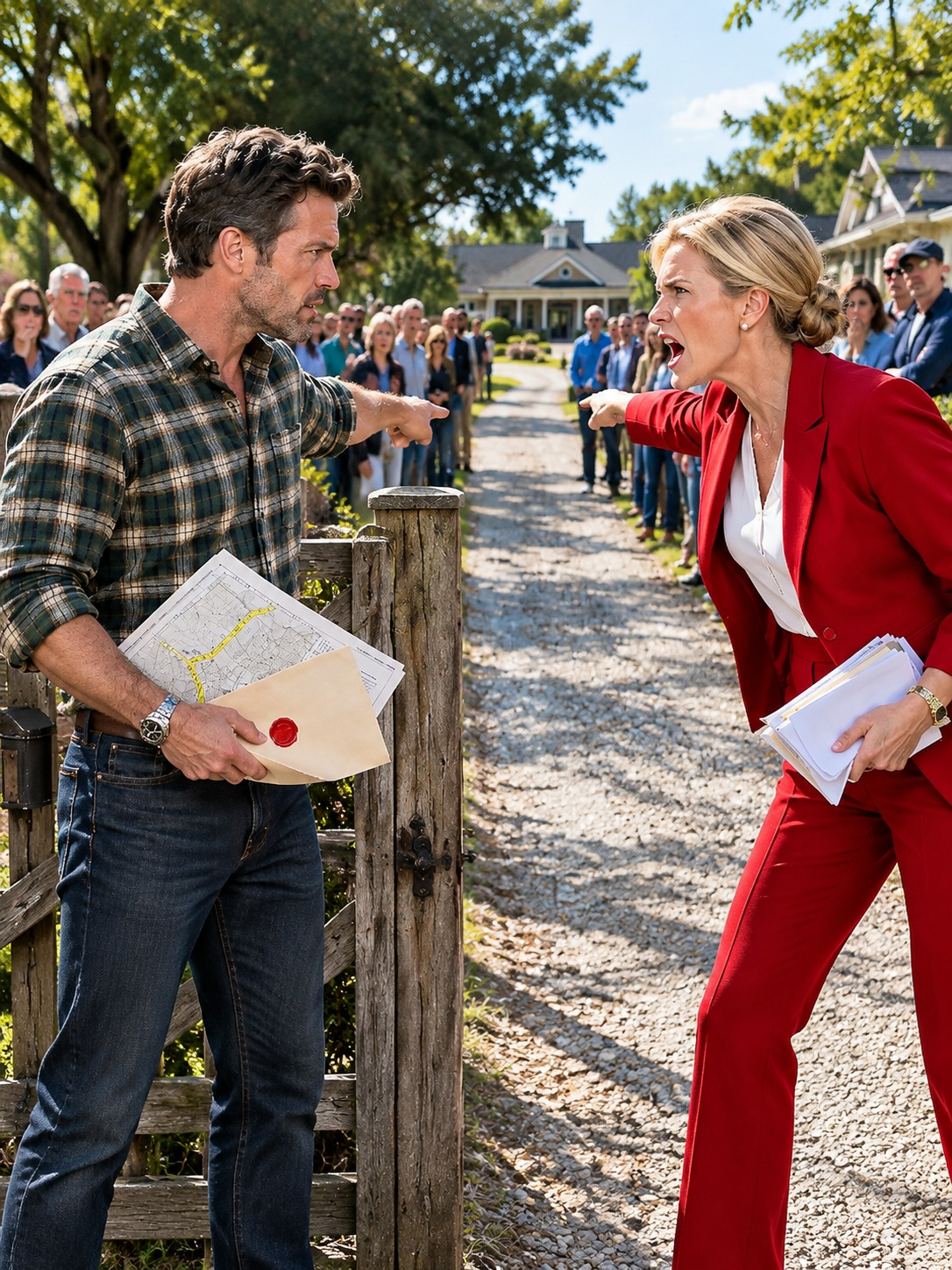
"Pay the fine, or we'll block your road!" Marla Voss shouted, thrusting a red notice toward my chest.
Thirty-four neighbors watched as the HOA president waved a document stamped with an official-looking seal.
I noticed one small detail beneath the $1,800 charge.
The space for the recorded easement number was blank.
Marla had just threatened to take away something she might not own.
My name is Gideon Mercer, and until that week, I had never imagined that repairing a few washed-out sections of gravel could turn my entire neighborhood against me.
I was thirty-nine years old, according to the number of birthdays I had celebrated, but some mornings my back felt considerably older. Years of hauling gravel, clearing drainage ditches, and repairing the road to my house had left me with a permanent ache between my shoulders.
I didn't mind it.
That road was my way home.
It ran past a weathered wooden gate, curved between mature oak trees, and ended at my modest house beyond the newer homes of the subdivision. Forty-three years earlier, somebody had cut that route through the land. Long before the homeowners association existed, long before matching mailboxes and architectural committees, people had used that narrow strip of gravel to reach the property at the end.
For years, I had kept it usable.
I bought crushed stone when heavy rain opened ruts. I rented equipment when the drainage ditch filled with mud. I removed fallen branches after storms and filled potholes before winter made them worse.
Nobody from the HOA ever volunteered to help.
Nobody offered reimbursement.
And until the red envelope appeared, nobody had complained.
The trouble began on a Tuesday afternoon.
I had just returned from the hardware store with two bags of concrete mix, a replacement shovel handle, and a box of galvanized screws. I parked my truck near the mailbox and noticed something taped to the wooden post.
A red envelope.
Not a regular mailing envelope, either. This one was thick, bright, and positioned where anybody passing the road could see it.
My name was printed across the front.
GIDEON MERCER.
FINAL NOTICE.
I remember standing there with the truck engine ticking behind me, wondering what kind of emergency required somebody to tape a letter to my mailbox.
Inside was a notice from the Briarwood Ridge Homeowners Association.
The amount appeared halfway down the page.
$1,800.
I read it twice.
The violation was described as unauthorized private road usage and alteration of a shared access corridor.
According to the letter, my recent repairs had changed the character of community infrastructure without board approval.
The association demanded payment by Friday.
Failure to comply, it warned, could result in additional enforcement measures, including restrictions on access and possible collection proceedings.
I looked down the road.
A few weeks earlier, a storm had washed a trench across one of the steeper sections. I had spent an entire Saturday filling it with gravel and rebuilding the shoulder so my truck wouldn't slide into the ditch.
Apparently, keeping the only road to my home passable had become a punishable offense.
I carried the envelope inside and placed it beside my coffee maker.
Then I took out my receipts.
There were three from the gravel supplier, one from the equipment rental company, and another for drainage pipe. I kept everything in labeled folders because I had learned that memory was a poor substitute for paper.
My father had taught me that.
"Keep the receipt, son," he used to say. "The person who promises you'll never need it is usually the reason you will."
I had laughed at him when I was younger.
That afternoon, I wished he were still around so I could tell him how right he had been.
I called the number at the bottom of the notice.
Marla Voss answered on the fourth ring.
"Gideon," she said, sounding almost pleased. "I assume you've received the association's correspondence."
"I have. I need to understand what this fine is for."
"The unauthorized alterations to the access corridor."
"I repaired a washout."
"You modified community property without permission."
I looked through the kitchen window toward the gravel road.
"Marla, I've maintained that road for years."
"That doesn't give you ownership."
"I didn't say it did."
"Then we're clear."
"No," I said. "We're not."
There was a pause.
I asked who actually held the recorded easement.
Marla gave a little sigh, the kind people use when they want you to feel foolish for asking a reasonable question.
"The association's governing documents establish our authority."
"Can you give me the deed reference?"
"Our attorney has reviewed the matter."
"Which recorded document did the attorney review?"
"Gideon, I'm not going to conduct a legal seminar over the telephone."
"I'm not asking for a seminar. I'm asking for a recording number."
Her voice hardened.
"You have until Friday."
"And if I don't pay?"
"The board has enforcement options."
"Such as?"
"Restrictions on your access, for one."
I leaned against the counter.
"You mean blocking the road to my house?"
"If necessary."
I let that answer settle.
"Marla, that's my only entrance."
"Then I suggest you take the deadline seriously."
She ended the call.
I stood there holding my phone, listening to the silence.
The amount bothered me. Eighteen hundred dollars was real money, especially when I had already paid for the repairs.
But the threat bothered me more.
I could dispute a bill.
I could argue over dues.
I could even tolerate somebody criticizing how I spread gravel.
What I couldn't accept was a person threatening to cut off access to my home without showing a single document proving she had that right.
That evening, I opened the folder containing my property papers.
The deed to my house was there, along with the survey from when I purchased the property. I had always known the road was old. The survey showed it crossing land that had later become part of Briarwood Ridge, but the notes were dense, and some referenced older instruments I had never requested.
One notation caught my attention.
ACCESS EASEMENT — SEE PRIOR RECORDING.
No recording number appeared on the copy I had.
I circled the notation in pencil.
Then I wrote three questions on a yellow legal pad.
Who owned the land beneath the road?
Who held the right to use it?
And what authority, if any, did the HOA possess over repairs?
I wasn't a lawyer. I knew enough to understand that owning land and holding an easement over it were not necessarily the same thing.
I also knew a neighborhood board couldn't settle the question simply by announcing an answer.
The following morning, an email arrived from Marla.
The subject line read:
NOTICE TO COMMUNITY MEMBERS — UNAUTHORIZED ROAD ACTIVITY.
She had copied the entire association mailing list.
The message described my repairs as deliberate disregard for community standards.
It said the board had attempted to resolve the matter cooperatively.
It suggested that I was refusing to respect the same rules everyone else followed.
Then came the sentence that made me sit up.
"Residents are advised not to engage directly with Mr. Mercer regarding the disputed access corridor while the board pursues enforcement."
I read that line three times.
She wasn't merely fining me.
She was telling my neighbors to avoid me.
By lunchtime, the effect was visible.
I drove to the grocery store and passed a neighbor named Daniel Price walking his dog. Daniel usually lifted two fingers in greeting.
That day, he looked down at the leash.
Later, another neighbor left a note under my windshield wiper.
It was unsigned.
"Please just pay the fine. We don't need trouble in this neighborhood."
I folded the note and put it in my folder.
I didn't respond.
Instead, I called the association office and requested a copy of the rule I had supposedly violated, the board minutes authorizing the fine, and any recorded document supporting its claim over the road.
The receptionist told me she would forward my request.
An hour later, Marla replied personally.
"The board will address your conduct at the upcoming general meeting."
Not my questions.
My conduct.
That distinction told me more than she probably intended.
The meeting was scheduled for the following Thursday.
For several days, I continued my routine.
I went to work. I bought groceries. I checked the drainage ditch after a short rain.
I didn't repair anything else.
Not because I agreed with Marla, but because I wanted the condition of the road documented before the dispute became worse.
I took photographs of the repaired shoulder, the old culvert, the wooden gate, and the road as it approached my house.
Then I printed them.
By Thursday, my folder had grown thick enough that I needed a rubber band to keep it closed.
The community room was already crowded when I arrived.
Thirty-four homeowners sat in folding chairs arranged in uneven rows. A long table stood at the front with a stack of handouts, a pitcher of water, and a coffee urn that smelled as though it had been brewing since morning.
Marla stood behind the table.
She was wearing a tailored emerald-green suit and a cream blouse. Her dark auburn hair was perfectly arranged, and she held a stack of papers as though she were preparing to announce a court verdict.
I took a seat near the middle.
Corbin Hale, who had served on several neighborhood committees, turned toward me.
"Why not just get approval like everybody else?" he asked.
His tone wasn't cruel.
That almost made it harder.
"Approval for what?" I asked.
"For changing the road."
"I repaired damage."
"That's still a change."
"Corbin, if the road washes out, I can't reach my house."
He frowned.
"Well, everybody has to follow the rules."
"I agree," I said. "I just want to know which rule applies."
He turned back toward the front.
Marla called the meeting to order.
For the first twenty minutes, she discussed landscaping, mailbox paint, and a proposed increase in reserve contributions.
Then she reached my name.
"Unfortunately," she began, "we have a serious matter involving one homeowner's refusal to respect community property."
Several people looked at me.
Marla described my repairs as unauthorized construction.
She said the association was responsible for preserving the appearance and use of shared infrastructure.
She emphasized that allowing one resident to act independently would create a dangerous precedent.
Then she displayed the $1,800 fine.
"Mr. Mercer has been given multiple opportunities to comply," she announced.
I raised my hand.
She hesitated before recognizing me.
"Can you show us the recorded easement?" I asked.
Marla looked annoyed.
"We've already discussed this."
"Not the document."
"The association's attorney has reviewed the relevant records."
"Which records?"
She glanced toward the other board members.
Nobody answered.
I kept my voice even.
"I'm not asking anyone here to take my word for anything. I'm asking to see the recorded instrument that gives the association control over the road."
A woman in the second row shifted in her chair.
Corbin folded his arms.
Marla straightened the papers in front of her.
"Mr. Mercer, this is not a courtroom."
"No," I agreed. "It's a homeowners meeting. That's why I think the homeowners deserve to see the document."
The room became quiet.
Marla's cheeks reddened.
"You don't get to dictate how this board operates."
"I haven't tried to."
"You've repeatedly challenged its authority."
"I've repeatedly asked where that authority is recorded."
She placed both hands on the table.
"If you continue using the access corridor without authorization, the association may have to physically restrict your access."
A murmur moved through the room.
I looked directly at her.
"You're threatening to block the only road to my home?"
"I'm explaining the consequences of noncompliance."
"Then I strongly suggest you check the county records before making that promise."
Marla laughed.
It was short, dismissive, and loud enough for everyone to hear.
"Mr. Mercer, the association has legal counsel. We don't need you teaching us property law."
I said nothing.
She apparently mistook my silence for surrender.
"The fine stands," she announced. "Payment is due Friday."
The meeting moved on.
But I noticed something different as people began gathering their belongings.
A few neighbors no longer looked quite as certain.
One man glanced at the survey sticking out of my folder.
Another asked his wife something too quietly for me to hear.
Corbin passed without speaking.
Marla remained near the front table, surrounded by board members.
As I reached the exit, she called after me.
"Gideon."
I turned.
She approached with a smile that didn't reach her eyes.
"You should understand something," she said quietly. "Publicly challenging the board won't improve your situation."
"I wasn't trying to embarrass anyone."
"Then pay what you owe."
"Show me the recorded easement."
Her smile disappeared.
"You have no idea what you're getting into."
I looked at her for a moment.
"Maybe not."
Then I left.
Outside, the parking lot was nearly empty.
I sat in my truck and opened the folder again.
The old survey lay on top.
That single notation still bothered me.
ACCESS EASEMENT — SEE PRIOR RECORDING.
I ran my finger beneath the words.
Somewhere in the county's records was a document that could answer the question Marla had refused to answer.
I decided I would find it.
The next morning, I drove to the county records office instead of going straight to work.
A clerk named Evelyn Carter listened patiently while I explained what I needed.
She asked for my parcel number.
I gave it to her.
She entered the information into her computer, studied the screen, and frowned.
"That's interesting," she murmured.
"What is?"
She didn't answer immediately.
Instead, she stood and walked toward a locked records room.
Several minutes passed.
When she returned, she was carrying a thin, yellowed folder.
She placed it on the counter and opened it carefully.
Inside was a subdivision map dated forty-three years earlier.
There was my gravel road.
There was the land that would eventually become Briarwood Ridge.
And there was a handwritten notation beside the road.
Evelyn leaned closer.
"Mr. Mercer," she said, "I think you need to see whose name was on the original easement."
She turned the next page.
At the top of the document, beneath the recording date, was a name I had never heard before.
Elias Wren.
I stared at it.
Then Evelyn reached for another page.
"There's something else attached to this recording," she whispered.
She unfolded the paper.
And the first line read—






Comments 0