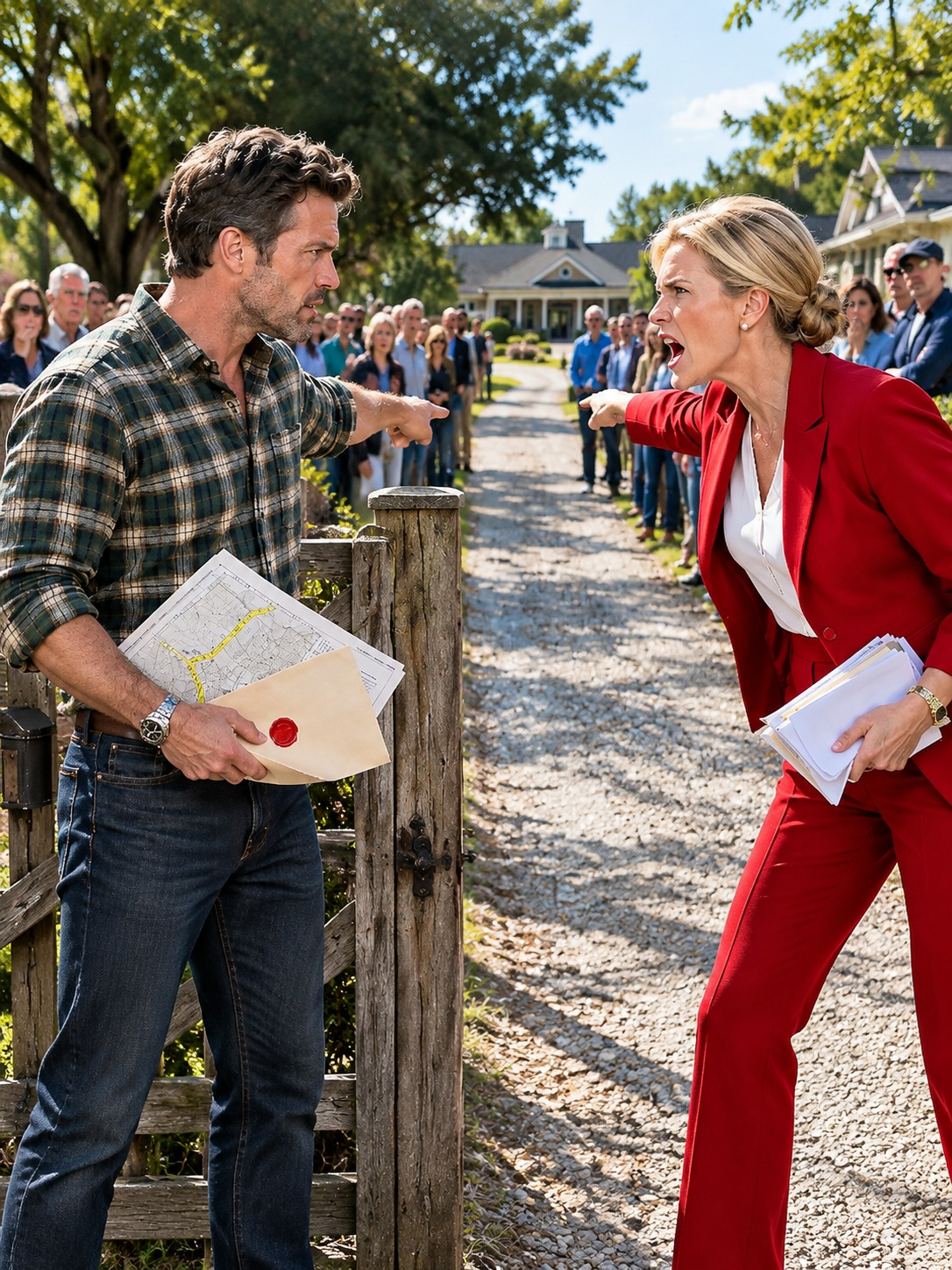
"Don't touch that door!"
Corbin Hale shouted as the metal storage-unit door slammed shut behind us.
The sound cracked through the warehouse like a gunshot.
I spun around.
For one terrible second, I thought somebody had locked us inside.
Corbin dropped the brown envelope onto a cardboard box and rushed toward the entrance.
"Hey!" he yelled. "Who's out there?"
No answer.
He grabbed the metal handle and pulled.
The door moved an inch.
Then stopped.
I joined him, gripping the bottom edge.
"On three," I said.
We pulled together.
The door scraped upward with a deafening rattle.
Cold night air rushed inside.
A man stood on the other side.
He wore a gray security uniform and held a flashlight.
"What the hell are you two doing in here?" he demanded.
Corbin stared at him.
"We're renting this unit."
The man lowered his flashlight.
"You're here after the office closed."
"The gate code worked."
"That doesn't mean you can stay all night."
I looked past him toward the empty parking lot.
"Did you close the door?"
"Yeah. Thought somebody left it open."
"You didn't see us inside?"
"Couldn't see past those boxes."
Corbin exhaled.
The security guard looked annoyed rather than threatening.
He checked Corbin's identification, confirmed the rental account, and told us we had fifteen minutes to finish.
Then he walked away.
I watched him disappear around the corner.
My pulse was still racing.
Corbin looked at me.
"Well, that took ten years off my life."
I tried to smile.
It didn't work.
Because the brown envelope was still sitting on the box behind us.
And I hadn't forgotten the warning written beneath its flap.
"Corbin," I said, "let's see who your father wanted us to contact."
He picked up the envelope.
His hands were shaking.
I leaned closer.
The final line read:
If this envelope has been opened before the county receives the original, contact Patricia Bell immediately.
I stared at the name.
Patricia Bell.
The closing agent who handled my home purchase five years earlier.
The same woman Rebecca Sloan had contacted that afternoon.
Corbin looked at me.
"Why would Dad know your closing agent?"
I didn't answer.
Because I was asking myself the same question.
We left the storage facility without opening the envelope.
That was Corbin's decision.
"My father wrote 'original' on it," he said as we climbed into his truck. "If this is evidence, I don't want us tearing it apart in a parking lot."
I agreed.
We photographed the sealed envelope from every angle, including the writing beneath the flap.
Then Corbin placed it inside a clean document box.
I called Rebecca.
She answered on the third ring.
"Gideon?"
"We found something."
"What kind of something?"
"An envelope in Arthur Hale's old storage unit. It says it contains the original Wren document."
There was a pause.
"Is it sealed?"
"Yes."
"Don't open it."
"We haven't."
"Good. Where are you?"
"Leaving the storage facility."
"Take it somewhere secure. I'll arrange to examine it with you tomorrow."
I looked at Corbin.
"There's something else."
"What?"
"The warning on the envelope says to contact Patricia Bell."
Rebecca went silent.
"Rebecca?"
"I'm here."
"Why would Arthur Hale tell someone to contact my closing agent?"
"I don't know."
"Could Patricia have worked on the original development?"
"She wouldn't have been old enough when the first documents were created."
"Then why her?"
"That's a question we need to ask."
I stared through the windshield.
The streetlights passed over Corbin's face.
He looked exhausted.
Rebecca continued.
"Gideon, did you tell Patricia about Arthur Hale?"
"No."
"Did Corbin?"
He shook his head.
"No."
I relayed his answer.
Rebecca spoke more slowly.
"Then I want to establish when Arthur wrote that warning and whether Patricia knew about it."
"Could this be connected to my closing?"
"Possibly."
I looked at the document box.
The envelope had been hidden in Arthur Hale's storage unit for years.
My home purchase had happened much later than the original easement dispute.
Yet Arthur had written Patricia Bell's name on the envelope.
There had to be a reason.
"Rebecca," I said, "I don't think this is just about the road anymore."
She didn't disagree.
We reached my house shortly before ten.
Corbin parked outside the chained entrance, and we carried the document box down the gravel road.
The steel chain was still fastened between the wooden posts.
The orange HOA sign hung crookedly from one side.
Every time I saw it, I felt the same surge of disbelief.
Marla Voss had turned my only access road into a public demonstration of her authority.
But tonight, I barely looked at the chain.
My attention remained on the envelope.
Inside the house, Corbin placed the box on my kitchen table.
I made coffee neither of us wanted.
Then we sat in silence.
Finally, Corbin spoke.
"My father knew something."
I nodded.
"He certainly thought the document was important."
"No. I mean he knew something was going to happen."
I looked at him.
"What makes you say that?"
"He didn't just keep old papers. He hid an original document and left instructions."
"Maybe he was worried about losing it."
Corbin shook his head.
"Dad wasn't the kind of man who hid things without a reason."
He looked toward the window.
"When I was a kid, he used to say that a signature could steal more than a gun."
I frowned.
"What did he mean?"
"I never asked."
Corbin rubbed his eyes.
"He worked in land development for thirty years. He saw people sign things they didn't understand. He saw developers promise roads, drainage systems, and parks that never got built."
I thought about the proposed replacement road.
The red line on the planning map.
The houses that now stood where the road was supposed to run.
"Maybe that's why he kept the evidence," I said.
Corbin nodded.
"Maybe."
Then he looked at me.
"Gideon, do you think Marla knows this envelope exists?"
I considered the anonymous email.
The photograph of my kitchen window.
The warning to stop searching for Elias Wren.
"I don't know."
"But somebody knew we were looking."
"Yes."
He stared at the box.
"Then we need to be careful."
At eight the next morning, Rebecca called.
"I've spoken with Patricia Bell."
I sat upright.
"What did she say?"
"She remembers Arthur Hale."
I closed my eyes.
"How?"
"Arthur contacted her shortly before your property purchase."
I looked toward the document box.
"Why?"
"He wanted to make sure the original access easement was properly examined before the sale."
I was silent.
Rebecca continued.
"According to Patricia, Arthur had concerns about the historical release and the proposed replacement road."
"Did he give her documents?"
"Some copies. She says he told her an original instrument existed that could resolve the dispute if anyone ever challenged the access."
I stared at the envelope.
"Why didn't she tell me?"
"She says the title insurer reviewed the available records and concluded there was sufficient basis to insure your access rights. She didn't believe there was an active dispute requiring you to investigate Arthur's private files."
"But she knew about the envelope?"
"Not its location. Arthur told her he was preserving something important."
I rubbed my forehead.
"Rebecca, this is unbelievable."
"I understand."
"Did Arthur tell her what the original document was?"
"Not specifically."
I looked toward the kitchen window.
The road beyond it was empty.
"Then we need to open the envelope."
"Yes. But I'd like to do it with Patricia present, if possible."
"Why?"
"Because Arthur identified her in his instructions. She may recognize the document or explain why he wanted her contacted."
I nodded.
"When?"
"This afternoon."
I looked at the clock.
"Where?"
"My office. Two o'clock."
At eleven, another HOA email arrived.
Marla had apparently learned that Rebecca filed for emergency relief.
The subject line read:
ASSOCIATION RESPONSE TO LEGAL THREATS.
I opened it.
The message accused me of wasting community resources by pursuing unnecessary litigation.
It claimed that the association had already demonstrated its authority.
It also stated that the board would seek reimbursement for legal expenses caused by my refusal to comply.
I forwarded the email to Rebecca.
Then I closed my laptop.
I was tired of Marla's announcements.
Tired of the threats.
Tired of being told that asking for recorded proof was somehow an attack on the neighborhood.
But I was especially tired of the chain.
I walked outside and stood beside it.
A woman from the subdivision approached with a grocery bag.
It was Sarah Price.
She looked at the padlock.
"Still here?"
"Still here."
She shook her head.
"Daniel says the board is fighting about it."
"I heard."
"Leonard wants it removed."
"Good."
She handed me the grocery bag.
I blinked.
"What's this?"
"Milk, bread, eggs. Daniel said you couldn't get your truck through."
I looked at her.
For a moment, I couldn't speak.
It wasn't the groceries themselves.
I could still walk to the subdivision entrance.
I could still ask someone for a ride.
But the fact that a neighbor had thought about the inconvenience and decided to help meant more than she knew.
"Sarah, you didn't have to do this."
"I know."
She smiled.
"That's why I did."
I thanked her.
As she turned to leave, she stopped.
"One more thing."
"What?"
"Helen has twenty-one signatures on the petition."
I stared at her.
"Twenty-one?"
"People want an independent review. And they want the chain gone."
I looked toward the subdivision houses.
For days, I had felt as though the entire neighborhood stood behind Marla.
Now the people who had watched her threaten me were beginning to ask questions.
Sarah lowered her voice.
"Marla's furious."
I looked at the chain.
"She can be furious."
Sarah smiled.
"That's what Daniel said you'd say."
At two o'clock, Corbin and I entered Rebecca's office carrying the sealed envelope.
Patricia Bell was already waiting.
She was a woman in her late fifties with silver-streaked brown hair and the calm expression of someone who had spent decades explaining complicated documents to nervous homebuyers.
She stood when she saw me.
"Mr. Mercer."
"Patricia."
She shook my hand.
"I'm sorry we're meeting under these circumstances."
"Me too."
Her eyes moved toward the box.
"Is that Arthur's envelope?"
Corbin nodded.
"It was in his storage unit."
Patricia sat down slowly.
For a moment, she seemed lost in thought.
Then she said, "Arthur told me he had kept something safe."
Rebecca opened a notebook.
"Patricia, can you explain how you knew him?"
She nodded.
"Arthur contacted our office when Mr. Mercer's property was being prepared for sale. He had been involved with the original subdivision planning and wanted to make sure the access issue wasn't overlooked."
"Did he provide the historical easement?"
"He gave us copies of several documents. The recorded easement, correspondence with the developer, and a planning map."
I leaned forward.
"Did he mention Harold Voss?"
Patricia looked at me.
"Yes."
My stomach tightened.
"What did he say?"
"That Harold had been determined to eliminate the old access easement."
Corbin stared at her.
"Why?"
Patricia hesitated.
"Arthur believed the developer wanted unrestricted control of the road corridor so the subdivision could be marketed without complicated access disclosures."
I thought about the old investor agreement.
Harold's signature.
The proposed replacement road.
"Did Arthur think the release was invalid?" Rebecca asked.
"He questioned it."
"On what basis?"
Patricia looked toward the envelope.
"He said the recorded version didn't match the document he remembered seeing."
The room went silent.
I stared at her.
"What do you mean?"
"He believed the original terms were different."
Rebecca leaned forward.
"Different how?"
Patricia shook her head.
"He wouldn't tell me without showing the original. And at the time, he said he wasn't ready to release it."
Corbin looked down.
"That sounds like Dad."
Patricia continued.
"He was afraid the document would disappear if he handed it to the wrong person."
I felt a chill.
The anonymous warning flashed through my mind.
Stop searching for Elias Wren if you want to keep your house.
Rebecca looked at Corbin.
"Do you authorize us to open the envelope and examine the contents?"
"Yes."
She documented the condition of the envelope.
Photographed the seals.
Recorded the date and the people present.
Then she carefully opened one edge.
Nobody spoke.
Inside was a folded document wrapped in thin protective paper.
Rebecca lifted it out.
The paper was yellowed.
The ink had faded in places.
But the title remained legible.
AGREEMENT FOR CONDITIONAL RELEASE AND SUBSTITUTE ACCESS.
I leaned forward.
Rebecca unfolded the document.
It contained four pages.
The first identified Elias Wren and the original developer.
The second described the existing easement.
The third contained the conditions under which Wren would agree to release it.
And the fourth carried signatures.
I looked at the third page.
Rebecca read aloud.
"The release of the existing access easement shall become effective only upon completion, acceptance, and recordation of the substitute access route described in Exhibit B."
She stopped.
I stared at her.
"Only upon completion?"
"That's what it says."
I looked at Corbin.
"The replacement road was never built."
He nodded slowly.
Rebecca continued reading.
"Until such conditions are fully satisfied, the existing recorded easement shall remain in full force and effect."
Nobody moved.
Patricia covered her mouth.
Corbin leaned back in his chair.
I stared at the words.
For days, Marla had claimed the original easement had been released.
But this document appeared to say that the release was conditional.
And the condition involved a road that had never existed.
Rebecca held up one hand.
"We need to verify the document's authenticity and compare it with the recorded instrument. But this is potentially very important."
I nodded.
My heart was racing.
"Does it mean I still have access rights?"
"It strongly supports that possibility, assuming the document is authentic and no later instrument changed the arrangement."
I looked at the old paper.
The answer had been sitting in a storage unit for years.
Waiting.
Rebecca turned to the fourth page.
Then her expression changed.
"There's something else."
I leaned closer.
"What?"
She pointed to a signature line.
Elias Wren had signed.
The developer's representative had signed.
But Harold Voss's name appeared only beneath a witness acknowledgment.
Rebecca compared the signatures with the recorded release.
Then she looked at Patricia.
"These are not identical documents."
Patricia nodded.
"No."
Rebecca placed them side by side.
The recorded version omitted the paragraph preserving the easement until the replacement route was completed.
I felt my stomach drop.
"Someone removed it?"
"We don't know how the difference arose," Rebecca said. "But the omission is material."
Corbin stared at the papers.
"My father knew."
Rebecca nodded.
"He appears to have recognized the discrepancy."
I looked at the original document again.
The missing paragraph was everything.
Without it, the recorded release appeared unconditional.
With it, the old easement remained in effect until the substitute road was completed and recorded.
A road that had never been built.
I leaned back.
For the first time since Marla kicked off this nightmare, I could see a path forward.
Not a guaranteed victory.
But a real one.
Rebecca spent the next hour examining the document.
She checked the paper, signatures, dates, and references to the subdivision plans.
Patricia compared it against the title company's records.
Corbin answered questions about his father's storage unit.
I watched them work.
I wanted to call Marla.
I wanted to tell her what we had found.
I wanted to stand beside that chain and ask her whether she still believed the HOA could block my road.
But Rebecca had warned me against acting too soon.
And she was right.
The document needed authentication.
The county records needed comparison.
The title history needed further review.
If the evidence was as strong as it appeared, we would present it properly.
Not in an angry email.
Not in a shouting match.
In a form Marla couldn't dismiss with another gavel.
At four thirty, Rebecca received a call from the court clerk.
She stepped into the hallway.
When she returned, she looked directly at me.
"The emergency hearing has been scheduled."
I stood.
"When?"
"Tomorrow morning."
I felt my chest tighten.
"That soon?"
"Yes."
"What happens?"
"We present the access obstruction, the recorded documents, and the evidence supporting your claim. The court will decide whether immediate temporary relief is warranted."
I nodded.
"And the envelope?"
"We'll need to determine how best to authenticate and introduce it. It may not be fully addressed at the initial hearing."
I understood.
The law didn't move according to the emotional urgency of the people involved.
But tomorrow, someone with actual authority would examine what Marla had done.
Rebecca continued.
"The association's counsel has been notified."
I looked at her.
"How did they respond?"
"They requested copies of the documents we intend to rely on."
"Did you send the original agreement?"
"Not the physical original. We'll handle disclosure appropriately."
She paused.
"There's something you should know."
"What?"
"The association's attorney sounded surprised when I described the conditional-release language."
I stared at her.
"Surprised?"
"Very."
I thought about Marla's confidence at the meeting.
The way she had displayed the recorded release.
The way she had treated it as final proof.
Maybe her attorney had never seen the original agreement.
Maybe Marla hadn't either.
Or maybe someone had deliberately kept it from them.
I couldn't know.
Not yet.
Corbin drove me home just before sunset.
We stopped beside the chained entrance.
He looked at the padlock.
"Think it'll be gone tomorrow?"
"I hope so."
He nodded.
Then he turned toward me.
"Gideon, I owe you an apology."
I frowned.
"For what?"
"When this started, I thought you were being stubborn."
I looked at him.
"You weren't the only one."
"I figured the HOA must have had a reason."
"Most people did."
He stared at the chain.
"My father spent years worrying about that road. I thought he was just holding onto an old grudge."
I said nothing.
Corbin continued.
"Now I think he was trying to protect something."
I looked at the document box between us.
"He may have protected my home."
Corbin swallowed.
Then he nodded.
We carried the box to my porch.
Before leaving, he shook my hand.
"See you at the hearing."
"See you there."
I watched him walk back toward the gate.
Then I went inside.
At seven fifteen, I received another anonymous email.
No subject.
No greeting.
Just four words.
You opened the envelope.
I stared at the screen.
My pulse quickened.
The sender shouldn't have known.
Only Rebecca, Patricia, Corbin, and I had been present.
I forwarded the message to Rebecca and called Deputy Mills.
He took the information and advised me to preserve the original email.
I did.
Then I checked the locks.
Again.
At eight, Rebecca called.
"I saw the message."
"How could somebody know?"
"We don't know that they do. They may be guessing based on your recent activity."
"But they mentioned the envelope."
"Yes. That's concerning."
I looked toward the kitchen window.
"Do you think somebody followed us?"
"It's possible. But don't assume."
I exhaled.
"I know."
She paused.
"Gideon, I want you to avoid being alone outside tonight if possible."
"Okay."
"And if you see anything suspicious, call the sheriff."
"I will."
We ended the call.
I sat in the kitchen with the lights on.
The original document was secured in Rebecca's office.
My closing packet was in a locked drawer.
The chain remained across the road.
And somewhere, somebody knew we had opened Arthur Hale's envelope.
I tried to read.
Couldn't concentrate.
I tried to watch television.
Couldn't follow the program.
At nine thirty, my phone vibrated.
A text from Helen.
Marla called an emergency board meeting. Again.
I stared at the message.
Then another arrived.
Leonard says she's trying to get the chain removed before the hearing.
I sat upright.
A third message appeared.
But there's a problem.
I typed back.
What problem?
The reply came almost immediately.
The padlock key is missing.
I looked toward the road.
That was ridiculous.
The association had installed the chain.
Surely somebody knew who had the key.
I called Helen.
She answered breathlessly.
"Gideon, I'm standing near the gate."
"What's happening?"
"Leonard and two board members are here. They say the association voted to remove the chain."
I stood.
"Then remove it."
"They can't find the key."
"Call the contractor."
"They did."
"And?"
"The contractor says Marla took possession of both keys."
I closed my eyes.
"Where is she?"
"Nobody knows."
I grabbed my jacket.
"I'm coming down."
I walked quickly along the gravel road.
By the time I reached the gate, several neighbors had gathered.
Leonard stood beside the chain.
A board member held a flashlight.
Helen was on the phone.
The padlock remained fastened.
Leonard looked embarrassed.
"Gideon, I'm sorry."
I stared at him.
"Did the board vote to remove it?"
"Yes."
"Then cut the lock."
He hesitated.
"We're trying to get authorization from counsel."
I looked at the chain.
"Leonard, this is your association's lock."
"I know."
"And you voted to remove it."
"I know."
He rubbed his forehead.
"We're trying to do this properly."
I looked at the gathered neighbors.
For once, nobody was defending Marla.
Nobody was telling me to pay the fine.
They were all staring at a chain that should never have been installed without clear authority.
Helen lowered her phone.
"Marla isn't answering."
Leonard sighed.
"Then we'll have to wait."
I looked toward my house.
I was tired.
More tired than I had ever been.
But tomorrow morning, we would stand before a judge.
And for the first time, Marla wouldn't be the person deciding when the discussion was over.
I turned toward the gate.
Then I noticed something attached to the wooden post.
A small white envelope.
It hadn't been there earlier.
My name was written across the front.
GIDEON MERCER.
I stopped.
"Helen, did someone leave this?"
She looked at it.
"I didn't see anybody."
Leonard stepped closer.
"What is it?"
I didn't touch it.
Instead, I took out my phone and photographed it.
Then I called Deputy Mills.
While we waited, the neighbors moved away from the gate.
Nobody spoke.
The envelope was thin.
Its edges were perfectly clean.
And beneath my name, written in small black letters, were three words.
BEFORE THE HEARING.
When Deputy Mills arrived, he examined the envelope and photographed it.
He asked whether anyone had seen who left it.
Nobody had.
He carefully opened it while I stood beside him.
Inside was a single photograph.
He looked at it.
Then he looked at me.
"Mr. Mercer," he said quietly, "I need you to tell me whether you recognize this person."
He turned the photograph around.
I leaned closer.
The image showed a man standing beside Elias Wren's old gravel road.
The photograph was decades old.
But the man in it was wearing a jacket I recognized.
And standing beside him was a woman whose face I had seen only hours earlier.
I reached for the photograph.
Deputy Mills pulled it back.
"Don't touch it yet."
I stared at the woman's face.
Then I looked at the handwritten date in the corner.
It was from twenty-three years earlier.
Long before I bought my house.
Long before Marla installed the chain.
And the woman standing beside the road was Rebecca Sloan.
I took a step backward.
"That can't be right."
Deputy Mills looked at me.
"Why not?"
I opened my mouth.
Before I could answer, my phone rang.
Rebecca.
I stared at her name on the screen.
Then I answered.
"Gideon," she whispered, "don't show that photograph to anyone else."
I froze.
"How do you know about the photograph?"
She didn't answer.
Instead, I heard a door close on her end of the line.
Then she said something that made my blood run cold.
"Because the man standing beside me in that picture was supposed to be dead."
And at that exact moment, Deputy Mills turned the photograph over.
On the back was a second name.
He read it silently.
His face changed.
Then he looked straight at me.
"Gideon, there's something you need to know about Elias Wren's death certificate. The person who signed it was—"






Comments 0