"Harold Voss."
I whispered the name while staring at the fourth page of the document Rebecca Sloan had sent me.
The signature at the bottom was unmistakable.
Harold Voss.
Marla Voss's father-in-law.
The man whose investment company had helped develop Briarwood Ridge decades before the homeowners association existed.
And according to the handwritten statement above his signature, he had personally witnessed Elias Wren surrender his access rights.
There was only one problem.
The statement contradicted almost everything we had found.
"Rebecca," I said into the phone, "why would Harold Voss sign this?"
"That's exactly what we need to establish."
I leaned closer to my laptop.
The supplemental page was titled Affidavit of Witness to Execution.
It claimed that Elias Wren had voluntarily executed a release of his recorded easement in the presence of Harold Voss and another individual.
The document was dated the same day as the disputed release.
It carried a county recording stamp.
And it had apparently remained attached to the archived instrument for decades.
I felt a slow, uncomfortable pressure building behind my ribs.
"Does this mean the HOA owns the road?"
"No," Rebecca answered immediately. "It means someone recorded a document claiming Wren released certain rights. Those are two very different things."
I looked at the signature again.
"Could the affidavit be false?"
"Possibly. But we don't know that yet."
"What about the hospital notice?"
"That raises questions. It doesn't establish where Wren was at every moment of that day or whether he signed the instrument."
I rubbed my forehead.
I wanted a clean answer.
A signature that was obviously forged.
A document that was clearly invalid.
Something that would make Marla's threats disappear with one phone call.
Instead, every answer seemed to uncover another question.
Rebecca continued.
"There's something important about the language of the release."
I opened the third page.
"Go ahead."
"It doesn't say the easement was transferred to the homeowners association."
I stopped scrolling.
"What?"
"It purports to release the existing easement in favor of a replacement access arrangement to be established through the development."
"Was that replacement ever recorded?"
"That's what I'm investigating."
I looked toward my kitchen window.
Beyond the darkness, the steel chain still blocked the only road to my house.
"So even if Wren signed this, it doesn't automatically prove Marla can block my road?"
"Correct. We would still need to determine the legal effect of the release, whether its conditions were satisfied, and what access rights continued afterward."
I sat back.
For the first time that evening, I felt a little steadier.
Not because the problem was solved.
Because I understood what the problem actually was.
Marla had been treating a complicated chain of recorded property rights like a simple HOA violation.
But the documents were telling a different story.
A story involving a developer, an old easement, a proposed replacement road arrangement, and a witness whose family had a financial interest in the subdivision.
"Rebecca, do you think Marla has this document?"
"Given what you've told me, I suspect she may have a copy. But we can't assume that."
"She's planning to present something at tomorrow's meeting."
"Then let her present it."
I looked down at my notes.
"Should I challenge her?"
"Ask her to identify the instrument and explain the authority she claims it creates. Don't accuse anyone of forgery. Don't speculate about motives. And don't sign anything."
"Understood."
Her voice softened slightly.
"Gideon, I know this is personal. Someone has physically restricted access to your home. But the strongest thing you can do right now is remain careful."
I glanced at the old envelope from Corbin's father.
"I've been trying."
"I can tell."
After we ended the call, I remained at the kitchen table.
The clock above the stove read 10:18 p.m.
I had been awake since before sunrise.
My coffee was cold.
The house was quiet.
And somewhere in the neighborhood, Marla Voss was preparing to tell thirty-four homeowners that she had won.
I printed the affidavit.
Then I placed it beside the original easement.
Two documents.
Two versions of history.
One road.
And a name that connected them both.
Harold Voss.
I slept badly.
Every time a vehicle passed the subdivision entrance, I woke and listened.
The anonymous photograph of my kitchen window remained in my mind.
I had checked the locks twice before going to bed.
I had also moved the external drive containing my scanned documents into a locked drawer.
I knew that was probably unnecessary.
But the message had changed how I felt inside my own home.
Someone had wanted me frightened enough to stop searching.
I wasn't going to give them that satisfaction.
By seven the next morning, I was back at the kitchen table.
I opened a fresh legal pad and wrote down the timeline.
Forty-three years earlier, Elias Wren received a recorded access easement benefiting the parcel at the end of the gravel road.
Years later, the surrounding land was sold for development.
The developer proposed replacing or releasing Wren's access rights.
Wren objected, according to his correspondence.
A later instrument purported to release the original easement.
Harold Voss signed an affidavit claiming to have witnessed its execution.
The HOA was formed afterward.
And decades later, Marla Voss claimed the association controlled the road.
I studied the sequence.
Something was missing.
Not just a document.
An entire step.
If the old easement had been released in exchange for a replacement access arrangement, where was the replacement?
My house had never been connected to another road.
The gravel route was still the only way in or out.
Had the developer promised something that was never completed?
Had the original right remained in effect because a condition wasn't satisfied?
Or had some later instrument preserved access in a way none of us had yet discovered?
I circled the words replacement access.
Then I called Corbin.
He answered groggily.
"Gideon?"
"Sorry to wake you."
"It's eight in the morning."
"Seven forty."
"That's worse."
Despite everything, I almost laughed.
"I found something in the county records."
He became alert.
"What?"
"An affidavit signed by Harold Voss."
There was a long silence.
Then Corbin said, "Marla's father-in-law?"
"Yes."
"What does it say?"
"That he witnessed Elias Wren sign a release."
Corbin exhaled.
"That doesn't sound right."
"Why?"
"Because my father always said Wren refused."
"Maybe he changed his mind."
"Maybe."
Corbin sounded unconvinced.
I continued.
"Do you remember anything about the replacement road the developer proposed?"
"Replacement road?"
"The release refers to a new access arrangement."
He was silent for several seconds.
Then he said, "Wait."
I heard something scrape against the phone.
"What?"
"My father used to complain about a road that was never built."
I sat upright.
"Where?"
"Behind the original development lots. He said the developer had drawn it on a planning map, but the county never approved the final layout."
I grabbed my pen.
"Do you have that map?"
"I don't know."
"Could it be in the boxes?"
"Maybe."
"Can you look?"
"Gideon, I've got to leave for work in twenty minutes."
"Right. Sorry."
He paused.
"Listen. I'll check tonight. But there's something else you should know."
"What?"
"Marla called me again."
I closed my eyes.
"When?"
"Late last night."
"What did she want?"
"She said I needed to decide whether I was loyal to the association."
I stared at the wall.
"That's ridiculous."
"That's what I told her."
"What did she say?"
"She said people who interfere with enforcement can face consequences."
I rubbed my forehead.
"Corbin, you don't have to get involved any further."
He gave a short laugh.
"Little late for that."
"Seriously. I don't want you dragged into this because of me."
"Gideon, my father kept those papers for a reason. I'm starting to think he knew somebody would need them one day."
I looked at the old affidavit.
"Maybe he did."
At ten, Rebecca called.
Her voice was brisk.
"I've spoken with the association's attorney."
I stood up.
"What did he say?"
"He confirmed that the board claims authority under the historical release and subsequent governing documents."
"So Marla has the same document."
"Apparently."
"Did he explain how that gives the HOA the right to block access?"
"He said the association believes it has enforcement authority over the corridor."
"That's not an answer."
"No," Rebecca said. "It isn't a complete one."
I walked toward the kitchen window.
The chain was still there.
"What happens now?"
"I've demanded that the obstruction be removed immediately pending resolution. I've also requested the board resolution authorizing its installation and the recorded instrument establishing the association's claimed rights."
"Did he agree?"
"He said he'd consult his client."
I almost laughed.
That phrase was becoming painfully familiar.
Consult his client.
Review the documents.
Consider the matter.
Meanwhile, I couldn't drive out of my own property.
Rebecca continued.
"I've also identified the original developer's corporate successor. There may be archived records that clarify the replacement-access arrangement."
"Can we get them?"
"We can request them. Whether they still exist is another question."
I looked at the legal pad.
"What about the old planning map?"
"What planning map?"
I told her what Corbin remembered.
She became quiet.
Then she said, "That could be important."
"Why?"
"Because the release appears to reference a replacement route. If the contemplated arrangement was never established, we need to examine what the agreement required and whether any condition affected its operation."
I wrote that down.
"Would that help my case?"
"It might. But don't get ahead of the evidence."
I smiled despite myself.
"You say that a lot."
"Because clients rarely enjoy hearing it."
"Fair enough."
Before hanging up, she asked whether I planned to attend the evening meeting.
"Yes."
"Then I want you to take copies of the original easement, the historical plat, and your written requests for the association's authority. I'll be there."
I stopped.
"You're coming?"
"Given the access restriction and the board's planned presentation, I think it would be useful."
For the first time in days, I felt something close to relief.
Marla had spent the past week treating me like a nuisance.
Tonight, she would have to answer questions in front of someone who understood property law.
By late afternoon, the neighborhood had become unusually quiet.
People who normally worked in their yards stayed inside.
Cars slowed near the chained entrance.
A few residents stopped to photograph the sign.
I received two text messages from neighbors asking whether I was really going to challenge the board at the meeting.
I replied with the same sentence.
"I'm going to ask for the documents."
At five thirty, Helen Brooks called.
"Gideon, are you ready for tonight?"
"As ready as I can be."
"Good. Because people are coming."
"How many?"
"More than Marla expects."
I frowned.
"What do you mean?"
"Word got around about the chain. Some residents who haven't attended a meeting in years want answers."
I looked at the road.
"That's their right."
"Exactly."
She lowered her voice.
"And Leonard is furious."
"About what?"
"Marla told him the chain was approved by the board. He says it wasn't."
I sat down.
"Has he put that in writing?"
"Not yet."
"Then I hope he does."
Helen paused.
"Gideon, there's something I want to ask you."
"Go ahead."
"If the association really doesn't own the road, what happens to Marla?"
I considered the question.
"I don't know."
"Would you sue her?"
"I've already spoken to an attorney about the access restriction. Beyond that, I want the facts established."
"You're being awfully reasonable."
"I don't see how being unreasonable would help."
Helen sighed.
"Sometimes I think that's what bothers her most."
After we hung up, I changed into clean clothes.
A navy work jacket.
A gray shirt.
Olive work pants.
Nothing special.
I wasn't going to court.
I was going to a community meeting about a road I had spent years repairing.
I gathered my documents into a folder.
Then I walked toward the chained gate.
Rebecca had arranged to meet me on the subdivision side.
Corbin was already waiting.
He held a cardboard box.
"Found something," he said.
I looked at it.
"The map?"
"Maybe better."
He opened the box.
Inside was a rolled planning drawing secured with a brittle rubber band.
I carefully removed it.
The paper was old, but the lines were still visible.
It showed the proposed subdivision layout.
The existing gravel road ran along the edge.
And behind several planned lots, a second route had been drawn in red pencil.
I stared at it.
"That's the replacement?"
"That's what Dad called it."
The red line connected my parcel to a different public street.
But there was a problem.
The proposed route crossed land that had later been divided into residential lots.
Houses stood there now.
I traced the line with my finger.
"If this was supposed to replace the gravel road, where did it go?"
Corbin shook his head.
"It never got built."
I looked at him.
"Are you sure?"
"I grew up here, Gideon. There's never been a road through those lots."
I stared at the drawing.
The developer had proposed a replacement access route.
The old easement release appeared to depend on some form of replacement arrangement.
And the replacement road had never been constructed.
That didn't automatically invalidate the recorded release.
But it raised a question that could change the entire dispute.
"Does Rebecca know about this?"
"Not yet."
I took a photograph and sent it to her.
Her reply arrived almost immediately.
Bring the original drawing. Do not let anyone take possession of it.
I looked at Corbin.
He nodded.
"Thought she'd say that."
The community room was packed when we arrived.
Every folding chair was occupied.
People stood along the walls.
Several residents held printed copies of the HOA's emails.
Marla stood at the front table, speaking quietly with Leonard Briggs and two other board members.
She wore the same emerald-green suit she had worn during the confrontation at the gate.
Her expression was controlled.
Confident.
Almost pleased.
When she saw me enter, her eyes moved immediately to the folder in my hand.
Then she noticed Rebecca.
Her smile disappeared.
Rebecca was in her early forties, with short brown hair and a calm, professional manner. She wore a charcoal blazer and carried a slim leather portfolio.
She didn't look intimidating.
That was probably why Marla underestimated her.
Marla approached us.
"Mr. Mercer. I wasn't aware you intended to bring outside counsel."
Rebecca extended her hand.
"Rebecca Sloan. I represent Mr. Mercer."
Marla looked at the offered hand for a moment before shaking it.
"This is a private association meeting."
"I understand," Rebecca said. "I'm here regarding the board's actions affecting my client's property access."
Marla's jaw tightened.
"The board has already addressed that matter."
"Then I'm sure you'll be able to identify the documents supporting its decision."
I almost smiled.
Marla didn't.
She turned toward the front.
"We'll begin shortly."
Rebecca leaned toward me.
"Remember. Let the documents do the work."
I nodded.
We took seats near the middle.
Corbin sat beside us.
Helen stood near the back, talking quietly with several homeowners.
The room smelled of burnt coffee and printer paper.
I could hear people whispering.
"That's the man whose road they blocked."
"Isn't that his only entrance?"
"I heard the road's older than the subdivision."
"Why would they put a chain across it?"
Marla struck the table lightly with a wooden gavel.
The room fell silent.
"This special meeting has been called to address ongoing misinformation concerning the association's access corridor."
She looked directly at me.
"Unfortunately, one homeowner has continued to challenge established community authority despite repeated warnings."
I kept my hands folded.
Rebecca remained motionless beside me.
Marla continued.
"The board has obtained historical documentation confirming that the original private easement was released decades ago."
A murmur moved through the room.
She lifted a thick document.
"This recorded instrument establishes the basis for the association's position."
I watched her place it beneath a document camera.
The first page appeared on the screen.
It was the release.
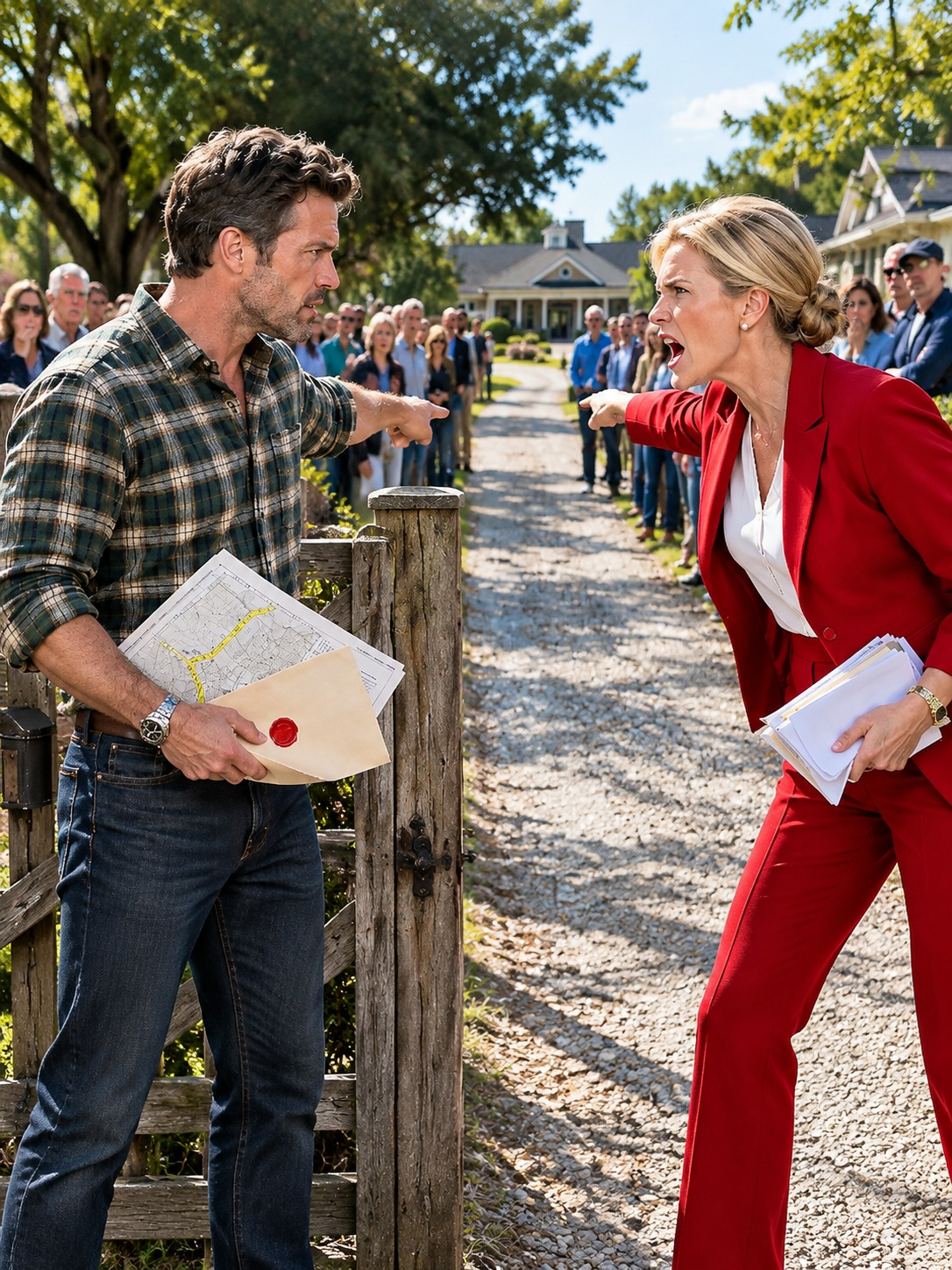
The same instrument Rebecca had sent me.
Marla smiled.
"As you can see, the original access rights were formally relinquished."
Rebecca raised her hand.
Marla hesitated.
"Yes?"
"Does the association contend that this release transferred the easement to the HOA, or that it extinguished the easement entirely?"
The room became quiet.
Marla blinked.
"The document establishes the association's authority."
"That's not quite what I asked."
Marla's expression hardened.
"Our attorney has reviewed the matter."
Rebecca nodded.
"Then perhaps you can identify the provision granting the association the right to physically obstruct Mr. Mercer's only access."
Marla looked down at the paper.
For several seconds, she said nothing.
Then she pointed to a paragraph.
"This section concerns replacement access arrangements."
Rebecca leaned forward.
"Yes. It does."
Marla looked relieved.
"Then you agree."
"I agree that the document refers to a replacement access arrangement."
The relief vanished.
Rebecca continued.
"Would you please identify where that replacement arrangement was recorded and established?"
Marla stared at her.
The room was silent.
I could hear the air conditioner humming.
Finally, Marla said, "The development documents address that."
"Which development documents?"
"The relevant plans."
Rebecca opened her portfolio.
"Would those be the plans showing a proposed road that was never constructed?"
Marla froze.
Corbin carefully unrolled his father's drawing.
Rebecca held up a copy.
The red line was clearly visible.
Several neighbors leaned forward.
Marla stared at the map.
For the first time that evening, she looked genuinely surprised.
"Where did you get that?"
Rebecca answered calmly.
"From a former planning committee member's retained records."
Marla's eyes moved toward Corbin.
He didn't look away.
Rebecca continued.
"The original easement appears to have benefited Mr. Mercer's parcel. The purported release refers to replacement access. Yet the proposed route shown here was never built. We are requesting the complete recorded documentation establishing what happened to those rights."
Marla's face reddened.
"You're misrepresenting the history."
"Then please correct the record."
Silence.
Rebecca waited.
Marla looked toward Leonard.
He stared at the table.
She looked toward another board member.
The woman avoided her eyes.
Then Marla straightened.
"The board has no obligation to litigate historical property matters in front of residents."
Rebecca nodded.
"You're correct that this meeting cannot adjudicate title. But the board has already installed a physical obstruction based on its asserted authority. My client is entitled to challenge that action."
A voice rose from the back.
Helen Brooks.
"Then why is the chain still there?"
Several people murmured in agreement.
Marla lifted the gavel.
"Order."
Helen didn't sit.
"That's his only road, Marla."
"I am aware."
"Then how is he supposed to get out?"
"The board has procedures."
"What procedures?"
Marla struck the gavel again.
"Mrs. Brooks, please sit down."
Helen folded her arms.
"Show us the procedures."
A ripple of quiet agreement spread through the room.
I watched Marla's expression.
The certainty she had displayed at the beginning was slipping.
She had expected the old release to end the discussion.
Instead, it had opened questions she couldn't answer.
Then Leonard stood.
"Madam President, I need to make a statement."
Marla turned sharply.
"Leonard, this is not on the agenda."
"It concerns the access restriction."
She stared at him.
He continued.
"I did not vote to authorize the installation of a locked chain."
The room went silent.
Marla's face changed.
"Leonard—"
"And I have not been shown minutes documenting a board vote approving that specific action."
Someone gasped.
Corbin looked at me.
Rebecca remained still.
Marla gripped the edge of the table.
"This is an internal governance matter."
Leonard shook his head.
"No. We told residents the board approved it. I want the record to reflect that I did not."
For several seconds, nobody moved.
Then a man in the front row asked, "Who authorized the chain?"
Marla didn't answer.
Another resident stood.
"Did the attorney approve it?"
Still no answer.
I looked at Rebecca.
She gave me the smallest nod.
It was time.
I stood.
The room quieted.
"Marla," I said, "I have one question."
She stared at me.
"Of course you do."
I held up the original easement.
"Can you show us a recorded document proving the association has the right to block my access?"
Her expression tightened.
"I've already presented the release."
"That document doesn't identify the HOA as the owner of the easement."
"You're not qualified to interpret it."
"That's why I hired someone who is."
A few people shifted in their chairs.
I kept my voice low.
"I don't want special treatment. I don't want a fight. I want to drive to my house without somebody putting a chain across the road."
Marla opened her mouth.
Then closed it.
I continued.
"I paid for the gravel. I repaired the drainage. I cleared fallen trees. And when you fined me eighteen hundred dollars, I asked you to show me the authority behind the charge."
I looked around the room.
"That's all I've asked from the beginning."
Nobody spoke.
I turned back toward Marla.
"If the association has the right, show the document. If it doesn't, remove the chain."
The silence lasted several seconds.
Then Marla reached into her folder.
Her hands were trembling slightly.
She pulled out another paper.
"This meeting is not over," she said.
Rebecca leaned forward.
"What is that document?"
Marla looked directly at me.
"Something Mr. Mercer should have disclosed before making accusations."
My stomach tightened.
She lifted the page toward the document camera.
At the top was my full name.
GIDEON MERCER.
Beneath it was a date from several years earlier.
The year I purchased my house.
And below that was a signature.
My signature.
Marla looked around the room.
"Perhaps Mr. Mercer would like to explain why he signed an agreement acknowledging the association's authority."
I stared at the screen.
I recognized the signature.
I recognized the date.
But I had never seen that agreement before.
Rebecca reached for her glasses.
Then she leaned closer to the projected document.
Her expression changed.
She whispered, "Gideon, don't say another word."
Marla turned the page.
And beneath my signature was a paragraph that began—






Comments 0