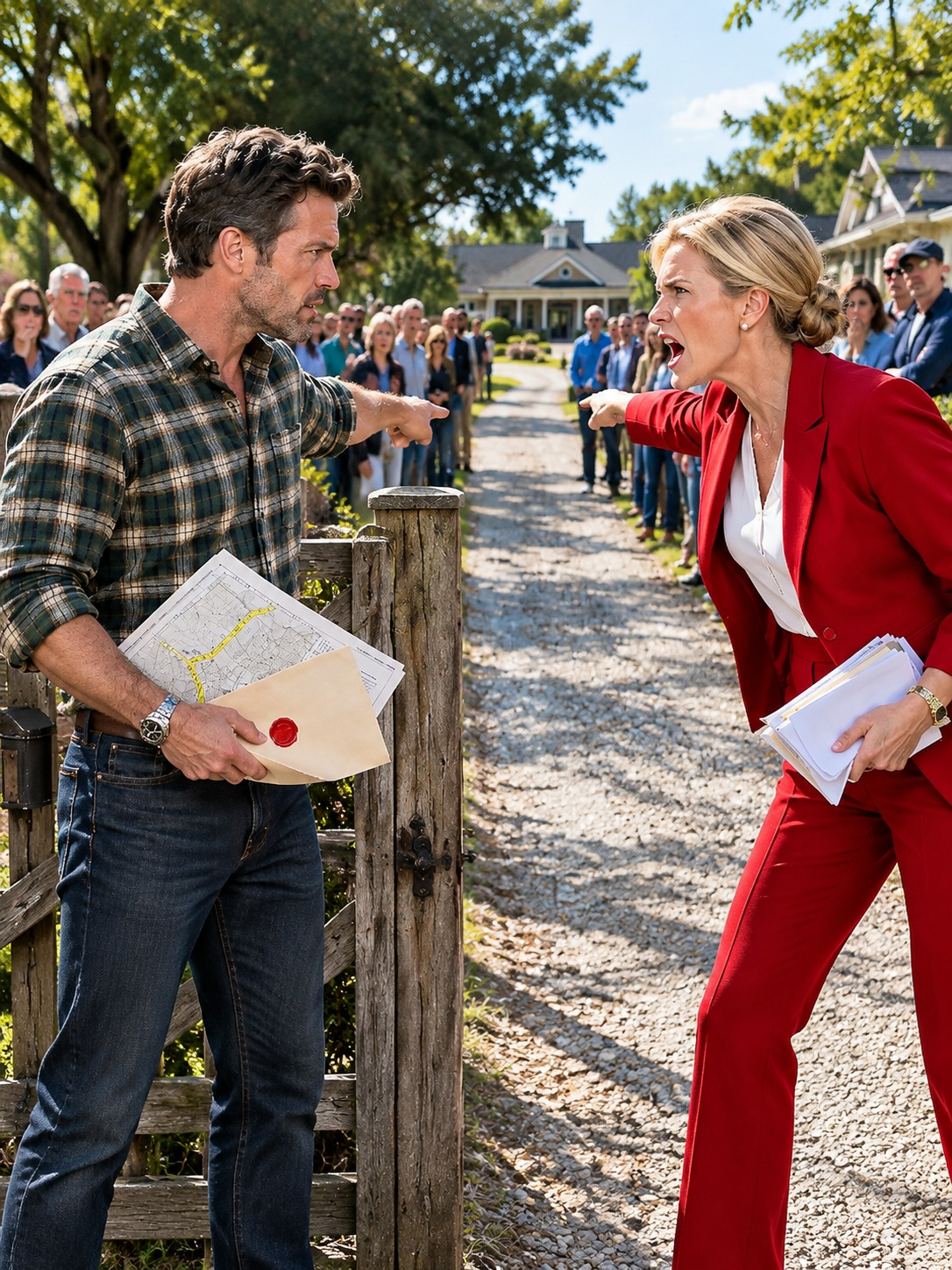
"There's something else attached to this recording," Evelyn Carter whispered.
She unfolded the yellowed paper across the counter, smoothing its edges with both hands.
At the top, beneath a faded county stamp, were five words that made my stomach tighten.
PERPETUAL ACCESS — SUCCESSORS AND ASSIGNS.
I leaned closer.
"Does that mean what I think it means?"
Evelyn looked at me over her glasses.
"It means you shouldn't let anybody tell you this road belongs to them until you've followed the entire chain of title."
For a moment, neither of us spoke.
The county records office was quiet except for the hum of an old ventilation system and the occasional clicking of a keyboard. Somewhere behind us, a printer began feeding out pages.
I stared at the document.
Forty-three years.
That was how long this piece of paper had existed.
Forty-three years of property sales, new houses, neighborhood meetings, and people arguing about mailbox colors.
And somehow, nobody had mentioned the name printed at the top.
Elias Wren.
"Who was he?" I asked.
Evelyn shook her head.
"I can tell you what the recorded documents say. Anything beyond that, you'll have to research."
She pointed toward the first paragraph.
The instrument had been recorded when the surrounding land was still largely undeveloped. It described a permanent right of access over a narrow strip of property connecting a private parcel to the public road.
The route matched the gravel road leading to my house.
I recognized the curve near the wooden gate.
I recognized the drainage ditch.
Even the old boundary marker beside the oak tree appeared on the accompanying survey.
Evelyn moved her finger to the next section.
"The important part is identifying the benefited parcel," she explained. "An easement can benefit a piece of land rather than simply one individual. If that's the case, the right may pass with that land through later conveyances."
I nodded slowly.
"So Elias Wren might not be the person who owns the right anymore."
"Correct."
"And the HOA might not own it either."
"That's something the documents need to establish."
I appreciated that answer.
After listening to Marla Voss speak as though every question had already been settled, it was refreshing to hear someone distinguish between what a document proved and what still needed investigation.
"Can I get copies of everything?"
"Of course."
"Certified copies?"
She smiled.
"Planning to make a point?"
"Planning to make sure nobody can say I invented the paperwork."
That earned a quiet laugh.
She entered several document numbers into her computer.
While the printer worked, I studied the old map.
The land surrounding my property had once belonged to a family named Wren. The road crossed a section that had later been divided and sold to developers.
My parcel sat at the end of the route, separated from the public road by the land that eventually became Briarwood Ridge.
The easement appeared to have been created specifically to preserve access to that parcel.
It made sense.
Without the road, the property would have been difficult to reach.
But one question kept bothering me.
If the easement existed before the subdivision, how had Marla convinced herself that the HOA could control it?
I asked Evelyn whether the association's name appeared anywhere in the original instrument.
She examined the page.
"No. The association didn't exist when this was recorded."
"Could the HOA have acquired rights later?"
"Possibly. That's why you'll want to check subsequent conveyances, amendments, releases, and any other recorded instruments affecting the parcels."
I wrote those words down.
Subsequent conveyances.
Amendments.
Releases.
It wasn't the dramatic answer I had hoped for.
There was no single sentence declaring Marla wrong and me right.
There was only a trail of documents.
But trails were something I understood.
You followed them carefully.
You didn't skip the difficult sections.
And you never assumed the road ahead was clear simply because somebody said it was.
Evelyn returned with a stack of copies.
She placed the original easement on top.
"There's another thing you should know," she said.
I looked up.
"What's that?"
"The original subdivision plat references this access corridor. But the HOA's founding documents were recorded years later."
"How many years?"
She checked the dates.
"Seventeen."
I stared at her.
"The road existed seventeen years before the HOA?"
"According to these records, yes."
I thought about Marla standing in front of thirty-four neighbors, describing my repairs as unauthorized alterations to association infrastructure.
I thought about her threatening to block my entrance.
And I thought about the blank space on the violation notice where the recorded easement number should have been.
"Can I see the founding documents?"
Evelyn nodded.
"That's the next place I'd look."
I spent the next two hours at a public computer in the records office.
The association's founding papers were longer than I expected.
There were declarations, amendments, maps, descriptions of common areas, and pages of restrictions governing everything from fences to exterior paint.
I searched for the gravel road.
At first, I found nothing.
Then I located a section describing shared access and maintenance responsibilities.
The language was broad.
It gave the association authority over designated common areas and certain roads within the subdivision.
But the map attached to that section showed something peculiar.
The internal subdivision streets were shaded.
The landscaped entrance was shaded.
A small recreation area was shaded.
My gravel road wasn't.
It appeared as a narrow line along the edge of the development, marked with a reference to an existing access easement.
I leaned closer to the screen.
"Existing."
That word mattered.
It suggested the developer had recognized something already in place.
I printed the page.
Then I printed the map.
I wasn't ready to declare victory. The association could still have maintenance or enforcement rights under some later document I hadn't found.
But the difference between the original plat and Marla's statements was becoming difficult to ignore.
She had told the neighborhood the HOA owned the easement.
The founding documents I had seen did not clearly establish that claim.
I checked the time.
Almost noon.
I had missed half a workday, but I wasn't leaving yet.
I returned to Evelyn's counter.
"Can I ask one more question?"
She looked up.
"You've been asking good ones so far."
I showed her the map.
"Is there a way to see whether this easement was ever released?"
She nodded toward the computer.
"We can search recorded instruments by the original parties and by the relevant parcels. But keep in mind that indexing systems aren't perfect, especially with older records."
"Could you help me start?"
She typed Elias Wren's name.
Several entries appeared.
One was the original easement.
Another involved a land conveyance.
A third was a document recorded years later.
Evelyn opened it.
The page contained a legal description of property transferred from the Wren family to another owner.
My eyes moved toward the parcel reference.
It matched the land at the end of the gravel road.
My land.
I felt a strange pressure in my chest.
Not excitement exactly.
Something closer to recognition.
The property had changed hands several times before I bought it, but the old easement reference appeared in the historical chain.
It was a lead worth pursuing.
I asked Evelyn whether I could obtain the complete sequence of deeds.
She told me how to request them.
Then she added something I wouldn't forget.
"Mr. Mercer, property records can be complicated. If somebody is threatening your access, you should have a qualified real estate attorney review this before you make any legal conclusions."
"I will."
"And keep copies of any notices or threats."
I thought about my labeled folders.
"I've got those."
"Good."
I gathered my papers and paid the copying fees.
Before leaving, I looked once more at the original instrument.
Elias Wren.
Whoever he had been, he had taken the trouble to record an access right before the surrounding land was developed.
Maybe he had understood exactly how important that road would become.
Maybe he had simply been careful.
Either way, forty-three years later, his name was giving me the first solid lead I'd had since the red envelope appeared.
When I returned to Briarwood Ridge, a white SUV was parked near the wooden gate.
I recognized it immediately.
Marla Voss.
She stood beside the road with Corbin Hale and another board member, a thin man named Leonard Briggs.
All three were looking toward the repaired drainage ditch.
I slowed my truck.
Marla turned as I approached.
She was wearing sunglasses and holding a clipboard.
I stopped a few feet away and lowered my window.
"Afternoon," I said.
Marla didn't return the greeting.
"Where have you been?"
I looked at her.
"Out."
"We've been trying to reach you."
"My phone's been on silent."
"That's convenient."
I glanced toward Corbin.
He looked uncomfortable.
Leonard kept his eyes on the ditch.
"Is there a problem?" I asked.
Marla lifted her clipboard.
"The board is conducting an inspection."
"Of what?"
"The unauthorized work."
I looked toward the section I had repaired.
The gravel was level.
The drainage pipe was clear.
There was no visible damage.
"You're welcome to look," I said. "Just don't block the road."
Marla lowered her sunglasses.
"You're in no position to give instructions."
I didn't respond.
Instead, I reached into the passenger seat and picked up the folder.
"I went to the county records office this morning."
That changed her expression.
Only slightly.
But I noticed.
Corbin looked toward the folder.
Marla's voice remained controlled.
"And?"
"I found the original access easement."
For the first time, Leonard stopped examining the ditch.
Marla crossed her arms.
"Our attorney has already reviewed the relevant documents."
"Then this should be familiar."
I held up a copy of the original plat.
"The road was recorded before the subdivision existed."
Marla didn't reach for it.
"That doesn't change the association's authority."
"Maybe not. But the HOA's founding map identifies the road as an existing easement. It doesn't show it as one of the shaded common roads."
Corbin stepped closer.
"Can I see that?"
Marla turned sharply.
"Corbin, this is a board matter."
He hesitated.
Then looked at me.
"I'd still like to see it."
I handed him the copy.
He studied the map.
His eyebrows drew together.
"That's the old entrance," he said.
"Yes."
"And this line goes all the way to your parcel?"
"That's what the survey shows."
Marla took a step toward him.
"Those documents need legal interpretation."
"I agree," I said.
She looked surprised.
I continued.
"That's why I haven't claimed they settle everything. I'm asking for the association's recorded document so we can compare them."
Corbin glanced between us.
"Marla, do we have that?"
She stiffened.
"The board has the necessary documentation."
"Then why not give Gideon a copy?"
Her lips tightened.
"Because this isn't how association enforcement works."
I watched Corbin's face.
Something had changed.
At the meeting, he had treated me like a man trying to escape the rules.
Now he was holding a county record that raised the same question I had been asking.
He folded the map carefully and handed it back.
"I think the board should look at this," he said.
Marla's eyes narrowed.
"The board will decide what it needs to review."
I returned the paper to my folder.
"Fine. I'll send copies to everyone."
"That would be inappropriate," Marla said immediately.
I looked at her.
"Why?"
"Because you'll confuse residents with incomplete information."
"Then send the complete information."
Her face reddened.
For several seconds, the only sound was wind moving through the oak leaves.
Then Marla pointed toward my truck.
"You still owe eighteen hundred dollars."
"I dispute the charge."
"The deadline hasn't changed."
"Neither has my request."
She stared at me.
I could tell she wanted an argument.
She wanted me to shout, threaten, or do something she could describe as aggressive.
I wasn't going to give her that.
I rolled up my window and drove through the gate.
In the rearview mirror, I saw Corbin speaking to Leonard.
Marla stood apart from them.
She was watching my truck.
That evening, I scanned the county documents and saved them in two places.
One copy went onto my computer.
Another went onto a small external drive.
Then I wrote an email to the association board.
I kept it short.
I attached the original easement, the historical plat, and the relevant page from the HOA founding documents.
I requested the recorded instrument supporting the association's ownership claim.
I also asked the board to suspend the fine and any proposed access restriction until the documents could be reviewed.
I copied the association's general email address.
Then I sent it.
Twenty minutes later, my phone rang.
Corbin Hale.
I almost didn't answer.
"Hello?"
"Gideon, it's Corbin."
"I know."
There was an awkward pause.
"Listen, I've been thinking about that map."
"Okay."
"I didn't realize the road was older than the subdivision."
"Most people don't."
"Marla always called it community property."
"That's what she told me too."
He cleared his throat.
"Do you really think the association doesn't control it?"
"I think we need to see the records before anybody makes that claim."
Corbin was silent.
Then he said something unexpected.
"My father lived here when the first houses were built."
I leaned back in my chair.
"Really?"
"He used to talk about the old Wren property."
My fingers tightened around the phone.
"Wren?"
"Yeah. Elias Wren. I haven't heard that name in years."
I sat forward.
"You knew him?"
"Not personally. My father did."
"What did he say about him?"
Corbin hesitated.
"Mostly that he was stubborn about the road."
I looked toward the folder.
"Stubborn how?"
"He wouldn't let the developer pretend it didn't exist."
That sentence landed harder than I expected.
"What do you mean?"
"I don't remember all the details. I was a kid. But my father said there was an argument when the subdivision was planned. Something about access rights."
"Did the developer try to close the road?"
"I honestly don't know."
I wrote down every word.
"Corbin, is your father still alive?"
"No. He passed six years ago."
"I'm sorry."
"Thanks."
He paused.
"But I still have some of his old paperwork."
I stopped writing.
"What kind of paperwork?"
"Neighborhood stuff. He was on the original planning committee. Kept everything in boxes."
"Would you be willing to look through it?"
"Maybe."
His voice dropped.
"There's something else, Gideon."
"What?"
"Marla called me after you left today."
I waited.
"She was angry that I asked to see your map."
"That doesn't surprise me."
"She told me not to discuss the road with you anymore."
I looked down at the phone.
"Did she say why?"
"She said you were trying to undermine the board."
"By asking for documents?"
"That's what I said."
For a moment, neither of us spoke.
Then Corbin added, "I don't like being told what questions I'm allowed to ask."
It was the first time I had heard him sound genuinely angry.
Not at me.
At the situation.
"I appreciate the call," I said.
"Don't thank me yet. I haven't found anything."
"Even looking helps."
He promised to check the boxes over the weekend.
After we hung up, I sat quietly for a long time.
Elias Wren was no longer just a name on an old instrument.
He was somebody people remembered.
Somebody who had apparently fought to protect that road before I was born.
And if Corbin's father had kept records from the original development, there might be more to the story than the county documents alone revealed.
The next morning, the association sent its response.
I opened the email while standing in my kitchen.
The subject line read:
FORMAL NOTICE OF NONCOMPLIANCE.
Marla had copied the board.
She stated that my continued refusal to pay constituted a willful violation of association rules.
She claimed my documents were being used to misrepresent the association's authority.
She warned that additional fees could be assessed.
Then came a sentence that made my coffee go cold.
"The association reserves the right to install temporary access-control measures pending resolution."
I read it again.
Temporary access-control measures.
That sounded like a gate.
Or a barrier.
Or something worse.
I forwarded the email to a local real estate attorney whose office I had found through a county bar association referral directory.
Her name was Rebecca Sloan.
I included the recorded documents and asked for the earliest available consultation.
Then I called her office.
The receptionist offered me an appointment the following Tuesday.
I accepted.
Before ending the call, I explained that the HOA had threatened to block my only access.
The receptionist put me on hold.
A minute later, she returned.
"Ms. Sloan asked whether the association has already installed anything."
"Not yet."
"She says to preserve every communication and call us immediately if that changes."
"I will."
I hung up.
Then I went outside.
The gravel road looked exactly as it always had.
Sunlight fell across the repaired shoulder.
A squirrel crossed the wooden fence.
A delivery truck passed the subdivision entrance.
Ordinary things.
But now every vehicle slowing near the gate made me look twice.
I spent the afternoon photographing the road again.
I measured the width of the entrance.
I took pictures of the public-road connection.
I documented the drainage work and saved the original image files.
Then I checked the association's online portal.
The fine was still there.
$1,800.
Due immediately.
A new line had appeared beneath it.
ENFORCEMENT REVIEW PENDING.
I printed the screen.
At four thirty, someone knocked on my door.
It was Daniel Price, the neighbor who had avoided waving at me earlier that week.
He stood on the porch holding his baseball cap.
"Hey, Gideon."
"Daniel."
He looked embarrassed.
"Got a minute?"
"Sure."
He glanced over his shoulder before speaking.
"I heard you found some old property records."
"That's right."
"Corbin mentioned it."
I nodded.
Daniel shifted his weight.
"Look, I don't want trouble with the board."
"Neither do I."
"But my wife and I were talking. If they can block your road over a fine, what stops them from doing something similar to somebody else?"
It was a fair question.
"I don't know," I said. "That's part of why I'm challenging it."
He looked relieved that I hadn't turned the conversation into an argument.
Then he reached into his jacket.
"I thought you should see this."
He handed me a folded sheet of paper.
It was a photocopy of an association maintenance schedule.
Several years old.
I recognized the format.
"What am I looking at?"
"Check the road section."
I unfolded it.
The document listed common-area maintenance responsibilities.
Landscaping.
Drainage.
Streetlights.
Pavement repairs.
Then, near the bottom, I saw a handwritten notation.
PRIVATE ACCESS ROAD — EXCLUDED FROM HOA MAINTENANCE.
I looked at Daniel.
"Where did you get this?"
"My wife used to help with the landscaping committee. She kept copies."
"Do you know who wrote the note?"
"No."
I studied the page.
The handwriting was small and neat.
The notation was dated.
And beside it were two initials.
M.V.
My eyes moved back to Daniel.
"Marla?"
He nodded slowly.
"That's what my wife thinks."
I felt a cold, steady realization.
If Marla herself had acknowledged that the road was excluded from HOA maintenance, why was she now fining me for maintaining it?
The document didn't necessarily settle ownership or enforcement authority.
But it raised another serious inconsistency.
"Can I keep this?"
Daniel nodded.
"Just don't tell her I gave it to you."
"I won't volunteer your name."
He thanked me and left.
I closed the door and placed the paper beside the original easement.
Two documents.
Two different decades.
Both raising questions about Marla's claims.
I was still examining the handwriting when my phone buzzed.
A text from Corbin.
Found one of Dad's boxes. There's a letter about the Wren road.
I replied immediately.
Can you send me a picture?
Three dots appeared.
Disappeared.
Then appeared again.
I'd rather show you in person.
I looked at the time.
When?
His answer came almost instantly.
Tonight. Eight. Your place. Don't tell Marla.
At seven fifty-five, I cleared the kitchen table.
I placed the county records in one stack and Daniel's maintenance schedule in another.
Then I made coffee.
At eight exactly, headlights swept across my front window.
Corbin's truck pulled into the driveway.
He climbed out carrying a battered cardboard file box.
I opened the door before he reached the porch.
"Thanks for coming."
He stepped inside.
"You might not thank me after you see this."
I looked at the box.
"What did you find?"
Corbin set it on the table.
"My father kept correspondence from the original subdivision planning meetings. I found letters between the developer, county officials, and somebody named Elias Wren."
He removed a folder secured with an old rubber band.
The papers inside were yellowed.
Some had handwritten notes in the margins.
Others carried faded letterhead from a development company that no longer existed.
Corbin carefully separated one page.
"This is the one I wanted you to see."
He handed it to me.
The letter was dated several years before the HOA's formation.
It referred to the proposed subdivision and the existing gravel access route.
One paragraph discussed the developer's desire to consolidate road maintenance under a future neighborhood association.
Another stated that the original easement would require separate consideration.
I read the letter twice.
Then I noticed a handwritten note at the bottom.
"Do not assume authority over Wren access. Existing rights must be honored."
The initials beside the note belonged to the developer's attorney.
I looked up.
"Corbin, this is important."
"I thought so."
"Where's the rest of the correspondence?"
He opened the box again.
"There's more."
He pulled out another envelope.
This one was addressed to Elias Wren.
The return address belonged to the original developer.
Corbin held it carefully.
"My father wrote something on the back."
He turned it over.
In faded blue ink were six words.
WREN REFUSED TO SIGN THE RELEASE.
I felt my pulse quicken.
"What release?"
Corbin shook his head.
"I don't know."
I examined the envelope.
It was still sealed.
"Did your father ever open it?"
"Apparently not."
"How did he get it?"
"That's what I've been wondering."
We stared at the envelope.
If the developer had tried to obtain a release of the access easement, the attempt itself might explain the old dispute.
But an unsigned release wouldn't necessarily extinguish the recorded right.
We needed to know what had happened afterward.
"Should we open it?" Corbin asked.
I looked at him.
"It belonged to your father. That's your decision."
He hesitated.
Then carefully slid a finger beneath the flap.
The old adhesive separated with a dry crackle.
Inside were two folded pages.
Corbin removed them.
The first was a proposed agreement.
The second was a letter.
He read the first paragraph silently.
Then his face changed.
"Gideon."
"What?"
He looked at me.
"This wasn't just about the road."
I stood.
"What do you mean?"
He turned the letter toward me.
Before I could read it, headlights appeared outside.
A vehicle had stopped at the wooden gate.
Then another.
Corbin looked toward the window.
"Are you expecting somebody?"
"No."
We watched two figures step out beside the road.
One carried a flashlight.
The other moved toward the gatepost.
I reached for my phone.
Then a metallic clank echoed across the driveway.
Corbin's face went pale.
"Gideon, they're putting something across the entrance."
I hurried to the window.
A heavy chain was being pulled between the wooden posts.
And standing beside it, holding a clipboard, was Marla Voss.
She looked directly toward my house.
Then she raised her phone.
A second later, mine began to ring.






Comments 0