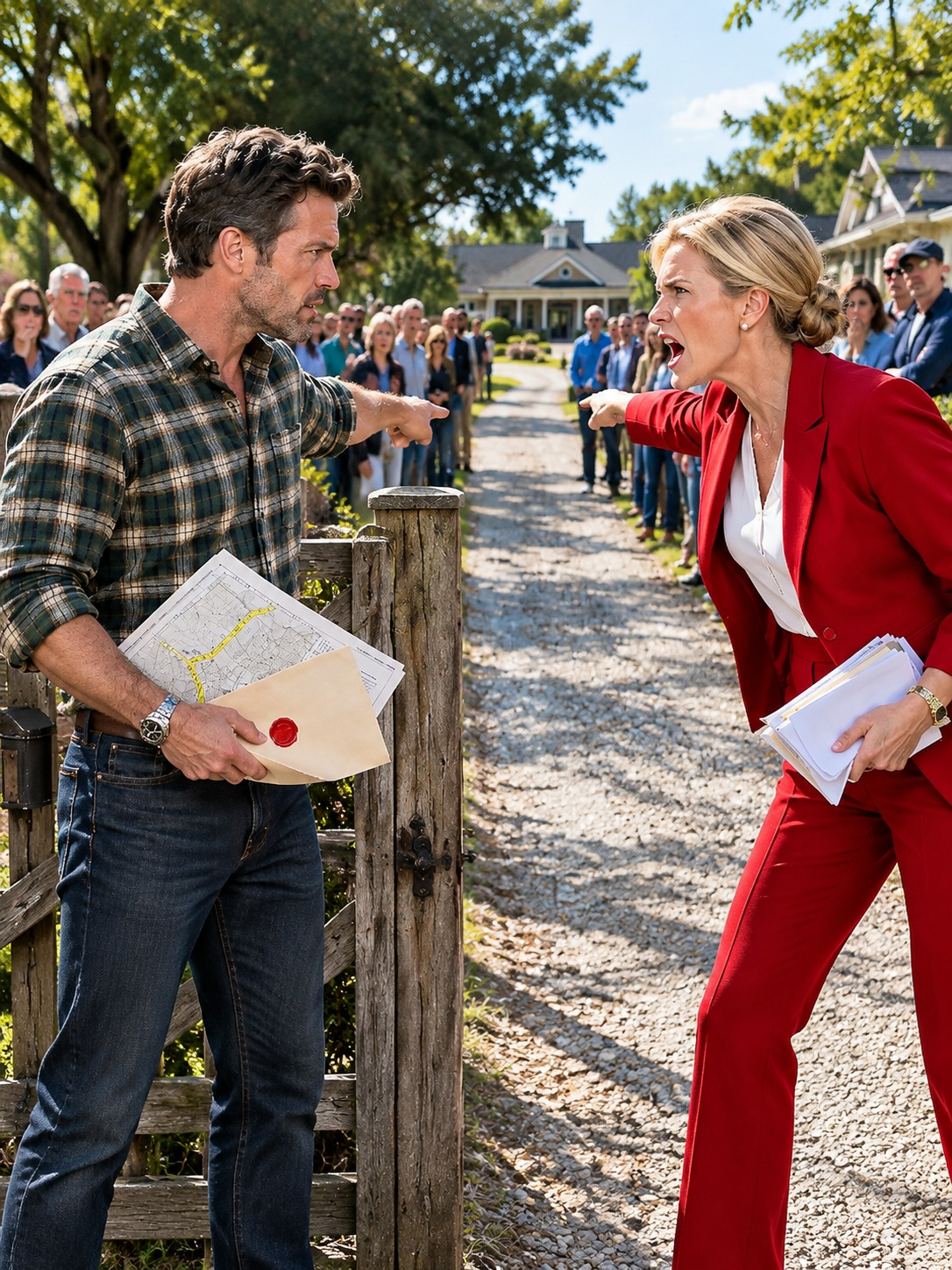
"I never agreed to give up my road!"
My voice cut through the crowded community room before I could stop myself.
On the screen behind Marla Voss was a document bearing my signature.
My real signature.
But the paragraph beneath it claimed I had voluntarily surrendered my right to challenge the homeowners association's authority over the gravel road leading to my house.
I had never seen those words before.
Rebecca Sloan gripped my wrist.
"Gideon," she whispered, "sit down."
I looked at her.
"That's not what I signed."
"I believe you. But right now, we need to find out what she has."
Across the room, Marla smiled as though she had been waiting all evening for this exact moment.
Thirty-four homeowners had watched her threaten me beside the wooden gate. More had gathered for tonight's special meeting. Now they were staring at a projected document that made me look like a liar.
Marla adjusted the document beneath the camera.
"Perhaps everyone can finally understand why Mr. Mercer's accusations are so troubling."
I forced myself to sit.
My heart was pounding hard enough that I could feel it in my throat.
Rebecca leaned toward me.
"Tell me exactly what you remember signing when you purchased the property."
I swallowed.
"Closing documents. Acknowledgments. The deed. The title insurance paperwork."
"Anything concerning the HOA?"
"There was a disclosure packet."
"Did you sign an access agreement?"
"Not that I remember."
She studied my face.
"Don't guess. We'll get the original closing file."
Marla tapped the page.
"The agreement clearly states that Mr. Mercer acknowledged the association's jurisdiction over the access corridor."
A man in the front row turned toward me.
"Then why have you been telling everybody they don't have authority?"
I opened my mouth.
Rebecca raised one finger.
She stood.
"Before anyone draws conclusions, I'd like to examine the complete document, including all pages, attachments, and the source from which this copy was obtained."
Marla's smile tightened.
"This is a certified association record."
"Certified by whom?"
"Our administrative office."
"Is it a recorded instrument?"
Marla hesitated.
"It was retained in the association's permanent files."
"That wasn't my question."
Several residents shifted in their chairs.
Rebecca continued.
"Was this document recorded with the county?"
"I don't believe that was necessary."
"Does the association possess the original signed agreement?"
Marla looked toward Leonard Briggs.
Leonard stared at the table.
"The board has a copy," Marla said.
"Then please provide the complete copy."
Marla straightened.
"You're welcome to submit a formal request."
"My client has submitted several."
A quiet murmur moved through the room.
I watched Marla's expression harden.
She had expected the signature to silence me.
Instead, Rebecca was asking where the document came from.
And Marla didn't seem eager to answer.
I remembered the day I bought my house.
Not every detail.
Nobody remembers every page of a real estate closing.
But I remembered enough.
I was thirty-four then, sitting across from a closing agent named Patricia Bell in a small conference room above a title company's downtown office.
My father had died the previous year.
The house was the first place I had purchased entirely on my own.
I had saved for years, worked overtime, and turned down vacations because I wanted something permanent.
Something nobody could take away simply because a landlord changed his mind.
Patricia had placed a thick stack of papers in front of me.
She explained the mortgage, taxes, insurance, and property boundaries.
She also pointed out the recorded access easement.
I remembered asking about it.
"That's the gravel road?"
"Yes," she had said. "Your parcel benefits from an existing access easement."
"Does the neighborhood association maintain it?"
"According to the information provided, maintenance is handled separately."
That sentence had mattered.
I knew the road needed work.
The gravel was uneven, and the drainage ditch had been neglected.
But I wasn't afraid of maintaining it.
I had grown up repairing things.
A road was just another responsibility.
At closing, Patricia had given me a folder containing copies of everything I signed.
I still had it.
At least, I hoped I did.
It was stored in a metal filing cabinet in my home office.
And I had never thrown away a closing document.
Marla continued speaking.
"The association has been patient. We have offered Mr. Mercer numerous opportunities to resolve this matter privately."
Helen Brooks raised her hand.
Marla ignored her.
Helen stood anyway.
"Then why did you put a chain across his only road?"
Marla sighed.
"Mrs. Brooks, we've already addressed that."
"No, you've talked around it."
A few people nodded.
Marla struck the gavel.
"Please sit down."
Helen remained standing.
"Show us where that agreement says you can lock him inside his property."
Marla pointed toward the projected page.
"It acknowledges association authority."
"That isn't the same thing."
I looked at Helen.
She wasn't a lawyer.
She didn't need to be.
She understood the difference between acknowledging rules and surrendering access to a home.
Rebecca spoke again.
"Even if the document is authentic, its legal effect would require analysis. It would not automatically resolve the recorded easement, the chain of title, or the authority to obstruct access."
Marla's cheeks reddened.
"Are you accusing the association of falsifying records?"
"No," Rebecca said calmly. "I'm requesting the complete record before anyone relies on it."
"Mr. Mercer clearly signed."
"That appears to be his signature. We haven't established what document it originally accompanied."
For the first time, I saw something flicker across Marla's face.
It was brief.
But unmistakable.
Concern.
Rebecca noticed it too.
She turned toward me.
"We're leaving."
I blinked.
"Now?"
"Yes."
Marla looked startled.
"Mrs. Sloan, this meeting is still in session."
"Then please continue. My client has preserved his objections, and we have work to do."
I gathered my folder.
As we stood, Marla called after us.
"Walking out won't make the agreement disappear, Gideon."
I turned.
For a moment, every angry thought in my head demanded to be spoken.
Instead, I said, "Neither will refusing to show the original."
Then I followed Rebecca outside.
The parking lot was crowded.
People stood in small groups beneath the lights, talking about the document and the chain.
Rebecca stopped beside her car.
"Gideon, I need you to listen carefully."
"I'm listening."
"Don't discuss the signature with neighbors tonight."
"Why?"
"Because we need to compare the document against your original closing records before making any public statement."
I nodded.
"Do you think it's forged?"
"I think we don't have enough information."
"But the signature is mine."
"That doesn't necessarily mean the entire document is what it appears to be."
I stared at her.
She continued.
"Signatures can appear on legitimate documents that are later copied, rearranged, or presented without context. Pages can also be missing. We need to examine the complete source."
I thought about the closing packet.
"I have my copies at home."
"Good. Find them."
"And then?"
"Call me."
I looked toward the road.
"Marla still has the chain up."
"I know. I've already prepared the papers needed to seek emergency relief if the association refuses to remove it."
"How soon?"
"Potentially tomorrow, depending on the court's schedule and the final documents."
I nodded.
Rebecca opened her car door.
Then she stopped.
"One more thing."
"What?"
"That agreement appeared at exactly the moment the board was being questioned about the chain."
I looked at her.
"You noticed."
"Of course."
"What does that tell you?"
"That we should find out when the association obtained it."
She drove away.
I stood beside my truck, watching the taillights disappear.
For days, I had been asking Marla to show me a document.
Now she had produced one.
And somehow, that made the situation more disturbing than before.
I reached my house just after ten.
Because the chain still blocked the gravel road, my truck remained parked on the subdivision side.
I walked home carrying my folder beneath one arm.
The porch light was on.
The windows were dark.
I unlocked the front door and went directly to my office.
The metal filing cabinet stood beside an old wooden desk.
I opened the bottom drawer.
Taxes.
Insurance.
Vehicle records.
Then the folder I wanted.
PROPERTY PURCHASE — MERCER.
I carried it to the kitchen table.
Inside were the original copies from closing.
The deed.
The settlement statement.
The title insurance policy.
The survey.
And a stack of acknowledgments.
I spread everything out.
Then I opened the photographs I had taken of Marla's projected agreement.
The first page looked familiar.
It contained language about receiving the subdivision's governing documents.
I found a similar page in my closing packet.
The heading matched.
The date matched.
Even the font looked the same.
But the document Marla had shown contained an additional paragraph.
I read it again.
"The purchaser acknowledges the association's exclusive authority to regulate, restrict, and control access through the designated corridor, including the right to suspend access for violations."
My stomach tightened.
I looked at my original copy.
That paragraph wasn't there.
Instead, the corresponding section concerned the purchaser's receipt of community rules and responsibility for reviewing recorded restrictions.
Nothing about surrendering access.
Nothing about a locked gate.
Nothing about the HOA having exclusive control over the road.
I checked the page numbers.
My copy had four pages.
Marla's projected document appeared to have five.
I leaned closer.
On my original acknowledgment, the signature appeared at the bottom of page four.
In Marla's version, the same signature appeared beneath the added paragraph.
I felt cold.
I took photographs of both documents.
Then I called Rebecca.
She answered immediately.
"Did you find the file?"
"Yes."
"And?"
"The language is different."
There was a pause.
"Explain."
I read both versions aloud.
When I finished, Rebecca was silent for several seconds.
"Gideon, I want high-resolution scans of every page."
"I'll send them."
"Include the backs, any staples, and the original envelope if you have it."
"Why?"
"Because we need to preserve the physical evidence and compare the copies carefully."
I looked at the papers.
"Rebecca, somebody changed the agreement."
"That is one possibility. We need to establish the provenance of both versions."
I exhaled.
"Okay."
"Do you remember whether your closing packet was stapled?"
"Yes."
"Are the staples still in place?"
I checked.
The acknowledgment pages were still attached by two old staples.
"Yes."
"Good. Don't remove them."
I carefully set the packet down.
Rebecca continued.
"Do you have the title company's contact information?"
I looked at the settlement statement.
"Yes."
"Send it to me. I'll request their retained closing file."
"What if they don't have it anymore?"
"Then we'll look for other copies."
I stared at Marla's document on my phone.
"What happens if the original proves mine is correct?"
Rebecca's voice remained measured.
"Then we'll ask how the association obtained a materially different version."
I understood what she wasn't saying.
If someone had knowingly altered a document to make it appear I had surrendered property rights, the dispute was no longer just about an $1,800 fine.
But we weren't there yet.
We needed proof.
The next morning, I woke to a message from Corbin.
You need to see what Marla sent the neighborhood.
I opened my email.
The subject line was:
DOCUMENTED ACKNOWLEDGMENT OF HOA AUTHORITY.
Marla had attached a photograph of the disputed agreement.
She wrote that the association had presented conclusive evidence of my prior acknowledgment.
She claimed my continued objections were knowingly misleading.
Then she added a sentence that made my jaw tighten.
"Residents should be aware that the board is considering additional financial remedies for costs incurred as a result of Mr. Mercer's conduct."
I forwarded the message to Rebecca.
Then I called Corbin.
"Did you see the whole document last night?" I asked.
"No. Just what she projected."
"Did she give the board copies?"
"Not before the meeting."
"Where did she say it came from?"
"Association archives."
I looked at my original closing packet.
"Corbin, my copy is different."
He went quiet.
"Different how?"
"There's no paragraph giving the HOA authority to suspend access."
"Are you serious?"
"Yes."
He swore softly.
"That's bad."
"It raises questions."
"Gideon, you don't have to be careful with me."
I almost smiled.
"I'm trying to be careful with everybody."
He sighed.
"Fair enough."
Then his voice lowered.
"There's something I haven't told you about last night."
"What?"
"After you left, Leonard asked Marla where the agreement came from."
"And?"
"She said Harold Voss had kept the original."
I stopped moving.
"Harold?"
"Yes."
"Marla's father-in-law?"
"That's what she said."
I stared at the old investor agreement lying on the table.
Harold Voss had signed the affidavit claiming Elias Wren released his easement.
Now Marla claimed he had also retained the original agreement supposedly giving the HOA control over my road.
But Harold had died long before I purchased my house.
"Corbin, that doesn't make sense."
"I know."
"Harold couldn't have kept a document I signed years after he died."
Silence.
Then Corbin said, "Oh, God."
I sat down.
The dates were right there.
Harold Voss had died eight years earlier.
I had bought my house five years earlier.
He could not have personally retained an original agreement bearing my signature from that closing.
Unless Marla had misspoken.
Unless Corbin had misunderstood.
Or unless somebody had assembled a document from records created at different times.
"Did anyone challenge her?" I asked.
"Leonard asked a follow-up question. She said the records had been transferred through the family."
That was more plausible.
An old archive could have contained documents added later.
But it didn't explain the altered paragraph.
"Corbin, can you put exactly what she said in writing?"
"Yes."
"Please do."
I ended the call and wrote down the dates.
Harold Voss's death.
My closing.
Marla's presentation.
Then I drew a line beneath them.
The timeline didn't prove misconduct.
But it gave Rebecca another question to ask.
By noon, the neighborhood was divided.
Some residents believed Marla had settled the matter.
Others wanted to know why the chain remained in place when the board's authority was still being challenged.
Helen Brooks called me after lunch.
"Gideon, I'm organizing a petition."
"For what?"
"An independent review of the road documents and the board's enforcement actions."
I leaned against the counter.
"That sounds reasonable."
"We also want the chain removed while the review happens."
"I'd appreciate that."
She paused.
"Marla says you're trying to turn the neighborhood against her."
"I'm trying to get home without climbing around a locked chain."
Helen laughed once.
Then she became serious.
"People are starting to understand that."
I looked out the window.
A delivery van had stopped at the entrance.
The driver examined the chain, checked his phone, and turned around.
Another package I wouldn't receive.
Another ordinary part of life disrupted by a dispute that should have begun with someone producing a recorded document.
"Helen, don't make this personal."
"What do you mean?"
"Ask for the records. Ask for the vote. Ask for the legal authority. But don't turn it into a campaign against Marla."
She was quiet.
Then she said, "You know, most people in your position would want her humiliated."
I thought about the email.
The photograph.
The chain.
The document with my signature beneath words I had never seen.
"Maybe," I said. "But humiliation won't fix my road."
At two thirty, Rebecca called.
She had reached the title company.
The closing agent who handled my purchase, Patricia Bell, still worked there.
And she remembered the property.
"She remembers the gravel road?" I asked.
"Very clearly."
"Why?"
"Because the access easement required additional review during your purchase."
I sat upright.
"What kind of review?"
"She said the title insurer examined the recorded documents before issuing the policy."
"Did they find a problem?"
"She couldn't discuss the full file without authorization, but she's locating the retained records."
I looked at the original survey.
"Rebecca, if they reviewed the easement, wouldn't they have seen the release?"
"Possibly. That's one reason their file may be important."
I waited.
She continued.
"Patricia also said something interesting."
"What?"
"She remembers that the HOA did not provide maintenance for the access road."
"That's what she told me at closing."
"And she remembers the association's disclosure packet."
My pulse quickened.
"Does she remember the agreement?"
"She said the standard acknowledgment did not ordinarily include language allowing the association to suspend access to a private residence."
I closed my eyes.
For the first time, someone other than me remembered the document differently.
Not proof.
But corroboration.
"When can we get the file?"
"She's working on it."
I looked toward the clock.
"Rebecca, how much longer can they keep the chain up?"
"I'm filing for emergency relief this afternoon if the association hasn't removed it by the deadline in my demand."
I stood.
"What deadline?"
"Three o'clock."
I looked at the time.
2:47.
Thirteen minutes.
"What happens at three?"
"We proceed."
I stared toward the road.
For days, Marla had controlled the deadlines.
Friday.
Monday.
Pay immediately.
Comply or face consequences.
Now there was a deadline she hadn't chosen.
At 3:06 p.m., Rebecca emailed me.
No confirmation of removal. Emergency filing submitted.
I read the message twice.
Then I walked outside.
The chain was still there.
A neighbor stood beside it, taking pictures.
I recognized him as one of the men who had questioned me at the first meeting.
He lowered his phone when he saw me.
"Hey, Gideon."
"Afternoon."
He looked embarrassed.
"I owe you an apology."
I stopped.
"For what?"
"I told you to pay the fine."
I remembered.
He had been one of the people insisting that everyone had to follow the rules.
"You weren't the only one."
"Yeah, but I didn't know they were going to lock the road."
"Neither did I."
He looked at the chain.
"My wife asked me something last night."
"What?"
"She asked what we'd do if the board locked our driveway over a disagreement."
I nodded.
"That's a fair question."
He extended his hand.
"I'm sorry."
I shook it.
"Thank you."
He walked away.
I remained beside the gate.
For the first time, the chain looked less like a symbol of Marla's authority and more like evidence of how far the dispute had gone.
I took another photograph.
Then I returned home.
At five, Corbin arrived carrying a small envelope.
He looked exhausted.
"Found something in Dad's records," he said.
I invited him inside.
He placed the envelope on the table.
"Remember the old planning committee?"
"Yes."
"My father kept a roster of everyone who had access to the developer's archives."
I opened the envelope.
Inside was a photocopied list of names.
Harold Voss appeared near the top.
Several other names followed.
At the bottom was a handwritten note added years later.
"Records transferred to R. Voss after Harold's death."
I looked up.
"Richard Voss?"
Corbin nodded.
"Marla's husband."
I checked the date.
Richard had died eight years earlier, according to what Corbin had told me.
But the handwritten note was dated earlier, when Harold's health had apparently begun to decline.
"Who got the records after Richard died?" I asked.
Corbin looked at me.
"That's what I wanted to know."
He handed me another sheet.
It was a receipt for archived documents transferred to a private storage facility.
The recipient was listed as Marla Voss.
I stared at it.
"So she really did inherit the old records."
"Looks that way."
That explained how Marla might have obtained historical developer documents.
It didn't explain why my closing signature appeared beneath altered language.
But it connected her directly to the archive.
Corbin pointed to the receipt.
"Look at the inventory."
I read the listed items.
Subdivision maps.
Corporate correspondence.
Investor agreements.
Access easement files.
Then a final entry.
"Blank association acknowledgment forms."
I looked at him.
He looked back.
Neither of us spoke.
Blank forms.
Historical archives.
A signature copied from a later closing.
The possibility forming in my mind was ugly.
And I wasn't ready to say it aloud.
At six twenty, Rebecca called again.
Her voice sounded different.
More urgent.
"Gideon, Patricia Bell found your closing file."
I stood.
"Does it match mine?"
"Yes."
I gripped the phone.
"Every page?"
"According to her preliminary review, the retained acknowledgment matches the version you provided."
I closed my eyes.
"And Marla's?"
"It contains language absent from both copies."
For a moment, I couldn't speak.
Rebecca continued.
"Patricia has agreed to provide a formal statement and authenticated business records through the appropriate process."
I looked at the papers on the table.
"So the association's version is different from the closing records."
"Yes."
"Can we prove someone altered it?"
"Not yet. We can establish that it differs. Determining how and when the difference arose is another matter."
I nodded.
"Okay."
"There's more."
I opened my eyes.
"What?"
"The title company retained an internal memorandum concerning the old Wren easement."
My heart began beating faster.
"What does it say?"
"Patricia is sending the complete file. But the memorandum refers to an unresolved issue with the historical release."
I looked at Corbin.
He could tell from my expression that something important was happening.
Rebecca continued.
"The title insurer apparently obtained a legal opinion before issuing your policy."
"About my access?"
"Yes."
"What was the opinion?"
"I haven't seen the full text yet."
I rubbed my forehead.
"Rebecca, every time we find an answer, there's another document."
"That's how complicated title disputes sometimes work."
I almost laughed.
Then she said, "But this one may be different."
"How?"
"Because the memorandum references a sworn statement from someone who personally knew Elias Wren."
I stopped breathing for a moment.
"Who?"
"Patricia hasn't located the statement yet."
I looked at the original easement.
The old signature.
The disputed release.
Harold Voss's affidavit.
And the chain across my road.
"Rebecca, please tell me we're close."
"We're closer than we were yesterday."
After we hung up, I told Corbin what she'd found.
He sat down slowly.
"My father knew Wren," he said.
"I know."
"What if he gave the statement?"
I looked at him.
"That's possible."
He stared at the envelope.
Then he shook his head.
"No."
"What?"
"My father never told me he testified about the road."
"Maybe he didn't."
Corbin looked up.
"Or maybe he did, and that's why he kept all those papers."
At eight fifteen, an unfamiliar vehicle stopped beyond the chain.
I saw its headlights from my kitchen window.
A dark sedan.
The driver remained inside for almost a minute.
Then the headlights went off.
I stood.
Corbin looked toward the road.
"Expecting somebody?"
"No."
We watched the vehicle.
A door opened.
A woman stepped out carrying a briefcase.
She walked toward the chain, examined the padlock, and took a photograph.
Then she looked up the road toward my house.
My phone rang.
Rebecca.
I answered immediately.
"Gideon, are you home?"
"Yes."
"Good. I've sent someone from my office to deliver documents."
I exhaled.
"She's at the gate."
"Her name is Natalie Brooks. She's our litigation paralegal."
"Why didn't she just email them?"
"Because I need you to sign an affidavit confirming the obstruction and the condition of the road. She also has a copy of the emergency filing."
I looked toward the woman.
"Okay."
"There's one more thing."
I waited.
"Patricia located the sworn statement."
My grip tightened.
"Who signed it?"
Rebecca was silent for a moment.
Then she said, "Gideon, I want you to read it yourself."
I looked at Corbin.
He was watching me.
"What is it?"
"Something that may explain why the original developer never stopped trying to control that road."
I ended the call and hurried outside.
Natalie stood beside the chain.
She introduced herself and handed me a sealed document envelope.
I signed the receipt.
Then she pointed toward the road.
"Ms. Sloan asked me to verify that this is the only vehicular entrance."
"It is."
She photographed the gate and the chain.
Then she returned to her car.
I carried the envelope back to the house.
Corbin stood beside the kitchen table.
"Open it," he said.
I broke the seal.
Inside were copies of the emergency filing, my proposed affidavit, and a thin packet marked:
HISTORICAL TITLE REVIEW — CONFIDENTIAL WORKING FILE.
I turned to the final attachment.
It was a sworn statement dated years after the original development dispute.
The first paragraph identified the witness as someone who had personally attended meetings between Elias Wren and the developer.
The second described the proposed release.
The third stated that Wren had refused to sign away his access without a completed replacement route.
I looked at Corbin.
His face had gone pale.
"What's wrong?" I asked.
He pointed toward the bottom of the page.
"That's my father's handwriting."
I looked down.
The witness's name was Arthur Hale.
Corbin's father.
I read the statement again.
Then I noticed a handwritten addition beneath the notarized signature.
It had been initialed and dated.
The note referred to an original document Arthur had retained because he believed the recorded release did not reflect what had happened at the meeting.
I turned the page.
There was a reference to a sealed evidence packet.
And beside it, an address.
Corbin leaned closer.
"That's my father's old storage unit."
I stared at him.
"Do you still have access?"
He nodded slowly.
"I never emptied the back compartment."
I looked at the time.
8:43 p.m.
"Can we go tonight?"
Corbin didn't answer immediately.
Then he reached for his keys.
"Get your jacket."
We drove to the storage facility in his truck.
The building stood on the edge of town, behind a row of warehouses.
Corbin unlocked the main unit.
Inside were boxes, old furniture, and a metal cabinet covered with dust.
He moved several cartons aside.
Then he knelt beside the cabinet.
"There was always a second compartment," he said. "Dad kept the key separate."
He reached into his pocket.
A small brass key lay in his palm.
I watched him fit it into the lock.
It turned.
The compartment opened.
Inside was a single sealed brown envelope.
Across the front, in Arthur Hale's handwriting, were the words:
ORIGINAL WREN DOCUMENT — DO NOT DESTROY.
Corbin lifted it carefully.
Then he noticed something written beneath the flap.
A date.
And a warning.
He read it aloud.
"If this envelope has been opened before the county receives the original, contact—"
He stopped.
His face drained of color.
I stepped closer.
"Contact who?"
Corbin turned the envelope toward me.
The final line contained a name.
A name neither of us expected to see.
And before I could read it, the storage-unit door slammed shut behind us.






Comments 0