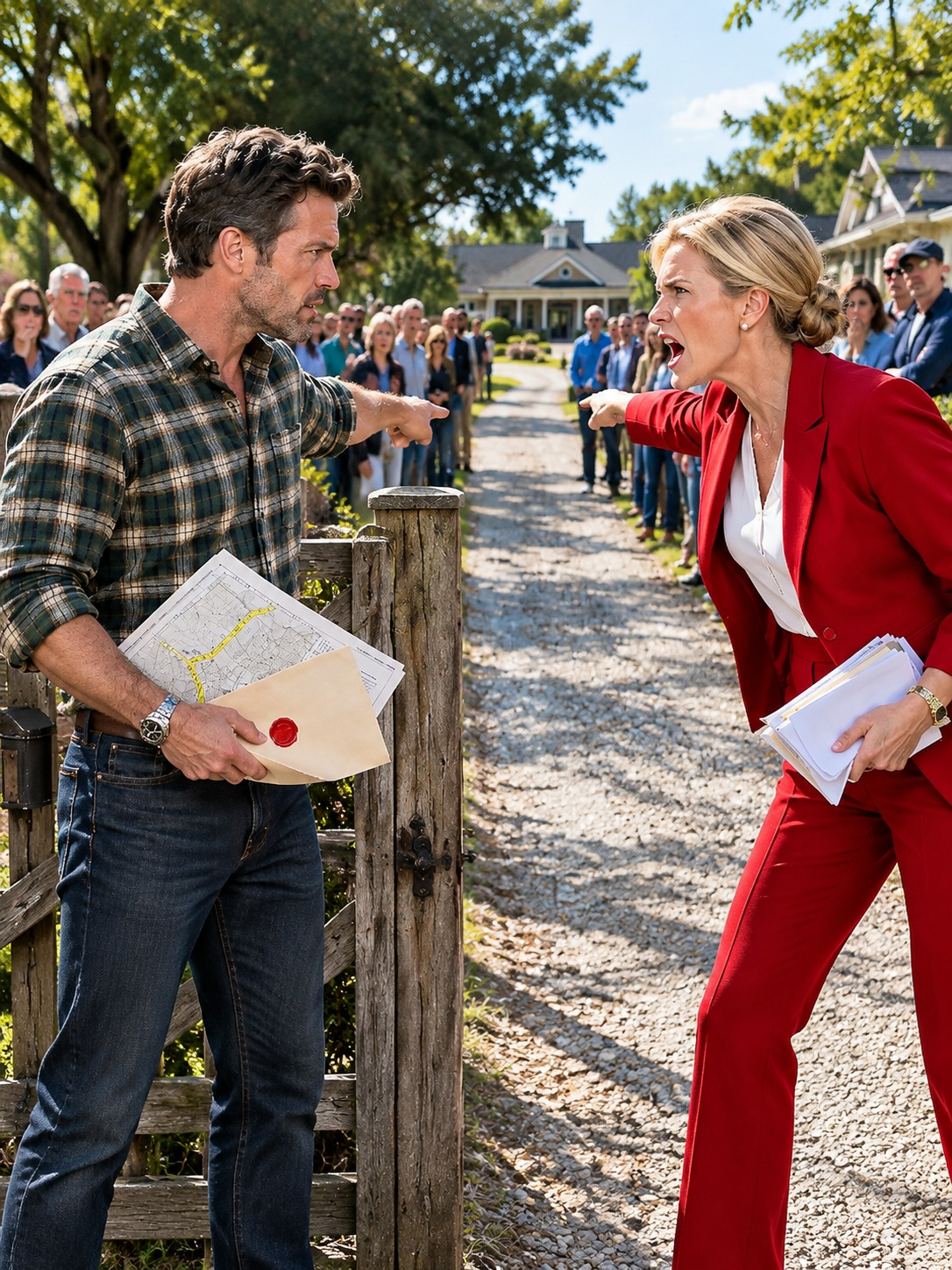
"My father died of a heart attack."
I said the words through the closed front door.
The stranger on the porch didn't answer immediately.
Then he said, "I know what the death certificate says, Gideon."
My hand froze on the deadbolt.
Behind me, Corbin Hale stepped closer.
"Don't open it," he whispered.
I looked through the peephole.
A man in his late sixties stood beneath the porch light. He wore a brown canvas jacket, faded jeans, and a baseball cap pulled low over his forehead.
His hands were empty.
A battered leather document case rested beside his boots.
He didn't look threatening.
But after the anonymous emails, the photograph taken through my kitchen window, and the chain across my road, I had learned not to judge danger by appearances.
"Who are you?" I asked.
"My name is Thomas Rourke."
The name meant nothing to me.
"How do you know my father?"
There was a pause.
"Because he asked me to keep something safe."
I looked toward Corbin.
He shook his head.
I kept the door locked.
"What did he ask you to keep?"
"The original deed to the strip of land beside your road."
My stomach tightened.
Rebecca was still on the phone.
I lifted it to my ear.
"Rebecca, there's a man at my door. Thomas Rourke."
She went silent.
Then she said, "Don't let him leave."
I stared at the phone.
"You know him?"
"I know the name."
"From where?"
"The archived deed."
I felt my pulse quicken.
"Rebecca, what name did you find?"
She answered slowly.
"Margaret Mercer."
I stopped breathing.
My grandmother.
The woman who used to make peach cobbler every Sunday and tell me stories about the old farms that existed before Briarwood Ridge.
The woman who had died when I was seventeen.
I looked toward the front door.
"Margaret Mercer owned the land?"
"According to the recorded deed, she acquired a narrow parcel along the access corridor decades ago. But I need to verify the subsequent transfers."
I pressed my hand against the wall.
My grandmother had owned land beside the road.
And nobody had ever told me.
"Rebecca, why would my family own that strip?"
"I don't know yet."
The stranger knocked once.
"Gideon?"
I lowered the phone.
"Wait."
Then I looked at Corbin.
"Rebecca knows his name. I'm going to talk to him."
Corbin hesitated.
"At least keep the door open and stay where I can see you."
I nodded.
Then I unlocked the deadbolt.
Thomas Rourke looked older up close.
Deep lines crossed his face, and his hands were rough with the kind of wear that comes from decades of physical work.
He glanced at Corbin standing behind me.
"Arthur Hale's boy?"
Corbin stiffened.
"You knew my father?"
Thomas nodded.
"Better than you might think."
I stepped onto the porch, leaving the front door open.
"Start with my grandmother."
Thomas looked toward the gravel road.
"Margaret Mercer bought a strip of land from Elias Wren."
I stared at him.
"When?"
"Before the subdivision was built."
"Why?"
"Because Wren needed someone he trusted to protect the drainage corridor."
I frowned.
"That doesn't make sense."
"It will."
He opened the leather case.
Inside was a document wrapped in protective paper.
He didn't hand it to me.
Instead, he showed me the first page.
The heading read:
WARRANTY DEED.
Below it was my grandmother's name.
MARGARET E. MERCER.
The legal description referred to a narrow parcel running along the northern edge of the existing access easement.
I recognized the boundary calls from my survey.
It was the same strip Rebecca had just identified.
"How did you get this?" I asked.
"Your father gave it to me."
"When?"
"About six months before he died."
I stared at him.
"Why didn't he give it to me?"
Thomas lowered his eyes.
"Because he wasn't sure what it meant for your property."
I felt anger rising.
"My father knew I was buying that house."
"Yes."
"And he never told me his own mother had owned land beside it?"
Thomas looked at me.
"He was trying to figure out whether her interest had passed through the family or been transferred somewhere else."
I thought about my father.
He had been a practical man.
He hated paperwork.
He fixed things with his hands and trusted people who kept their word.
But he had also been stubborn.
When he believed something mattered, he wouldn't let it go.
"Why did he give you the deed?" I asked.
"Because I worked with Elias Wren."
I stared at him.
"You knew Wren?"
Thomas nodded.
"I helped maintain the road when I was young."
Corbin stepped forward.
"Did you know Harold Voss?"
Thomas's expression changed.
"Unfortunately."
The porch fell silent.
Then Thomas said, "Harold wanted that strip almost as badly as he wanted the easement."
I invited him inside.
Rebecca remained on the phone long enough to confirm that Thomas was willing to speak with her the next morning.
She advised us not to alter or mark the document.
Thomas agreed.
Then I ended the call.
We sat around the kitchen table.
Thomas placed the deed between us.
I studied the old legal description.
The land was narrow, irregular, and seemingly insignificant.
But it ran along the drainage ditch beside my road.
Near the subdivision entrance, it widened around the area where Marla had installed the wooden gateposts.
I looked at Thomas.
"Why would anyone care about a strip this small?"
"Because whoever controlled it could interfere with the road."
"How?"
"Drainage. Utilities. Access to the edge of the corridor. The developer wanted to build without negotiating with Wren every time something crossed his property."
Corbin nodded slowly.
"My father's notes mention that."
Thomas looked at him.
"Arthur tried to stop them from cutting corners."
"Did he succeed?"
"Sometimes."
I looked at the deed.
"Did Margaret know what she was buying?"
"Absolutely."
That surprised me.
"My grandmother?"
Thomas smiled faintly.
"Margaret was sharper than most of the lawyers in that room."
I remembered her sitting at the kitchen table, correcting my grandfather's arithmetic and refusing to let anyone leave without eating.
I had never imagined her negotiating with land developers.
Thomas continued.
"Elias trusted her. She was one of the few people willing to stand up to Harold."
"Why?"
"Because Margaret believed a road should remain open for the people who depended on it."
I looked down.
My grandmother had died before I was old enough to ask questions about property deeds.
Now I was learning that she had been involved in the same fight I was facing.
"Did she ever sell the strip?" I asked.
Thomas hesitated.
"That's the part your father was trying to determine."
My stomach tightened.
"What do you mean?"
"After Margaret died, the family records became complicated. There were estate documents, old tax assessments, and a proposed transfer that may never have been completed."
I looked at Corbin.
He was watching Thomas closely.
"Who proposed the transfer?" Corbin asked.
Thomas's expression darkened.
"Harold Voss."
For the next hour, Thomas explained what he remembered.
The original developer had wanted to consolidate control over the entire access corridor.
Elias Wren refused to surrender his road without a completed replacement.
Margaret Mercer acquired the adjoining drainage strip.
Harold Voss objected.
He believed the narrow parcel complicated development plans and created unnecessary restrictions.
But Margaret wouldn't sell.
Not without written protections for the existing road.
"Did Harold threaten her?" I asked.
Thomas shook his head.
"Not that I witnessed."
"Did he pressure her?"
"He sent offers. He argued. He tried to persuade other family members."
I leaned forward.
"Did she ever agree?"
"Not while I was involved."
That wasn't the same as saying she never sold.
I understood the distinction.
Rebecca had taught me to be careful with the difference between what a document suggested and what it proved.
I looked at the deed again.
"Thomas, do you have any evidence of what happened after Margaret died?"
He nodded.
"Some."
He reached into the case and removed a folded letter.
It was addressed to my father.
The date was several years before his death.
I recognized his name immediately.
ROBERT MERCER.
My throat tightened.
Thomas handed me the letter.
I unfolded it carefully.
The handwriting belonged to my father.
He had written to Thomas asking whether the original deed was still available.
He said he had discovered a discrepancy in the property records.
A transfer appeared in an old index, but he couldn't locate a corresponding signed instrument.
He wanted to know whether Margaret had ever agreed to convey the strip to the developer.
I read the final paragraph twice.
"If the land still belongs to the family, I need to make sure Gideon understands what he owns before somebody convinces him otherwise."
I stared at the words.
My father had been trying to protect me.
Even before I knew there was anything to protect.
I swallowed.
"Why didn't he tell me?"
Thomas looked at me with genuine sadness.
"Because he didn't have an answer yet."
I shook my head.
"He could've told me he was looking."
"Maybe he should have."
I appreciated that Thomas didn't try to excuse everything.
He simply told me what he knew.
I folded the letter.
Then I asked the question that had been bothering me since he arrived.
"Why did you say my father died trying to protect the deed?"
Thomas looked down.
"I chose those words badly."
I stared at him.
"What do you mean?"
"Robert was investigating the property when he died. But I have no evidence that his death was caused by anything connected to the land."
I exhaled.
"My father had a heart attack."
"Yes."
"At home."
"Yes."
Thomas nodded.
"I shouldn't have made it sound like something else."
I studied his face.
For the first time that evening, I believed he was telling me the whole truth about at least one thing.
He had used dramatic words to get me to open the door.
That didn't make him trustworthy.
But admitting it mattered.
At nine thirty, Thomas left.
Before he went, he agreed to meet Rebecca and provide the original deed for examination.
He also gave me copies of my father's letter and several old maps.
Corbin walked him to the porch.
I remained at the kitchen table.
The house felt strangely different.
My grandmother had owned land beside my road.
My father had investigated it.
Arthur Hale had preserved the conditional-release agreement.
Daniel Sloan had disappeared while examining related survey records.
And Harold Voss's name appeared in nearly every disputed chapter of the property's history.
I opened my laptop.
Then I searched through the county documents Rebecca had sent.
The deed to Margaret Mercer was recorded.
That much was clear.
But the later chain of title wasn't.
There were references to estate proceedings.
A tax parcel number.
An index entry suggesting a transfer.
And then a gap.
I wrote down the recording references.
One by one.
Then I emailed Rebecca.
Thomas Rourke brought an original deed naming Margaret Mercer. He says my father was investigating an unlocated transfer. I have copies of his letter and the related maps.
I attached the photographs.
Then I added one more sentence.
I want to know whether my grandmother's land was ever legally conveyed out of the family.
I pressed Send.
The next morning, Rebecca called before eight.
"I reviewed the photographs."
I sat upright.
"And?"
"The deed appears consistent with the archived record I found."
My pulse quickened.
"So Margaret really owned the strip."
"She acquired it according to the recorded instrument. But we still need to establish what happened afterward."
I nodded.
"Thomas says there may have been an incomplete transfer."
"That's what I'm investigating."
I looked at my notes.
"Could I own the strip now?"
"Possibly. It depends on the subsequent conveyances, probate records, and whether the property passed through your family's estate."
I leaned back.
"If I do, what does that mean for the gateposts?"
"It could affect whether the HOA had permission to install structures on that portion of the land. But ownership and easement rights are separate questions."
I nodded.
"Understood."
Rebecca continued.
"There's another issue."
I closed my eyes.
"Of course there is."
She almost laughed.
"The recorded deed to Margaret contains a restriction."
"What kind?"
"It limits certain uses of the strip in order to protect drainage and existing access."
I sat forward.
"Can the HOA ignore it?"
"That depends on the language and whether the restriction remains enforceable."
I looked toward the road.
The drainage ditch I had repaired ran along the same strip.
Marla had fined me for maintaining it.
But the original deed might contain obligations or protections concerning that very drainage system.
"Rebecca, I want to see the complete document."
"I'll send it."
A few minutes later, the email arrived.
I opened the attachment.
The restriction was written in old-fashioned legal language.
But the meaning was clear enough to raise questions.
The land was to remain available for drainage and access-related purposes benefiting the adjoining property.
Any alteration that materially interfered with those purposes required appropriate authorization.
I stared at the words.
The HOA had accused me of unauthorized alterations.
Yet the same corridor had been subject to recorded protections long before the association existed.
I called Rebecca back.
"Could this help challenge the fine?"
"It may. We need to establish exactly what work you performed and how it relates to the recorded rights and obligations."
I nodded.
"I repaired storm damage."
"Then we'll document that."
I looked at the photographs of the washout.
The broken culvert.
The gravel I had spread.
The drainage ditch I had cleared.
I had saved every receipt.
Every invoice.
Every photograph.
At the time, I thought I was simply being organized.
Now those records might help establish that my work preserved access rather than damaged it.
By noon, Marla had sent another email.
The subject line was:
ONGOING LITIGATION AND COMMUNITY COSTS.
She warned homeowners that legal expenses were increasing because of my refusal to accept established rules.
She said the association would continue defending its authority.
She did not mention the court's temporary order.
She did not mention that the chain had been removed.
And she did not mention the original conditional-release agreement.
I forwarded the email to Rebecca.
Then I called Helen Brooks.
"Have you seen it?" I asked.
"Oh, I've seen it."
She sounded furious.
"She's blaming you for the legal bills."
"Apparently."
"Gideon, people are asking why the board didn't just show the documents when you first requested them."
"That's a good question."
Helen sighed.
"Leonard wants a special membership meeting."
"For what?"
"To discuss the board's handling of the road dispute."
I looked toward the kitchen window.
"That could be useful."
"Marla says it's unnecessary."
"Of course."
Helen lowered her voice.
"There's talk about removing her as president."
I didn't answer.
She continued.
"Don't sound so excited."
I almost smiled.
"I'm not."
"Well, some of us are."
I leaned against the counter.
"Helen, I want the road issue resolved. What the association does about its leadership is up to the members."
She was quiet.
Then she said, "You're making it very difficult for me to dislike you."
I laughed.
It was the first genuine laugh I'd had in days.
That afternoon, I met Rebecca at the county records office.
Evelyn Carter, the clerk who had first shown me Elias Wren's easement, recognized me immediately.
"Mr. Mercer."
"Hello, Evelyn."
She looked at Rebecca.
"More research?"
Rebecca smiled.
"Quite a bit."
Evelyn led us to a records terminal.
Together, we examined the deed index, probate references, and historical parcel maps.
The original transfer to Margaret Mercer was clearly recorded.
A later index entry referenced a proposed conveyance involving a company associated with Harold Voss.
But the document number led to a different instrument.
Rebecca frowned.
"That's unusual."
Evelyn leaned closer.
"Could be an indexing error."
"Possibly," Rebecca said.
I looked at the screen.
"What does that mean?"
"It means the index alone doesn't establish a valid transfer. We need to locate the underlying instrument or determine whether the reference was entered incorrectly."
Evelyn searched another database.
Then an older scanned ledger.
Finally, she found a handwritten notation.
The entry had been marked:
INSTRUMENT RETURNED — DEFECTIVE ACKNOWLEDGMENT.
I stared at it.
"What does that mean?"
Rebecca leaned forward.
"It suggests the recording office rejected a submitted document because something about its acknowledgment was defective."
"Would that mean the transfer never happened?"
"Not necessarily. An unrecorded conveyance can raise separate legal questions, and we still need to examine what was signed and delivered. But this is important."
I looked at the date.
It was several years after Margaret's death.
I felt my pulse quicken.
"Could someone have tried to transfer the land after she died?"
Rebecca studied the ledger.
"We need to see the actual document before drawing conclusions."
Evelyn looked up.
"There may be a retained rejection file."
Rebecca turned toward her.
"Can we request it?"
"Yes. It may take some time."
I nodded.
"Please."
Evelyn entered the request.
Then she printed the ledger page.
I looked at the old handwriting.
A rejected instrument.
A defective acknowledgment.
A proposed transfer involving Harold Voss's company.
And a strip of land my grandmother had once owned.
The pieces were beginning to fit together.
But I still couldn't see the whole picture.
At four thirty, Rebecca received a call from Patricia Bell.
She stepped into the hallway.
When she returned, her expression was serious.
"Patricia found something in the title company's archived correspondence."
I stood.
"What?"
"A letter from your father."
My stomach tightened.
"Another one?"
"Yes."
"Who was it addressed to?"
"The title insurer."
I looked at her.
"What did he say?"
"He asked whether your purchase would include any interest in the drainage strip formerly owned by Margaret Mercer."
I stared at her.
"So he was trying to find out before I bought the house."
"Yes."
"Did they answer?"
"They told him the strip was not included in the seller's legal description and that any family interest would require separate investigation."
I sat down.
My father had known the house and the strip were legally distinct.
He had been trying to understand whether our family retained an interest in the adjoining land.
But he died before resolving it.
Rebecca continued.
"There's a handwritten note on the letter."
I looked up.
"What does it say?"
She hesitated.
"It appears to be from the title company's attorney."
"And?"
"It says the issue may involve a disputed estate conveyance and should be referred to probate counsel."
I rubbed my forehead.
"Did my father ever do that?"
"We haven't found evidence yet."
I stared at the old deed.
My grandmother.
My father.
Me.
Three generations connected to a strip of land nobody in the neighborhood seemed to understand.
Then Rebecca said, "Gideon, there's one more name in the correspondence."
I looked up.
"Who?"
"Richard Voss."
Marla's late husband.
My stomach tightened.
"What was he doing in my father's property investigation?"
Rebecca shook her head.
"That's what we need to determine."
That evening, I returned home and found Corbin waiting on my porch.
He held a small stack of papers.
"You're going to want to see these."
I sighed.
"Everybody keeps saying that."
He gave a tired smile.
"Sorry."
We went inside.
Corbin placed the papers on the table.
They were copies of old board correspondence.
One letter was from Richard Voss.
It concerned the drainage strip beside the access road.
Richard had apparently been reviewing the developer's old property files shortly before his death.
He wrote that the association should not assume ownership of the corridor without a complete title review.
I stared at the letter.
"Richard knew there was a problem."
Corbin nodded.
"Looks that way."
"Did Marla know?"
"I don't know."
I read the next page.
Richard had asked the board to postpone any permanent improvements near the gate until the property records were clarified.
The request had been denied.
The denial was signed by the association president at the time.
Marla Voss.
I looked at Corbin.
"She knew Richard had concerns."
"Yes."
I sat back.
The old letters showed that Marla had been warned about the access corridor years before she fined me.
But knowing there were questions wasn't the same as knowing the answers.
We still needed to establish what she had actually done.
Corbin turned to the final page.
It was a handwritten note from Richard.
"Original estate transfer may not be valid. Need to speak with Robert Mercer."
I stared at the sentence.
Richard Voss had wanted to speak with my father.
About my grandmother's land.
And both men were now dead.
"Corbin, do you know whether they ever met?"
He shook his head.
"No."
I looked toward the window.
The sun was setting behind the trees.
For a moment, I imagined my father sitting at this same kitchen table, trying to understand the documents I was now reading.
He had always told me to keep receipts.
To ask questions.
To never sign anything I didn't understand.
I used to think those were ordinary lessons.
Now I wondered whether he had been trying to prepare me for something.
At eight forty-five, my phone rang.
Rebecca.
I answered.
"Gideon, I have news."
I sat upright.
"What?"
"The county located the rejected instrument."
My pulse quickened.
"The transfer from Margaret's estate?"
"Yes."
"Does it show who tried to convey the land?"
"It does."
I looked at Corbin.
He stopped moving.
Rebecca continued.
"The document was submitted by a representative of the developer's successor company."
"Who signed it?"
She hesitated.
"Gideon, the signature purports to be Margaret Mercer's."
I stared at the wall.
"My grandmother was already dead."
"According to the death record, yes."
I stood so quickly my chair scraped against the floor.
"Then how could she sign it?"
"She couldn't have personally signed it on that date. We need to examine whether the document was misdated, improperly prepared, or otherwise invalid."
I gripped the phone.
"Rebecca, that's not a small mistake."
"No. It isn't."
I looked at Corbin.
His face had gone pale.
Rebecca continued.
"The county rejected the instrument because the acknowledgment was defective. The file also contains a note questioning the execution date."
I closed my eyes.
A document bearing my dead grandmother's signature.
Submitted after her death.
Rejected by the county.
And connected to the same development interests that had tried to eliminate Elias Wren's access rights.
I felt sick.
"Rebecca, what happens now?"
"We preserve the records, investigate the chain of title, and determine whether any later instrument validly transferred the property."
I nodded.
Then she said, "There's something else."
I almost laughed.
"What now?"
"The rejected document included an attachment."
I stared at the phone.
"What attachment?"
"A letter authorizing someone to act on behalf of Margaret's estate."
I swallowed.
"Who signed it?"
Rebecca was silent.
Then she said, "Your father."
I stopped breathing.
"Robert Mercer?"
"Yes."
I looked at Corbin.
He stared back.
Rebecca continued.
"But the signature date is after his death."
The room went silent.
I could hear the refrigerator humming.
I looked down at my father's old letter.
The one asking Thomas Rourke to protect the deed.
Then Rebecca said, "Gideon, I need you to come to my office tomorrow. There's a second attachment, and I don't want to discuss it over the phone."
I closed my eyes.
"What is it?"
"A sworn statement."
"From who?"
She hesitated.
Then she said, "From someone who claims your father gave permission to transfer the land."
I gripped the phone.
"Who?"
Rebecca took a breath.
And before she could answer, Corbin's phone began ringing.
He looked at the screen.
His expression changed.
"Who is it?" I asked.
He didn't answer.
Instead, he turned the phone toward me.
The caller ID displayed a name I had seen only in old missing-person records.
DANIEL SLOAN.
Corbin stared at the screen.
Then the call connected.
A man's voice whispered, "Don't trust the deed. I'm standing outside Gideon's house right now."






Comments 0