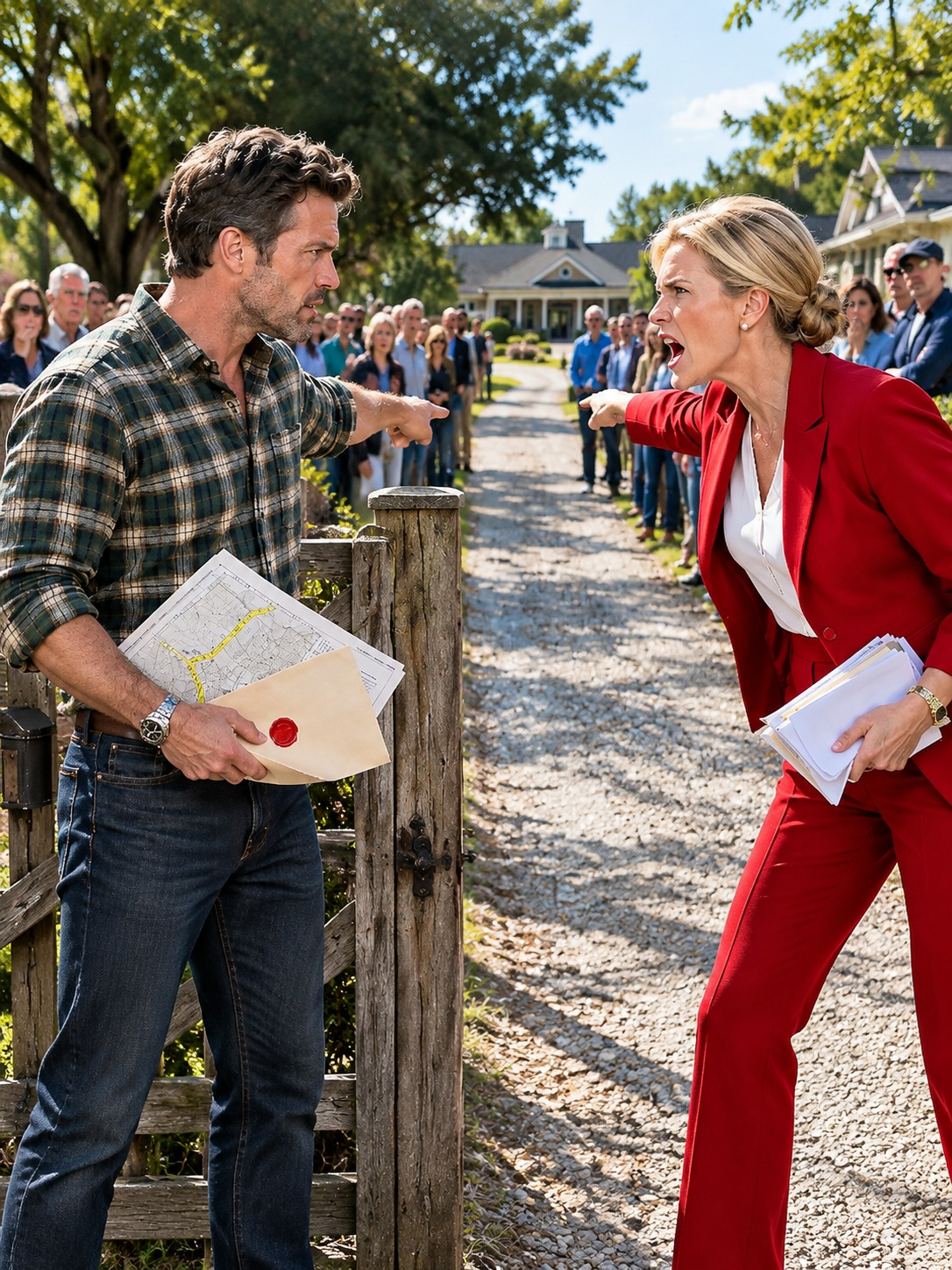
"Don't trust the deed. I'm standing outside Gideon's house right now."
The voice came through Corbin Hale's phone.
Low.
Rough.
Almost swallowed by the sound of wind.
For three seconds, nobody moved.
Then Corbin looked at me.
"Gideon, that's impossible."
I stared at the caller ID.
DANIEL SLOAN.
Rebecca's uncle.
The survey technician who had disappeared twenty-three years earlier.
The man whose family had eventually obtained a legal declaration of death.
The man in the old photograph beside my road.
I reached for the phone.
"Who is this?"
Silence.
Then the voice answered.
"Look through your kitchen window."
My stomach tightened.
I turned.
The kitchen window faced the side yard, where the porch light reached only a few feet beyond the flower bed.
At first, I saw nothing.
Then a shape moved near the oak tree.
A man.
Standing perfectly still.
Watching the house.
Corbin stepped beside me.
"Jesus Christ."
I lifted the phone.
"Who are you?"
The man outside raised one hand.
The voice on the phone whispered, "Don't open the door."
Then the call disconnected.
I stared at the dark figure.
He lowered his hand.
And disappeared behind the tree.
Corbin reached for the light switch.
"Leave it," I said.
He stopped.
"Why?"
"Because I want to see whether he comes back."
I pulled the curtains halfway closed and moved away from the window.
My heart was hammering.
The house had never felt so exposed.
Every window seemed like an opening.
Every shadow looked occupied.
I called Deputy Aaron Mills.
He answered after several rings.
"Deputy Mills."
"Someone's outside my house."
His voice changed immediately.
"Mr. Mercer?"
"Yes."
"Are you inside?"
"Yes. Corbin Hale is here."
"Stay inside. Lock the doors. Do not confront anyone."
I looked toward the back entrance.
"Someone called Corbin's phone claiming to be Daniel Sloan."
There was a pause.
"The missing survey technician?"
"Yes."
"Did the caller identify himself verbally?"
"No. The caller ID showed his name."
"All right. Keep the phone and call record. I'm sending someone."
I gave him the details.
Then I called Rebecca.
She answered immediately.
"Gideon?"
"Someone just called Corbin from a number labeled Daniel Sloan."
Silence.
Then she said, "What?"
"He told us he was outside my house."
"Did you see him?"
"A man was standing near the oak tree."
Rebecca's breathing changed.
"Did you see his face?"
"No."
"Did he speak to you directly?"
"Only over the phone."
I heard something fall on her end of the line.
"Gideon, listen carefully. Daniel's old number was disconnected years ago."
I looked at Corbin.
He was staring at his phone.
"Then how did his name appear?"
"Caller ID can be manipulated. Someone may be using his identity."
I nodded.
That was the reasonable explanation.
But it didn't explain how the caller knew we were inside.
Or why someone had been watching my kitchen window.
Rebecca continued.
"Have you called the sheriff?"
"Yes."
"Good. Don't go outside."
I looked toward the dark yard.
"Rebecca, do you think your uncle is alive?"
She didn't answer immediately.
Then she said, "I don't know what to think anymore."
The first patrol vehicle arrived eleven minutes later.
Deputy Mills came with another officer.
They checked the yard, the tree line, and the gravel road.
Nobody was there.
They found fresh impressions in the damp soil near the oak tree, but the marks were indistinct.
Mills photographed them.
Then he examined Corbin's call log.
The displayed name was Daniel Sloan.
The number was unfamiliar.
"Do you recognize this number?" Mills asked Rebecca over speakerphone.
"No."
"Do you have records of your uncle's old number?"
"Possibly. I can check."
Mills nodded.
"We'll document it."
He turned toward me.
"Did the person outside threaten you?"
"Not directly."
"What exactly did he say?"
I repeated the words.
Don't trust the deed.
I'm standing outside Gideon's house right now.
Look through your kitchen window.
Don't open the door.
Mills wrote everything down.
Then he looked toward the oak tree.
"Did you see the person leave?"
"No. He moved behind the tree."
"Could he have gone toward the subdivision?"
"Yes."
Mills nodded.
"We'll check the area."
I looked at the gravel road.
The chain was gone.
The court had required the association not to reinstall an obstruction while the dispute continued.
For the first time in days, emergency vehicles could reach my house without stopping at a padlocked gate.
That fact suddenly mattered more than I could explain.
Before leaving, Mills advised me to preserve the call record and avoid responding to unknown contacts.
He also asked whether I had received any more anonymous emails.
"Not since yesterday."
"Keep everything."
"I will."
He looked at me.
"Mr. Mercer, I know you've been dealing with a lot. But don't try to investigate someone trespassing around your house by yourself."
I nodded.
"I won't."
He held my gaze for another second.
Then he left.
Corbin stayed until nearly midnight.
We sat at the kitchen table with the lights on.
Neither of us wanted coffee.
Neither of us wanted to talk.
Finally, Corbin said, "I don't think that was Daniel Sloan."
I looked at him.
"Why?"
"Because if a man disappeared twenty-three years ago and wanted to come back, why would he stand outside your house in the dark and call my phone?"
I considered that.
"Maybe he was afraid."
"Of what?"
"I don't know."
Corbin rubbed his forehead.
"Or somebody wants us to believe he's alive."
I looked at the call log.
"That seems more likely."
He nodded.
Then he said, "There's something else bothering me."
"What?"
"The caller said not to trust the deed."
I looked toward the stack of documents.
"Which deed?"
"Exactly."
My grandmother's deed.
The rejected estate transfer.
The old Wren easement.
The conditional-release agreement.
We had so many documents that the warning could refer to almost anything.
Corbin leaned forward.
"What if somebody's trying to make us doubt the real evidence?"
I stared at him.
"That's possible."
"Or what if the deed really is wrong?"
I looked at the copy of Margaret Mercer's deed.
The old legal description.
The recorded stamp.
The signature.
Everything appeared ordinary.
But the past week had taught me that ordinary-looking documents could conceal extraordinary problems.
"Rebecca will examine it," I said.
Corbin nodded.
Then he looked toward the window.
"Can I ask you something?"
"Sure."
"Do you ever wish you'd just paid the fine?"
I thought about the eighteen-hundred-dollar notice.
The public humiliation.
The chain.
The anonymous threats.
The old documents.
The missing man.
For a moment, I imagined paying the fine and walking away.
But I knew that wouldn't have ended the problem.
Marla would still have claimed authority over the road.
The questionable documents would still exist.
And my access would still depend on someone else's willingness to let me use it.
"No," I said.
Corbin studied my face.
"Not even a little?"
I shook my head.
"I wish I'd never had to fight. That's different."
He nodded slowly.
"Yeah."
The next morning, Rebecca called before eight.
Her voice sounded strained.
"I found something in the old missing-person file."
I sat upright.
"About Daniel?"
"Yes."
"What?"
"A supplemental report from the week after he disappeared."
I looked at the kitchen window.
"What does it say?"
"An investigator received a tip that Daniel had been seen at a roadside motel several counties away."
My pulse quickened.
"Was it confirmed?"
"No."
"Then why is it important?"
"Because the witness described him carrying a leather document case."
I thought about Thomas Rourke's case.
The old deed.
The folded maps.
"Did they find the case?"
"No."
Rebecca paused.
"But the report includes a note about what Daniel was supposedly carrying."
I leaned forward.
"What?"
"A set of original survey records."
I closed my eyes.
"Of course."
Rebecca continued.
"There's another detail."
I waited.
"The witness said Daniel appeared frightened and asked whether anyone had been looking for him."
I stared at the table.
"Did he say who?"
"No."
I rubbed my forehead.
"Rebecca, could he have disappeared voluntarily?"
"Possibly. We don't know."
"And the legal declaration of death?"
"It established his legal status after years of absence. It didn't prove what physically happened to him."
I nodded.
That distinction mattered.
A man could be legally declared dead without anyone ever finding his body.
I had known that in theory.
Now it felt terrifyingly personal.
Rebecca continued.
"There's something I need to tell you about the photograph."
I sat forward.
"What?"
"I enlarged the image and compared it with another photograph of my uncle."
"And?"
"The jacket matches one he owned."
I felt my stomach tighten.
"But the photograph is twenty-three years old."
"Yes."
"So what does that prove?"
"Nothing about whether he's alive today. But it confirms the picture was likely taken during the period he was investigating the road."
I nodded.
Then she said, "Gideon, I also found a note in his old files."
"What kind of note?"
"A list of people he intended to interview."
I waited.
"Harold Voss was on it."
I closed my eyes.
"Of course he was."
"And so was Richard Voss."
I opened my eyes.
"Marla's husband?"
"Yes."
I stared at the wall.
Richard had been reviewing the drainage strip before his death.
My father had been investigating the same land.
Arthur Hale had preserved the original release agreement.
Daniel Sloan had disappeared while examining the records.
The same names kept appearing.
The same road.
The same strip of land.
And the same family.
At ten, I met Rebecca at her office.
She had arranged for another attorney, Michael Trent, to review the case because of her family connection.
Michael was a tall man in his fifties with a quiet manner and a habit of reading every page twice.
He shook my hand.
"Mr. Mercer."
"Gideon is fine."
He nodded.
"I've reviewed the current pleadings and the title materials."
I sat down.
"Do you think Rebecca can continue representing me?"
"With appropriate disclosure and safeguards, possibly. But there are issues we need to address."
Rebecca sat beside him.
Michael continued.
"Her uncle's disappearance may become relevant to the evidence. If Rebecca becomes a necessary witness, that could affect her role as trial counsel."
I nodded.
"What do you recommend?"
"That I take primary responsibility for litigation while Rebecca continues assisting with the historical title research, subject to the applicable professional rules."
I looked at Rebecca.
She nodded.
"I think that's the right approach."
I appreciated that neither of them tried to minimize the problem.
"Okay," I said.
Michael opened a folder.
"Now, about the land."
I leaned forward.
He spread out three documents.
Margaret Mercer's recorded deed.
The rejected estate transfer.
And the current survey of my property.
"The original deed appears to establish that Margaret acquired the narrow drainage parcel," he said.
I nodded.
"The rejected transfer doesn't establish that she conveyed it," he continued. "But we need the full probate history and any subsequent instruments."
"What about the signature dated after her death?"
"That's a serious discrepancy."
"And my father's authorization?"
"Also serious, especially given the date."
I looked at the documents.
"Could someone have forged both signatures?"
"It's possible. But we need authenticated records and a careful examination before reaching that conclusion."
I nodded.
Michael continued.
"If the strip remained in your grandmother's estate, the question becomes who inherited it and whether title was ever properly distributed."
I leaned back.
"So I might own part of the land beside my road."
"Potentially. But not necessarily by yourself."
I frowned.
"What do you mean?"
"Your grandmother may have had multiple heirs. We need to review her will, probate proceedings, and any later transfers."
I thought about my family.
My father had been an only child.
At least, that was what I believed.
My grandfather had died before I was born.
My grandmother had never mentioned another child.
"Rebecca, can we get the probate file?"
She nodded.
"We've requested it."
Michael looked at me.
"And until we have it, don't assume the land belongs to you."
I nodded.
"Understood."
At noon, Helen Brooks called.
"Gideon, you need to hear this."
I sighed.
"What happened?"
"Marla is calling another emergency board meeting."
I looked at the clock.
"Again?"
"Yes."
"Why?"
"She says the association needs to respond to new allegations concerning historical records."
I frowned.
"What allegations?"
"She didn't say."
I thought about the rejected transfer.
The altered closing acknowledgment.
The original conditional-release agreement.
There were plenty of questions.
But we hadn't publicly accused anyone of wrongdoing.
"Did she mention me?"
"Of course."
I closed my eyes.
Helen continued.
"She says your legal team is attempting to undermine the association's ownership."
I looked toward the office window.
"That's not what we're doing."
"I know."
She paused.
"Leonard says the board is divided."
"About what?"
"Whether to suspend enforcement against you until the title issues are resolved."
I sat upright.
"That would be reasonable."
"Marla doesn't think so."
I almost laughed.
"That doesn't surprise me."
Helen lowered her voice.
"There's talk of a vote of no confidence."
I was silent.
She continued.
"Some homeowners want her removed as president."
I looked at the folder in front of me.
The old deed.
The disputed transfer.
The road.
I didn't want to become the center of a neighborhood political fight.
But I also knew that Marla's decisions had affected more than me.
She had used the association's authority to block access to a home.
She had publicly accused a homeowner of misconduct without producing a clear legal basis.
And now the board was spending community money defending those actions.
The homeowners had a right to ask questions.
"That's their decision," I said.
Helen sighed.
"You really won't say anything against her, will you?"
"I'll say what happened. I'll show the documents. But I'm not going to invent motives."
She was quiet.
Then she said, "Maybe that's why people believe you."
At three, Corbin came to my house with another box from his father's records.
He placed it on the kitchen table.
"I found the old survey correspondence."
I opened the box.
Inside were letters from Arthur Hale to Daniel Sloan.
Most were routine.
Measurements.
Boundary questions.
Requests for copies of plats.
But one letter caught my attention.
It was dated shortly before Daniel disappeared.
Arthur wrote:
"Daniel, I reviewed your sketch. The discrepancy at the northern drainage strip is significant. Please do not rely on the developer's revised boundary until we can compare it with Margaret Mercer's original deed."
I read the sentence twice.
Corbin leaned forward.
"There's more."
He handed me another page.
It was a photocopy of a survey sketch.
The original gravel road ran along the center.
The drainage strip lay beside it.
But a second boundary line had been drawn in red.
The red line shifted the strip toward the subdivision lots.
I stared at it.
"What is that?"
Corbin shook his head.
"I don't know."
I looked closer.
The revised line appeared to place the wooden gate area entirely within land the developer claimed to control.
If that line had been used in later records, it might explain why the HOA believed the entrance belonged to the association.
But the original deed showed something different.
I called Michael Trent.
He answered.
"Mr. Mercer?"
"Gideon. We found a survey sketch."
I explained the red line.
Michael listened carefully.
"Send me a copy."
I photographed it.
Then emailed it.
He reviewed the image while we remained on the phone.
After a minute, he said, "This could be important."
"Why?"
"Because it may show a discrepancy between the original legal description and a later proposed boundary."
I looked at the sketch.
"Could someone have moved the property line on paper?"
"We don't know whether the red line was a proposal, a correction, or something else. We'll need to identify the source and whether it was ever adopted in a recorded instrument."
I nodded.
"But if it wasn't?"
"Then the original recorded descriptions may control, subject to the full title history."
I looked at Corbin.
He was staring at the red line.
Michael continued.
"I'd like to have a licensed surveyor review both descriptions."
"Can you arrange that?"
"Yes."
I ended the call.
Corbin looked at me.
"My father wrote that Daniel found a discrepancy."
I nodded.
"And then Daniel disappeared."
Neither of us spoke.
At five thirty, Rebecca called.
Her voice was urgent.
"Gideon, the probate file arrived."
I sat upright.
"And?"
"Margaret Mercer left her estate to your father."
I exhaled.
"Okay."
"But the drainage strip wasn't specifically listed in the estate inventory."
I frowned.
"What does that mean?"
"It may have been overlooked. We need to determine whether the residuary provisions of her will transferred any remaining interest."
I looked at my father's old letter.
"So he may have inherited it without realizing?"
"Possibly."
I nodded.
Rebecca continued.
"There's another document in the probate file."
I closed my eyes.
"What?"
"A petition filed years later seeking authority to transfer the strip."
I stared at the wall.
"Who filed it?"
"A representative of the developer's successor company."
My pulse quickened.
"Was it approved?"
"No."
I sat forward.
"Why not?"
"The court requested additional proof of ownership and authority."
I looked at Corbin.
He was watching me.
Rebecca continued.
"The petition was never completed."
I felt a slow wave of disbelief.
The developer had tried to obtain the strip.
The recording office had rejected a transfer.
The probate court had requested more evidence.
And yet decades later, Marla claimed the association controlled the entire corridor.
"Rebecca, how many times did they try to get this land?"
"At least twice, based on what we've found."
I rubbed my forehead.
"And did they ever succeed?"
"We haven't found a valid completed transfer yet."
I looked toward the window.
The gravel road lay quiet beneath the trees.
For years, I had maintained it without knowing my family might still own land beside it.
I had never imagined the history was this complicated.
Rebecca continued.
"There's one more thing."
I almost laughed.
"Please tell me it's good news."
"It may be."
I sat upright.
"What?"
"The probate file includes a letter from Richard Voss."
My stomach tightened.
"Marla's husband?"
"Yes."
"What does it say?"
"He objected to the petition."
I froze.
"Richard opposed the transfer?"
"Apparently."
I stared at Corbin.
He looked equally surprised.
Rebecca continued.
"Richard wrote that the developer had not established a valid claim to the drainage strip and that the Mercer family's interest should not be disturbed without proper notice."
I leaned back.
For the first time, Richard Voss seemed less like an extension of Harold's interests and more like someone who had tried to correct the past.
"Did Marla know?"
"We don't know."
I looked at the old letters.
Richard had warned the HOA not to assume ownership.
He had objected to the probate petition.
He had wanted to speak with my father.
Maybe he had been trying to protect the same rights I was fighting for now.
And maybe Marla had inherited documents she didn't fully understand.
I wanted to believe that.
It would have been easier.
But the altered acknowledgment still existed.
And someone had been threatening me.
At eight that evening, I received a message from an unknown number.
Stop asking about Richard Voss.
I stared at it.
Then another message arrived.
He tried to tell the truth.
My stomach tightened.
I forwarded both messages to Deputy Mills and Michael Trent.
Then I called Rebecca.
She answered immediately.
"Gideon?"
"Someone's texting me about Richard."
Her voice changed.
"What did they say?"
I read the messages.
Rebecca was silent.
Then she said, "Don't respond."
"I won't."
She paused.
"There's something you should know."
I closed my eyes.
"What?"
"Richard Voss left a sealed letter with his attorney before he died."
I sat upright.
"How do you know?"
"His former attorney contacted Michael this afternoon."
I stared at the wall.
"What was in the letter?"
"We don't know. It was addressed to someone who never collected it."
My pulse quickened.
"Who?"
Rebecca hesitated.
"Your father."
I stopped breathing.
"Robert Mercer?"
"Yes."
I looked at my father's photograph on the mantel.
He was smiling beside an old fishing boat.
I remembered the day it was taken.
I remembered him laughing.
I remembered thinking he would always be there.
"Why didn't he collect it?" I whispered.
"We don't know."
Rebecca continued.
"The attorney says the letter has remained sealed in his files."
I gripped the phone.
"Can we get it?"
"Michael is arranging a meeting tomorrow."
I nodded.
"Okay."
Then Rebecca said, "Gideon, there's another reason I called."
I looked toward the window.
"What?"
"Deputy Mills contacted me about the number that called Corbin last night."
My heart began beating faster.
"Did he identify it?"
"He says the number was registered recently using an identity that doesn't appear to belong to the person who activated it."
I frowned.
"Then who was calling?"
"They don't know yet."
I exhaled.
Rebecca continued.
"But there was a second call."
I sat upright.
"To who?"
"To the old number associated with Daniel Sloan's missing-person case."
I stared at the wall.
"What?"
"Someone contacted the sheriff's office claiming to have information about Daniel."
I felt cold.
"What did they say?"
Rebecca hesitated.
"They said Daniel Sloan never left the county."
I looked at the old photograph.
The man beside Rebecca.
The road.
The dark jacket.
The survey notebook.
"What does that mean?"
Rebecca's voice dropped.
"They claimed he was being hidden."
I stopped breathing.
"By who?"
She didn't answer.
Instead, I heard a knock on her office door.
Then a man's voice.
Low.
Unfamiliar.
"Rebecca Sloan?"
She went silent.
The voice spoke again.
"I've come about your uncle."
I gripped the phone.
"Rebecca?"
No answer.
Then I heard her chair move.
A door opened.
And a man said something so quietly I barely caught it.
"My name is Daniel."
Rebecca gasped.
The phone slipped from her hand.
I heard it hit the floor.
Then the man's voice returned, clearer this time.
"Tell Gideon Mercer the deed isn't the real secret."
A pause.
Then he said, "The secret is what they buried beneath his road."
And the line went dead.






Comments 0