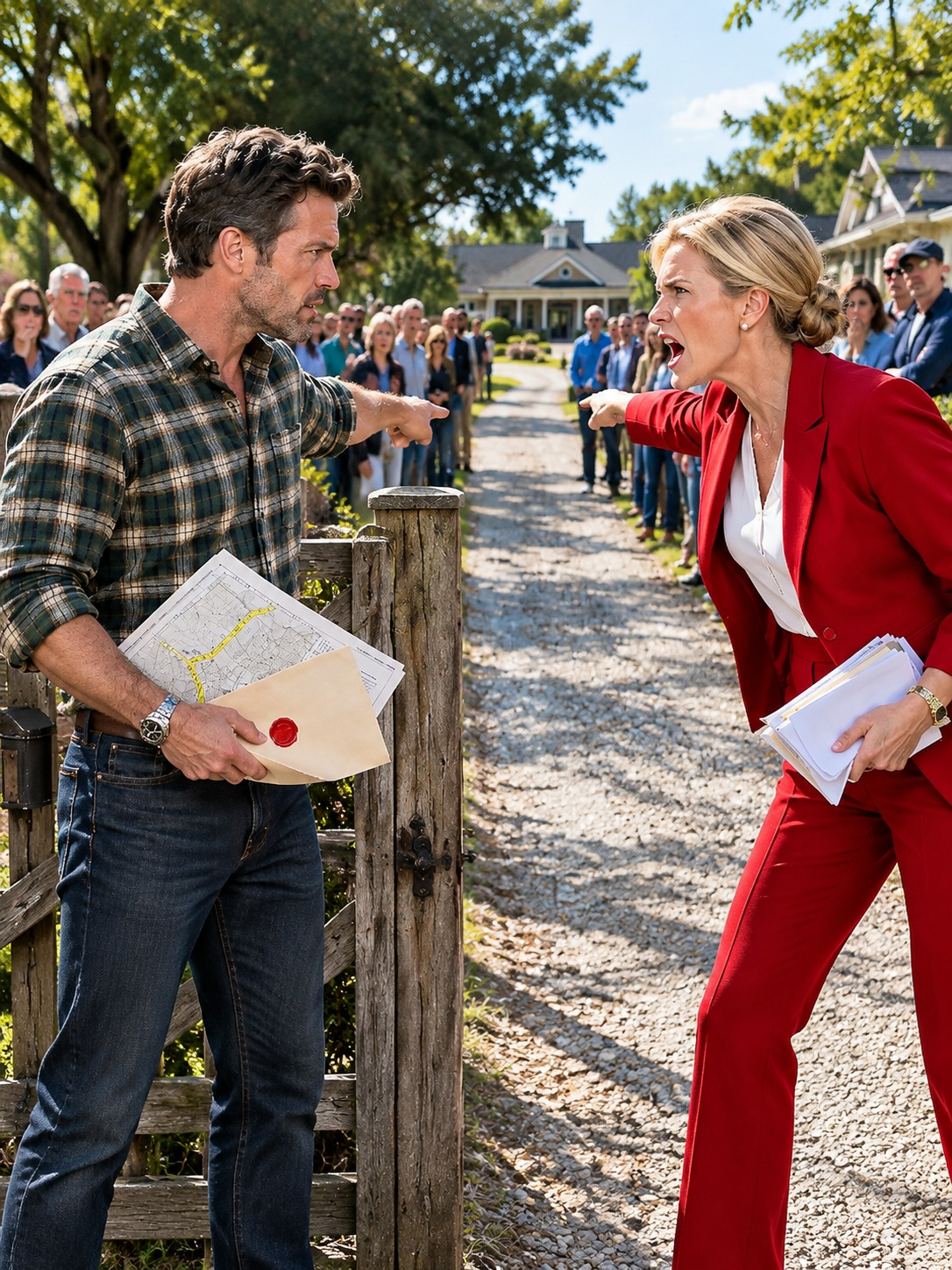
My phone rang while two men stretched a heavy steel chain across the only road leading to my house.
Marla Voss stood beside the wooden gate, watching the workers tighten it between the posts.
I could see her through my kitchen window.
She was smiling.
"Gideon," Corbin Hale whispered behind me. "Don't answer until you start recording."
I looked at the sealed envelope lying open on my kitchen table, the one containing a forty-year-old letter that might explain everything about my property.
Then I looked back at Marla.
She had chosen the wrong night to lock me inside my own home.
I answered the call.
"Good evening, Marla."
"Mr. Mercer," she said, using the formal tone she reserved for making ordinary people feel like defendants. "I'm calling to inform you that the association has initiated temporary access-control measures."
I watched one of the workers pull the chain taut.
"You're installing a chain across my driveway."
"We're securing association-controlled property."
"At eight o'clock at night?"
"The board's authority doesn't expire at sunset."
I glanced at Corbin.
He had already taken out his phone and started recording through the window.
"Marla, have you considered what happens if I need an ambulance?"
There was a pause.
"Emergency access can be arranged."
"How?"
"Through the appropriate channels."
"Which channels?"
"Gideon, I'm not going to argue with you."
"I'm not arguing. I'm asking how an emergency vehicle gets through a locked gate."
Her voice sharpened.
"You created this situation by refusing to comply."
I looked at the clock above my refrigerator.
8:14 p.m.
The fine had been due Friday, and Friday had barely ended. There had been no hearing about the disputed documents, no response to my request for the recorded easement, and no explanation of how the association had obtained the right to block my entrance.
Yet there she was, overseeing the installation of a chain.
"Marla, I am formally disputing both the fine and your authority to restrict access."
"Your objection is noted."
"Is this action authorized by a recorded easement?"
"Our legal counsel has reviewed the matter."
"Then provide the recording information."
She sighed.
"You're becoming repetitive."
"And you're still not answering."
Through the window, I watched her turn toward my house.
For a second, I thought she might see Corbin standing beside me.
Instead, she lifted one hand and motioned for the workers to continue.
"Payment arrangements can be discussed Monday," she said.
"And until then?"
"The restriction remains in place."
She disconnected.
I lowered the phone.
Corbin stared at me.
"She actually did it."
"Looks that way."
"No, Gideon. You don't understand. I've known Marla for years. She threatens people all the time. She sends letters. She makes speeches. But I've never seen her do something like this."
I looked toward the road.
One worker was fastening a padlock through the chain.
The other was attaching a rectangular metal sign.
PRIVATE ACCESS — HOA AUTHORIZATION REQUIRED.
I felt anger rising in my chest.
Not the kind that makes a person shout.
The quieter kind.
The kind that makes you want to walk outside and tear down everything in your way.
But I knew exactly what would happen if I did.
Marla would have photographs.
She would have witnesses.
By morning, the neighborhood would receive another email describing me as dangerous, aggressive, and unwilling to respect community rules.
I had spent too much time gathering evidence to hand her that advantage.
"Keep recording," I told Corbin.
Then I picked up my keys.
"Where are you going?"
"Outside."
"Gideon—"
"I'm not touching the chain."
He followed me.
We walked down the gravel road toward the gate.
The air smelled of damp earth and fresh-cut grass. Somewhere beyond the neighboring houses, a dog barked twice.
Marla stood beneath the yellow beam of a portable work light.
Her emerald-green suit looked almost black in the darkness.
Leonard Briggs was beside her, holding a clipboard.
The two workers had finished fastening the chain.
Marla turned as we approached.
"Mr. Mercer. I thought I made the situation clear."
"You did."
"Then why are you here?"
"To document what's happening."
Her eyes moved to Corbin.
"Corbin?"
He said nothing.
She looked at his phone.
"Are you recording this?"
"Yes," he answered.
Her expression changed.
"That is completely unnecessary."
"Then you shouldn't mind."
For the first time since I had known him, Corbin sounded genuinely unimpressed by her authority.
Marla turned back toward me.
"This is association property."
"Then show me the recorded document establishing that."
She pointed toward the sign.
"The board has already determined—"
"A sign isn't a deed, Marla."
Leonard cleared his throat.
"Maybe we should postpone this until the attorney—"
"Leonard," Marla interrupted, "the board voted."
He looked down.
I caught that.
"The board voted to block my road?"
Marla folded her arms.
"The board authorized enforcement."
"When?"
"At a properly conducted meeting."
"Was notice given?"
"That's not your concern."
"It becomes my concern when you're locking me out of my own entrance."
Corbin stepped forward.
"I don't remember voting on a chain."
Marla stared at him.
"You weren't present for the executive discussion."
"Then who voted?"
Her jaw tightened.
"Corbin, this isn't helping."
He looked at Leonard.
"Did you vote?"
Leonard shifted his weight.
"I agreed we needed to address the violation."
"That's not what I asked."
Nobody spoke.
I looked at the chain.
It was heavy enough to stop a vehicle. The padlock was new, its silver surface reflecting the work light.
A truck could not pass without removing it.
Neither could an ambulance.
I took several photographs.
Marla watched every movement.
"Those pictures won't change your obligations," she said.
"Maybe not."
"Then stop making this difficult."
I turned toward her.
"Marla, you can disagree with me about road maintenance. You can send notices. You can take your claim to court. But you cannot simply assume that threatening my access gives you the legal right to block it."
Her eyes narrowed.
"You'll hear from our attorney."
"I hope so."
She seemed surprised.
I continued.
"I've been asking for the association's legal basis for days. I'd welcome an answer from someone willing to provide it."
For a moment, I thought she might lose her temper.
Instead, she smiled.
"Enjoy your weekend, Gideon."
Then she walked toward her SUV.
The workers began gathering their equipment.
Leonard followed her without looking at either of us.
Corbin remained beside the chain.
When their vehicles finally disappeared down the subdivision street, he let out a long breath.
"I can't believe she did that."
I looked at the padlock.
"Neither can I."
He lowered his phone.
"What now?"
I took one last photograph.
"Now we make sure nobody can pretend it didn't happen."
At 8:47 p.m., I called the county sheriff's nonemergency number.
I explained that a homeowners association had installed a locked chain across the only access road to my residence, that the association's authority was disputed, and that I wanted the obstruction documented.
The dispatcher listened carefully.
She asked whether anyone was injured.
"No."
Whether there had been threats of physical violence.
"No."
Whether I could safely remain at my residence.
"Yes, but I can't drive out."
She told me a deputy would be sent when available.
I thanked her.
Then I called Rebecca Sloan's office.
The office was closed.
I left a message explaining that the threatened access restriction had now been installed.
I emailed photographs, the HOA notice, and a short description of the incident.
Corbin stayed with me.
We returned to the kitchen, where the old envelope still lay beside the coffee cups.
I almost forgot about it.
Almost.
Then Corbin looked at the papers.
"We never finished reading that letter."
I sat down.
"Let's finish."
He unfolded the first page.
The letter had been written by a representative of the original development company to Elias Wren.
It discussed a proposed release of the existing access easement.
The developer wanted Wren to surrender certain recorded rights so that the future subdivision could establish a unified system of road control.
In exchange, the company offered improvements to the road and a maintenance arrangement.
But the letter contained a condition.
The proposed release would become effective only after Wren executed the agreement and the appropriate instrument was recorded.
Corbin tapped the paragraph.
"That's what Dad meant."
I read it again.
Wren had apparently refused to sign.
If that was true, the proposed release alone wouldn't establish that the easement had been extinguished.
But I wasn't ready to assume no later agreement existed.
I had learned enough that morning to understand how dangerous assumptions could be.
"Do you have the actual release?" I asked.
Corbin shook his head.
"Not in this folder."
"Then we need to find out whether one was ever recorded."
He nodded.
I turned to the second page.
It was a response from Elias Wren.
The handwriting was neat but forceful.
He had written that access to his property was not a privilege granted by the developer.
It was a recorded property right.
He was willing to discuss maintenance.
He was not willing to surrender control of his only access route without a legally sufficient replacement.
I read those lines twice.
Forty-three years earlier, a man I had never met had faced a dispute that sounded disturbingly familiar.
He had asked for clear legal protection.
The developer had wanted flexibility.
And the road had sat between them.
Corbin watched me.
"Sound familiar?"
"Too familiar."
He turned over another page.
There was a handwritten note from his father.
"Wren said the road was his lifeline. Developer promised it would remain open. Never signed release as far as I know."
I sat back.
My father used to say that people revealed themselves by what they tried to take away from others.
I had always thought he meant money.
Now I wasn't so sure.
The deputy arrived shortly after ten.
His name was Deputy Aaron Mills.
He was a broad-shouldered man in his early forties with a patient expression and a notebook that looked as though it had survived several years in a patrol car.
I met him at the chain.
Corbin came along as a witness.
Deputy Mills examined the padlock and the sign.
"Who installed this?"
"The homeowners association president directed it," I said.
"Do you have documentation?"
I showed him the notice and the photographs.
He asked whether I owned the land beneath the road.
"I don't know the complete ownership situation yet. I have a recorded easement affecting my parcel, and the association claims authority over the corridor. That's what we're disputing."
He nodded.
"That's important. I'm not going to determine property rights out here tonight."
"I understand."
"But I can document the obstruction and the circumstances."
He took photographs.
He asked about emergency access.
I explained that the road was my only vehicular entrance.
He looked down its length toward my house.
"Any alternate driveway?"
"No."
"Any other road?"
"No."
He wrote that down.
Then he called someone from his patrol vehicle.
When he returned, he told me he had attempted to contact the association representative listed on the notice.
There had been no answer.
He provided an incident number.
"Mr. Mercer, I strongly recommend contacting your attorney first thing in the morning."
"I've already sent her the photographs."
"Good."
He looked at the chain again.
"If there's a medical emergency, call 911 immediately and explain the obstruction. Don't delay seeking help."
I thanked him.
He didn't cut the chain.
I hadn't expected him to.
A civil property dispute wasn't going to be settled by a deputy standing beside a wooden gate at ten thirty on a Friday night.
But the incident was documented.
And that mattered.
After he left, Corbin stood beside me.
"Do you think Marla knows how bad this looks?"
"I think she believes she can make it look like my fault."
He shook his head.
"She doesn't know about the letters."
"Not yet."
"Are you going to tell her?"
"Eventually."
He studied my face.
"You've got something planned."
"I've got an appointment with a lawyer."
"That's not what I meant."
I looked at the chain.
"Corbin, I'm not interested in humiliating Marla. I want my road open, the fine withdrawn, and the truth established."
He nodded.
"Fair enough."
Then he said something that stayed with me.
"My father always told me the original developers were careful about what they put in writing. If there's a document they didn't want people to see, it probably wasn't in the neighborhood newsletter."
Saturday morning began with a phone call.
Rebecca Sloan.
I answered before the second ring.
"Mr. Mercer?"
"Speaking."
"I received your message and the photographs."
"Thank you for calling."
"First, are you safe?"
"Yes."
"Can you leave your property by vehicle?"
"No. The chain is still there."
She was quiet for a moment.
"All right. I want you to send me the original easement instrument, the complete current deed, the subdivision plat, and every HOA notice you have."
"I can do that."
"Also, do not remove the chain yourself unless there's an immediate emergency requiring action. We need to handle this carefully."
"I understand."
She asked several questions about the road's history.
How long had I owned the property?
How long had I maintained the road?
Had the HOA ever paid for repairs?
Had I received written permission for previous maintenance?
Had anyone challenged my use of the road before this dispute?
I answered each question.
Then I told her about Elias Wren.
She became noticeably more interested.
"Do you have the recording number?"
"Yes."
"Good. And you said the instrument includes successors and assigns?"
"That's right."
"That may be significant, but I need to review the complete language and chain of title."
I appreciated her caution.
After days of Marla speaking in absolutes, it was reassuring to hear an attorney explain what she needed before reaching a conclusion.
I mentioned the old letters Corbin had found.
Rebecca asked me to scan them.
Then she asked a question I hadn't considered.
"Mr. Mercer, has the HOA ever sent you a copy of the board resolution authorizing the obstruction?"
"No."
"Has anyone provided the minutes of the meeting where that decision was made?"
"No."
"Has the association identified the owner of the servient parcel?"
I hesitated.
"The what?"
"The land burdened by the easement. The land the road crosses."
"Not specifically."
"All right."
I heard her typing.
"One more question. Do you know whether the HOA owns the gateposts or the land where the chain was installed?"
"I don't."
"Then we need to determine that too."
She explained that the right to use an easement, the ownership of the underlying land, and the authority to maintain or regulate the route were separate issues.
A recorded access easement could provide important protection, but the exact rights depended on the instrument and applicable law.
The HOA couldn't necessarily eliminate those rights merely by imposing a fine.
But neither could I assume the original document resolved every question.
We needed the full record.
"I'll review what you've sent," she said. "If the facts support it, we may need to seek urgent relief to restore access."
I felt my shoulders relax for the first time since the chain went up.
"How soon?"
"I'll know more after reviewing the documents. Meanwhile, keep documenting everything."
Before ending the call, she added, "And Mr. Mercer?"
"Yes?"
"Don't let anyone pressure you into signing a release or access agreement without having it reviewed."
I looked toward the old envelope on the table.
"I won't."
By noon, the neighborhood knew about the chain.
Marla made sure of that.
An association email arrived with the subject line:
TEMPORARY ROAD SAFETY MEASURES.
It claimed that the board had installed access controls to prevent further unauthorized modifications.
It said the action was necessary to protect community property.
It did not mention that the chain blocked my only vehicular entrance.
It did not mention the original easement.
And it certainly did not mention that I had repeatedly requested proof of the HOA's authority.
I read the message twice.
Then I forwarded it to Rebecca.
I didn't reply to the neighborhood.
Not yet.
Instead, I walked down the road with my camera.
A few residents were standing near the gate.
Daniel Price was among them.
So was a woman named Helen Brooks, who lived three houses from the entrance.
Helen was in her sixties and had a reputation for speaking her mind.
She looked at the chain, then at me.
"Is this really your only road?"
"Yes."
She turned toward Daniel.
"Then how is he supposed to get groceries?"
Daniel shrugged.
"That's what we've been asking."
Helen examined the sign.
"Who authorized this?"
"Marla says the board did," I answered.
Helen frowned.
"Funny. I thought the board was supposed to represent the homeowners."
Corbin arrived a few minutes later.
He carried copies of the old subdivision map.
I hadn't asked him to bring them.
He simply handed one to Helen.
"Look at the road," he said.
She studied the paper.
"This is from before our houses were built?"
"Seventeen years before the association was formed," Corbin replied.
Helen looked toward the chain.
"Then why are we being told the HOA created the access?"
Nobody answered.
A small group formed around the map.
For the first time, I heard neighbors discussing the actual documents rather than repeating Marla's statements.
Some were skeptical.
One man said the association must have a reason.
Another suggested that the board should release its records.
I didn't try to persuade anyone.
I answered questions when asked.
I showed the county recording information.
I explained that my attorney was reviewing the chain of title.
And I made one point repeatedly.
"I don't need anyone to assume I'm right. I just want everyone to see the evidence."
That seemed to matter.
People were tired of being told what to believe.
They wanted to look for themselves.
Late that afternoon, Daniel returned to my house.
He brought his wife, Sarah.
She was carrying a small binder.
"I found something else," she said.
I invited them inside.
Sarah placed the binder on the kitchen table.
She had served on the landscaping committee several years earlier, when the association had considered improvements near the gravel-road entrance.
The binder contained meeting notes, maintenance proposals, and correspondence between committee members.
One page was marked with a yellow tab.
"Look at the third paragraph," Sarah said.
I read it.
The committee had proposed installing decorative stonework near the entrance.
A board representative had advised against placing permanent structures within the existing private access corridor until the recorded easement was reviewed.
I looked at the signature.
Marla Voss.
My mouth went dry.
"She knew."
Sarah nodded.
"At least she knew there was an easement issue."
The document didn't prove Marla understood every legal consequence.
But it showed that years earlier, she had acknowledged the need to review the recorded easement before interfering with the corridor.
Now she had authorized a locked chain across it.
"Can I make a copy?" I asked.
"That's why I brought it."
I scanned the page.
Then another.
And another.
Sarah watched me work.
"Marla always made it sound like the rules were simple," she said quietly.
"Sometimes they are."
"And sometimes?"
I looked at the old survey.
"Sometimes the person explaining them leaves out the part that matters."
She nodded.
Before leaving, Daniel paused near the door.
"There's talk about calling a special homeowners meeting."
"Who started that?"
"Helen."
I almost smiled.
"That sounds like Helen."
"People are upset, Gideon. Even some who thought you should pay."
"Good. They should ask questions."
Daniel looked at me.
"You're not going to back down, are you?"
I thought about the chain.
The $1,800 fine.
The old easement.
The name Elias Wren.
"No," I said. "But I'm going to do this properly."
That evening, Rebecca emailed me.
She had completed a preliminary review.
Her message was careful.
The original instrument appeared to create an easement benefiting the parcel I owned.
The chain of title required further verification, but the available documents supported a serious challenge to the HOA's claim that it could unilaterally obstruct access.
She also noted that the association's founding map did not, on its face, establish ownership of the easement.
She wanted to obtain additional records before making a final assessment.
Then came the part that made me sit up.
She had found a reference to a later recorded instrument involving the original developer.
It appeared in an index associated with the surrounding property.
The entry was incomplete in the online database.
She had requested the full document.
I called her.
"What kind of instrument?"
"I don't know yet," she said. "The index description isn't enough."
"Could it be the release the developer wanted Elias Wren to sign?"
"Possibly. But don't jump to that conclusion."
I looked at Corbin's old letter.
"What if it is?"
"Then we examine who signed it, what rights it affected, and whether it was validly executed and recorded."
I rubbed my forehead.
"How long will that take?"
"I'm hoping to have the document Monday."
I thanked her.
Before we hung up, she said, "Mr. Mercer, one more thing. I've sent a preservation and demand letter to the association's counsel regarding the obstruction. We'll see how they respond."
For the first time, Marla would have to answer someone who wasn't intimidated by her title.
I should have felt relieved.
Instead, I found myself staring at the old envelope.
WREN REFUSED TO SIGN THE RELEASE.
If Wren had refused, what was the later instrument?
And why had the developer continued pursuing control over the road?
I opened my laptop and searched through the scanned records again.
The answer wasn't there.
At least, not in anything I had seen.
Around nine, Corbin called.
"Gideon, I found another box."
I sat upright.
"More letters?"
"Some. But there's something strange."
"What?"
"My father kept a list of the original subdivision investors."
I frowned.
"Okay."
"One of the names looks familiar."
"Who?"
Corbin hesitated.
"Not over the phone."
I glanced toward the window.
The chain still hung across the entrance.
"Corbin, what did you find?"
"I'll bring it over."
"Tonight?"
"Right now."
The line went dead.
Twenty minutes later, headlights appeared beyond the gate.
Corbin parked on the subdivision side because the chain still blocked the road.
He climbed out carrying a narrow black folder.
I walked toward him.
He looked nervous.
More nervous than he had when Marla installed the chain.
"What's wrong?" I asked.
He didn't answer.
Instead, he opened the folder and removed a photocopied document.
It was an old investor agreement.
Several signatures appeared at the bottom.
I recognized none of them.
Corbin pointed to the final signature.
"Look at the surname."
I leaned closer.
The handwriting was faded, but the letters were clear enough.
Voss.
I looked up.
"Marla's family?"
"Maybe."
He swallowed.
"But that's not the part that bothers me."
He turned the page.
Attached to the agreement was a handwritten note referring to the Wren easement and a proposed transfer of development interests.
Corbin pointed toward a date.
It matched the year the original developer had tried to obtain Elias Wren's release.
Then he showed me a second document.
A letter from his father.
The recipient's name had been blacked out with thick ink.
Only the final sentence remained readable.
"If this agreement is ever used to claim control of the Wren road, the original signed copy must be produced."
I stared at the page.
"Where's the original?"
Corbin shook his head.
"I don't know."
"Why would your father keep this?"
His expression tightened.
"That's what I'm afraid to find out."
Before I could ask another question, my phone vibrated.
An email had arrived from an unfamiliar address.
There was no subject line.
No greeting.
Only one sentence.
Stop searching for Elias Wren if you want to keep your house.
Below it was an attachment.
A photograph.
I opened it.
The image showed my kitchen window.
Taken from outside.
Taken that evening.
And reflected in the glass was someone standing directly behind me.






Comments 0