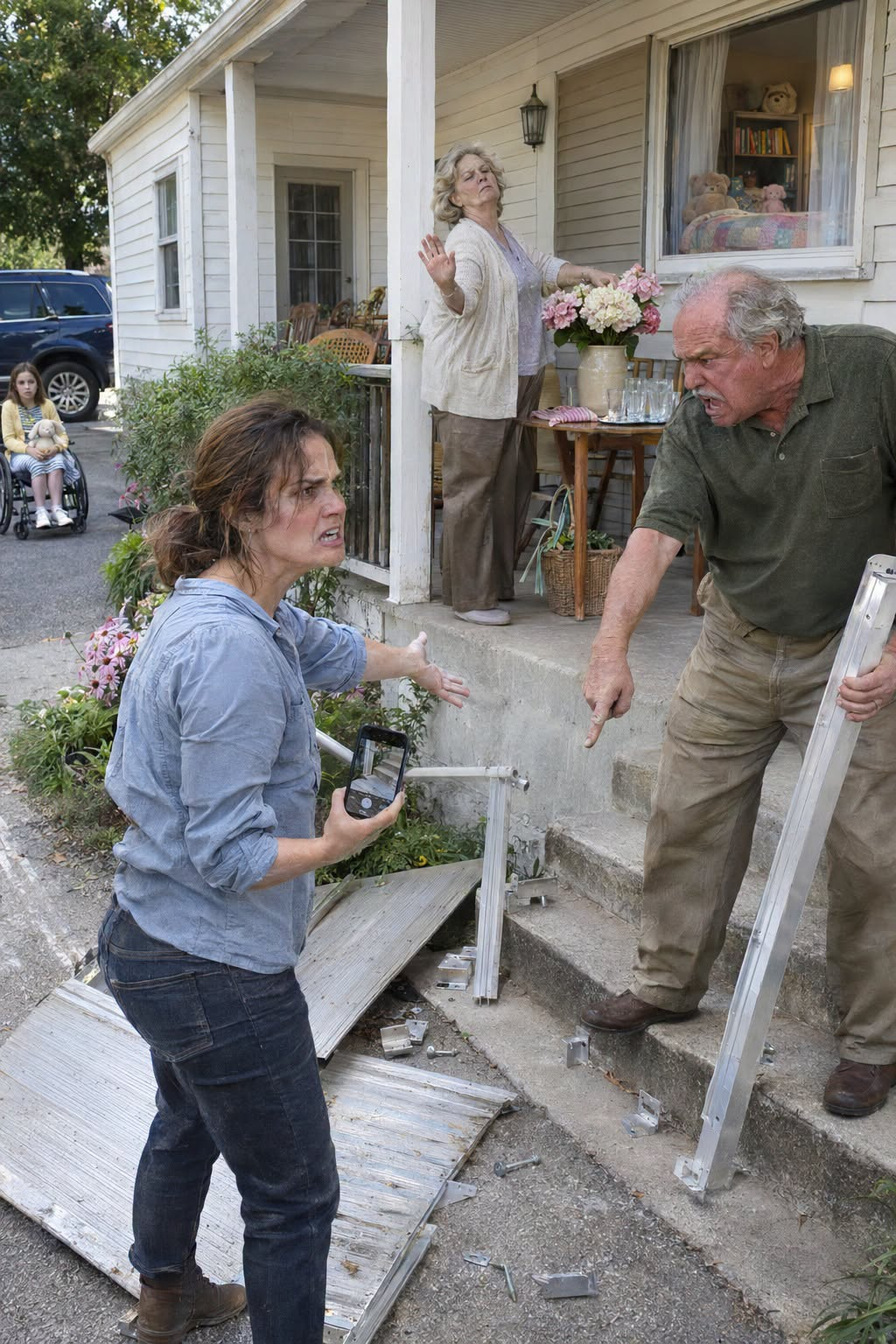
The first photograph showed my parents' house from the street.
I recognized the white siding, the covered porch, and the two enormous ceramic planters my mother had insisted on buying for her garden party.
But something was wrong.
The photograph had been taken before the ramp was removed.
I could see its silver railing extending from the driveway toward the front entrance.
Someone had carefully positioned the camera so the ramp was barely visible behind the flowering shrubs.
I leaned closer to my laptop.
The listing had a price.
$489,000.
My parents were selling their house.
And nobody had told me.
For almost six years, Rosie and I had lived in the attached apartment, paying rent every month. My parents had always described the arrangement as mutually beneficial. I needed an affordable place where Rosie could remain close to her doctors and school. They needed dependable rental income.
At least, that was what they'd told me.
Now I was looking at a real estate advertisement for the property where my daughter and I lived.
The listing described a charming suburban residence with flexible living space, a beautifully maintained yard, and an attached apartment offering excellent potential for guests or extended family.
I scrolled farther.
There were twenty-three photographs.
The first several showed the main house.
My mother's dining room looked immaculate. The kitchen counters were empty. Fresh flowers stood on nearly every available surface.
Then I reached the photographs of the attached apartment.
My kitchen.
My living room.
The narrow hallway Rosie had learned to navigate when she was six.
I stopped scrolling.
I hadn't given anyone permission to photograph our home.
I hadn't even known someone had entered it.
"Jenna?"
Marcy stood in the kitchen doorway wearing an oversized sweatshirt and holding a mug of tea.
"You're still awake?"
I turned the laptop toward her.
"Look at this."
She walked over.
For several seconds, she said nothing.
Then she lowered her mug.
"Is that your parents' house?"
"Yes."
"Are they selling it?"
"Apparently."
She pulled out the chair beside me.
"Did they tell you?"
I shook my head.
Marcy leaned toward the screen.
"Wait. Isn't that your kitchen?"
I nodded.
"Who took these pictures?"
"I don't know."
She studied the photograph.
"Jenna, your coffee maker is gone."
I looked again.
She was right.
The little red coffee maker that normally sat beside my refrigerator wasn't there.
Neither was the wooden fruit bowl Rosie had painted for me at school.
The counters had been cleared.
I opened another photograph.
The living room looked similarly arranged.
The throw blanket was folded neatly over the couch.
The stack of library books beside Rosie's favorite chair had disappeared.
Someone had moved our belongings to make the apartment look less occupied.
Marcy stared at me.
"When were these taken?"
I searched the listing for a publication date.
There wasn't one displayed.
"Maybe while we were at an appointment," I said.
The words sounded strange even as I spoke them.
My parents had keys to our apartment. They owned the property, but they had never been allowed to enter whenever they pleased.
Or at least, that was what I'd believed.
I clicked through the remaining pictures.
Then I saw Rosie's bedroom.
Her lavender walls.
Her white bookshelf.
Her little desk beside the window.
The stuffed animals arranged across her bed.
The photograph had been taken from the doorway.
I felt sick.
Rosie was particular about her room. She liked knowing where everything belonged because moving around independently was easier when the furniture stayed in familiar places.
She kept her art supplies in the bottom drawer of her desk.
Her favorite books were on the lowest shelf.
Her wheelchair fit perfectly between the bed and the dresser.
And someone had walked into that private space to photograph it for strangers.
Marcy put her hand over mine.
"Take screenshots."
I looked at her.
"Of everything," she said. "Before they change it."
I started saving the listing.
Every photograph.
Every paragraph.
The asking price.
The agency's name.
The property description.
I also copied the website address into an email and sent it to myself.
When I finished, Marcy was still sitting beside me.
"Are you going to call your parents?"
I looked toward the hallway where Rosie was sleeping.
"No."
"Why not?"
"Because if I call them now, Dad will tell me I'm overreacting. Mom will say they were planning to explain everything. Then they'll start changing their story."
Marcy nodded slowly.
"So what are you going to do?"
I looked at the photographs on my phone.
The broken ramp.
The concrete steps.
The dumpster.
"I need to find out exactly what they did."
The next morning, Rosie woke before seven.
I found her sitting on the guest bed with her stuffed rabbit in her lap.
She looked toward the doorway when I entered.
"Are we going home today?"
I sat beside her.
"Not today, sweetheart."
She considered that.
"Is Grandma still having her party?"
"Yes."
"Even without my ramp?"
I felt the familiar ache return.
"Yes."
Rosie looked down at the rabbit.
"Maybe she'll put it back after the party."
I wanted to believe that.
But I'd seen the metal.
The ramp hadn't been carefully dismantled for temporary storage.
It had been destroyed.
"That ramp can't be put back the way it was," I said gently.
She frowned.
"Why?"
"Some of the pieces are bent."
"Can they fix it?"
"Maybe some parts. But we would need someone to inspect it first."
Rosie rubbed the rabbit's ear between her fingers.
"Did Grandpa know it was expensive?"
"Yes."
"Did he know you worked extra hours to buy it?"
I nodded.
She was quiet for a moment.
Then she whispered, "I liked going up it by myself."
I put my arm around her.
"I know."
"I didn't need anybody to push me."
"I know, baby."
She leaned against me.
That was the moment I understood that the money wasn't the worst part.
Forty-eight hundred dollars was a tremendous amount for me.
But I could eventually earn more money.
What I couldn't easily replace was the confidence Rosie had built every time she rolled herself into our home without assistance.
My parents hadn't simply removed a piece of equipment.
They'd taken away something my daughter had worked years to achieve.
And they'd done it because they wanted the entrance to look prettier for a party.
After breakfast, Marcy offered to take Rosie to the library.
Rosie loved the children's section, especially the long table where she could spread out drawing paper.
I was grateful for the distraction.
Once they left, I called the company that had installed the ramp.
The receptionist answered with the same cheerful voice I remembered from three years earlier.
"AccessWay Mobility Solutions. How can I help you?"
"My name is Jenna Rowe. You installed a wheelchair ramp at my parents' property almost three years ago."
I gave her the address.
She searched her records.
"Yes, Ms. Rowe. I have your installation here."
"I need a copy of the contract and invoice."
"Certainly. Is there a problem with the ramp?"
I hesitated.
"My parents had it removed yesterday."
There was a pause.
"Removed?"
"Destroyed, actually."
The receptionist became serious.
"Was our company involved?"
"No."
"Did another accessibility contractor remove it?"
"I don't think so. A landscaping crew was working at the property."
She was silent again.
Then she said, "I'm going to transfer you to our installation manager."
A man named Daniel Mercer answered.
I explained what had happened.
He asked several questions about the damaged sections, the mounting brackets, and the concrete anchors.
When I told him the ramp had been bent and thrown into a dumpster, he let out a slow breath.
"That doesn't sound like a professional removal."
"Can it be repaired?"
"I'd need to inspect it. But if the main sections are bent, replacing them may be safer than attempting repairs."
I closed my eyes.
"How much would that cost?"
"Depending on the damage, it could approach the cost of a new installation."
I looked at my bank balance on the laptop.
I didn't have another $4,800.
Not even close.
"Can you send me the original paperwork?"
"Of course."
"And could you confirm whether anyone contacted your company about removing it?"
He checked.
"No removal request is recorded."
"Thank you."
Before hanging up, he added, "Ms. Rowe, please don't let anyone use those damaged sections as a temporary ramp. Bent aluminum and compromised supports can be dangerous."
"I won't."
The email arrived ten minutes later.
I opened the invoice first.
$4,800.
Paid in full.
My name appeared under the customer information.
The installation agreement contained a separate signature from Gordon Rowe, identified as the property owner.
I stared at that signature.
My father had approved the ramp.
He had known exactly what it was for.
And he'd watched the installation crew secure it to the concrete entrance.
I saved the documents in a new folder.
Then I called the landscaping company whose name I'd photographed on the truck.
A woman answered.
"Greenfield Property Services."
I introduced myself and explained that I was calling about work performed at my parents' address.
She found the job.
"Yes. We completed exterior preparation and removal work yesterday."
"Removal of what?"
She hesitated.
"I'm sorry, are you the property owner?"
"I'm the tenant of the attached apartment. The item removed was a wheelchair ramp I purchased."
There was a long pause.
"One moment, please."
I heard muffled voices.
Then a man came on the line.
"This is Rick, the site supervisor."
I explained again.
He listened without interrupting.
Finally, he said, "Ma'am, we were instructed to clear the entrance."
"By whom?"
"The homeowner."
"My father?"
"Mr. Rowe was present."
"Did you know the ramp was being used by a child in a wheelchair?"
He didn't answer immediately.
Then he said something that made my stomach tighten.
"We weren't told anyone was currently using it."
I sat up straighter.
"What?"
"Our work order described it as an unused temporary structure."
I stared at the wall.
"Unused?"
"That's what the paperwork said."
"My daughter used that ramp every day."
"I'm sorry, ma'am."
"Did you see her yesterday?"
"Yes."
"Then you know."
His voice became quieter.
"I do now."
I looked at the photographs again.
The bent railing.
The yellow tape.
The sunflower sticker.
"Did your company damage the ramp?"
"We were instructed to dismantle it and dispose of the material."
"Did you know it cost forty-eight hundred dollars?"
"No, ma'am."
"Did anyone ask whether it belonged to the homeowner?"
Another pause.
"I can't discuss the customer's paperwork without authorization."
I took a breath.
"Can you preserve the work order and any photographs your crew took?"
"I can pass that request to our office."
"Please do."
After the call ended, I wrote down everything he'd said.
The time.
His name.
The phrase "unused temporary structure."
I underlined those three words twice.
My parents hadn't merely decided the ramp was ugly.
They had apparently described it to the workers as something nobody needed.
That was worse.
Because it meant they had made the decision knowing exactly what the ramp was, then presented it as abandoned equipment.
Around noon, my phone rang.
Dad.
I watched his name appear on the screen.
For a moment, I considered ignoring it.
Then I answered.
"Hello."
"Where are you?"
No greeting.
No concern about Rosie.
Just a demand.
"We're somewhere safe."
He exhaled sharply.
"Don't be ridiculous. Come home."
"Rosie can't get inside."
"Here we go again."
I looked at the installation contract.
"Dad, you signed the paperwork for that ramp."
"So?"
"You knew it was professionally installed."
"And I had it removed."
"You destroyed something I paid for."
"It was attached to my house."
"That doesn't make it yours."
He laughed once.
A short, unpleasant sound.
"You've always had a problem understanding who owns what."
I stayed quiet.
He continued.
"Your mother is very upset."
"About Rosie?"
"About the scene you caused yesterday."
I looked toward the empty guest room.
"What scene?"
"Photographing the property. Making the landscapers uncomfortable. Storming off like a teenager."
"I documented what happened."
"You made us look bad."
I almost laughed.
Not because anything was funny.
Because he still believed the problem was how other people perceived him.
"Dad, I need you to answer something."
"What?"
"Are you selling the house?"
Silence.
For the first time during the conversation, he had nothing ready to say.
Then he cleared his throat.
"Who told you that?"
"I found the listing."
Another pause.
"Your mother and I have been considering our options."
"Considering?"
"Yes."
"The house is listed for $489,000."
He sounded irritated again.
"There's nothing wrong with exploring the market."
"Why didn't you tell me?"
"Because every time we discuss anything involving the property, you make it about Rosie."
I stared at the phone.
"Rosie lives there."
"We're aware."
"I pay rent."
"You're getting a very generous arrangement."
I closed my eyes.
There it was.
The same argument he'd used for years.
Whenever I questioned a decision, he reminded me that my parents had allowed us to live in the apartment.
As if paying rent meant I should also surrender my right to ask questions.
"Did you have someone photograph our apartment?"
He didn't answer.
"Dad?"
"Your mother handled the listing."
"Did someone enter while we were out?"
"Jenna, I don't have time for this."
"Did someone photograph Rosie's bedroom?"
His voice hardened.
"You need to stop acting like you're the only person whose needs matter."
Then he hung up.
I sat motionless for several seconds.
He hadn't denied it.
Not once.
At two that afternoon, I received an email from AccessWay Mobility Solutions.
Daniel had attached the installation contract, the paid invoice, and a short written confirmation that his company had not authorized or performed the removal.
I printed everything using Marcy's home printer.
Then I arranged the documents beside my photographs.
I wasn't sure yet what I would do with them.
But I knew I needed a clear record.
I also checked my lease.
It was a simple written agreement my parents and I had signed when Rosie and I moved into the apartment.
The monthly rent was listed.
The apartment was identified separately from the main residence.
There were provisions about maintenance and access.
And there was nothing stating that my parents could remove accessibility equipment without notifying me.
I read the document twice.
Then I found a local tenant-rights organization and left a message asking for guidance.
I didn't want revenge.
I wanted to know how to protect my daughter.
I wanted to know whether we could recover the cost of the ramp.
And I wanted to know what my parents were planning to do with our apartment.
By late afternoon, I was exhausted.
Marcy returned with Rosie, who proudly showed me a drawing of a purple dragon sitting in a wheelchair.
"He's the fastest dragon in the world," she explained.
I smiled.
"Obviously."
"And he has a ramp to his castle."
My throat tightened.
"That's a very smart dragon."
She studied my face.
"Are you sad?"
"A little."
"Because of Grandpa?"
I sat beside her.
"Because some grown-ups made a very bad decision."
She looked down at her drawing.
"Can they change their minds?"
"Sometimes."
"Will Grandpa?"
I didn't know.
And I was tired of pretending I did.
"I hope he understands why it hurt us," I said.
Rosie nodded.
Then she handed me the picture.
"You can keep this one."
I held it carefully.
"Thank you, sweetheart."
That evening, after dinner, I opened the real estate listing again.
I wanted to compare the photographs with the rooms as I'd left them.
The kitchen.
The living room.
The hallway.
Rosie's bedroom.
I noticed something I'd missed the night before.
The listing photographs weren't simply staged.
Some of our belongings had been moved into places they didn't normally belong.
The small wooden chest from my bedroom was visible in the hallway.
Rosie's desk chair had been pushed against the opposite wall.
The framed photograph of her first day of school was missing from her dresser.
I wondered whether my mother had removed it because she didn't want potential buyers to know a child lived there.
Then I remembered the landscaping supervisor's words.
Unused temporary structure.
I opened the listing description again.
I read every sentence carefully.
The attached apartment was described as having "immediate availability."
I frowned.
That wasn't true.
Rosie and I lived there.
Our clothes were there.
Our furniture was there.
Our school supplies, medical equipment, family photographs, and everything we'd accumulated over six years were there.
I copied the description into a separate document.
Then I noticed another phrase.
"Property prepared for upcoming private viewings."
I thought about the sign hidden behind my mother's planter.
Saturday.
The garden party.
Twenty-six guests.
My mother had spent weeks talking about the event.
She'd ordered flowers.
Hired landscapers.
Rearranged furniture.
Insisted that everything look perfect.
Had she been preparing for more than a party?
I checked the real estate agency's website.
There was a contact form.
I typed a short message explaining that I was the current tenant of the attached apartment and wanted clarification about the listing's claim of immediate availability.
I included my phone number.
Then I clicked send.
A few minutes later, my phone buzzed.
A text from my mother.
"Jenna, your father says you've been making accusations. We need you to stop contacting people about our property. You're creating unnecessary problems."
I read it twice.
Then another message appeared.
"Also, please don't come by tomorrow. We have important guests arriving and don't need another embarrassing scene."
I stared at those words.
Important guests.
Not family.
Not Rosie's grandparents asking whether she was comfortable.
Not an apology.
Just another warning to stay away.
I placed the phone facedown.
A moment later, it buzzed again.
This time, the message came from an unfamiliar number.
"Ms. Rowe, this is Caroline Hayes with the real estate agency. I received your inquiry about the property on Willow Creek Drive. There appears to be a discrepancy between the information provided by the sellers and what you've told me."
I sat up.
Before I could reply, a second message arrived.
"I need to speak with you privately. There is something in the seller's disclosure that you should see."
I looked toward the hallway.
Rosie was asleep.
Marcy was upstairs.
I typed, "What does it say?"
Three dots appeared on the screen.
They disappeared.
Then Caroline sent a photograph of a document.
I tapped the image.
At the top was my parents' property address.
Below it was a section labeled:
OCCUPANCY STATUS — ATTACHED RESIDENTIAL UNIT.
A box had been checked.
I enlarged the image.
And beneath the checked box, someone had written my name beside a date that hadn't happened yet.






Comments 0